

Learning Money for Class 1
Money helps us buy things we need every day like toys, chocolates, books, fruits, and pencils. We use coins and notes when we go to shops. In this lesson, Class 1 students will learn what money is, how to identify coins and notes, and how to count money using simple pictures and fun examples.
What is Money?
Money is what we use to buy things.
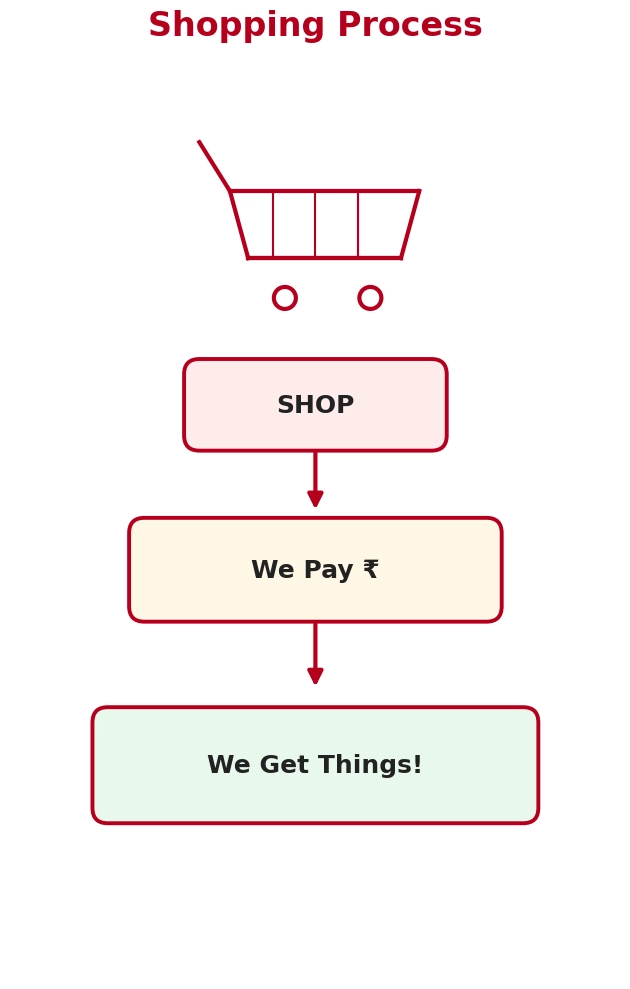
Money helps us buy:
🍎 Apple
🧃 Juice box
✏️ Pencil
🍫 Chocolate
📚 Book
🪀 Toy
One simple sentence to remember:
We give money → We get things we want.

Types of Money
Money comes in two types Coins and Notes.
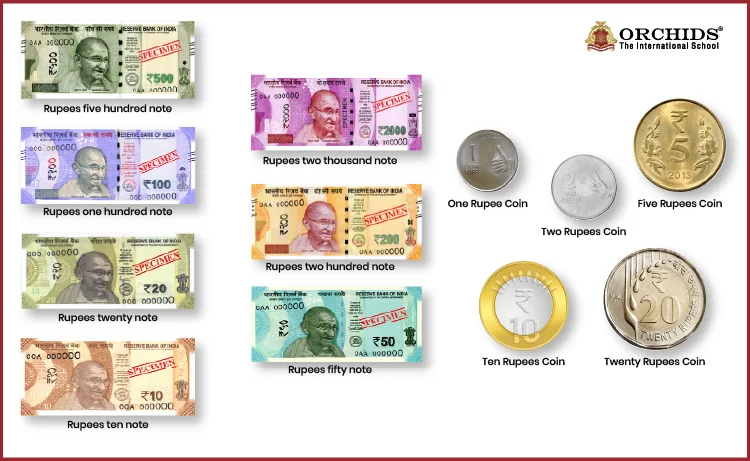
Coins
Coins are small and round. They are made of metal.
( ₹ 1 ) Small coin
( ₹ 2 ) Medium coin
( ₹ 5 ) Bigger coin
( ₹ 10 ) Biggest coin
- Round shape
- Made of metal
- Hard and shiny
Notes
Notes are flat and made of paper. They are bigger than coins.
| ₹ 10 | Small note
| ₹ 20 | Medium note
| ₹ 50 | Bigger note
| ₹ 100 | Biggest note
- Flat shape
- Made of paper
- Has pictures and numbers
Quick Look:
Where Do We Use Money?
We use money in many places every day.
- 🏪 SHOP → Buy sweets, fruits, toys
- 🏫 SCHOOL → Buy books, pencils, bag
- 🍎 GROCERY → Buy milk, eggs, vegetables
- 🚌 BUS → Pay for the ride
- 🎡 FAIR → Buy tickets for fun rides
Match the Object with the Price
Draw a line to match!
OBJECT PRICE
🍎 Apple → ₹ 100
✏️ Pencil → ₹ 20
🪀 Toy → ₹ 10
🍫 Chocolate → ₹ 5
Answers:
🍎 Apple → ₹ 20
✏️ Pencil → ₹ 10
🪀 Toy → ₹ 100
🍫 Chocolate → ₹ 5
Count the Money
Let's add coins and notes together!
Example 1:
( ₹5 ) + ( ₹5 ) = ?
5 + 5 = 10
Answer = ₹ 10
Example 2:
| ₹10 | + | ₹20 | = ?
10 + 20 = 30
Answer = ₹ 30
Example 3:
| ₹50 | + | ₹10 | = ?
50 + 10 = 60
Answer = ₹ 60
Now you try.
( ₹2 ) + ( ₹2 ) = ___
| ₹20 | + | ₹20 | = ___
( ₹5 ) + | ₹10 | = ___
Answers:
₹2 + ₹2 = ₹4
₹20 + ₹20 = ₹40
₹5 + ₹10 = ₹15
Compare Money
Which is GREATER? Circle the bigger amount!
Question 1:
₹ 20 OR ₹ 50
Answer: ₹ 50 is GREATER
Question 2:
₹ 10 OR ₹ 5
Answer: ₹ 10 is GREATER
Question 3:
₹ 100 OR ₹ 20
Answer: ₹ 100 is GREATER
Question 4:
₹ 2 OR ₹ 1
Answer: ₹ 2 is GREATER
Remember: Bigger NUMBER = More money
₹100 > ₹50 > ₹20 > ₹10 > ₹5 > ₹2 > ₹1
₹1 is the SMALLEST
₹100 is the BIGGEST (in this lesson)
Fill in the Blanks
Fill in the missing number!
Question 1:
₹5 + ₹5 = ___
Answer: ₹ 10
Question 2:
₹20 + ₹10 = ___
Answer: ₹ 30
Question 3:
₹50 + ₹50 = ___
Answer: ₹ 100
Question 4:
A ₹100 note is bigger than ₹ ___.
Answer: ₹ 10 (or any smaller amount)
Question 5:
Coins are made of ___.
Answer: metal
Question 6:
Notes are made of ___.
Answer: paper
Fun Activity Pretend Shop
Let's Play Shop!
This is a super fun activity for the whole class!
What the teacher sets up:
PRETEND SHOP 🏪
Items for sale:
🍎 Apple → ₹ 100
✏️ Pencil → ₹ 10
📚 Book → ₹ 50
🪀 Toy → ₹ 30
🍫 Chocolate → ₹ 5
What students get:
Each student gets fake money:
( ₹1 ) ( ₹2 ) ( ₹5 ) ( ₹10 )
| ₹20 | | ₹50 | | ₹100 |
How to play:
Step 1: Teacher puts items on the table with price tags.
Step 2: One student is the SHOPKEEPER.
Other students are CUSTOMERS.
Step 3: Customer picks one item.
Shopkeeper says the price.
Step 4: Customer counts the money and pays.
Shopkeeper checks if the amount is correct.
Step 5: If correct → Customer gets the item!
If wrong → Count again and try!
What you learn from this activity:
- How to count money
- How to identify coins and notes
- How to compare prices
- How money works in real life
Practice Questions on Money for Class 1
Q1: Add the money:
₹10 + ₹10 = ___
Answer: ₹20
Q2: Which is greater?
₹5 OR ₹2
Answer: ₹5
Q3: Fill in the blank:
₹50 + ₹50 = ___
Answer: ₹100
Q4: Match the price:
🍫 Chocolate → ₹5 or ₹100?
Answer: ₹5
Q5: True or False:
Notes are made of metal.
Answer: FALSE ❌ (Notes are made of paper)
Q6: Count and write:
( ₹2 ) + ( ₹2 ) + ( ₹2 ) = ___
Answer: ₹6
Q7: Which is the smallest coin?
₹1 ₹2 ₹5 ₹10
Answer: ₹1
Q8: If you have ₹100, can you buy a toy that costs ₹50?
Answer: YES (₹100 is more than ₹50)
Frequently Asked Questions
1. What is money?
Money is something we use to buy goods and services. It comes in the form of coins and notes.
2. Why do we use money?
We use money to buy things like food, toys, books, clothes, and other everyday items instead of exchanging goods.
3. What are coins and notes?
Coins are made of metal, while notes are made of paper or polymer. Both are used as money.
4. What are the Indian currency coins?
Common Indian coins are ₹1, ₹2, ₹5, ₹10, and ₹20.
5. What are the Indian currency notes?
Common Indian currency notes are ₹10, ₹20, ₹50, ₹100, ₹200, and ₹500.
6. How do you count money?
Count the value of each coin or note and then add the amounts together to find the total.
Numbers make sense when they're taught right. To see how Orchids The International School turns Maths from intimidating to intuitive, reach out to our admissions team.


Admissions Open for 2026-27
What type of concept pages would you prefer?
CBSE Schools In Popular Cities
- CBSE Schools in Bangalore
- CBSE Schools in Mumbai
- CBSE Schools in Pune
- CBSE Schools in Hyderabad
- CBSE Schools in Chennai
- CBSE Schools in Gurgaon
- CBSE Schools in Kolkata
- CBSE Schools in Indore
- CBSE Schools in Sonipat
- CBSE Schools in Delhi
- CBSE Schools in Rohtak
- CBSE Schools in Bhopal
- CBSE Schools in Aurangabad
- CBSE Schools in Jabalpur
- CBSE Schools in Jaipur
- CBSE Schools in Jodhpur
- CBSE Schools in Nagpur
- CBSE Schools in Ahmednagar
- CBSE School In Tumkur











Orchids The International School is one of India's leading chains of CBSE and ICSE schools, with 130+ schools across the country.