

Introduction to Multiplication for Class 1: Easy Guide with Examples
Multiplication for Class 1 introduces young learners to the simple idea that we can count many equal groups quickly instead of counting one by one. This short introduction uses familiar, playful examples so children see multiplication as groups they can make, count, and talk about. The guide focuses on simple actions of making equal groups, drawing or arranging objects in rows, and saying the total using ‘groups of’ language and everyday words to build skills in repeated addition, pattern recognition, and faster counting.
Table of Contents
- Multiplication as Repeated Addition for Class 1
- Multiplication Tables of 1, 2 and 5
- Building Arrays for Class 1
- Frequently Asked Questions of Introduction to Multiplication for Class 1

Multiplication as Repeated Addition for Class 1
Repeated addition means adding the same number over and over again.
🍎🍎🍎(3) + 🍎🍎🍎(3) + 🍎🍎🍎(3) = 9
Here, 3 apples + 3 apples + 3 apples = 9 apples. We added 3, three times in a row.
We added the number 3 a total of 3 times. Instead of writing out 3 + 3 + 3 every single time, mathematicians invented a shortcut. We write:
From Repeated Addition to Multiplication
3 + 3 + 3 = 3 × 3 = 9
‘3 times 3 equals 9’ read as "3 multiplied by 3"
The ‘×’ symbol means ‘times’ or ‘multiplied by’. So 3 × 3 means ‘3 taken 3 times’.
The Golden Rule of Multiplication
Number of groups × Number in each group = Total
In 3 × 3 = 9, the first 3 tells us how many groups there are, and the second 3 tells us how many objects are in each group.
Multiplication Tables of 1, 2 and 5
Table of 1
When we multiply a number by 1, we get the same number.
Table of 2
Table of 5
Building Arrays for Class 1
An array is an arrangement of objects in equal rows and equal columns. Arrays make multiplication visible.
Arrays have an equal number of objects in each row.
We can do multiplication and find the total number of objects using arrays. We write the multiplication statement for an array as follows.
Look at this array of stars arranged in 3 rows, with 4 stars in each row:
⭐⭐⭐⭐
⭐⭐⭐⭐
⭐⭐⭐⭐
3 rows × 4 stars in each row = 3 × 4 = 12 stars in total
The Array Rule:
Number of rows × Number in each row = Total number of objects
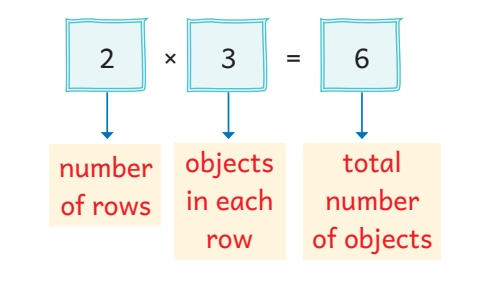
Two numbers multiplied in any order will give the same answer.
2 × 3 = 6 and 3 × 2 = 6
Here's a set of questions for practice.
Practice Worksheet: Introduction to Multiplication for Class 1 (Free Download). Improve your maths skills with this Introduction to Multiplication for Class 1 worksheet.
Frequently Asked Questions of Introduction to Multiplication for Class 1
1. How is multiplication related to repeated addition?
Multiplication is repeated addition written in a shorter way. When you add the same number multiple times, like 5 + 5 + 5, you can write it as 3 × 5 instead.
2. What is table of 1 in multiplication?
The table of 1 means multiplying any number by 1. The rule is simple: any number multiplied by 1 stays the same. For example, 1 × 1 = 1, 1 × 2 = 2, 1 × 5 = 5, and 1 × 10 = 10.
3. What is an array in class 1 maths?
An array is an arrangement of objects in equal rows and equal columns, like eggs in an egg carton or chairs in a classroom.
4. Why do we start with tables of 1, 2, 5, and 10 in class 1?
The tables of 1, 2, 5, and 10 are the easiest for young children because they follow simple, predictable patterns.
Numbers make sense when they're taught right. To see how Orchids The International School turns Maths from intimidating to intuitive, reach out to our admissions team.


Admissions Open for 2026-27
What type of concept pages would you prefer?
CBSE Schools In Popular Cities
- CBSE Schools in Bangalore
- CBSE Schools in Mumbai
- CBSE Schools in Pune
- CBSE Schools in Hyderabad
- CBSE Schools in Chennai
- CBSE Schools in Gurgaon
- CBSE Schools in Kolkata
- CBSE Schools in Indore
- CBSE Schools in Sonipat
- CBSE Schools in Delhi
- CBSE Schools in Rohtak
- CBSE Schools in Bhopal
- CBSE Schools in Aurangabad
- CBSE Schools in Jabalpur
- CBSE Schools in Jaipur
- CBSE Schools in Jodhpur
- CBSE Schools in Nagpur
- CBSE Schools in Ahmednagar
- CBSE School In Tumkur











Orchids The International School is one of India's leading chains of CBSE and ICSE schools, with 130+ schools across the country.