

Ways to Prove a Quadrilateral is Cyclic
A quadrilateral can be proved cyclic if you can show that its opposite angles are supplementary, meaning their sum is 180°. Another common way is to prove that an exterior angle of the quadrilateral is equal to the interior opposite angle. You can also use the fact that angles in the same segment of a circle are equal. If any one of these conditions is true, the quadrilateral is cyclic.
Methods to Prove a Quadrilateral is Cyclic
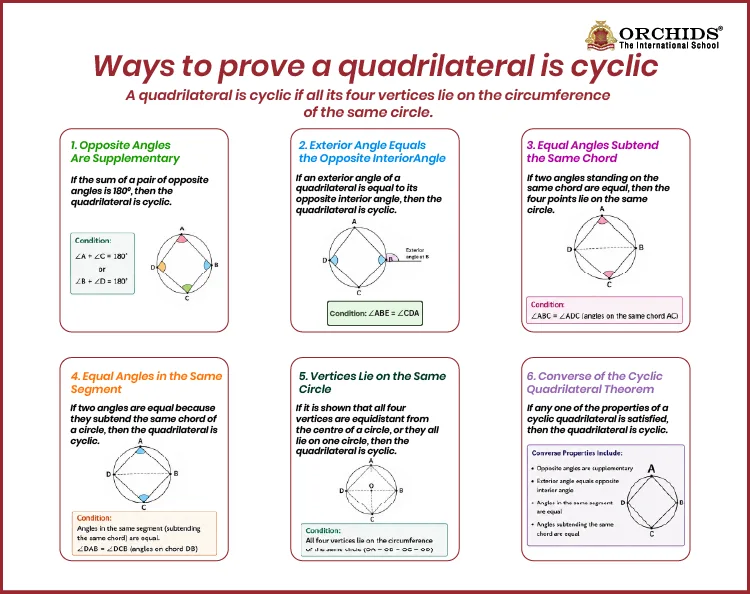
A quadrilateral is called a cyclic quadrilateral if all four of its vertices lie on the circumference of the same circle. There are several methods to prove that a quadrilateral is cyclic, depending on the information given in the problem.
1. Opposite Angles Are Supplementary
If the sum of a pair of opposite angles is 180°, then the quadrilateral is cyclic.
Condition:
-
∠A + ∠C = 180°, or
-
∠B + ∠D = 180°
This is the most commonly used test.
2. Exterior Angle Equals the Opposite Interior Angle
If an exterior angle of a quadrilateral is equal to its opposite interior angle, then the quadrilateral is cyclic.
Condition:
-
Exterior angle at one vertex = Interior opposite angle
3. Equal Angles Subtend the Same Chord
If two angles standing on the same chord are equal, then the four points lie on the same circle, making the quadrilateral cyclic.
Condition:
-
∠ABC = ∠ADC, or
-
∠BAD = ∠BCD
4. Equal Angles in the Same Segment
If two angles are equal because they subtend the same chord of a circle, then the quadrilateral is cyclic.
This method is frequently used in geometry proofs involving circles.
5. Vertices Lie on the Same Circle
If it is shown that all four vertices are at the same distance from the centre of a circle, or they all lie on one circle, then the quadrilateral is cyclic.
6. Converse of the Cyclic Quadrilateral Theorem
If any one of the properties of a cyclic quadrilateral is satisfied (such as opposite angles being supplementary or an exterior angle equalling the opposite interior angle), then the quadrilateral is cyclic.

Summary Table:
These are the standard methods used in geometry to prove that a quadrilateral is cyclic.
Frequently Asked Questions on How to Prove a Quadrilateral is Cyclic
1. What is a cyclic quadrilateral?
A cyclic quadrilateral is a quadrilateral whose four vertices lie on the circumference of the same circle.
2. How do you prove that a quadrilateral is cyclic?
A quadrilateral can be proved to be cyclic if any one of these conditions is satisfied:
- The sum of a pair of opposite angles is 180°.
- An exterior angle equals the interior opposite angle.
- A pair of equal angles subtend the same chord.
- The four vertices lie on a common circle.
3. What is the easiest way to prove a quadrilateral is cyclic?
The easiest method is to show that the sum of one pair of opposite angles is 180°. This is the most commonly used criterion in geometry problems.
4. How do you prove a quadrilateral is cyclic using opposite angles?
Measure or calculate the opposite angles. If:
∠A + ∠C = 180°
or
∠B + ∠D = 180°
then the quadrilateral is cyclic.
5. How do you prove a quadrilateral is cyclic using an exterior angle?
If an exterior angle of a quadrilateral is equal to its interior opposite angle, then the quadrilateral is cyclic.
6. Can equal angles prove that a quadrilateral is cyclic?
Yes. If two angles subtend the same chord or are equal and stand on the same segment, the quadrilateral can be proved to be cyclic.
7. What is the converse of the cyclic quadrilateral theorem?
The converse states that if the sum of a pair of opposite angles of a quadrilateral is 180°, then the quadrilateral is cyclic.
8. What are the properties of a cyclic quadrilateral?
The main properties are:
- Opposite angles are supplementary.
- An exterior angle equals the interior opposite angle.
- All four vertices lie on the same circle.
- Angles standing on the same chord are equal.
9. Why are cyclic quadrilaterals important in geometry?
They help solve problems involving circles, angles, chords, tangents, and geometric proofs. They are also commonly tested in school and competitive examinations.
10. What types of exam questions are asked on cyclic quadrilaterals?
Common questions include:
- Prove that a quadrilateral is cyclic.
- Find unknown angles using cyclic properties.
- Apply the exterior angle theorem.
- Solve proof-based geometry problems involving circles.
11. How can I identify a cyclic quadrilateral in a diagram?
Look for clues such as:
- Opposite angles adding up to 180°.
- An exterior angle equal to the opposite interior angle.
- Four vertices lying on the same circle.
- Equal angles subtended by the same chord.
Numbers make sense when they're taught right. To see how Orchids The International School turns Maths from intimidating to intuitive, reach out to our admissions team.


Admissions Open for 2026-27
What type of concept pages would you prefer?
CBSE Schools In Popular Cities
- CBSE Schools in Bangalore
- CBSE Schools in Mumbai
- CBSE Schools in Pune
- CBSE Schools in Hyderabad
- CBSE Schools in Chennai
- CBSE Schools in Gurgaon
- CBSE Schools in Kolkata
- CBSE Schools in Indore
- CBSE Schools in Sonipat
- CBSE Schools in Delhi
- CBSE Schools in Rohtak
- CBSE Schools in Bhopal
- CBSE Schools in Aurangabad
- CBSE Schools in Jabalpur
- CBSE Schools in Jaipur
- CBSE Schools in Jodhpur
- CBSE Schools in Nagpur
- CBSE Schools in Ahmednagar
- CBSE School In Tumkur











Orchids The International School is one of India's leading chains of CBSE and ICSE schools, with 130+ schools across the country.