

Number Bonds for Class 1: Easy Examples and Practice Questions
Number bonds for Class 1 help young children understand how a number can be split into two parts and put back together, which builds a strong foundation for addition and subtraction. This short Number Bonds for Class 1 introduction uses simple words and everyday examples like sharing cookies or using fingers, so children learn the idea of a ‘whole’ and its ‘parts’ (for example, 5 = 2 + 3). The guide shows how to build number sense with hands-on activities, joining counters to make a total, finding missing parts, and saying bonds aloud so learners connect counting with relationships between numbers.
Table of Contents
- What Is a Number Bond?
- How Number Bonds Work: The Part-Part-Whole Idea
- Number Bonds to 10: The Most Important Set
- Number Bonds Examples: Real-Life Connections
- Fun Activities to Practice Number Bonds at Home
- Frequently Asked Questions of Number Bond for Class 1

What Is a Number Bond?
A number bond is a simple diagram that shows how two smaller numbers (called parts) come together to make a bigger number (called the whole).
"When two numbers are put together by a bond, they form a bigger number."
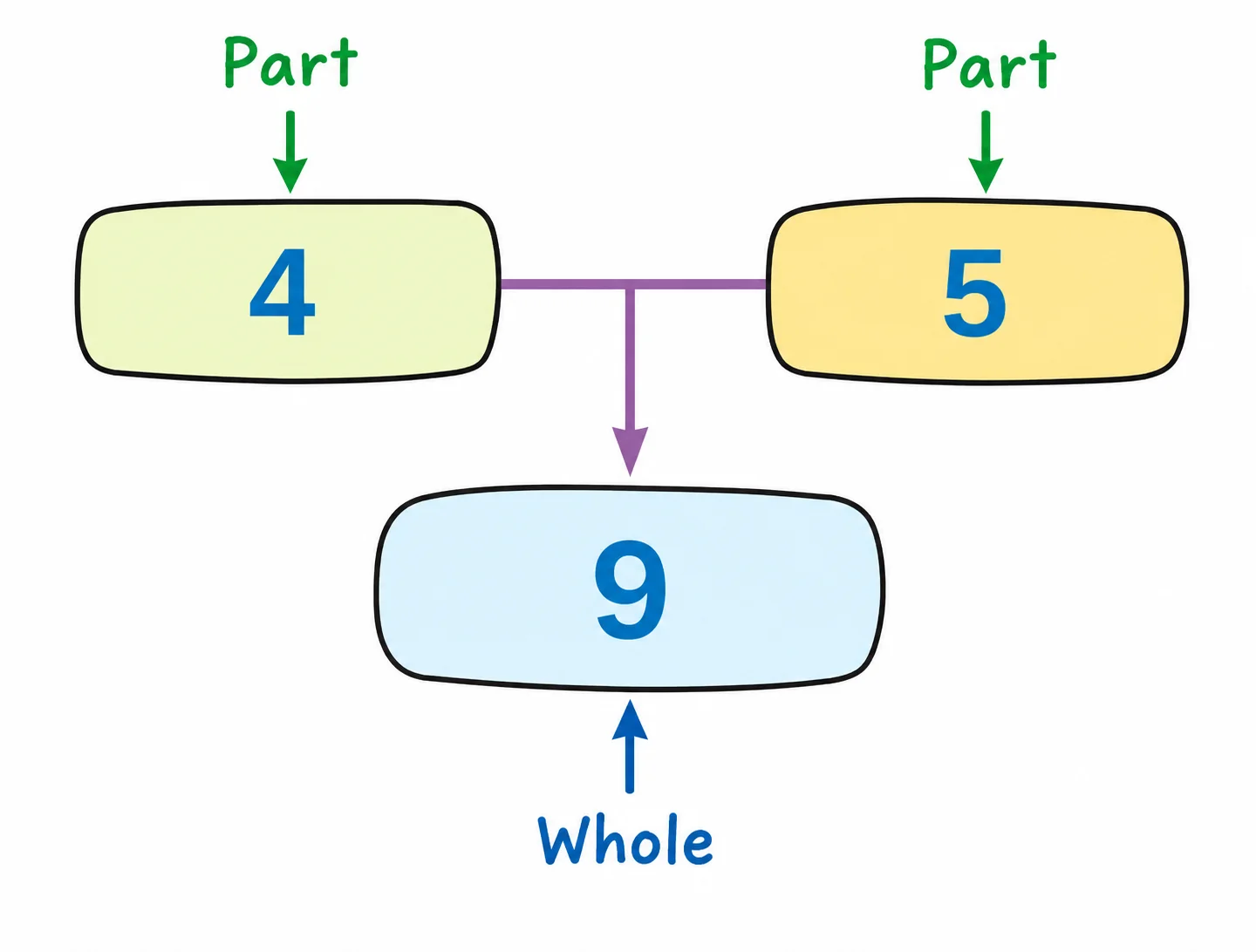
Example: 4 and 5 come together to make 9. So:
-
Whole = 9
-
Part = 4
-
Part = 5
Know more about related topics:
How Number Bonds Work: The Part-Part-Whole Idea
Every number bond has three elements:
- The Whole: the total, the bigger number
- Part 1: one group that makes up the whole
- Part 2: the other group that makes up the whole
The relationship is always the same: Part 1 + Part 2 = Whole.
Example 1:
Whole = 14, Part 1 = 6, Part 2 = 8
6 + 8 = 14
Example 2:
Whole = 15, Part 1 = 7, Part 2 = ?
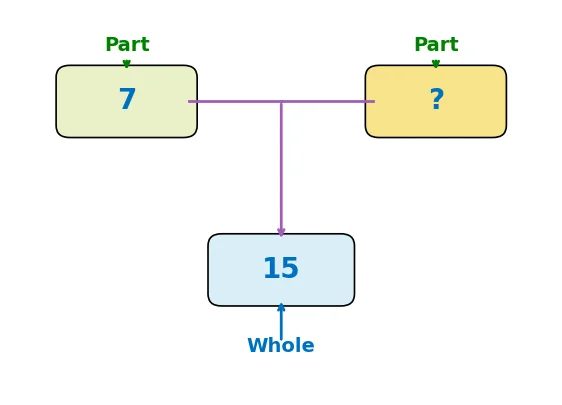
7 + ___ = 15
→ 15 − 7 = 8, so the missing part is 8
Example 3: Whole = ?, Part 1 = 9, Part 2 = 5
9 + 5 = _____
→ 9 + 5 = 14, so the whole is 14
Number Bonds to 10: The Most Important Set
If there's one group of number bonds every Class 1 child should know off by heart, it's the number bonds to 10.
Number Bonds Examples: Real-Life Connections
One of the best ways to help children understand number bonds is to connect them to situations they actually encounter every day. Here are some examples you can use at home or in the classroom.
-
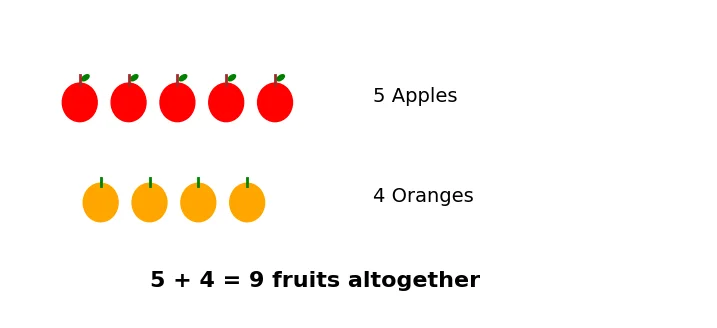
At the fruit bowl: There are 5 apples and 4 oranges in the bowl. How many fruits altogether? 5 and 4 make 9. That's a number bond.
-
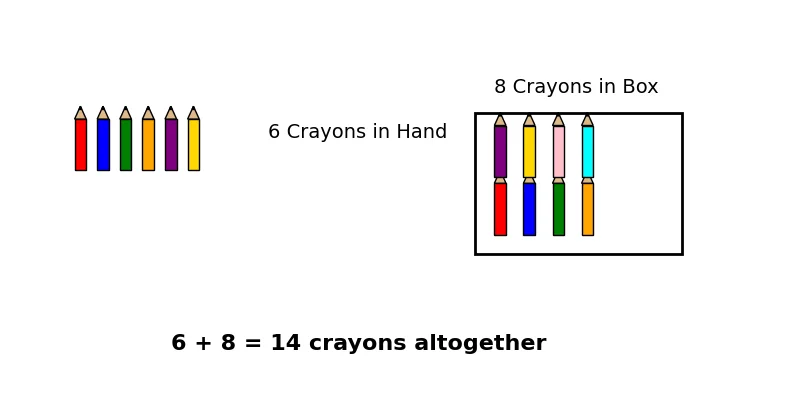
In the toy box: Meera has 6 crayons in her hand and 8 more in the box. How many crayons total? 6 and 8 make 14.
-
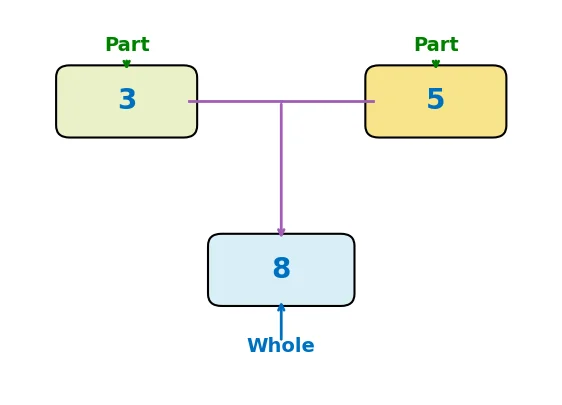
At snack time: Raju eats 3 biscuits and then 5 more. He ate 8 biscuits in all. Parts: 3 and 5. Whole: 8.
-
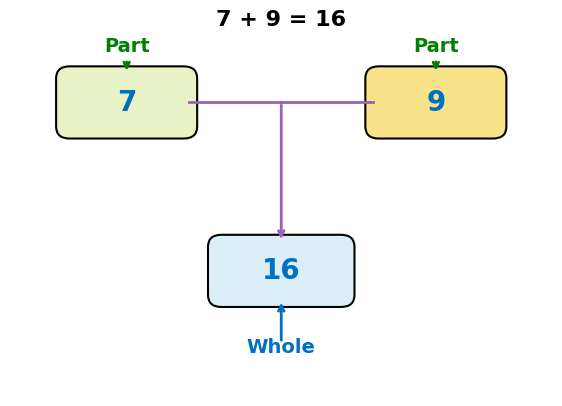
On the playground: 7 children are playing on the swings and 9 on the slide. How many children are playing altogether? 7 + 9 = 16. Number bond: 7, 9, 16.
Fun Activities to Practice Number Bonds at Home
Here are some activities that feel like play but build genuine mathematical understanding.
1. The Hiding Game
Take 10 small objects: buttons, coins, pebbles. Show your child all 10. Ask them to close their eyes. Hide some in your hand and put the rest on the table. Ask: ‘How many am I hiding?’ They count what's visible and figure out the missing part. This builds number bonds to 10 beautifully.
2. Two-Colour Towers
Give your child 10 building blocks: 5 in one colour and 5 in another. Ask them to build towers using different combinations and tell you the bond: ‘3 red and 7 blue make 10’ They'll naturally discover all the pairs.
3. Number Bond Hopscotch
Draw a hopscotch grid outside. Call out a whole number (7) and ask your child to hop to two squares that add up to 7. It gets them moving and thinking at the same time.
4. Bond Hunt in the Kitchen
Pick any number, say, 8. Challenge your child to find 3 different number bonds to 8 using objects from the kitchen: 8 spoons = 3 big spoons + 5 small spoons. 8 fruits = 6 apples + 2 bananas. And so on.
5. Flashcard Bonds
Make simple flashcard sets where the whole is shown on one side and one part on the other. ‘Whole is 11, one part is 4, what's the other part?’ Quick-fire rounds of this build automatic recall over time.
Numbers make sense when they're taught right. To see how Orchids The International School turns Maths from intimidating to intuitive, reach out to our admissions team.
Frequently Asked Questions of Number Bond for Class 1
1. What is a number bond for Class 1?
A number bond is a diagram with three connected circles: one showing the whole (total) and two showing the parts (smaller numbers) that make up that whole.
2. What are number bonds to 10?
Number bonds to 10 are all the pairs of numbers that add up to 10: 1+9, 2+8, 3+7, 4+6, 5+5, and so on.
3. How do I explain number bonds to a 6-year-old?
Start with physical objects. Take 7 stones and put 3 in one hand and 4 in the other. Show both hands together. Say: "3 and 4 make 7." Then draw it in the three-circle diagram. Keep practising with real objects before moving to numbers on paper.
Related Links


Admissions Open for 2026-27
What type of concept pages would you prefer?
CBSE Schools In Popular Cities
- CBSE Schools in Bangalore
- CBSE Schools in Mumbai
- CBSE Schools in Pune
- CBSE Schools in Hyderabad
- CBSE Schools in Chennai
- CBSE Schools in Gurgaon
- CBSE Schools in Kolkata
- CBSE Schools in Indore
- CBSE Schools in Sonipat
- CBSE Schools in Delhi
- CBSE Schools in Rohtak
- CBSE Schools in Bhopal
- CBSE Schools in Aurangabad
- CBSE Schools in Jabalpur
- CBSE Schools in Jaipur
- CBSE Schools in Jodhpur
- CBSE Schools in Nagpur
- CBSE Schools in Ahmednagar
- CBSE School In Tumkur











Orchids The International School is one of India's leading chains of CBSE and ICSE schools, with 110+ schools across the country.