

Addition Without Regrouping for Class 2: A Complete Guide
Addition Without Regrouping for Class 2 helps young learners add two-digit numbers confidently by mastering column addition when the sum of ones and tens stays under 10. This lesson teaches students to align numbers vertically, add ones first then tens, and write the answer without carrying over using hands-on activities with base-10 blocks, place-value charts, and visual number models. In this guide you will learn how to set up column addition problems correctly, add digits step-by-step, recognize when regrouping isn needed, practice with worksheets and real-life scenarios, and build fluency for future addition with regrouping.
Table of Contents
- What Is Addition Without Regrouping?
- Addition of a 2-Digit Number with a 3-Digit Number
- Addition of Two 3-Digit Numbers
- Addition Using Three Addends
- Important Facts of Addition
- Number Stories of Addition Without Regrouping
- Frequently Asked Questions of Addition Without Regrouping for Class 2

What Is Addition Without Regrouping?
Addition simply means combining two or more numbers to find the total. The numbers being added are called addends, and the result is called the sum.
Without regrouping means that when you add the digits in each place (ones, tens, hundreds), the answer is always less than 10 so there's no need to carry over anything to the next column.
Know more about related topics:
Addition of a 2-Digit Number with a 3-Digit Number
While adding a 2-digit number with a 3-digit number, always arrange the numbers according to their place values before adding. Ones go under ones, tens under tens, and hundreds under hundreds.
Example: Add 233 + 45.
Method 1:
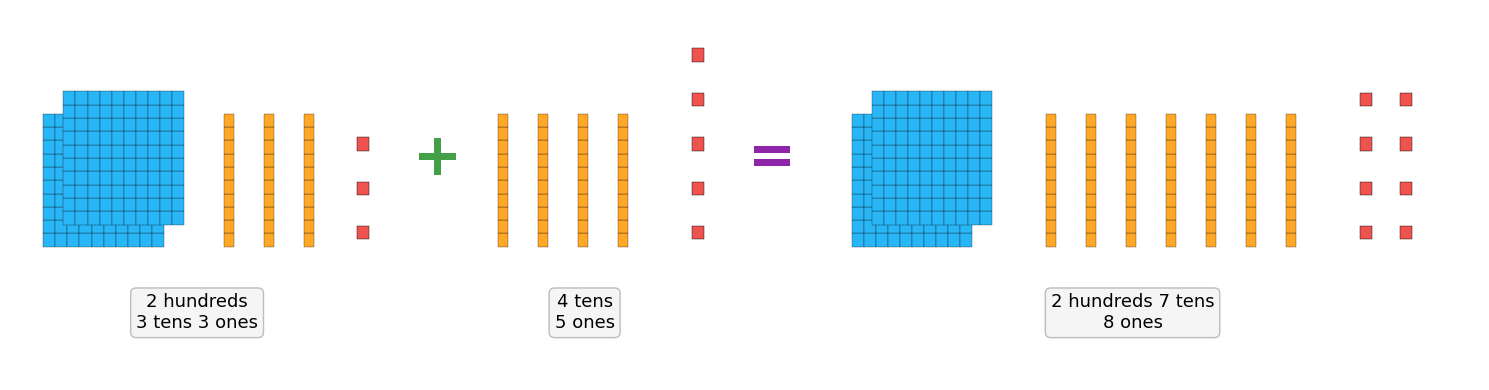
Method 2: Column Method
H T O
2 3 3
+ 4 5
---------
Step 1: Arrange the numbers by place value.
Step 2: Add the ones digits: 3 + 5 = 8
Step 3: Add the tens digits: 3 + 4 = 7
Step 4: Bring down the hundreds digit: 2 (since 45 has no hundreds digit)
H T O
2 3 3
+ 4 5
---------
2 7 8
So, 233 + 45 = 278
Addition of Two 3-Digit Numbers
Example 1: 124 + 223
Method 1:
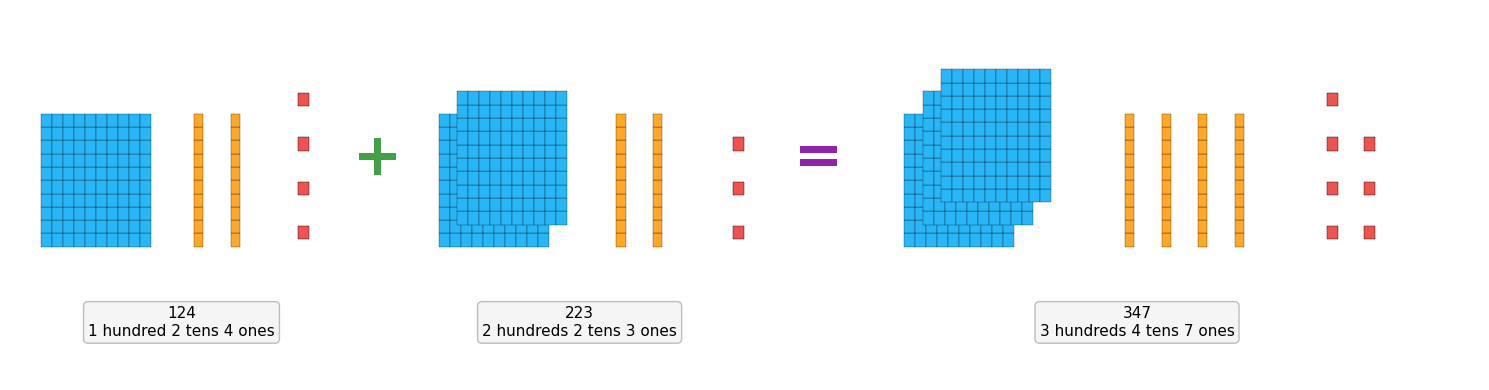
Method 2: Column Method
H T O
1 2 4
+ 2 2 3
---------
-
Ones: 4 + 3 = 7
-
Tens: 2 + 2 = 4
-
Hundreds: 1 + 2 = 3
H T O
1 2 4
+ 2 2 3
---------
3 4 7
So 124 + 223 = 347
Example 2: 306 + 122
H T O
3 0 6
+ 1 2 2
---------
-
Ones: 6 + 2 = 8
-
Tens: 0 + 2 = 2
-
Hundreds: 3 + 1 = 4
So, 306 + 122 = 428
Addition Using Three Addends
To add three numbers at once, the method is exactly the same, just with one more row.
Example 1: 201 + 365 + 420
H T O
2 0 1
3 6 5
+ 4 2 0
---------
-
Ones: 1 + 5 + 0 = 6
-
Tens: 0 + 6 + 2 = 8
-
Hundreds: 2 + 3 + 4 = 9
H T O
2 0 1
3 6 5
+ 4 2 0
---------
9 8 6
So, 201 + 365 + 420 = 986
Example 2: 342 + 227 + 220
H T O
3 4 2
2 2 7
+ 2 2 0
---------
-
Ones: 2 + 7 + 0 = 9
-
Tens: 4 + 2 + 2 = 8
-
Hundreds: 3 + 2 + 2 = 7
H T O
3 4 2
2 2 7
+ 2 2 0
---------
7 8 9
So, 342 + 227 + 220 = 789
Important Facts of Addition
These shortcut rules or facts make maths faster and help children check their answers.
Rule 1: Adding 0
When you add 0 to any number, the number stays the same.
Example:
512 + 0 = 512
0 + 236 = 236
Rule 2: Adding 1
When you add 1 to a number, you get the very next number.
Example:
412 + 1 = 413
1 + 807 = 808
Rule 3: Adding 10
When you add 10, only the tens digit changes it goes up by 1. The rest stays the same.
Example:
506 + 10 = 516 ( the tens went from 0 to 1)
10 + 275 = 285
Rule 4: Adding 100
When you add 100, only the hundreds digit increases by 1. The tens and ones digits stay exactly the same.
Example:
452 + 100 = 552
100 + 368 = 468
Rule 5: Order of Addition
No matter what order you add numbers in, the sum is always the same.
Example:
306 + 140 = 140 + 306; Both equal 446
212 + 320 + 145 = 145 + 320 + 212; both arrangements give 677
Number Stories of Addition Without Regrouping
Question 1: There were 451 boys and 223 girls at an event. How many students were present in all?
Solution:
Number of boys = 451
Number of girls = 223
H T O
4 5 1
+ 2 2 3
---------
6 7 4
Answer: 674 students were present in all.
Question 2: Esha collected 132 shells, Mona collected 200 shells and Pooja collected 156 shells. Find the total number of shells they collected.
Solution:
Number of shells collected by Esha = 132
Number of shells collected by Mona = 200
Number of shells collected by Pooja = 156
H T O
1 3 2
2 0 0
+ 1 5 6
---------
4 8 8
Answer: They collected 488 shells altogether.
Question 3: A garden had 124 rose plants, 132 periwinkle plants and 111 jasmine plants. How many plants were there altogether?
Solution: Number of rose plants = 124
Number of periwinkle plants = 132
Number of jasmine = 111
H T O
1 2 4
1 3 2
+ 1 1 1
---------
3 6 7
There were 367 plants in the garden.
Here's a set of questions for practice. Solve them in a notebook with a proper layout.
Numbers make sense when they're taught right. To see how Orchids The International School turns Maths from intimidating to intuitive, reach out to our admissions team.
Frequently Asked Questions of Addition Without Regrouping for Class 2
1. What is the difference between addition with regrouping and without regrouping?
In addition without regrouping, the digits in each column add up to 9 or less, so nothing carries over. In addition with regrouping, the column sum is 10 or more, so a digit carries over to the next column.
2. My child keeps getting the wrong answer, what should I do?
Start by checking the alignment. Draw a ruled H-T-O (Hundreds-Tens-Ones) grid on a piece of paper and have your child write numbers into boxes.
3. Is this the same as ‘no carrying’ in addition?
Yes. ‘Without regrouping’ and ‘without carrying’ mean the same thing.
4. How many examples should my child practice per day?
5–10 problems a day done correctly is much better than 30 problems rushed. Focus on understanding and accuracy first.
Related Links


Admissions Open for 2026-27
What type of concept pages would you prefer?
CBSE Schools In Popular Cities
- CBSE Schools in Bangalore
- CBSE Schools in Mumbai
- CBSE Schools in Pune
- CBSE Schools in Hyderabad
- CBSE Schools in Chennai
- CBSE Schools in Gurgaon
- CBSE Schools in Kolkata
- CBSE Schools in Indore
- CBSE Schools in Sonipat
- CBSE Schools in Delhi
- CBSE Schools in Rohtak
- CBSE Schools in Bhopal
- CBSE Schools in Aurangabad
- CBSE Schools in Jabalpur
- CBSE Schools in Jaipur
- CBSE Schools in Jodhpur
- CBSE Schools in Nagpur
- CBSE Schools in Ahmednagar
- CBSE School In Tumkur











Orchids The International School is one of India's leading chains of CBSE and ICSE schools, with 130+ schools across the country.