

Multiplication for Class 2: A Complete Guide
Multiplication for Class 2 helps young learners understand repeated addition and begin mastering times tables using visual models and the column method. This lesson introduces multiplication as groups of equal size, arrays, number lines, and repeated addition, then shows how to write and read multiplication sentences (× and =), identify factors and products, and use skip‑counting to build fluency. The resource includes step‑by‑step examples, printable worksheets, quick tips for memorisation, and classroom activities to reinforce understanding and prepare learners for formal times‑table mastery.
Table of Contents
- What is Multiplication?
- Multiplication as Repeated Addition
- Skip Counting and Multiplication
- Properties of Multiplication
- Multiplication Without Regrouping
- Multiplication With Regrouping
- Number Stories of Multiplication for Class 2
- Frequently Asked Questions of Multiplication for Class 2

What is Multiplication?
Definition
When the same number is added to itself again and again, it is called repeated addition. Multiplication is a quicker way to do repeated addition.
The × sign is the symbol of multiplication. The answer of a multiplication statement is called the product.
For example, Rohan’s mother has placed 3 plates on the table. Each plate has 4 cookies on it. Now, Rohan wants to know how many cookies are there in total?
He could count one by one: 1, 2, 3... all the way to 12. Or he could add: 4 + 4 + 4 = 12. But the fastest way is to multiply.
3 plates, 4 cookies each → 3 groups of 4 → 3 × 4 = 12 cookies
We read this as: "Three times four is twelve."
Know more about related topics:
Multiplication as Repeated Addition
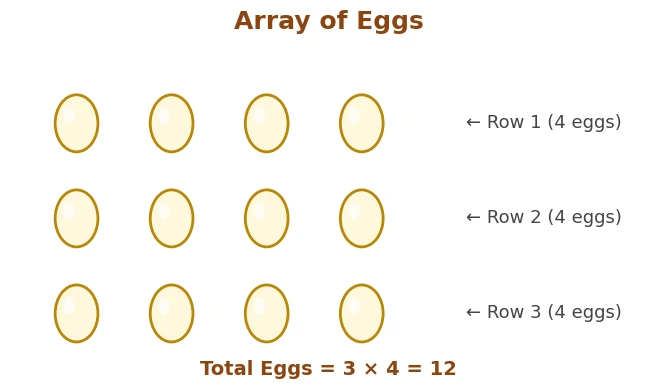
Let us think of a real situation: Rohan is looking at an egg tray. There are 3 rows of eggs, and each row has 4 eggs.
Total eggs = 4 + 4 + 4 = 12
Since 4 is being added 3 times, we call this repeated addition. And we can write it as a multiplication statement:
Number of rows × Eggs in each row = Total eggs
3 × 4 = 12
More Examples:
Skip Counting and Multiplication
Skip counting means jumping ahead by the same number each time on a number line. Skip counting by any number gives you the same answers as that number's multiplication table.
Skip count by 3: This gives the 3 times table.
0 3 6 9 12 15 18 21 24 27 (+3) (+3) (+3) (+3) (+3) (+3) (+3) (+3) (+3)
When you jump 3 steps at a time, after 1 jump you reach 3 (1 × 3 = 3), after 2 jumps you reach 6 (2 × 3 = 6), and so on.
Properties of Multiplication
-
Multiply by 1
Any number × 1 = same number
Example: 68 × 1 = 68
-
Multiply by 0
Any number × 0 = 0
Example: 562 × 0 = 0
-
Order Property
3 × 5 = 5 × 3 = 15
-
Doubling
Any number × 2 = double
Example: 2 × 5 = 10
5 + 5 = 10
Multiplication Without Regrouping
When we need to multiply a 2-digit or 3-digit number by a 1-digit number, we use the column method.
The rule is always start multiplying from the ones place (the right side).
Multiplying a 2-Digit Number
Example: 23 × 3
23 has 2 tens and 3 ones. When we multiply by 3, both the tens and ones come 3 times.
23
× 3
--------
Multiply ones: 3 × 3 = 9. Write 9 in ones place.
23
× 3
--------
9
Multiply tens: 2 × 3 = 6. Write 6 in tens place.
23
× 3
--------
69
23 × 3 = 69
Multiplying a 3-Digit Number
Example: 123 × 2
123 has 1 hundred, 2 tens and 3 ones. All three types of place values get multiplied by 2.
123
× 2
----------
3 × 2 = 6 . Write 6 in the ones place.
123
× 2
----------
6
2×2=4 tens=40. Write 4 in the tens place.
123
× 2
----------
46
2×1=2 hundreds=200. Write 2 in the hundreds place.
123
× 2
----------
246
So 123 × 2 = 246
Multiplication With Regrouping
Sometimes when we multiply, the ones place gives a two-digit answer. When that happens, we carry the tens digit over to the next column. This is called regrouping.
Regrouping at the Ones Place
Example: 13 × 4
13 has 1 ten and 3 ones. When we multiply by 4, 4 × 3 ones = 12 ones. Now 12 ones = 1 ten + 2 ones, so we carry 1 ten over.
13
× 4
---------
4×3=12
Write 2 in the ones place and carry 1 to the tens place.
1
13
× 4
---------
2
4×1=4. Add the carried 1: 4+1=5
Write 5 in the tens place.
1
13
× 4
---------
52
So, 13 × 4 = 52
Number Stories of Multiplication for Class 2
Question 1: A farmer planted 42 seeds in a row. How many seeds did he plant in 2 such rows?
Solution: Seeds in 1 row = 42
Number of rows = 2
Total seeds = 42 × 2
42
× 2
---------
84
The farmer planted 84 seeds in 2 rows.
Question 2: There are 12 lemons in a box. How many lemons are there in 8 such boxes?
Solution: Lemons in 1 box = 12
Number of boxes = 8
Total lemons = 12 × 8 = 96 lemons
1
12
× 8
---------
96
Question 3: The cost of 1 kilogram of mangoes is ₹104. Rohan wants to buy 2 kilograms. How much money does he need?
Solution: Cost of 1 kg = ₹104
Number of kg = 2
104
× 2
----------
208
Total cost = 104 × 2 = ₹208
Here's a set of questions for practice. Solve them in a notebook with a proper layout. Free download.
Numbers make sense when they're taught right. To see how Orchids The International School turns Maths from intimidating to intuitive, reach out to our admissions team.
Frequently Asked Questions of Multiplication for Class 2
1. What is repeated addition?
When the same number is added to itself again and again, it is called repeated addition. Example: 4 + 4 + 4 = 12 = 3 × 4
2. What is the difference between multiplication with and without regrouping?
Multiplication with regrouping involves carrying over values when a product exceeds one digit, while multiplication without regrouping does not require carrying because all partial products stay within a single digit.
3. What does the × symbol mean?
The × symbol means ‘times’ or ‘multiplied by’.
4. What happens when you multiply by 0?
Any number × 0 = 0
5. Is 4 × 3 the same as 3 × 4?
Yes, both 4 × 3 and 3 × 4 equal 12.
Related Links


Admissions Open for 2026-27
What type of concept pages would you prefer?
CBSE Schools In Popular Cities
- CBSE Schools in Bangalore
- CBSE Schools in Mumbai
- CBSE Schools in Pune
- CBSE Schools in Hyderabad
- CBSE Schools in Chennai
- CBSE Schools in Gurgaon
- CBSE Schools in Kolkata
- CBSE Schools in Indore
- CBSE Schools in Sonipat
- CBSE Schools in Delhi
- CBSE Schools in Rohtak
- CBSE Schools in Bhopal
- CBSE Schools in Aurangabad
- CBSE Schools in Jabalpur
- CBSE Schools in Jaipur
- CBSE Schools in Jodhpur
- CBSE Schools in Nagpur
- CBSE Schools in Ahmednagar
- CBSE School In Tumkur











Orchids The International School is one of India's leading chains of CBSE and ICSE schools, with 130+ schools across the country.