

Addition with Regrouping for Class 2: A Complete Guide
Addition with regrouping for Class 2 helps young learners add two-digit numbers confidently when the ones digits total 10 or more by teaching the column method with carrying (regrouping). This lesson shows students how to align numbers vertically, add the ones first, form a ten from the ones and carry it to the tens column, and then add the tens, including the carried ten. In this guide, you will learn how to set up column addition problems correctly, decide when regrouping is needed, perform carrying using drawings, practise with worksheets and real‑life scenarios, and build fluency for later three‑digit addition and subtraction with regrouping.
Table of Contents
- What Is Addition With Regrouping?
- Addition of a 2-Digit Number and a 1-Digit Number with Regrouping
- Addition of Two 2-Digit Numbers With Regrouping
- Addition of Three 2-Digit Numbers With Regrouping
- Facts of Addition With Regrouping
- Number Stories of Addition With Regrouping
- Frequently Asked Questions of Addition With Regrouping for Class 2

What Addition With Regrouping?
When you add two numbers, sometimes the digits in the ones place add up to a number that is 10 or more. In that case, you can't fit both digits in a single column, so you need to regroup.
The golden rule of addition with regrouping is ‘When the sum of digits in any column is 10 or more, write the ones digit of that sum under that column and carry the tens digit to the next column on the left’.
Know more about related topics:
Addition of a 2-digit number and a 1-digit number with Regrouping
Example 1: Add 38 and 5
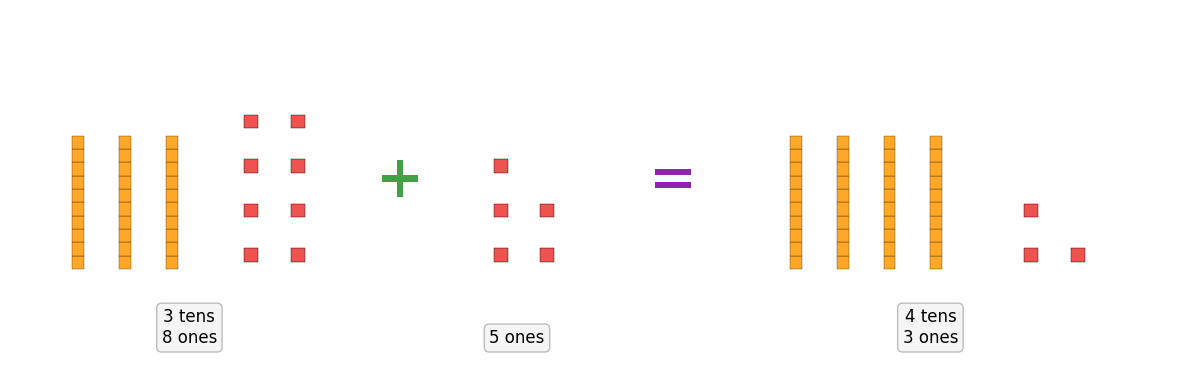
You add a 2-digit number like 38 to a 1-digit number like 5. The ones add up to more than 9, so you need to carry.
Step 1: Ones
T O
1
3 8
+ 5
3
8 + 5 = 13
Write 3, carry 1 to tens
Step 2: Tens
T O
1
3 8
+ 5
4 3
1 (carry) + 3 = 4
Write 4 in tens
So, 38 + 5 = 43
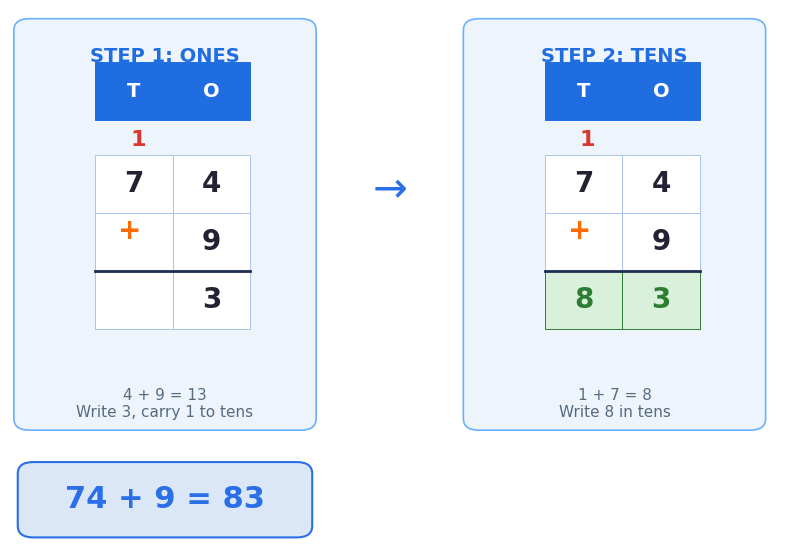
Example 2: Add 74 with 9.
Addition of Two 2-digit numbers With Regrouping
To add two 2-digit numbers. The process is the same, but both numbers have tens and ones digits to manage.
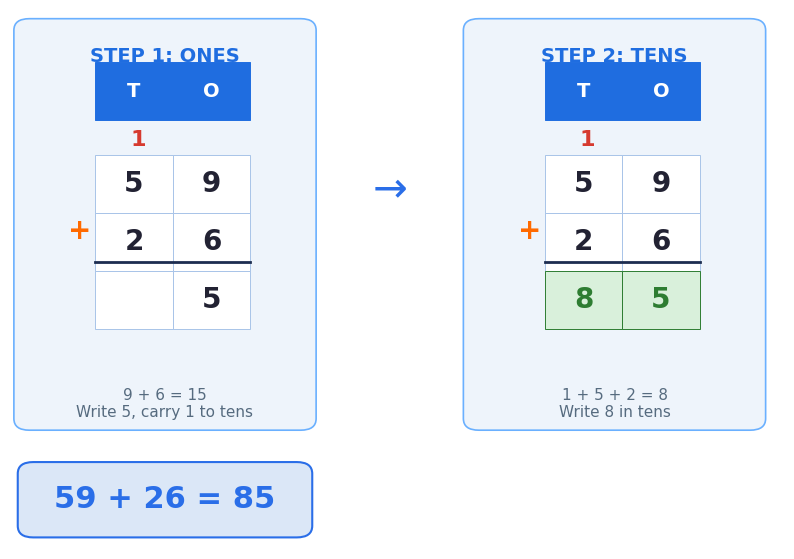
Example 1: Add 59 and 26
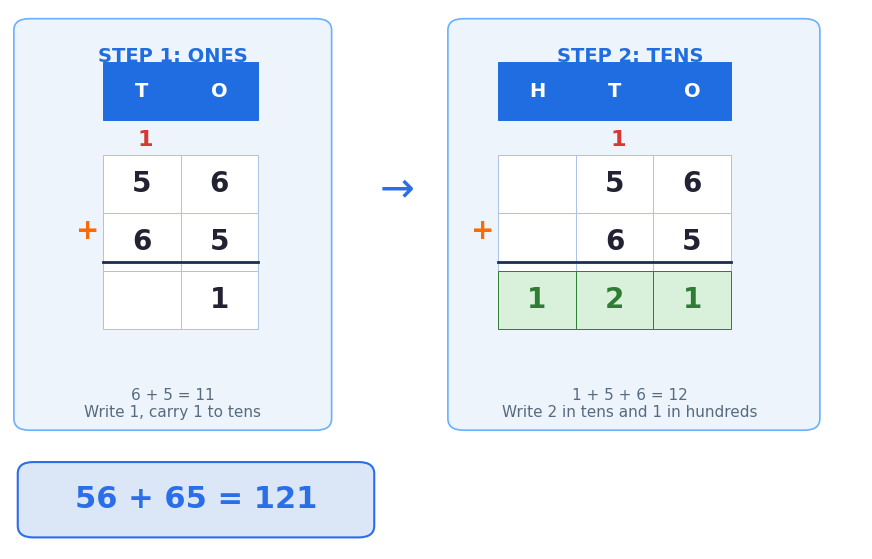
Example 2: Add 56 with 65.
Addition of Three 2-digit numbers With Regrouping
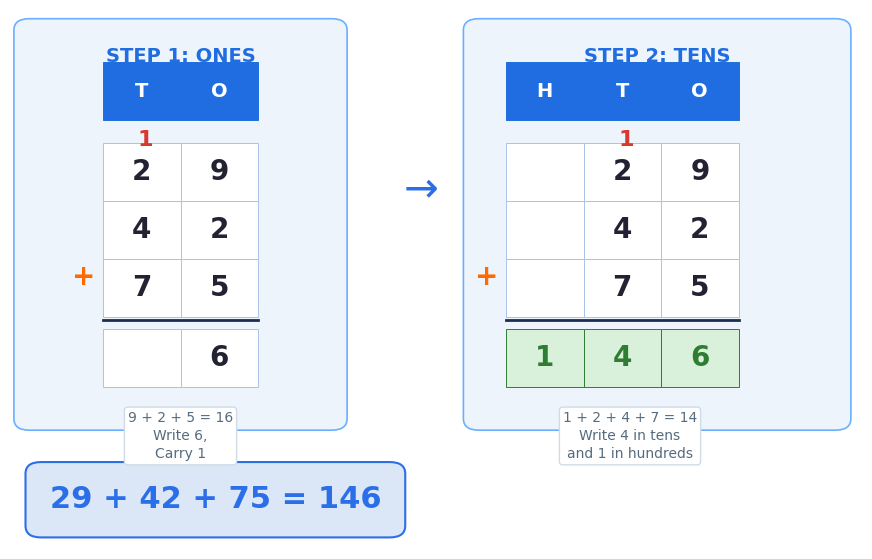
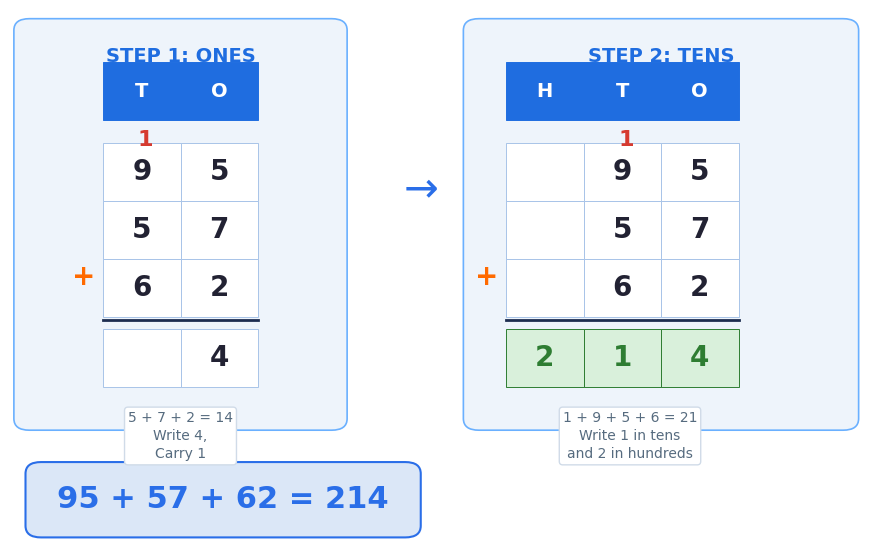
Adding three numbers follows the same steps: just add all three ones digits together first. If the sum is 10 or more, carry as usual.
Example 1: Add 29, 42 and 75
Example 2: Add 95 + 57 + 62
Facts of Addition With Regrouping
Here are a few facts of addition with regrouping that help save a lot of time.
-
Adding 1
When you add 1 to any number, you get the very next number.
49 + 1 = 50, 99 + 1 = 100
-
Adding 10
The ones digit stays the same; the tens digit goes up by 1.
95 + 10 = 105, 67 + 10 = 77
-
Order of Addition
You can add numbers in any order. The answer will stay the same
28 + 53 = 53 + 28 = 81
Number stories of Addition With Regrouping
Question 1: Meera has 15 cards, Jason has 36 cards and Rima has 25 cards. How many cards do they have in all?
Solution:
Number of cards with Meera = 15
Number of cards with Jason = 36
Number of cards with Rima = 25
H T O
1
1 5
3 6
+ 2 5
─────
7 6
Ones: 5 + 6 + 5 = 16; write 6, carry 1
Tens: 1 + 1 + 3 + 2 = 7
Total number of cards = 76 cards
Question 2: Ankit has 96 fish in his tank. His mother added 14 more fish. How many fish are there in the tank now?
Solution:
T O
1
9 6
+ 1 4
───
1 1 0
Ones: 6 + 4 = 10; write 0, carry 1
Tens: 1 + 9 + 1 = 11; write 1, carry 1 to hundreds
Total number of fish in the tank = 110 fish
Here's a set of questions for practice. Solve them in a notebook with a proper layout.
Numbers make sense when they're taught right. To see how Orchids The International School turns Maths from intimidating to intuitive, reach out to our admissions team.
Frequently Asked Questions of Addition With Regrouping for Class 2
1. What is addition with regrouping for Class 2?
Addition with regrouping for Class 2 is a method of adding two or more numbers where the sum of the ones digits equals 10 or more.
2. What is the difference between addition with regrouping and without regrouping?
In addition without regrouping, the sum of the ones digits is less than 10, so no carrying is needed. In addition with regrouping, the ones digits add up to 10 or more, so we must carry a digit over to the tens column.
3. When do we use regrouping in addition?
We use regrouping in addition whenever the sum of the digits in any column (ones, tens, or hundreds) is 10 or more.
4. How is regrouping in addition related to place value?
Regrouping is built on place value. In the place value system, each column holds only one digit (0–9). When the sum in a column exceeds 9, it creates a new group.
5. Is addition with regrouping the same as addition with carrying?
Yes, they are the same thing. 'Regrouping' and 'carrying' are two terms for the same process.
Related Links


Admissions Open for 2026-27
What type of concept pages would you prefer?
CBSE Schools In Popular Cities
- CBSE Schools in Bangalore
- CBSE Schools in Mumbai
- CBSE Schools in Pune
- CBSE Schools in Hyderabad
- CBSE Schools in Chennai
- CBSE Schools in Gurgaon
- CBSE Schools in Kolkata
- CBSE Schools in Indore
- CBSE Schools in Sonipat
- CBSE Schools in Delhi
- CBSE Schools in Rohtak
- CBSE Schools in Bhopal
- CBSE Schools in Aurangabad
- CBSE Schools in Jabalpur
- CBSE Schools in Jaipur
- CBSE Schools in Jodhpur
- CBSE Schools in Nagpur
- CBSE Schools in Ahmednagar
- CBSE School In Tumkur











Orchids The International School is one of India's leading chains of CBSE and ICSE schools, with 130+ schools across the country.