

Class 10 Maths Chapter 2 ‘Polynomials’ Case Study with Answers
This set of case-study questions for Chapter 2: Polynomials Class 10 aligned to CBSE and NCERT provides short, exam-style scenarios that build reasoning and problem-solving skills in topics like polynomial identities, factorization, zeroes of polynomials, and the Remainder and Factor Theorems; each question includes step-by-step answers, common-trap warnings, and a downloadable PDF with full solutions and timed practice sets for quick revision, classroom worksheets, and focused pre-exam practice.
Solved Polynomials Case Study Questions and Answers
CBSE's case-based questions usually give you a short passage describing a real situation, sometimes with a small figure, followed by 4 - 5 questions of increasing difficulty, a couple of MCQs to check basic understanding, a short-answer question that needs a calculation, and a longer question that asks you to interpret or justify your answer.

Case Study 1: Parabolic Arches in Architecture
Scenario:
The pictures around us are full of natural and man-made examples of parabolic shapes. A parabolic arch is an arch in the shape of a parabola. In structures, this curve represents an efficient method of load distribution and so can be found in bridges and architecture in a variety of forms.
Questions and Answers:
Q1. In the standard form of a quadratic polynomial ax² + bx + c, the conditions on a, b, and c are:
a) All are real numbers
b) All are rational numbers
c) 'a' is a non-zero real number and b and c are any real numbers
d) All are integers
Q2. If the roots of a quadratic polynomial are equal, where the discriminant D = b² − 4ac, then:
a) D > 0 b) D < 0
c) D ≥ 0 d) D = 0
Q3. If α and β are the zeros of the quadratic polynomial 2x² − k, then the value of k is:
Q4. The graph of x² + 1 = 0:
a) Intersects x-axis at two distinct points
b) Touches x-axis at a point
c) Neither touches nor intersects x-axis
d) Either touches or intersects x-axis
Q5. If the sum of the roots is −p and the product of the roots is −1/p, then the quadratic polynomial is:
a) k(−px² + x/p − 1)
b) k(px² − x/p + 1)
c) k(x² + px − 1/p)
d) k(x² − px + 1/p)
Solution:
Q1: (c) . The standard form requires 'a' to be non-zero,because if a = 0, the expression becomes linear (bx + c), not quadratic. However, b and c can be any real numbers, including zero.
Q2: (d) D = 0
When D = 0, the quadratic formula gives x = −b/2a for both roots, meaning both roots are identical.
Q3: (b) k = −1/2. Here the sum of zeros α + β = 0 and product αβ = −k/2
Q4: (c) Neither touches nor intersects x-axis
Rewrite as x² = −1. Since x² is always ≥ 0 for real numbers, there is no real value of x that satisfies this. The discriminant D = 0 − 4(1)(1) = −4 < 0, confirming no real zeros. The parabola sits entirely above the x-axis.
Q5: (c) k(x² + px − 1/p)
A quadratic with zeros α, β can be written as k[x² − (α+β)x + αβ]. Substituting sum = −p and product = −1/p
k[x² − (−p)x + (−1/p)] = k(x² + px − 1/p).
Know more about related topics:
Case Study 2: Sports and Projectile Motion
Scenario:
Basketball and soccer are played with a spherical ball. Even though an athlete dribbles the ball in both sports, a basketball player uses their hands and a soccer player uses their feet. Usually, soccer is played outdoors on a large field and basketball is played indoors on a wooden court. The path traced (projectile) of a soccer ball and a basketball are in the form of a parabola, representing a quadratic polynomial.
Questions and Answers:
Q1. The shape of the path traced is:
a) Spiral b) Ellipse
c) Linear d) Parabola
Q2. The graph of a parabola opens upwards if:
a) a = 0 b) a < 0
c) a > 0 d) a ≠ 0
Q3. In the graph shown, how many zeros does the polynomial have?
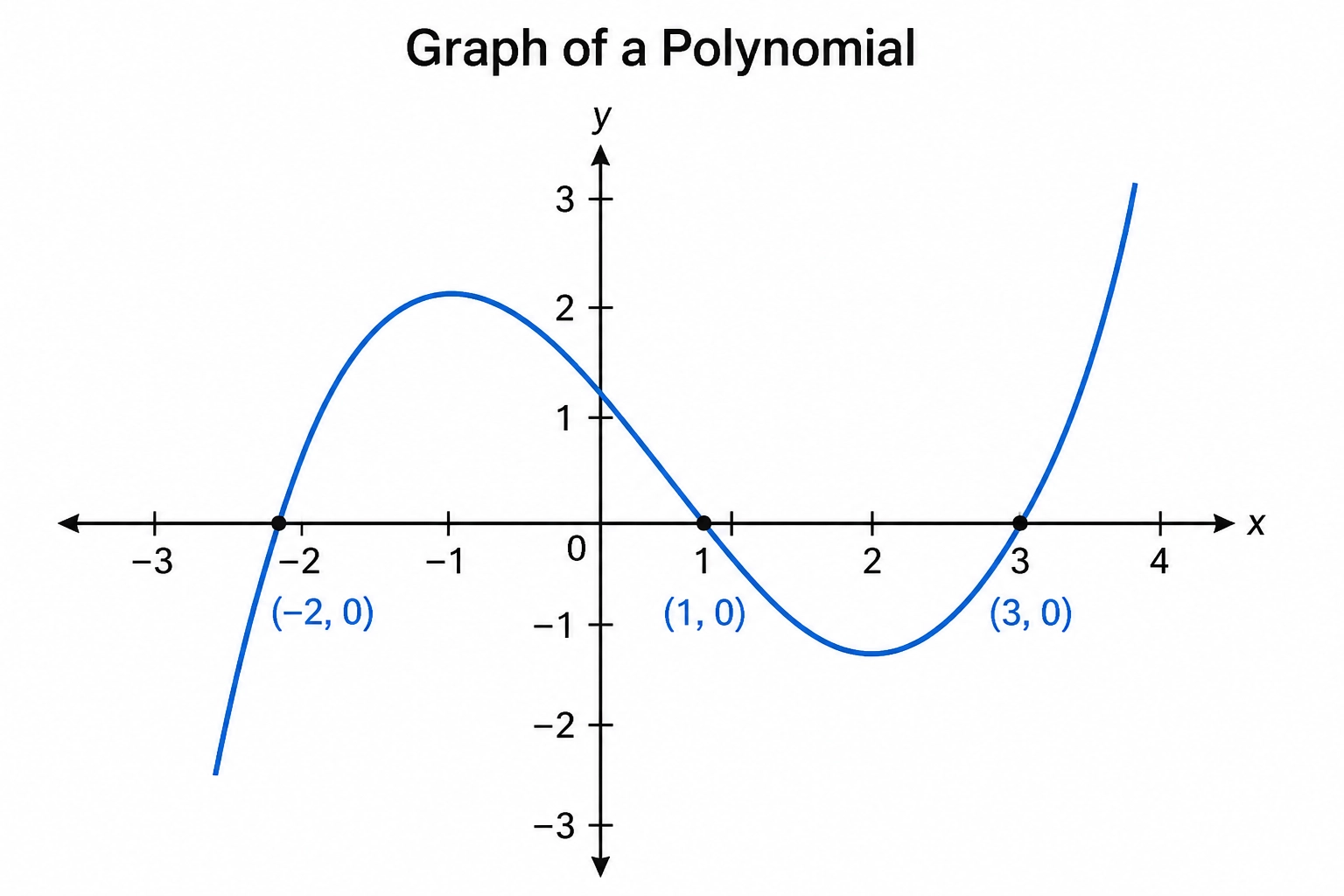
a) 0 b) 1
c) 2 d) 3
Q4. The three zeros in the graph are:
a) 2, 3, −1
b) −2, 3, 1
c) −3, −1, 2
d) −2, −3, −1
Q5. The expression of the polynomial with zeros −3, −1, and 2 is:
Solution:
Q1: (d) Parabola
Any object thrown at an angle under gravity follows a parabolic path, this is basic physics that perfectly aligns with quadratic polynomial graphs. The ball rises, reaches a peak, and falls back in a symmetric curve.
Q2: (c) a > 0
When the leading coefficient is positive, the parabola opens upward.
Q3: (d) 3
This particular graph represents a cubic polynomial (degree 3), not a quadratic. A cubic can have up to 3 real zeros. The graph crosses the x-axis at three distinct points.
Q4: (c) −3, −1, 2
Read the x-intercepts from the graph. The polynomial crosses the x-axis at x = −3, x = −1, and x = 2.
Q5: (x + 3)(x + 1)(x − 2) = x³ + 2x² − 5x − 6
If the zeros are r₁, r₂, r₃, then the polynomial is k(x − r₁)(x − r₂)(x − r₃). Substituting −3, −1, 2:
(x − (−3))(x − (−1))(x − 2) = (x + 3)(x + 1)(x − 2)
Expanding step by step:
(x + 3)(x + 1) = x² + 4x + 3
(x² + 4x + 3)(x − 2) = x³ + 4x² + 3x − 2x² − 8x − 6 = x³ + 2x² − 5x − 6
Case Study 3: The Farmer's Field
A farmer wants to fence a rectangular piece of land along a straight river. He does not need to fence the side along the river. He has 60 metres of fencing wire available. He realises that the area A (in sq. metres) of the fenced land can be expressed as a quadratic polynomial in terms of one side x: A(x) = −2x² + 60x. He also wants to understand the mathematical properties of this polynomial to maximise the area.
Questions and Answers:
Q1. The polynomial A(x) = −2x² + 60x represents area. The shape of its graph is:
a) A straight line
b) An upward parabola
c) A downward parabola
d) A circle
Q2. The zeros of A(x) = −2x² + 60x are:
a) x = 0 and x = 30
b) x = 0 and x = 60
c) x = −30 and x = 30
d) x = 2 and x = 30
Q3. What does the zero x = 0 physically represent in this problem?
a) Maximum area of the field
b) Minimum fencing required
c) No width means no enclosed area
d) Width equals length
Q4. The sum of the zeros of A(x) = −2x² + 60x using the coefficient formula is:
a) −30 b) 60
c) 30 d) −60
Which of the following is true about A(x) = −2x² + 60x?
a) It has no real zeros
b) Both zeros are negative
c) The product of zeros is 0
d) The product of zeros is 30
Solution:
c) A downward parabola
Since the coefficient of x² is −2 (negative), the parabola opens downward. This makes sense, as area has a maximum value and falls off on both sides.
Q2: a) x = 0 and x = 30
Factorise: A(x) = −2x(x − 30). Setting each factor to zero: x = 0 or x = 30. These are the values of side length where area = 0 (no enclosure at all).
Q3: When x = 0, no width is fenced so the enclosed area is zero. The zero is the boundary condition, not a meaningful farming dimension.
Q4: Sum of zeros = −b/a = −60/(−2) = 30. Verify: 0 + 30 = 30
Q5: c) The product of zeros is 0.
Product of zeros = c/a = 0/(−2) = 0. Verify: 0 × 30 = 0 . One zero being 0 always makes the product 0.
Quick Revision: Key Concepts You Must Know
1. Types of Polynomials by Degree
-
Linear polynomial: degree 1 → example: 2x + 3 (has 1 zero)
-
Quadratic polynomial: degree 2 → example: x² − 5x + 6 (has at most 2 zeros)
-
Cubic polynomial: degree 3 → example: x³ − 2x² + x (has at most 3 zeros)
2. Relationship Between Zeros and Coefficients (Quadratic)
For a quadratic polynomial ax² + bx + c, if α and β are its zeros:
-
Sum of zeros: α + β = −b/a
-
Product of zeros: αβ = c/a
3. The Discriminant
For ax² + bx + c
-
D = b² − 4ac
-
D > 0 → two distinct real zeros
-
D = 0 → two equal (repeated) zeros
-
D < 0 → no real zeros (graph doesn't cross x-axis)
4. Geometric Meaning of Zeros
The zeros of a polynomial are the x-coordinates of the points where its graph intersects the x-axis. A quadratic polynomial's graph is always a parabola.
Download Free PDF - Case Study: Class 10 Chapter 2: Polynomials
Frequently Asked Questions of Chapter 2: Polynomials Case Study for Class 10
1. Are case study questions compulsory in the Class 10 Maths Board Exam?
Yes. Since 2021-22, CBSE has included compulsory case study-based questions in the board exam. Chapter 2 (Polynomials) is a frequently tested chapter in this format.
2. Can I skip drawing graphs in case study questions?
If the question only asks you to identify zeros or describe the shape, you may not need to draw. But for questions where you need to interpret a given graph, reading it carefully is essential.
3. Are cubic polynomial case studies also asked?
Yes. While Chapter 2 focuses largely on quadratic polynomials, cubic polynomial graphs (with 3 zeros) also appear, as seen in the sports case study above.
4. What is the relationship between the zeros and coefficients of a quadratic polynomial?
For a quadratic polynomial :
- Sum of zeros = −b/a
- Product of zeros = c/a
5. How can I solve polynomial case study questions effectively?
Read the scenario carefully, identify the polynomial concept involved, apply the relevant formula or theorem, and verify your calculations before selecting or writing the answer.
Numbers make sense when they're taught right. To see how Orchids The International School turns Maths from intimidating to intuitive, reach out to our admissions team.


Admissions Open for 2026-27
What type of concept pages would you prefer?
CBSE Schools In Popular Cities
- CBSE Schools in Bangalore
- CBSE Schools in Mumbai
- CBSE Schools in Pune
- CBSE Schools in Hyderabad
- CBSE Schools in Chennai
- CBSE Schools in Gurgaon
- CBSE Schools in Kolkata
- CBSE Schools in Indore
- CBSE Schools in Sonipat
- CBSE Schools in Delhi
- CBSE Schools in Rohtak
- CBSE Schools in Bhopal
- CBSE Schools in Aurangabad
- CBSE Schools in Jabalpur
- CBSE Schools in Jaipur
- CBSE Schools in Jodhpur
- CBSE Schools in Nagpur
- CBSE Schools in Ahmednagar
- CBSE School In Tumkur











Orchids The International School is one of India's leading chains of CBSE and ICSE schools, with 110+ schools across the country.