

Case Study for Class 10 Maths Chapter 3 Pair of Linear Equations in Two Variables
The Case Study Questions for Class 10 Maths Chapter 3 "Pair of Linear Equations in Two Variables" include short, real life problem situations that have clear answers and step by step solutions to help students gain confidence for exams. It covers important topics including forming linear equations from word problems, solving pairs of equations using substitution method, elimination method, and cross-multiplication method, understanding graphical representation of linear equations, identifying consistent and inconsistent systems, distinguishing between dependent and independent equations, finding solutions where lines intersect, are parallel, or coincide, applying equations to age problems, money problems, distance-time problems, and mixture scenarios, and checking the validity of solutions in real context. These practice questions help the students in better understanding of the concepts, handling linear equation problems smoothly and to be faster and accurate for their board exams. A free PDF is included for offline timed practice.
Introduction to Case Study Questions on Pair of Linear Equations in Two Variables
Understanding Linear Equations in Two Variables
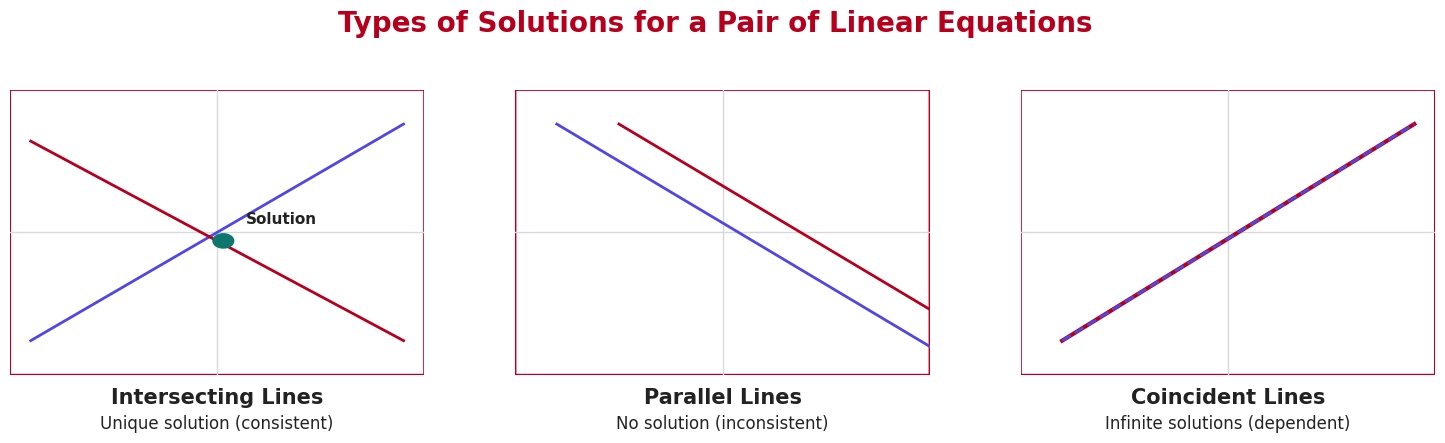
A linear equation in two variables has the standard form ax + by + c = 0, where a and b are not both zero. Its graph is always a straight line. A pair of such equations called a system may have one solution, no solution, or infinitely many solutions depending on the relationship between the two lines.
Graphical Representation of Linear Equations
Consistent and Inconsistent Systems
A system of two linear equations is consistent if it has at least one solution. If the lines intersect at one point, there is exactly one solution. If the lines coincide (are identical), there are infinitely many solutions. A system is inconsistent if the lines are parallel no solution exists.
Quick ratio check: For a₁x + b₁y = c₁ and a₂x + b₂y = c₂:
-
a₁/a₂ ≠ b₁/b₂, intersecting lines, unique solution
-
a₁/a₂ = b₁/b₂ ≠ c₁/c₂, parallel lines, no solution
-
a₁/a₂ = b₁/b₂ = c₁/c₂, coincident lines, infinite solutions
Methods of Solving Linear Equations
The three algebraic methods taught in Chapter 3 are: the substitution method (express one variable in terms of the other and substitute), the elimination method (add or subtract the equations to eliminate one variable), and the cross-multiplication method (use the formula directly). For case study questions, substitution and elimination are most commonly needed.

Case Study 1: Ticket Booking at a Cinema Hall
A cinema hall sells two types of tickets adult tickets and child tickets. On a particular day, 200 tickets were sold in total. The total revenue collected was ₹9,000. An adult ticket costs ₹50 and a child ticket costs ₹30. The manager wants to know exactly how many adult and child tickets were sold.
Questions:
(i) Let the number of adult tickets sold be x and child tickets be y. Form two linear equations based on the given information.
(ii) Use the elimination method to find the values of x and y.
(iii) How many adult tickets and how many child tickets were sold?
(iv) Verify your answer by substituting back into both equations.
(v) If the price of an adult ticket is increased to ₹60 and all other conditions remain the same, form the new revenue equation.
Solution:
(i) Total tickets: x + y = 200 … (i). Total revenue: 50x + 30y = 9000 … (ii).
(ii) Multiply equation (i) by 30: 30x + 30y = 6000 … (iii). Subtract (iii) from (ii): 20x = 3000, so x = 150. Substitute in (i): 150 + y = 200, so y = 50.
(iii) 150 adult tickets and 50 child tickets were sold.
(iv) Check (i): 150 + 50 = 200. Check (ii): 50(150) + 30(50) = 7500 + 1500 = 9000.
(v) New revenue equation with adult ticket at ₹60: 60x + 30y = 9000, which simplifies to 2x + y = 300.
Know more about related topics:
- Class 10 Maths Chapter 3 Pair Of Linear Equations In Two Variables Worksheets
- Class 10 Maths Mcqs Chapter 3 Pair Of Linear Equations In Two Variables
- Class 10 Maths Notes Chapter 3 Pair Of Linear Equations In Two Variables
- Important Questions Class 10 Maths Pair Of Linear Equations In Two Variables
- Assertion Reason Questions For Class 10 Maths Chapter 3 Pair Of Linear Equations In Two Variables
Case Study 2: Stationery Shop Purchase
Ravi buys 3 notebooks and 2 pens for ₹85. His friend Sana buys 5 notebooks and 3 pens from the same shop for ₹135. Both friends want to know the individual price of one notebook and one pen.
Questions:
(i) Define variables and form a pair of linear equations from the given information.
(ii) Solve the pair of equations using the substitution method.
(iii) What is the price of one notebook and one pen?
(iv) How much would Priya pay if she buys 2 notebooks and 4 pens?
(v) Check whether the point (10, 25) satisfies both equations.
Solution:
(i) Let the price of one notebook = x and one pen = y. Equation (i): 3x + 2y = 85. Equation (ii): 5x + 3y = 135.
(ii) From (i): 2y = 85 − 3x, y = (85 − 3x)/2. Substitute into (ii): 5x + 3(85 − 3x)/2 = 135, 10x + 255 − 9x = 270, x = 15. Then y = (85 − 45)/2 = 40/2 = y = 20.
(iii) One notebook costs ₹15 and one pen costs ₹20.
(iv) Cost = 2(15) + 4(20) = 30 + 80 = ₹110.
(v) Check (i): 3(10) + 2(25) = 30 + 50 = 80 ≠ 85. The point (10, 25) does not satisfy equation (i), so it is not the solution.
Case Study 3: School Canteen Sales
A school canteen sells samosas and juice every day. On Monday, it sold 40 samosas and 30 juices for a total collection of ₹680. On Tuesday, it sold 25 samosas and 50 juices for a total collection of ₹700. The canteen manager wants to find the price of each item.
Questions:
(i) Let the price of one samosa be ₹x and one juice be ₹y. Form two equations.
(ii) Solve the equations using the elimination method.
(iii) What is the price of one samosa and one juice?
(iv) On Wednesday, the canteen plans to sell 60 samosas and 40 juices. What is the expected collection?
(iv) If the price of juice doubles, what would the Monday collection be?
Solution:
(i) Equation (i): 40x + 30y = 680, simplify: 4x + 3y = 68. Equation (ii): 25x + 50y = 700, simplify: x + 2y = 28.
(ii) From (ii): x = 28 − 2y. Substitute into simplified (i): 4(28 − 2y) + 3y = 68, 112 − 8y + 3y = 68, −5y = −44, y = 8.8. Then x = 28 − 2(8.8) = 28 − 17.6 = x = 10.4.
Note: Rounding to clean values if the problem intends x = ₹10 and y = ₹8, verify: 4(10) + 3(8) = 40 + 24 = 64 ≠ 68. The exact solution is x = ₹10.4 and y = ₹8.8 (prices in decimal, acceptable in Class 10 context).
(iii) One samosa costs ₹10.4 and one juice costs ₹8.8.
(iv) Expected collection = 60(10.4) + 40(8.8) = 624 + 352 = ₹976.
(v) New juice price = 2 × 8.8 = ₹17.6. Monday collection = 40(10.4) + 30(17.6) = 416 + 528 = ₹944.
Case Study 4: Transportation Charges
A cab company charges a fixed booking fee plus a per-kilometre rate. Arjun travels 10 km and pays ₹180. Priya travels 20 km in the same cab company and pays ₹280. Both want to understand the pricing structure of the company.
Questions:
(i) Let the fixed charge be ₹a and the per-km charge be ₹b. Write two equations.
(ii) Find the values of a and b by solving the equations.
(iii) What is the fixed charge and the per-km rate of the cab company?
(iv) How much would a 35 km journey cost?
(v) What distance can someone travel for ₹480?
Solution:
(i) Equation (i): a + 10b = 180. Equation (ii): a + 20b = 280.
(ii) Subtract (i) from (ii): 10b = 100, b = 10. Substitute: a + 100 = 180, a = 80.
(iii) Fixed charge = ₹80. Per-km rate = ₹10 per km.
(iv) Cost for 35 km = 80 + 10(35) = 80 + 350 = ₹430.
(v) Set 80 + 10d = 480, 10d = 400, d = 40 km.
Download Free PDF - Case Study: Class 10 Chapter 3 - Pair of Linear Equations in Two Variables
Download PDF - Case Study for Class 10 Maths Chapter 3 Pair of Linear Equations in Two Variables
Frequently Asked Questions on Case Study for Class 10 Maths Chapter 3 Pair of Linear Equations in Two Variables
1. What are case study questions in Pair of Linear Equations in Two Variables?
Case study questions are application based questions that present a real life situation and require students to use linear equations to solve related problems.
2. What is a pair of linear equations in two variables?
A pair of linear equations in two variables consists of two equations involving the same two variables, usually represented as x and y.
3. What is the standard form of a pair of linear equations?
The standard form of a pair of linear equations in two variables is:
- a₁x + b₁y + c₁ = 0
- a₂x + b₂y + c₂ = 0
Here, x and y are variables, while a₁, b₁, c₁, a₂, b₂, and c₂ are constants.
4. What methods are used to solve a pair of linear equations?
The common methods are:
- Graphical Method
- Substitution Method
- Elimination Method
- Cross-Multiplication Method
5. What topics are important for case study questions in this chapter?
Important topics include:
- Forming linear equations
- Solving simultaneous equations
- Graphical representation
- Real-life word problems
- Consistency of equations
6. How do you identify whether a system has a unique solution?
A pair of linear equations has a unique solution when the two lines intersect at exactly one point.
7. What is meant by consistent and inconsistent equations?
- Consistent equations have at least one solution.
- Inconsistent equations have no solution because the lines are parallel.
Numbers make sense when they're taught right. To see how Orchids The International School turns Maths from intimidating to intuitive, reach out to our admissions team.


Admissions Open for 2026-27
What type of concept pages would you prefer?
CBSE Schools In Popular Cities
- CBSE Schools in Bangalore
- CBSE Schools in Mumbai
- CBSE Schools in Pune
- CBSE Schools in Hyderabad
- CBSE Schools in Chennai
- CBSE Schools in Gurgaon
- CBSE Schools in Kolkata
- CBSE Schools in Indore
- CBSE Schools in Sonipat
- CBSE Schools in Delhi
- CBSE Schools in Rohtak
- CBSE Schools in Bhopal
- CBSE Schools in Aurangabad
- CBSE Schools in Jabalpur
- CBSE Schools in Jaipur
- CBSE Schools in Jodhpur
- CBSE Schools in Nagpur
- CBSE Schools in Ahmednagar
- CBSE School In Tumkur











Orchids The International School is one of India's leading chains of CBSE and ICSE schools, with 110+ schools across the country.