

Case Study Class 10 Maths Chapter 7 Coordinate Geometry
The Case Study Questions for Class 10 Maths Chapter 7 "Coordinate Geometry" include short, real life problem situations that have clear answers and step by step solutions to help students gain confidence for exams. It covers important topics including understanding the Cartesian plane and coordinate systems, identifying coordinates of points (x, y), finding the distance between two points using the distance formula, calculating the area of a triangle formed by three points, applying the section formula to find coordinates of a point dividing a line segment, finding the midpoint of a line segment, determining if three points are collinear, calculating the slope of a line, identifying different types of quadrilaterals using coordinates, and solving practical problems involving maps, navigation, and positioning. These practice questions help the students in better understanding of the concepts, handling coordinate geometry problems smoothly and to be faster and accurate for their board exams. A free PDF is included for offline timed practice.
Introduction to Case Study Questions on Coordinate Geometry
Cartesian Coordinate System
The Cartesian coordinate system is a flat plane formed by two number lines crossing at right angles. The horizontal line is the x-axis and the vertical line is the y-axis. Their crossing point is called the origin, with coordinates (0, 0). The plane is divided into four quadrants. Every point on this plane can be uniquely described by an ordered pair (x, y).
Coordinates of a Point
The coordinates of a point are its (x, y) address on the plane. The x-coordinate (also called the abscissa) tells how far the point is from the y-axis. The y-coordinate (also called the ordinate) tells how far the point is from the x-axis.
Distance Formula
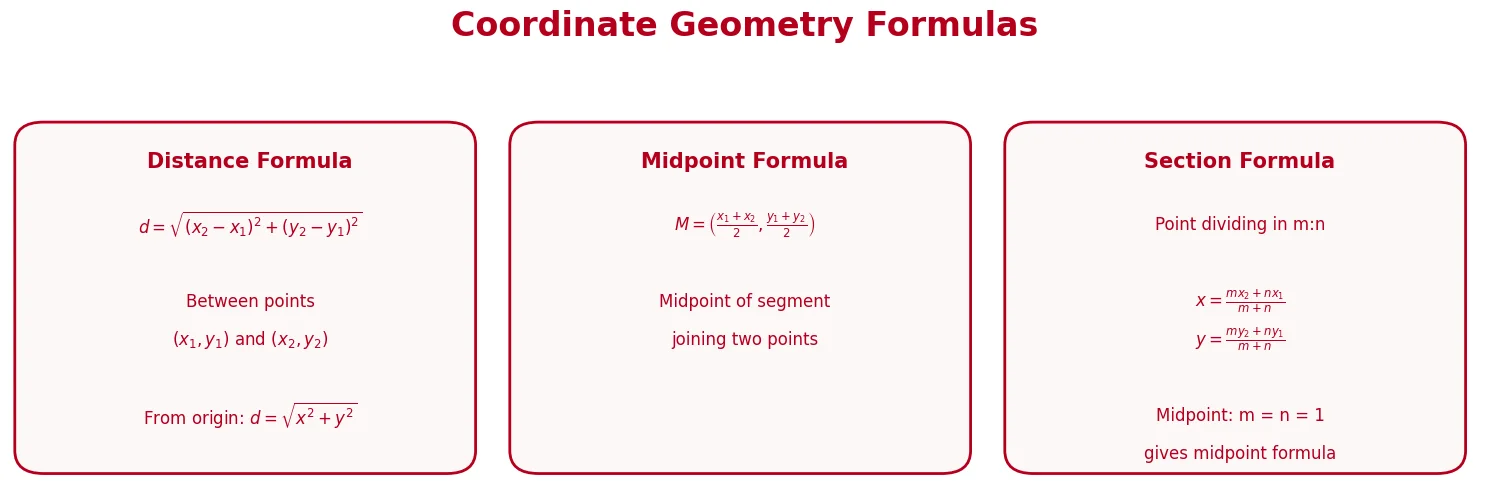
The distance between two points (x₁, y₁) and (x₂, y₂) is:
d = √[(x₂ − x₁)² + (y₂ − y₁)²]
This formula comes directly from the Pythagorean theorem applied to the horizontal and vertical distances between the two points.

Case Study 1: Locating Places on a City Map
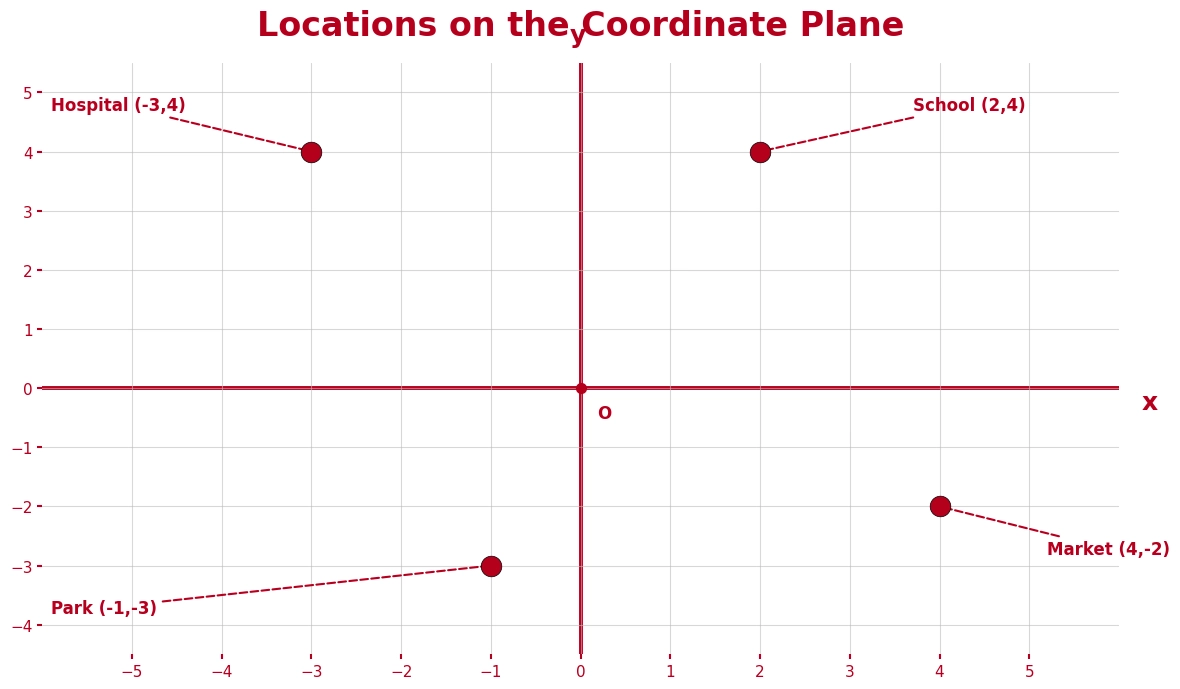
ScenarioA city planner is mapping key locations in a town on a coordinate grid, where each unit represents 1 kilometre. The Town Hall is at the origin (0, 0). A School is located at (2, 3), a Hospital is at (−3, 4), a Market is at (4, −2), and a Park is at (−1, −3). The planner needs to find distances between these locations for planning a transport route.
Questions:
(i) In which quadrant does the Hospital lie?
(ii) Find the distance between the School and the Hospital.
(iii) Find the distance of the Market from the Town Hall (origin).
(iv) What are the coordinates of the midpoint between the School and the Park?
(v) A new Bus Stop is to be placed exactly halfway between the Hospital and the Market. Find its coordinates.
Solution:
(i) Hospital is at (−3, 4): x is negative and y is positive, Quadrant II.
(ii) School (2, 3), Hospital (−3, 4). d = √[(−3 − 2)² + (4 − 3)²] = √[(−5)² + (1)²] = √[25 + 1] = √26 ≈ 5.1 km.
(iii) Market (4, −2), origin (0, 0). d = √[(4 − 0)² + (−2 − 0)²] = √[16 + 4] = √20 = 2√5 ≈ 4.47 km.
(iv) School (2, 3), Park (−1, −3). Midpoint = ((2 + (−1))/2, (3 + (−3))/2) = (1/2, 0) = (0.5, 0). This point lies on the x-axis, halfway between the two locations.
(v) Hospital (−3, 4), Market (4, −2). Midpoint = ((−3 + 4)/2, (4 + (−2))/2) = (1/2, 1) = (0.5, 1). The Bus Stop coordinates are (0.5, 1) slightly east of the town centre and slightly north.
Know more about related topics:
Case Study 2: School Campus Navigation
A school campus is represented on a coordinate grid where each unit equals 10 metres. The Main Gate is at A(0, 0), the Library is at B(6, 8), the Science Lab is at C(−4, 3), the Sports Ground is at D(5, −3), and the Canteen is at E(−2, −5). Students need to plan the most efficient paths between these buildings.
Questions:
(i) Find the distance from the Main Gate to the Library.
(ii) Which is closer to the Main Gate the Science Lab or the Sports Ground? Show calculations.
(iii) Find the midpoint of the path from the Science Lab to the Sports Ground.
(iv) A notice board is to be placed halfway between the Library and the Canteen. Find its location.
(v) Find the distance between the Library and the Sports Ground in metres.
Solution:
(i) Gate A(0,0), Library B(6,8). d = √[(6−0)² + (8−0)²] = √[36 + 64] = √100 = 10 units = 100 metres.
(ii) Gate A(0,0), Science Lab C(−4,3). d = √[(−4)² + (3)²] = √[16 + 9] = √25 = 5 units = 50 m. Gate to Sports Ground D(5,−3): d = √[(5)² + (−3)²] = √[25 + 9] = √34 ≈ 5.83 units ≈ 58.3 m. The Science Lab (50 m) is closer to the Main Gate.
(iii) Science Lab C(−4, 3), Sports Ground D(5, −3). Midpoint = ((−4+5)/2, (3+(−3))/2) = (1/2, 0) = (0.5, 0) the midpoint lies on the x-axis.
(iv) Library B(6, 8), Canteen E(−2, −5). Midpoint = ((6+(−2))/2, (8+(−5))/2) = (4/2, 3/2) = (2, 1.5).
(v) Library B(6, 8), Sports Ground D(5, −3). d = √[(5−6)² + (−3−8)²] = √[(−1)² + (−11)²] = √[1+121] = √122 ≈ 11.05 units = 110.5 metres.
Case Study 3: Planning a Sports Ground
A rectangular sports ground is being designed on a coordinate grid where each unit represents 5 metres. The four corners of the ground are marked as P(1, 1), Q(7, 1), R(7, 5), and S(1, 5). The sports committee wants to verify the shape is truly a rectangle, find the diagonal length, and plan a flag post at the centre.
Questions:
(i) Find the length PQ (width of the ground).
(ii) Find the length QR (height of the ground).
(iii) Find the diagonal PR. Does the relationship PQ² + QR² = PR² hold?
(iv) Find the centre of the ground (where the diagonals intersect).
(iv) What is the actual area of the sports ground in square metres?
Solution:
(i) P(1,1), Q(7,1). Both have y = 1, so this is a horizontal segment. PQ = |7 − 1| = 6 units = 30 metres.
(ii) Q(7,1), R(7,5). Both have x = 7, so this is a vertical segment. QR = |5 − 1| = 4 units = 20 metres.
(iii) P(1,1), R(7,5). PR = √[(7−1)² + (5−1)²] = √[36+16] = √52 = 2√13 ≈ 7.21 units = 36.06 m. Check: PQ² + QR² = 36 + 16 = 52 = PR². The Pythagorean theorem holds, confirming the right angle at Q.
(iv) Centre = midpoint of diagonal PR = ((1+7)/2, (1+5)/2) = (4, 3). Also verify with midpoint of SQ: ((1+7)/2, (5+1)/2) = (4, 3).
(v) Area in grid units = 6 × 4 = 24 square units. Each unit = 5 m, so each square unit = 25 m². Actual area = 24 × 25 = 600 square metres.
Case Study 4: GPS Tracking and Coordinates
A delivery company tracks three delivery vehicles on a coordinate map where each unit represents 2 km. Vehicle A is at coordinates (3, 4), Vehicle B is at (−2, 1), and Vehicle C is at (5, −3). The company's depot is at the origin (0, 0). A new parcel needs to be delivered from Vehicle A's location to a drop point located at the midpoint between B and C.
Questions:
(i) Find the distance of each vehicle from the depot.
(ii). Which vehicle is farthest from the depot?
(iii) Find the coordinates of the drop point (midpoint of B and C).
(iv) Find the distance Vehicle A must travel to reach the drop point.
(v) If a fuel station is located at the point that divides the segment from A to the depot in the ratio 1:2, find its coordinates.
Solution:
(i) Vehicle A(3,4): d = √[9+16] = √25 = 5 units = 10 km. Vehicle B(−2,1): d = √[4+1] = √5 ≈ 2.24 units ≈ 4.47 km. Vehicle C(5,−3): d = √[25+9] = √34 ≈ 5.83 units ≈ 11.66 km.
(ii) Vehicle C is farthest at approximately 11.66 km from the depot.
(iii) Midpoint of B(−2,1) and C(5,−3): = ((−2+5)/2, (1+(−3))/2) = (3/2, −1) = (1.5, −1).
(iv) Vehicle A(3,4), Drop Point(1.5,−1): d = √[(1.5−3)² + (−1−4)²] = √[(−1.5)² + (−5)²] = √[2.25+25] = √27.25 ≈ 5.22 units = 10.44 km.
(v) A(3,4), Depot(0,0), ratio 1:2 (m=1, n=2). x = (1×0 + 2×3)/(1+2) = 6/3 = 2. y = (1×0 + 2×4)/(1+2) = 8/3 ≈ 2.67. Fuel station is at (2, 8/3).
Important Topics from Coordinate Geometry for Case Studies
- Coordinate Plane: Understanding the four quadrants, the axes, and the origin is the starting point for every case study. Knowing which quadrant a point lies in (from its coordinate signs) is a regularly tested one-mark question.
- Ordered Pairs: Reading and writing coordinates correctly as (x, y) pairs and extracting them accurately from scenario descriptions is a core skill. A misread coordinate cascades into errors in every subsequent calculation.
- Distance Formula: d = √[(x₂−x₁)² + (y₂−y₁)²] appears in nearly every case study. The distance from the origin simplifies to d = √(x²+y²), which is useful when one point is the depot, station, or town centre at (0,0).
- Midpoint and Section Formulas: Midpoint = ((x₁+x₂)/2, (y₁+y₂)/2) is used whenever a case study asks for a halfway point, a centre, or a rest stop. The section formula handles any ratio m:n and reduces to the midpoint when m = n = 1.
Download Free PDF - Case Study: Class 10 Chapter 7 - Coordinate Geometry
Download PDF - Case Study Class 10 Maths Chapter 7 Coordinate Geometry
Frequently Asked Questions on Case Study Class 10 Maths Chapter 7 Coordinate Geometry
1. What are case study questions in Coordinate Geometry?
Case study questions are application based questions that use real life situations to test students understanding of coordinate geometry concepts and their problem solving skills.
2. What topics are important for Coordinate Geometry case study questions?
Important topics include:
- Distance Formula
- Section Formula
- Midpoint Formula
- Coordinate Plane
- Plotting Points
- Real-life applications of coordinates
3. What is the distance formula used in Coordinate Geometry?
The distance formula is used to find the distance between two points on a coordinate plane.
Distance d = √(x₂ − x₁)² + (y₂ − y₁)²
4. Are Coordinate Geometry case study questions based on real-life situations?
Yes, they often involve maps, navigation systems, city planning, land measurements, GPS tracking, and locating objects on a grid.
5. How do you solve Coordinate Geometry case study questions?
Read the case carefully, identify the coordinates given, select the appropriate formula, and perform calculations step by step.
6. Why is Coordinate Geometry important in real life?
Coordinate Geometry is used in computer graphics, architecture, engineering, navigation, surveying, and geographic information systems (GIS).
Numbers make sense when they're taught right. To see how Orchids The International School turns Maths from intimidating to intuitive, reach out to our admissions team.


Admissions Open for 2026-27
What type of concept pages would you prefer?
CBSE Schools In Popular Cities
- CBSE Schools in Bangalore
- CBSE Schools in Mumbai
- CBSE Schools in Pune
- CBSE Schools in Hyderabad
- CBSE Schools in Chennai
- CBSE Schools in Gurgaon
- CBSE Schools in Kolkata
- CBSE Schools in Indore
- CBSE Schools in Sonipat
- CBSE Schools in Delhi
- CBSE Schools in Rohtak
- CBSE Schools in Bhopal
- CBSE Schools in Aurangabad
- CBSE Schools in Jabalpur
- CBSE Schools in Jaipur
- CBSE Schools in Jodhpur
- CBSE Schools in Nagpur
- CBSE Schools in Ahmednagar
- CBSE School In Tumkur











Orchids The International School is one of India's leading chains of CBSE and ICSE schools, with 110+ schools across the country.