

Case Study Questions on Triangles Chapter 5 for Class 10 with Answers
This set of case-study questions for Chapter 6: Triangles Class 10 follows CBSE and NCERT guidelines and presents short, exam-style scenarios designed to build geometric reasoning, proof skills, and stepwise problem solving. Problems cover triangle congruence and similarity, properties of medians, altitudes and perpendicular bisectors, criteria and applications of similarity in ratio problems, exercises using the Basic Proportionality Theorem (Thales), and proofs that connect angle and side relations. Each question includes a clear, step-by-step solution and final answer keys. A downloadable PDF accompanies the pack with practice sets for quick revision, classroom worksheets for guided practice focused on improving speed and accuracy.
Solved Case Study Questions and Answers on Triangles
CBSE's case-based questions usually give you a short passage describing a real situation, sometimes with a small figure, followed by 4 - 5 questions of increasing difficulty, a couple of MCQs to check basic understanding, a short-answer question that needs a calculation, and a longer question that asks you to interpret or justify your answer.

Case Study 1:Vijay, Ajay and the Tower: Shadow Proportions
Vijay is trying to find the average height of a tower near his house. He uses the properties of similar triangles. Vijay's house is 20 m tall and casts a shadow 10 m long on the ground at a certain time of day. At that same moment, the tower casts a shadow 50 m long, and his neighbour Ajay's house casts a shadow 20 m long on the ground.
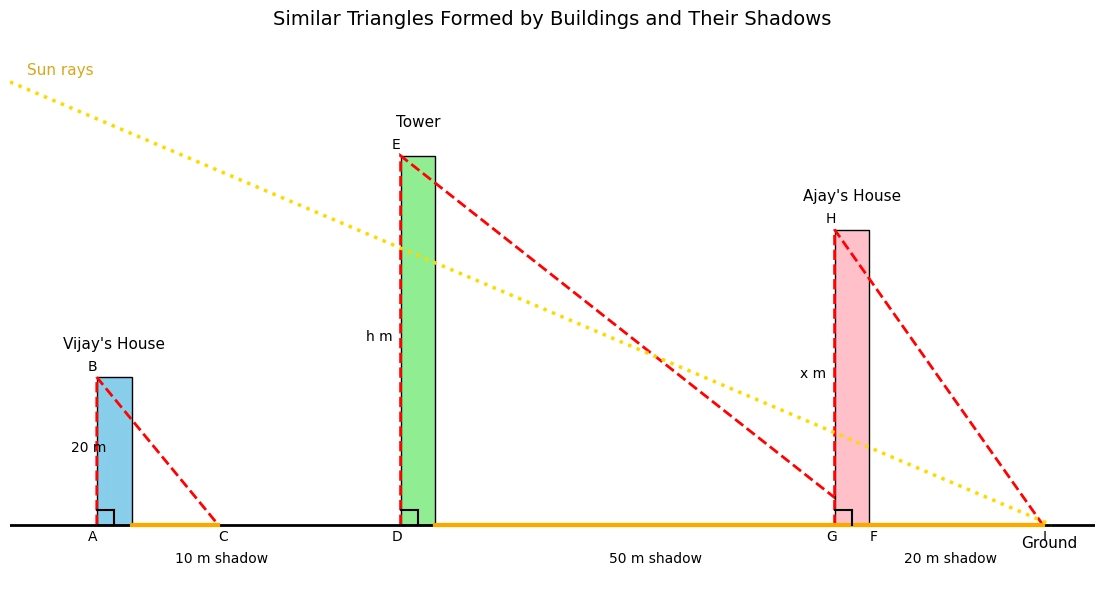
Q1 What is the height of the tower?
(a) 20 m
(b) 50 m
(c) 100 m
(d) 200 m
Q2 What is the height of Ajay's house?
(a) 30 m
(b) 40 m
(c) 50 m
(d) 20 m
Q3 When Vijay's house casts a shadow of 12 m, what will be the length of the tower's shadow?
(a) 75 m
(b) 50 m
(c) 45 m
(d) 60 m
Q4 When the tower casts a shadow of 40 m, what will be the length of the shadow of Ajay's house?
(a) 16 m
(b) 32 m
(c) 20 m
(d) 8 m
Solution:
Q1: Height of tower / Shadow of tower = Height of Vijay's house / Shadow of Vijay's house
⇒ Height of tower / 50 = 20 / 10
⇒ Height of tower = 2 × 50 = 100 m
Q2: Height of Ajay's house / 20 = 20 / 10
⇒ Height of Ajay's house = 2 × 20 = 40 m
Q3 : The new ratio = Height of Vijay's house / new shadow = 20/12 = 5/3
Tower's shadow × (5/3) = 100 ⇒ Tower's shadow = 100 × 3/5 = 60 m
Q4: Shadow of Ajay's house / Shadow of tower = Height of Ajay's house / Height of tower
= 40/100 = 2/5
Ajay's shadow = (40/100) × 40 = 16 m
Know more about related topics:
Case Study 2: The Lamp-Post and the Walking Girl
A girl of height 90 cm walks away from the base of a lamp-post at a speed of 1.2 m/s. The lamp is 3.6 m above the ground. The girl walks for 4 seconds and then stops.
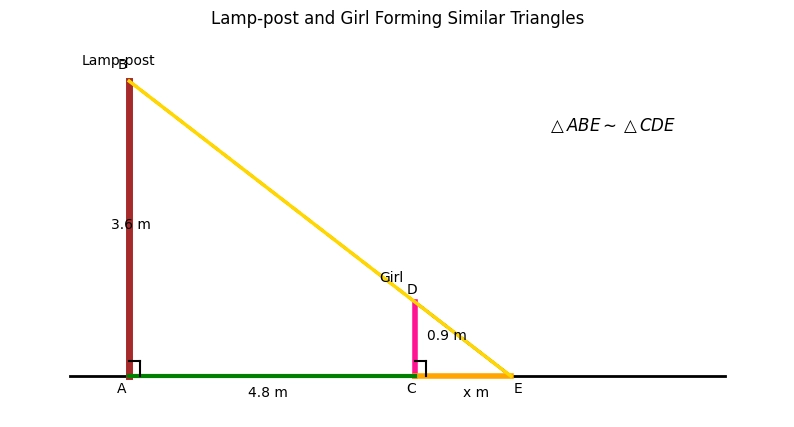
Q1 What is the girl's distance from the base of the lamp-post after 4 seconds?
(a) 1.2 m
(b) 4.8 m
(c) 6.0 m
(d) 3.6 m
Q2 What is the length of her shadow after 4 seconds?
(a) 1.0 m
(b) 1.2 m
(c) 1.6 m
(d) 2.4 m
Q3 Find the ratio AC : CE (i.e., total length from lamp base to girl's head tip : shadow)
(a) 4 : 1
(b) 2 : 1
(c) 3 : 1
(d) 4 : 3
Solution:
Q1 : Distance = Speed × Time = 1.2 m/s × 4 s = 4.8 m
Q2: △ABE ~ △CDE (AA), so BE/DE = AB/CD
(4.8 + x)/x = 3.6/0.9 = 4
4.8 + x = 4x ⇒ 3x = 4.8 ⇒ x = 1.6 m
Q3: AE = AB + BD + DE = 3.6 m from lamp to end isn't needed; we use:
AE/CE = BE/DE = (4.8 + 1.6)/1.6 = 6.4/1.6 = 4
So AE = 4 CE, meaning AC = AE − CE = 3CE
Therefore AC : CE = 3 : 1
Case Study 3: Two Triangular Land Plots
Two triangular land plots, Plot X and Plot Y are geometrically similar. The sides of Plot X measure 30 m, 40 m, and 50 m. The corresponding sides of Plot Y measure 15 m, 20 m, and 25 m. The area of Plot Y is 150 m².
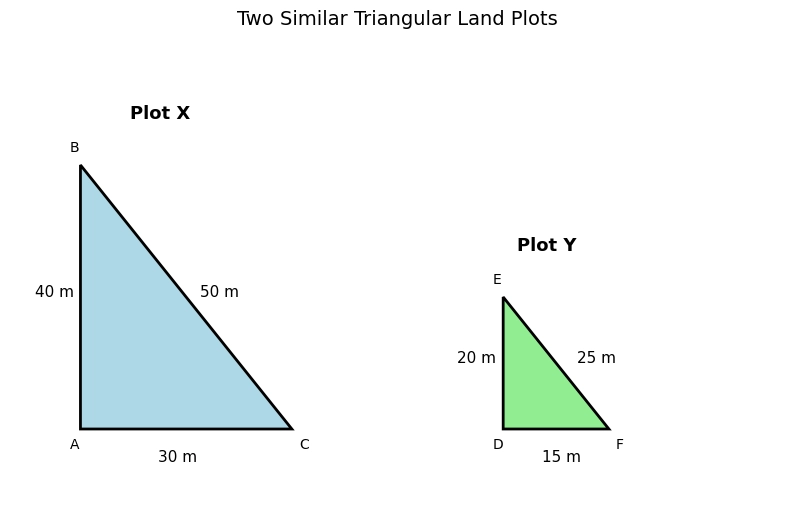
Q1 What is the ratio of corresponding sides (Plot X : Plot Y)?
(a) 1 : 2
(b) 2 : 1
(c) 3 : 1
(d) 4 : 1
Q2 What is the ratio of the areas of Plot X to Plot Y?
(a) 2 : 1
(b) 3 : 1
(c) 4 : 1
(d) 8 : 1
Q3 Is Plot X a right-angled triangle? Which theorem applies?
(a) Yes, Converse of Pythagoras Theorem
(b) No, it is not right-angled
(c) Yes, Pythagoras Theorem
(d) Cannot be determined
Q4 What is the area of Plot X?
(a) 300 m²
(b) 450 m²
(c) 600 m²
(d) 750 m²
Solution:
Q1: 30/15 = 40/20 = 50/25 = 2 : 1
Q2: Area ratio = (Side ratio)² = (2/1)² = 4 : 1
Q3: Check: 30² + 40² = 900 + 1600 = 2500 = 50²
By the Converse of Pythagoras Theorem, Plot X is right-angled at the vertex opposite the 50 m side.
Q4: Area(X)/Area(Y) = 4/1
Area(X) = 4 × 150 = 600 m²
Verify: Area of right-triangle with legs 30 m, 40 m = ½ × 30 × 40 = 600 m²
Theorem summary table
Download Free PDF - Case Study: Class 10 Chapter 6 Triangles
Frequently Asked Questions of Chapter 6: Triangles Case Study for Class 10
1. Are all sub-questions in a case study MCQ-based?
In the CBSE board exam pattern, Section E case study sub-questions are usually MCQs of 1 mark each (four per question). However, some recent papers and official sample papers have included 2-mark descriptive sub-questions within the case study format.
2. Is it necessary to write "By BPT" or "By AA criterion" in my answer?
Yes. CBSE marking schemes award marks for stating the theorem or criterion before using it. Writing 'By BPT' or 'Since △ABC ~ △DEF by AA criterion' is not optional.
3. What are case study questions in Triangles Class 10?
Case study questions are application-based problems that present a real-life scenario and require students to apply concepts such as similarity of triangles and proportionality to answer multiple questions.
4. What is the Basic Proportionality Theorem (BPT)?
The Basic Proportionality Theorem states that if a line is drawn parallel to one side of a triangle to intersect the other two sides, then it divides those sides in the same ratio.
Numbers make sense when they're taught right. To see how Orchids The International School turns Maths from intimidating to intuitive, reach out to our admissions team.


Admissions Open for 2026-27
What type of concept pages would you prefer?
CBSE Schools In Popular Cities
- CBSE Schools in Bangalore
- CBSE Schools in Mumbai
- CBSE Schools in Pune
- CBSE Schools in Hyderabad
- CBSE Schools in Chennai
- CBSE Schools in Gurgaon
- CBSE Schools in Kolkata
- CBSE Schools in Indore
- CBSE Schools in Sonipat
- CBSE Schools in Delhi
- CBSE Schools in Rohtak
- CBSE Schools in Bhopal
- CBSE Schools in Aurangabad
- CBSE Schools in Jabalpur
- CBSE Schools in Jaipur
- CBSE Schools in Jodhpur
- CBSE Schools in Nagpur
- CBSE Schools in Ahmednagar
- CBSE School In Tumkur











Orchids The International School is one of India's leading chains of CBSE and ICSE schools, with 110+ schools across the country.