

HOTS Questions on Chapter 10 Class 10 Circles
HOTS Questions on Class 10 Maths Chapter 10 Circles help students understand tangents, chords, and angle properties in a simple way. They improve knowledge of theorems, circle geometry, and problem solving based on real life figures. This chapter builds a strong base for solving geometry problems and improving math skills. A downloadable PDF is also available for easy revision and practice.
HOTS Questions Based on Tangents to a Circle
Question 1: A tangent PQ at a point P of a circle of radius 5 cm meets a line through the center O at a point Q so that OQ = 13 cm. Find the length of PQ. Then find the angle that OQ makes with the tangent.
Answer:
Given:
Radius OP = 5 cm
OQ = 13 cm
∠OPQ = 90° (radius ⊥ tangent)
Using Pythagoras theorem in △OPQ:
OQ² = OP² + PQ²
13² = 5² + PQ²
169 = 25 + PQ²
PQ² = 144
PQ = 12 cm
For angle OQP:
tan(∠OQP) = OP/PQ = 5/12
∠OQP = tan⁻¹(5/12) ≈ 22.6°
Answer: PQ = 12 cm, angle ≈ 22.6°
Question 2: From a point Q, the length of the tangent to a circle is 24 cm and the distance of Q from the center is 25 cm. Find the radius of the circle. If another point R is located such that QR = 7 cm and R lies on the tangent line extended, what is the distance from R to the center?
Answer:
Part 1:
QT = 24 cm (tangent length)
OQ = 25 cm
∠OTQ = 90°
OT² = OQ² - QT²
OT² = 625 - 576 = 49
OT = 7 cm (radius)
Part 2:
R lies on tangent line extended, QR = 7 cm
OR² = OT² + TR²
T is point of tangency, TR = QT + QR? No:
If R is beyond Q on the tangent line:
QR = 7 cm, QT = 24 cm
RT = QT + QR = 31 cm (if R is beyond Q)
OR² = OT² + TR²
OR² = 49 + 961 = 1010
OR = √1010 ≈ 31.78 cm
Answer: Radius = 7 cm, OR ≈ 31.78 cm
Question 3: Prove that the tangents drawn at the ends of a diameter of a circle are parallel to each other.
Answer:
Given:
Circle with center O, diameter AB
PA is tangent at A
QB is tangent at B
To prove: PA || QB
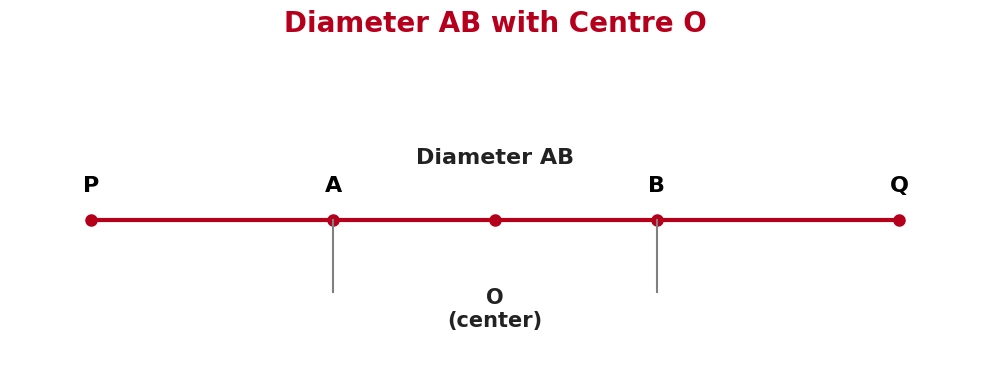
Since OA is radius and PA is tangent at A:
OA ⊥ PA → ∠OAP = 90°
Since OB is radius and QB is tangent at B:
OB ⊥ QB → ∠OBQ = 90°
Now ∠OAP + ∠OBQ = 90° + 90° = 180°
These are co-interior angles formed by
transversal AB with lines PA and QB.
Since co-interior angles sum = 180°:
PA || QB Hence Proved.
Question 4: In the figure, XY and X'Y' are two parallel tangents to a circle with center O and AB is another tangent with point of contact C between XY and X'Y'. Prove that ∠AOB = 90°.
Answer:
Given:
XY tangent at P (top)
X'Y' tangent at Q (bottom)
AB tangent at C
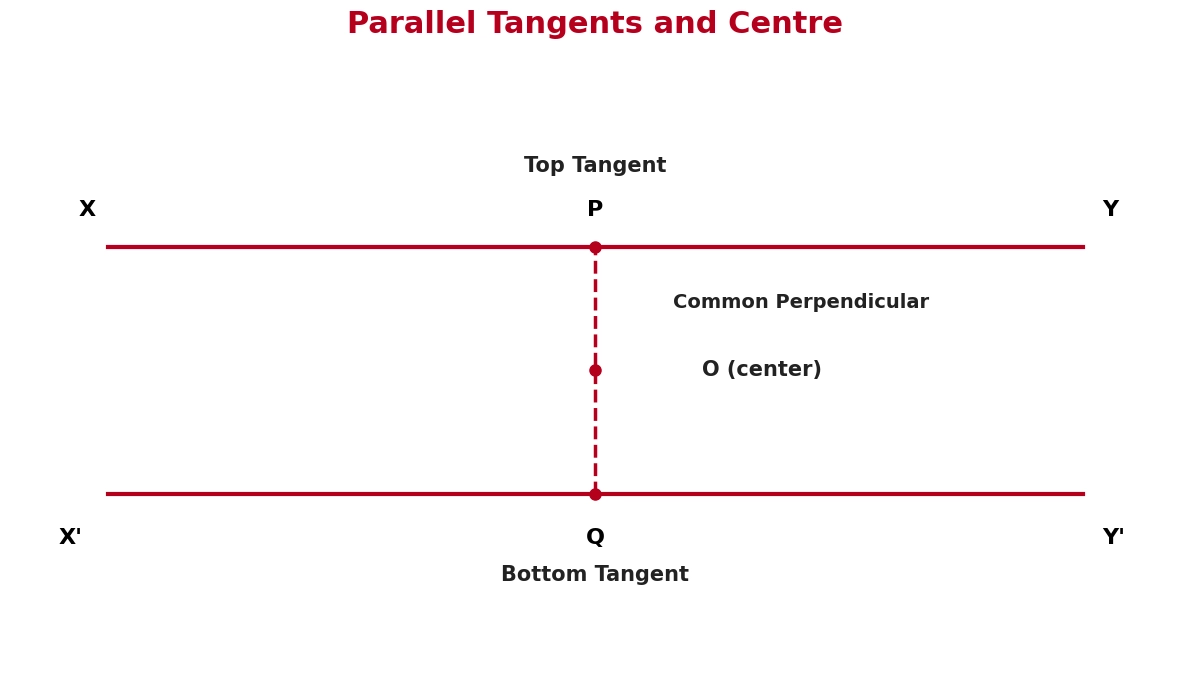
OA bisects ∠POC and OB bisects ∠QOC.
In △OPA and △OCA:
OP = OC (radii)
AP = AC (tangents from A)
OA = OA (common)
By SSS: △OPA ≅ △OCA
So: ∠POA = ∠COA
OA bisects ∠POC
Similarly OB bisects ∠QOC.
∠POQ = 180° (P and Q are ends of diameter)
∠POC + ∠QOC = 180°
2∠AOC + 2∠BOC = 180°
∠AOC + ∠BOC = 90°
∠AOB = 90° Hence Proved

HOTS Questions Based on Tangent-Radius Theorem
Question 5: A student says "If the radius of a circle is doubled, the length of the tangent from the same external point also doubles." Is this correct? Justify with calculation.
Answer:
This statement is INCORRECT.
Let external point P be at distance d from center O.
Original: radius = r
Tangent length = √(d² - r²)
If radius is doubled: radius = 2r
New tangent = √(d² - 4r²)
Example: d = 10, r = 6
Original tangent = √(100 - 36) = √64 = 8
If radius doubled to 12:
New tangent = √(100 - 144) = √(-44)
This is not even real! The point would be
INSIDE the circle no tangent possible.
Even for valid case: d = 13, r = 5
Original tangent = √(169 - 25) = √144 = 12
Radius doubled to 10:
New tangent = √(169 - 100) = √69 ≈ 8.3
8.3 ≠ 24 (not doubled!)
The student is WRONG.
Question 6: Two concentric circles have radii 5 cm and 13 cm. Find the length of the chord of the larger circle that is tangent to the smaller circle.
Answer :
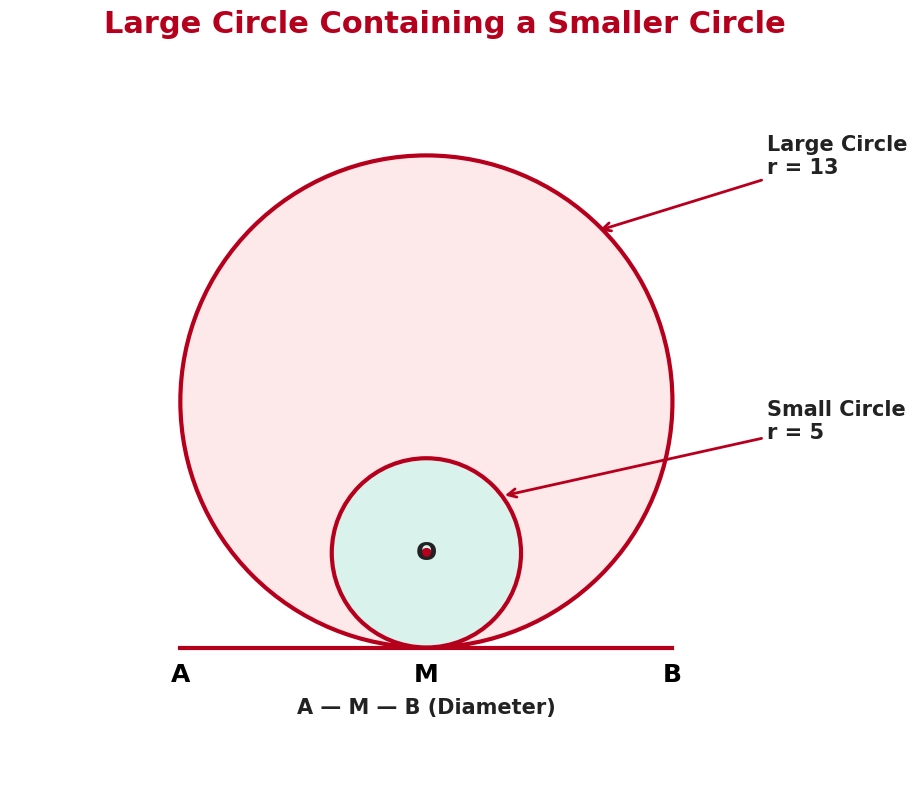
(chord AB is tangent to small circle at M)
Since AB is tangent to small circle at M:
OM ⊥ AB → OM = 5 cm (radius of small circle)
OA = 13 cm (radius of large circle)
In right △OMA:
AM² = OA² - OM²
AM² = 169 - 25 = 144
AM = 12 cm
Since OM ⊥ AB, M is midpoint of AB:
AB = 2 × AM = 2 × 12 = 24 cm
Answer: Length of chord = 24 cm
Question 7: Prove that the angle between the two tangents drawn from an external point to a circle is supplementary to the angle subtended by the line segment joining the points of contact at the center.
Answer:
Given:
PA and PB are tangents from external point P
A and B are points of contact
O is center
To prove: ∠APB + ∠AOB = 180°
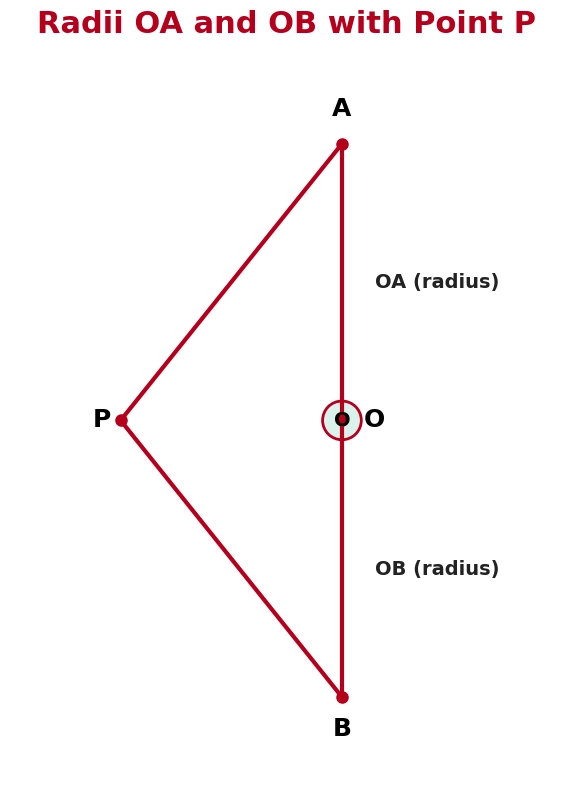
In quadrilateral OAPB:
∠OAP = 90° (radius ⊥ tangent at A)
∠OBP = 90° (radius ⊥ tangent at B)
Sum of angles in quadrilateral = 360°
∠AOB + ∠OAP + ∠APB + ∠OBP = 360°
∠AOB + 90° + ∠APB + 90° = 360°
∠AOB + ∠APB = 360° - 180°
∠AOB + ∠APB = 180° Hence Proved.
HOTS Questions Based on Equal Tangents
Question 8: In the figure, a triangle ABC is circumscribed about a circle of radius r. If AB = 10 cm, BC = 8 cm, CA = 7 cm, find the length of the tangents from each vertex.
Answer:
Let tangent from A = x
Let tangent from B = y
Let tangent from C = z
Since tangents from same external point are equal:
From A: AF = AE = x
From B: BF = BD = y
From C: CD = CE = z
AB = x + y = 10 ...(1)
BC = y + z = 8 ...(2)
CA = z + x = 7 ...(3)
Adding all three equations:
2(x + y + z) = 25
x + y + z = 12.5 ...(4)
From (4) and (2): x = 12.5 - 8 = 4.5
From (4) and (3): y = 12.5 - 7 = 5.5
From (4) and (1): z = 12.5 - 10 = 2.5
Tangent from A = 4.5 cm
Tangent from B = 5.5 cm
Tangent from C = 2.5 cm
Question 9: From an external point P, two tangents PA and PB are drawn to a circle with center O. If ∠APB = 70°, find ∠OAB.
Answer:
Given: ∠APB = 70°
Find: ∠OAB
Step 1: In quadrilateral OAPB:
∠OAP = ∠OBP = 90° (radius ⊥ tangent)
∠AOB + ∠APB = 180° (proved earlier)
∠AOB = 180° - 70° = 110°
Step 2: In triangle OAB:
OA = OB = r (radii)
So △OAB is isosceles
∠OAB = ∠OBA
Step 3:
∠OAB + ∠OBA + ∠AOB = 180°
2∠OAB + 110° = 180°
2∠OAB = 70°
∠OAB = 35°
Answer: ∠OAB = 35°
Question 10: In a right triangle ABC, right-angled at B, a circle is inscribed. If AB = 6 cm, BC = 8 cm, find the radius of the inscribed circle.
Answer :
Step 1: Find hypotenuse AC
AC² = AB² + BC² = 36 + 64 = 100
AC = 10 cm
Step 2: Let radius = r
Let tangent from A = x
Let tangent from C = y
Let tangent from B = tangents = (6 − r) and (8 − r)
But from B: tangents = r (since ∠B = 90°)
So 6 − r + 8 − r = 10
14 − 2r = 10
2r = 4
r = 2 cm
Alternative formula:
r = (AB + BC − AC)/2
r = (6 + 8 − 10)/2
r = 4/2 = 2 cm
Answer: Radius = 2 cm
HOTS Questions Based on Circle Geometry
Question 11: Two circles of radii 5 cm and 3 cm touch externally. Find the length of the direct common tangent.
Answer:
For externally touching circles:
Distance between centers = r₁ + r₂ = 5 + 3 = 8 cm
Length of direct common tangent:
= √(d² - (r₁ - r₂)²)
= √(64 - (5-3)²)
= √(64 - 4)
= √60
= 2√15 cm
≈ 7.75 cm
Answer: Length = 2√15 cm ≈ 7.75 cm
Question 12: If PA and PB are tangents from point P to a circle with center O, and M is a point on arc AB (minor arc), find ∠AMB in terms of ∠APB.
Answer:
Given: ∠APB = θ
From earlier theorem:
∠AOB = 180° - θ
∠AMB is angle in the major arc
(M is on minor arc, so ∠AMB is in major segment)
By the inscribed angle theorem:
Angle in major segment = 180° - (angle in minor segment)
Reflex ∠AOB = 360° - (180° - θ) = 180° + θ
∠AMB = (1/2) × reflex ∠AOB
= (1/2)(180° + θ)
= 90° + θ/2
= 90° + ∠APB/2
Answer: ∠AMB = 90° + (∠APB/2)
Question 13: PQ is a chord of a circle and PT is tangent at P. If ∠TPQ = 60°, find ∠PRQ where R is a point on the major arc.
Answer:
By tangent-chord angle theorem (alternate segment):
∠TPQ = angle in alternate segment
∠PRQ = ∠TPQ = 60°
(The angle between tangent and chord equals
the angle subtended by chord in alternate segment)
Answer: ∠PRQ = 60°
Circle HOTS Formulas
- Tangent length from external point P: PT = √(OP² - r²)
- Equal tangents: PA = PB
- Tangent radius angle: ∠OTP = 90°
- Angle sum in quadrilateral OAPB: ∠AOB + ∠APB = 180°
- Tangent-secant: PA² = PB × PC
Inscribed circle radius (right triangle): r = (a + b - c)/2
where c is hypotenuse
For circumscribed quadrilateral: AB + CD = BC + DA
For tangent chord angle = angle in alternate segment
Download Free PDF: HOTS Questions - Class 10 Chapter 10 Circles
Download PDF - HOTS Questions on Class 10 Maths Chapter 10 Circles
Read More:
Circle Notes Page
Circle Important Questions Page
Circle MCQs Page
Circle Worksheets Page
Circle NCERT Solutions Page
Circle Assertion Reason Page
Frequently Asked Questions on HOTS Questions on Chapter 10 Class 10 Circles
1. What are the most frequently asked Circle HOTS problems in board exams?
Common problems include:
- Finding tangent lengths
- Proving equal tangents
- Radius and tangent theorem questions
- Angle-based circle proofs
- Tangent and Pythagoras theorem applications
- Geometry construction and reasoning problems
2. How do you prove that a given line is a tangent to a circle?
Show that the line is perpendicular to the radius at the point where it touches the circle. If the angle formed is 90°, the line is a tangent.
3. How do you solve HOTS questions involving tangent lengths and radii?
Draw the figure carefully, mark equal radii, identify right triangles, and use circle theorems along with the Pythagoras theorem.
4. How do you find the perimeter of a figure formed by tangents and arcs?
Calculate the lengths of all tangents and arcs separately, then add them to obtain the total perimeter.
5. How do you prove that two tangents drawn from an external point are equal?
Join the center of the circle to the points of contact. Using congruent triangles and the fact that radii are equal, prove that the two tangent lengths are equal.
Numbers make sense when they're taught right. To see how Orchids The International School turns Maths from intimidating to intuitive, reach out to our admissions team.


Admissions Open for 2026-27
What type of concept pages would you prefer?
CBSE Schools In Popular Cities
- CBSE Schools in Bangalore
- CBSE Schools in Mumbai
- CBSE Schools in Pune
- CBSE Schools in Hyderabad
- CBSE Schools in Chennai
- CBSE Schools in Gurgaon
- CBSE Schools in Kolkata
- CBSE Schools in Indore
- CBSE Schools in Sonipat
- CBSE Schools in Delhi
- CBSE Schools in Rohtak
- CBSE Schools in Bhopal
- CBSE Schools in Aurangabad
- CBSE Schools in Jabalpur
- CBSE Schools in Jaipur
- CBSE Schools in Jodhpur
- CBSE Schools in Nagpur
- CBSE Schools in Ahmednagar
- CBSE School In Tumkur











Orchids The International School is one of India's leading chains of CBSE and ICSE schools, with 110+ schools across the country.