

HOTS Questions on Chapter 11 Class 10 Areas Related To Circles
HOTS Questions on Class 10 Maths Chapter 11 Areas Related to Circles help students understand sectors, segments, arcs, and shaded regions in a simple way. They improve knowledge of circle formulas, area calculations, and real life application based problems. This chapter builds a strong base for solving geometry questions and improving math skills. A downloadable PDF is also available for easy revision and practice.
HOTS Questions Based on Sectors of a Circle
Question 1: A sector of a circle of radius 12 cm has an angle of 120°. Find the area of the sector. Also find the area of the triangle formed by the two radii and the chord. Hence find the area of the minor segment.
Answer:
Given: r = 12 cm, θ = 120°
Step 1: Area of sector
= (θ/360) × πr²
= (120/360) × (22/7) × 144
= (1/3) × (22/7) × 144
= 3168/21
= 150.86 cm²
Step 2: Area of triangle OAB
= (1/2) × r² × sin θ
= (1/2) × 144 × sin 120°
= (1/2) × 144 × (√3/2)
= 36√3
= 36 × 1.732
= 62.35 cm²
Step 3: Area of minor segment
= Area of sector - Area of triangle
= 150.86 - 62.35
= 88.51 cm²
Answer: Sector = 150.86 cm², Triangle = 62.35 cm², Segment = 88.51 cm²
Question 2: Two circular discs of the same radius 14 cm are placed such that each passes through the center of the other. Find the area of the overlapping region.
Answer:
Each circle passes through center of other.
Distance between centers = 14 cm = r
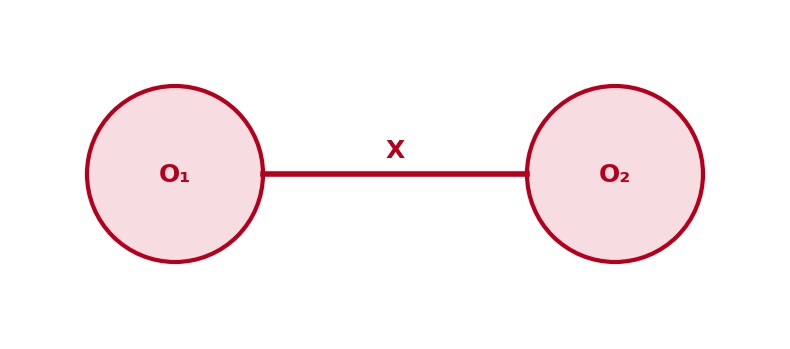
Each sector has θ = 60° (equilateral triangle)
Wait: central angle = 120° for this configuration.
In each circle:
The overlapping region = 2 segments
For each circle, the chord connecting
intersection points subtends 120° at center.
Area of one sector (120°):
= (120/360) × π × 14²
= (1/3) × (22/7) × 196
= (1/3) × 616
= 205.33 cm²
Area of triangle (equilateral, side = 14):
= (√3/4) × 14²
= (√3/4) × 196
= 49√3
= 84.87 cm²
Area of one segment:
= 205.33 - 84.87 = 120.46 cm²
Total overlapping area = 2 segments
= 2 × 120.46
= 240.92 cm²
Answer: Overlapping area = 240.92 cm²
Question 3: A student claims that if you double the radius of a sector while keeping the angle the same, the area becomes double. Is the student correct? Justify.
Answer:
The student is INCORRECT.
Area of sector = (θ/360) × πr²
If r is doubled, new radius = 2r
New area = (θ/360) × π(2r)²
= (θ/360) × π × 4r²
= 4 × [(θ/360) × πr²]
= 4 × original area
So area becomes FOUR TIMES (not double)
when radius is doubled.
This is because area depends on r²
(radius squared), not r.
Example:
r = 7, θ = 90°
Area₁ = (90/360) × (22/7) × 49 = 38.5 cm²
r = 14, θ = 90°
Area₂ = (90/360) × (22/7) × 196 = 154 cm²
154/38.5 = 4 (four times, not two times)

HOTS Questions Based on Segments of a Circle
Question 4: A chord of a circle of radius 10 cm subtends a right angle at the center. Find the areas of: a) The minor segment b) The major segment c) What percentage of the circle does the minor segment occupy?
Answer:
Given: r = 10 cm, θ = 90°
Step 1: Area of minor sector
= (90/360) × π × 100
= (1/4) × (22/7) × 100
= 2200/28
= 78.57 cm²
Step 2: Area of triangle OAB
= (1/2) × r × r (since θ = 90°)
= (1/2) × 10 × 10
= 50 cm²
Step 3: Area of minor segment
= 78.57 - 50
= 28.57 cm²
Step 4: Total circle area
= πr² = (22/7) × 100 = 314.28 cm²
Step 5: Area of major segment
= 314.28 - 28.57
= 285.71 cm²
Step 6: Percentage occupied by minor segment
= (28.57/314.28) × 100
= 9.09%
Answer: Minor = 28.57 cm², Major = 285.71 cm², Percentage = 9.09%
Question 5: In a circle of radius 21 cm, a chord AB makes an angle of 60° at the center O. Find the area of the minor segment cut off by chord AB.
Answer:
Given: r = 21 cm, θ = 60°
Step 1: Area of sector OAB
= (60/360) × (22/7) × 21²
= (1/6) × (22/7) × 441
= (1/6) × 1386
= 231 cm²
Step 2: Area of triangle OAB
Since OA = OB = 21 cm and θ = 60°:
Triangle OAB is equilateral (all sides = 21)
Area = (√3/4) × 21²
= (√3/4) × 441
= 110.25√3
≈ 110.25 × 1.732
≈ 190.95 cm²
Step 3: Area of minor segment
= 231 - 190.95
= 40.05 cm²
Answer: Area of minor segment = 40.05 cm²
Question 6: Compare the area of a minor segment when: Case 1: r = 14 cm, θ = 90° Case 2: r = 7 cm, θ = 180° (semicircle)
Which segment has greater area?
Answer:
Case 1: r = 14, θ = 90°
Sector area = (1/4) × (22/7) × 196 = 154 cm²
Triangle area = (1/2) × 14 × 14 = 98 cm²
Segment = 154 - 98 = 56 cm²
Case 2: r = 7, θ = 180° (semicircle)
Segment = semicircle (no triangle below diameter)
Area = (1/2) × (22/7) × 49
= (1/2) × 154
= 77 cm²
Comparison:
Case 1 segment = 56 cm²
Case 2 segment = 77 cm²
Case 2 has greater area even with
smaller radius because θ = 180°.
Answer: Case 2 (semicircle) has greater area at 77 cm²
HOTS Questions Based on Shaded Regions
Question 7: A square ABCD of side 14 cm has four quadrant circles drawn with each vertex as center and radius 7 cm (half the side). Find the area of the shaded region inside the square but outside all quadrants.
Answer:
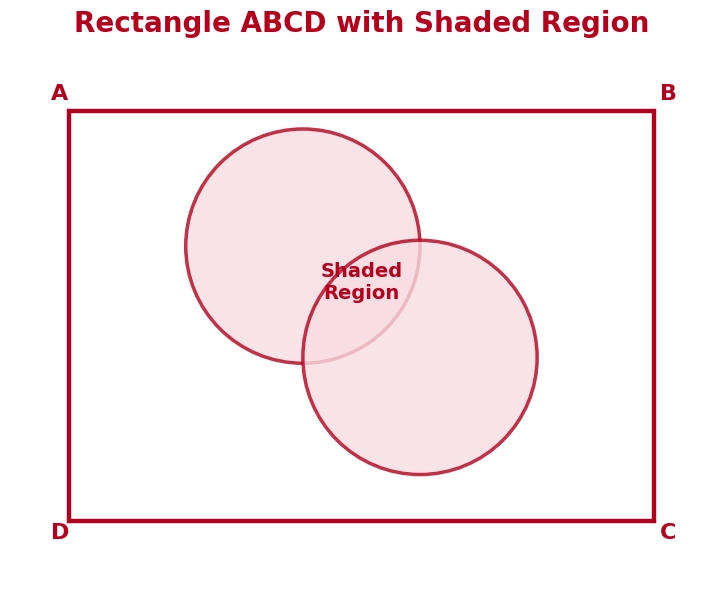
Step 1: Area of square
= 14² = 196 cm²
Step 2: Each quadrant has r = 7, angle = 90°
Area of one quadrant
= (90/360) × (22/7) × 7²
= (1/4) × (22/7) × 49
= (1/4) × 154
= 38.5 cm²
Step 3: Total area of 4 quadrants
= 4 × 38.5 = 154 cm²
Step 4: Shaded area (inside square, outside quadrants)
= 196 - 154
= 42 cm²
Answer: Shaded area = 42 cm²
Question 8: Find the area of the shaded region in a figure where an equilateral triangle of side 28 cm has a circle inscribed in it, and three sectors (each of 60°) are drawn at the three vertices with radius 14 cm.
Answer:
Step 1: Area of equilateral triangle
= (√3/4) × 28²
= (√3/4) × 784
= 196√3
= 196 × 1.732
= 339.48 cm²
Step 2: Each vertex sector has θ = 60°, r = 14
(Interior angle of equilateral triangle = 60°)
Area of one sector = (60/360) × (22/7) × 14²
= (1/6) × (22/7) × 196
= (1/6) × 616
= 102.67 cm²
Step 3: Total area of 3 sectors
= 3 × 102.67 = 308 cm²
Step 4: Shaded area = Triangle - 3 sectors
= 339.48 - 308
= 31.48 cm²
Answer: Shaded area = 31.48 cm²
Question 9: ABCD is a square of side 10 cm. Semicircles are drawn on each side as diameter, all pointing inward. Find the total shaded area inside the square but outside all semicircles.
Answer:
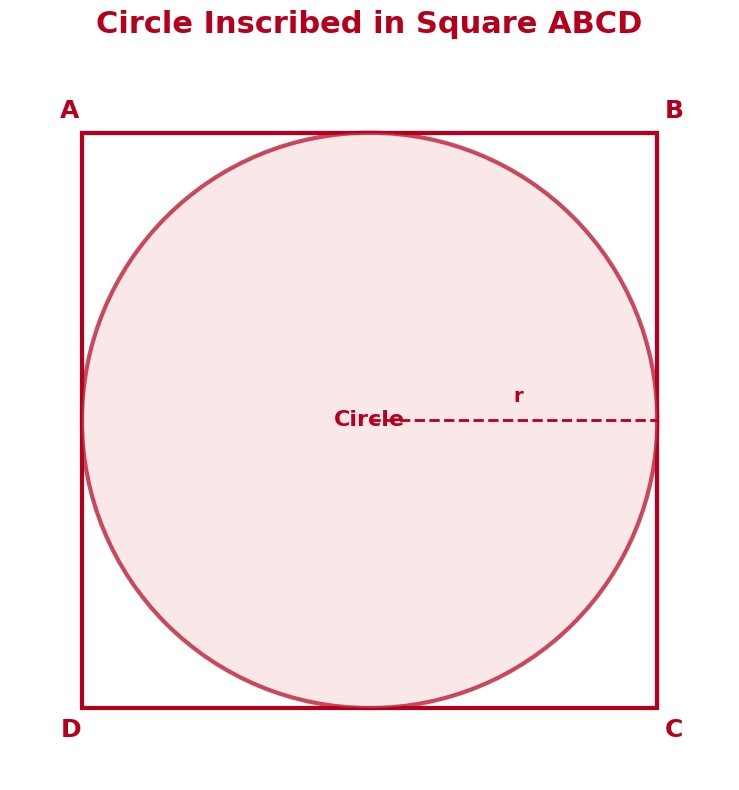
Step 1: Area of square = 10² = 100 cm²
Step 2: Semicircle diameter = 10 cm, r = 5 cm
Area of one semicircle = (1/2) × π × 25
= (1/2) × (22/7) × 25
= 275/7
= 39.28 cm²
Step 3: Total area of 4 semicircles
= 4 × 39.28 = 157.14 cm²
But semicircles overlap in the center!
Actual area covered = Total - Overlaps
For a square with inward semicircles on all 4 sides:
Covered area = π × r² = π × 25 = 78.57 cm²
(The four semicircles together cover a full circle area)
Step 4: Shaded area = Square - Circle
= 100 - 78.57
= 21.43 cm²
Answer: Shaded area = 21.43 cm²
HOTS Questions Based on Composite Figures
Question 10: A rectangular park is 40 m long and 30 m wide. Two semicircular flower beds are made on the two shorter sides (breadth). Find the cost of planting grass in the remaining rectangular area at ₹5 per m².
Answer:
Step 1: Rectangle area = 40 × 30 = 1200 m²
Step 2: Semicircle on breadth (30 m side)
Diameter = 30 m, r = 15 m
Area of one semicircle = (1/2) × π × 15²
= (1/2) × (22/7) × 225
= 2475/7
= 353.57 m²
Step 3: Two semicircles total = 2 × 353.57 = 707.14 m²
Step 4: Remaining grass area
= 1200 - 707.14
= 492.86 m²
Step 5: Cost = 492.86 × 5 = ₹2464.28
Answer: Cost = ₹2464.28
Question 11: In the figure, ABCD is a square of side 14 cm. A quadrant of a circle is drawn from B with radius BC = 14 cm. Also a semicircle is drawn on BC as diameter. Find the area of the shaded region.
Answer:
Step 1: Area of quadrant (center B, r = 14)
= (1/4) × (22/7) × 14²
= (1/4) × (22/7) × 196
= (1/4) × 616
= 154 cm²
Step 2: Area of semicircle on BC
Diameter = BC = 14 cm → r = 7 cm
= (1/2) × (22/7) × 7²
= (1/2) × (22/7) × 49
= (1/2) × 154
= 77 cm²
Step 3: Area of triangle ABC
= (1/2) × 14 × 14 = 98 cm²
Step 4: Shaded area
= Area of semicircle + (Area of quadrant - Area of triangle)
= 77 + (154 - 98)
= 77 + 56
= 133 cm²
Answer: Shaded area = 133 cm²
HOTS Questions Based on Real Life Applications
Question 12: A gardener wants to design a circular garden of radius 21 m. Inside the garden, he plans to grow roses in two sectors, each having a central angle of 45°. The remaining area will be grass. Find the area used for roses and the area of grass. Find the cost of growing roses at ₹10 per m² and grass at ₹5 per m².
Answer:
Step 1: Total circle area
= π × 21² = (22/7) × 441 = 1386 m²
Step 2: Each rose sector has θ = 45°, r = 21
Area of one sector = (45/360) × (22/7) × 441
= (1/8) × 1386
= 173.25 m²
Step 3: Total rose area = 2 × 173.25 = 346.5 m²
Step 4: Grass area = 1386 - 346.5 = 1039.5 m²
Step 5: Cost calculation
Rose cost = 346.5 × 10 = ₹3465
Grass cost = 1039.5 × 5 = ₹5197.50
Total cost = ₹3465 + ₹5197.50 = ₹8662.50
Answer: Rose area = 346.5 m², Grass area = 1039.5 m², Total cost = ₹8662.50
Question 13: A running track has two straight sections of 90 m each and two semicircular ends. The inner radius of the semicircular ends is 35 m and the track is 7 m wide throughout. Find: a) The total area of the track b) The distance a runner covers in one complete round on the inner edge
Answer:
Step 1: Track consists of:
- Two straight rectangular sections
- Two semicircular ring sections (annular sectors)
Inner radius (r) = 35 m
Outer radius (R) = 35 + 7 = 42 m
Straight length = 90 m
Step 2: Area of two straight sections
= 2 × (90 × 7) = 1260 m²
Step 3: Area of two semicircular rings
= 2 × (1/2) × π(R² - r²)
= π(R² - r²)
= (22/7) × (42² - 35²)
= (22/7) × (1764 - 1225)
= (22/7) × 539
= 22 × 77
= 1694 m²
Step 4: Total track area = 1260 + 1694 = 2954 m²
Step 5: Inner edge distance (one round):
= 2 straight sections + 2 semicircles
= 2 × 90 + 2 × π × r
= 180 + 2 × (22/7) × 35
= 180 + 220
= 400 m
Answer: Track area = 2954 m², One round on inner edge = 400 m
HOTS Question 14: An architect designs a window with a rectangular base of width 1.2 m and height 1.5 m, topped by a semicircle of the same width. Find the total area of glass needed for the window. If glass costs ₹450 per m², find the total cost.
Answer:
Step 1: Rectangle area
= 1.2 × 1.5 = 1.8 m²
Step 2: Semicircle on top
Diameter = 1.2 m, r = 0.6 m
Area = (1/2) × π × 0.6²
= (1/2) × (22/7) × 0.36
= (1/2) × 1.131
= 0.566 m²
Step 3: Total glass area
= 1.8 + 0.566
= 2.366 m²
Step 4: Total cost
= 2.366 × 450
= ₹1064.57
Answer: Glass area = 2.366 m², Cost = ₹1064.57
Quick Formula Reference
Area of sector = (θ/360) × πr²
Arc length = (θ/360) × 2πr
Area of minor segment = Sector - Triangle
Area of triangle in sector = (1/2) × r² × sin θ
Area of major segment = πr² - Minor segment
Area of annular ring = π(R² - r²)
Area of quadrant = (1/4) × πr²
Area of semicircle = (1/2) × πr²
Perimeter of sector = 2r + arc length
Download Free PDF: HOTS Questions - Class 10 Chapter 11 - Areas Related to Circles
Download PDF - HOTS Questions on Chapter 11 Class 10 Areas Related To Circles
Read More:
Areas Related To Circles Notes Page
Areas Related To Circles Important Questions Page
Areas Related To Circles MCQs Page
Areas Related To Circles Worksheets Page
Areas Related To Circles NCERT Solutions Page
Areas Related To Circles Assertion Reason Page
Numbers make sense when they're taught right. To see how Orchids The International School turns Maths from intimidating to intuitive, reach out to our admissions team.


Admissions Open for 2026-27
What type of concept pages would you prefer?
CBSE Schools In Popular Cities
- CBSE Schools in Bangalore
- CBSE Schools in Mumbai
- CBSE Schools in Pune
- CBSE Schools in Hyderabad
- CBSE Schools in Chennai
- CBSE Schools in Gurgaon
- CBSE Schools in Kolkata
- CBSE Schools in Indore
- CBSE Schools in Sonipat
- CBSE Schools in Delhi
- CBSE Schools in Rohtak
- CBSE Schools in Bhopal
- CBSE Schools in Aurangabad
- CBSE Schools in Jabalpur
- CBSE Schools in Jaipur
- CBSE Schools in Jodhpur
- CBSE Schools in Nagpur
- CBSE Schools in Ahmednagar
- CBSE School In Tumkur











Orchids The International School is one of India's leading chains of CBSE and ICSE schools, with 110+ schools across the country.