

HOTS Questions on Chapter 12 Class 10 Surface Areas and Volumes
HOTS Questions on Class 10 Maths Chapter 12 Surface Areas and Volumes help students understand 3D shapes, formulas, and real life applications in a simple way. They improve knowledge of cubes, cuboids, cylinders, cones, spheres, and mixed solids. This chapter builds a strong base for solving volume and surface area problems and improving math skills. A downloadable PDF is also available for easy revision and practice.
HOTS Questions Based on Cubes and Cuboids
Question 1: A cube of side 5 cm is cut into smaller cubes of side 1 cm. Find: a) The number of smaller cubes formed b) Total surface area of all smaller cubes c) The increase in total surface area compared to the original cube
Answer:
Step 1: Number of smaller cubes
= (Side of big cube / Side of small cube)³
= (5/1)³ = 125 smaller cubes
Step 2: Surface area of each small cube
= 6 × 1² = 6 cm²
Total surface area of 125 cubes
= 125 × 6 = 750 cm²
Step 3: Surface area of original cube
= 6 × 5² = 150 cm²
Step 4: Increase in surface area
= 750 - 150 = 600 cm²
Increase factor = 750/150 = 5 times
(When a cube is cut into n³ smaller cubes,
surface area increases by n times)
Answer: 125 cubes, Total SA = 750 cm², Increase = 600 cm²
Question 2: Two cubes each of volume 64 cm³ are joined end to end. Find the surface area of the resulting cuboid.
Answer:
Step 1: Find side of each cube
Volume = a³ = 64
a = 4 cm
Step 2: Dimensions of resulting cuboid
When joined end to end:
l = 4 + 4 = 8 cm
b = 4 cm
h = 4 cm
Step 3: Surface area of cuboid
= 2(lb + bh + hl)
= 2(8×4 + 4×4 + 4×8)
= 2(32 + 16 + 32)
= 2 × 80
= 160 cm²
Note: Original total SA = 2 × 6 × 16 = 192 cm²
Joined faces (2 squares) lost = 2 × 16 = 32 cm²
Net SA = 192 - 32 = 160 cm²
Answer: Surface area = 160 cm²
Question 3: A rectangular box has dimensions 8 cm × 6 cm × 4 cm. A cube has the same volume as this box. Which has the greater surface area and by how much?
Answer:
Step 1: Volume of cuboid
= 8 × 6 × 4 = 192 cm³
Step 2: Side of cube with same volume
a³ = 192
a = ∛192 ≈ 5.77 cm
Step 3: Surface area of cuboid
= 2(8×6 + 6×4 + 4×8)
= 2(48 + 24 + 32)
= 2 × 104 = 208 cm²
Step 4: Surface area of cube
= 6 × (5.77)²
= 6 × 33.29
= 199.74 cm²
Step 5: Comparison
Cuboid SA = 208 cm²
Cube SA = 199.74 cm²
Cuboid has greater surface area by:
208 - 199.74 = 8.26 cm²
Answer: Cuboid has greater SA by 8.26 cm²

HOTS Questions Based on Cylinders, Cones and Spheres
Question 4: A solid right circular cone of height 14 cm and base radius 7 cm is placed upright inside a cylinder of same base radius and same height. Find the volume of water that can be poured into the cylinder around the cone.
Answer:
Step 1: Volume of cylinder
= πr²h
= (22/7) × 7² × 14
= (22/7) × 49 × 14
= 22 × 7 × 14
= 2156 cm³
Step 2: Volume of cone
= (1/3)πr²h
= (1/3) × (22/7) × 49 × 14
= (1/3) × 2156
= 718.67 cm³
Step 3: Volume of water
= Volume of cylinder - Volume of cone
= 2156 - 718.67
= 1437.33 cm³
Answer: Water volume = 1437.33 cm³
Question 5: A hemispherical bowl of radius 9 cm is filled completely with pudding. The pudding is served into cones of radius 3 cm and height 3 cm. How many cones can be served?
Answer:
Step 1: Volume of hemispherical bowl
= (2/3)πr³
= (2/3) × (22/7) × 9³
= (2/3) × (22/7) × 729
= (2 × 22 × 729)/(3 × 7)
= 32076/21
= 1527.43 cm³
Step 2: Volume of one cone
= (1/3)πr²h
= (1/3) × (22/7) × 3² × 3
= (1/3) × (22/7) × 27
= (22 × 27)/(3 × 7)
= 594/21
= 28.29 cm³
Step 3: Number of cones
= Volume of bowl / Volume of one cone
= 1527.43 / 28.29
= 54 cones (approximately)
Exact calculation:
= [(2/3) × (22/7) × 729] / [(1/3) × (22/7) × 9]
= [2 × 729] / [1 × 9]
= 1458/9
= 162 cones
Answer: 162 cones can be served
Question 6: A cylinder, a cone, and a hemisphere all have the same base radius r = 7 cm and the same height h = 7 cm. Arrange them in ascending order of their volumes. Find the ratio of their volumes.
Answer:
Given: r = 7, h = 7
Volume of cone = (1/3)πr²h
= (1/3) × (22/7) × 49 × 7
= (1/3) × 1078
= 359.33 cm³
Volume of hemisphere = (2/3)πr³
(Since h = r = 7 for hemisphere)
= (2/3) × (22/7) × 343
= (2/3) × 1078
= 718.67 cm³
Volume of cylinder = πr²h
= (22/7) × 49 × 7
= 1078 cm³
Ratio:
Cone : Hemisphere : Cylinder
= 359.33 : 718.67 : 1078
= 1 : 2 : 3
This is the famous 1:2:3 ratio.
Ascending order:
Cone < Hemisphere < Cylinder
Answer: Ratio = 1:2:3 (Cone : Hemisphere : Cylinder)
HOTS Questions Based on Combination of Solids
Question 7: A toy is in the form of a cone mounted on a hemisphere. The diameter of the base of the cone is 6 cm and its height is 4 cm. Find the total surface area of the toy.
Answer:
Diagram:
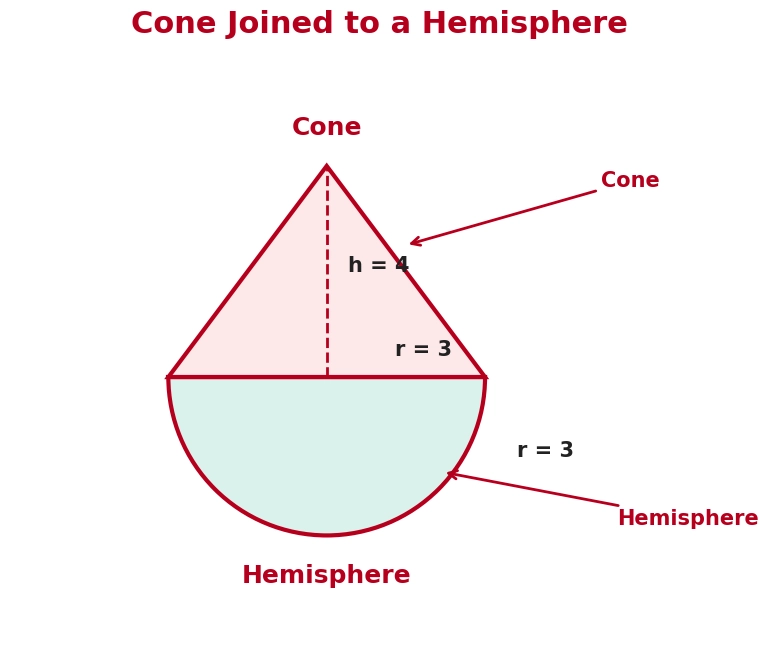
r = 3 cm (common radius)
h = 4 cm (height of cone)
Step 1: Slant height of cone
l = √(r² + h²)
= √(9 + 16)
= √25 = 5 cm
Step 2: Curved surface area of cone
= πrl
= (22/7) × 3 × 5
= 330/7
= 47.14 cm²
Step 3: Curved surface area of hemisphere
= 2πr²
= 2 × (22/7) × 9
= 396/7
= 56.57 cm²
Step 4: Total surface area of toy
= CSA of cone + CSA of hemisphere
(The flat circular base is hidden inside)
= 47.14 + 56.57
= 103.71 cm²
Answer: Total surface area = 103.71 cm²
Question 8: A wooden article was made by scooping out a hemisphere from each end of a solid cylinder. If the height of the cylinder is 10 cm and its base radius is 3.5 cm, find the total surface area of the article.
Answer:
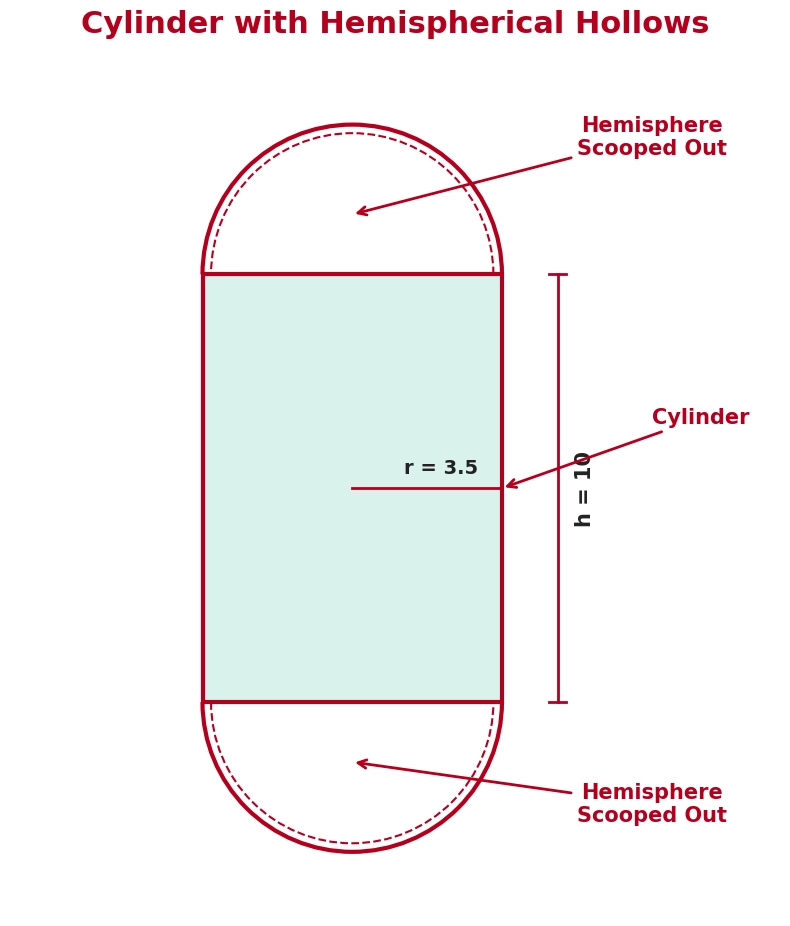
r = 3.5 cm, h = 10 cm
Step 1: Curved surface area of cylinder
= 2πrh
= 2 × (22/7) × 3.5 × 10
= 2 × 22 × 0.5 × 10
= 220 cm²
Step 2: Curved surface area of each hemisphere
= 2πr²
= 2 × (22/7) × 3.5²
= 2 × (22/7) × 12.25
= 2 × 38.5
= 77 cm²
Step 3: Total surface area
= CSA of cylinder + 2 × CSA of hemisphere
= 220 + 2 × 77
= 220 + 154
= 374 cm²
Answer: Total surface area = 374 cm²
Question 9: A tent is in the shape of a cylinder surmounted by a conical top. The height of the cylindrical part is 3 m and total height of the tent is 8 m. The diameter of the base is 12 m. Find the cost of canvas needed at ₹120 per m².
Answer:
r = 6 m
Height of cylinder = 3 m
Total height = 8 m
Height of cone = 8 - 3 = 5 m
Step 1: Slant height of cone
l = √(r² + h²)
= √(36 + 25)
= √61
≈ 7.81 m
Step 2: CSA of cylinder
= 2πrh
= 2 × (22/7) × 6 × 3
= 792/7
= 113.14 m²
Step 3: CSA of cone
= πrl
= (22/7) × 6 × 7.81
= (22 × 6 × 7.81)/7
= 1030.92/7
= 147.27 m²
Step 4: Total canvas needed
= CSA of cylinder + CSA of cone
= 113.14 + 147.27
= 260.41 m²
Step 5: Cost
= 260.41 × 120
= ₹31,249.20
Answer: Cost of canvas = ₹31,249.20
HOTS Questions Based on Conversion of Solids
Question 10: A solid metallic sphere of radius 10.5 cm is melted and recast into a number of smaller cones, each of radius 3.5 cm and height 3 cm. Find the number of cones formed.
Answer:
Step 1: Volume of sphere
= (4/3)πr³
= (4/3) × (22/7) × 10.5³
= (4/3) × (22/7) × 1157.625
= (4 × 22 × 1157.625)/(3 × 7)
= 101871/21
= 4851 cm³
Step 2: Volume of one cone
= (1/3)πr²h
= (1/3) × (22/7) × 3.5² × 3
= (1/3) × (22/7) × 36.75
= (22 × 36.75)/(7 × 3)
= 808.5/21
= 38.5 cm³
Step 3: Number of cones
= Volume of sphere / Volume of one cone
= 4851 / 38.5
= 126 cones
Answer: 126 cones are formed
Question 11: A solid cylinder of diameter 12 cm and height 15 cm is melted and recast into toys in the shape of a cone of radius 3 cm and height 9 cm with a hemispherical top of radius 3 cm. Find the number of toys.
Answer:
Step 1: Volume of cylinder
r = 6 cm, h = 15 cm
= π × 36 × 15 = 540π cm³
Step 2: Volume of one toy
Toy = Cone + Hemisphere (same radius r = 3)
Volume of cone part:
= (1/3)π × 9 × 9 = 27π cm³
Volume of hemisphere part:
= (2/3)π × 27 = 18π cm³
Total volume of one toy = 27π + 18π = 45π cm³
Step 3: Number of toys
= 540π / 45π
= 12 toys
(π cancels out clean calculation)
Answer: 12 toys are formed
Question 12: A sphere of diameter 6 cm is dropped into a cylinder of diameter 12 cm partially filled with water. If the sphere is completely submerged, find the rise in water level.
Answer:
Sphere r = 3 cm
Cylinder r = 6 cm
Step 1: Volume of sphere
= (4/3)π × 27 = 36π cm³
Step 2: The sphere displaces water equal
to its own volume.
Rise in water level = Volume of sphere / Base area of cylinder
= 36π / (π × 36)
= 36π / 36π
= 1 cm
Rise in water level = 1 cm
Answer: Water level rises by 1 cm
Question 13: A conical vessel of radius 6 cm and height 8 cm is completely filled with water. A sphere is lowered into the vessel. Find the largest sphere that can be placed in the cone without overflowing, and find the volume of water that overflows when it is placed.
Answer:
Given: Cone r = 6, h = 8
Slant height l = √(36 + 64) = √100 = 1
Step 1: Find radius of largest inscribed sphere
The sphere touches the base and the slant surface.
Using formula for inscribed sphere radius:
r_sphere = (r × h) / (r + l)
= (6 × 8) / (6 + 10)
= 48 / 16
= 3 cm
Step 2: Volume of sphere
= (4/3)π × 27
= 36π
= 113.14 cm³
Step 3: Volume of cone
= (1/3)π × 36 × 8
= 96π
= 301.71 cm³
Step 4: Volume of overflow
Since cone is full and sphere is placed:
Water overflow = Volume of sphere
= 113.14 cm³
Answer: Largest sphere radius = 3 cm, Water overflow = 113.14 cm³
Question 14: A hemispherical tank of radius 1.75 m is full of water. It is connected to a pipe which empties it at 7 liters per second. How much time will it take to empty the tank completely? (1 m³ = 1000 litres)
Answer:
Step 1: Volume of hemispherical tank
= (2/3)πr³
= (2/3) × (22/7) × (1.75)³
= (2/3) × (22/7) × 5.359
= (2 × 22 × 5.359)/(3 × 7)
= 235.79/21
= 11.228 m³
Step 2: Convert to litres
= 11.228 × 1000
= 11228 litres
Step 3: Time to empty
Rate = 7 litres per second
Time = 11228 / 7
= 1604 seconds
= 26 minutes 44 seconds
Answer: Time = 1604 seconds ≈ 26 minutes 44 seconds
Question 15: A manufacturer makes cylindrical cans of radius 3.5 cm and height 10 cm. These cans are packed in a rectangular box of dimensions 14 cm × 14 cm × 10 cm. How many cans fit in one box? What percentage of the box volume is wasted?
Answer:
Step 1: Can dimensions: r = 3.5 cm, h = 10 cm
Diameter of can = 7 cm
Step 2: Number of cans in box
Box base = 14 × 14 cm
Can diameter = 7 cm
Along 14 cm length: 14/7 = 2 cans
Along 14 cm width: 14/7 = 2 cans
Height of box = 10 cm = height of can (1 layer)
Total cans = 2 × 2 × 1 = 4 cans
Step 3: Volume of box
= 14 × 14 × 10 = 1960 cm³
Step 4: Volume of 4 cans
= 4 × πr²h
= 4 × (22/7) × 12.25 × 10
= 4 × 385
= 1540 cm³
Step 5: Wasted volume
= 1960 - 1540 = 420 cm³
Step 6: Percentage wasted
= (420/1960) × 100
= 21.43%
Answer: 4 cans fit, 21.43% of box volume is wasted
Question 16: A hollow sphere of internal and external diameters 4 cm and 8 cm respectively is melted into a cone of base diameter 8 cm. Find the height of the cone.
Answer:
Internal radius r₁ = 2 cm
External radius r₂ = 4 cm
Cone base radius = 4 cm
Step 1: Volume of hollow sphere
= (4/3)π(r₂³ - r₁³)
= (4/3)π(64 - 8)
= (4/3)π × 56
= 224π/3 cm³
Step 2: Volume of cone = Volume of sphere
(1/3)πr²h = 224π/3
(1/3) × 16 × h = 224/3
16h/3 = 224/3
16h = 224
h = 14 cm
Answer: Height of cone = 14 cm
Mixed HOTS Practice Questions on Surface Areas and Volumes
Question 17: A solid is in the shape of a cone standing on a hemisphere with both having the same radius of 1 cm. If the height of the cone is equal to its radius, find the volume and total surface area of the solid.
Answer:
r = 1 cm, h = 1 cm (cone height = radius)
Volume:
Cone = (1/3)π × 1 × 1 = π/3 cm³
Hemisphere = (2/3)π × 1 = 2π/3 cm³
Total = π/3 + 2π/3 = π = (22/7) = 3.14 cm³
Slant height of cone:
l = √(r² + h²) = √(1 + 1) = √2 cm
Surface area:
CSA of cone = π × 1 × √2 = √2π cm²
CSA of hemisphere = 2π × 1 = 2π cm²
Total = (√2 + 2)π
= (1.414 + 2) × 22/7
= 3.414 × 22/7
= 75.11/7
= 10.73 cm²
Answer: Volume = π ≈ 3.14 cm³, TSA = (√2 + 2)π ≈ 10.73 cm²
Question 18: Twenty-seven solid iron spheres, each of radius r, are melted to form a sphere of radius R. Find the ratio R:r. Also find the ratio of their surface areas.
Answer:
Volume conservation:
27 × (4/3)πr³ = (4/3)πR³
27r³ = R³
R³/r³ = 27
R/r = ∛27 = 3
So R = 3r, Ratio R:r = 3:1
Surface area of 27 small spheres:
= 27 × 4πr²
= 108πr²
Surface area of large sphere:
= 4πR²
= 4π(3r)²
= 36πr²
Ratio of surface areas:
(Large sphere):(27 small spheres)
= 36πr²:108πr²
= 36:108
= 1:3
So 27 small spheres have 3 times
more total surface area than the
single large sphere!
Answer: R:r = 3:1, Surface area ratio = 1:3
Question 19: A bucket is in the form of a frustum of a cone of height 30 cm with radii of its lower and upper ends as 10 cm and 20 cm respectively. Find: a) The capacity of the bucket (volume) b) The metal sheet required to make the bucket (curved surface + base) c) Cost at ₹10 per 100 cm²
Answer:
R = 20 cm (upper), r = 10 cm (lower), h = 30 cm
a) Volume of frustum:
= (πh/3)(R² + r² + Rr)
= (π × 30/3)(400 + 100 + 200)
= 10π × 700
= 7000π
= 7000 × 22/7
= 22000 cm³
= 22 litres
b) Slant height:
l = √(h² + (R-r)²)
= √(900 + 100)
= √1000
= 10√10 cm
CSA of frustum:
= π(R + r)l
= (22/7)(20 + 10)(10√10)
= (22/7) × 30 × 31.62
= (22 × 30 × 31.62)/7
= 20869.2/7
= 2981.31 cm²
Area of bottom circle (base):
= πr² = (22/7) × 100 = 314.28 cm²
Total metal sheet:
= 2981.31 + 314.28
= 3295.59 cm²
c) Cost:
= (3295.59/100) × 10
= 32.96 × 10
= ₹329.56
Answers: a) Capacity = 22000 cm³ = 22 litres b) Metal sheet = 3295.59 cm² c) Cost = ₹329.56
Formula Table:
Download Free PDF: HOTS Questions - Class 10 Chapter 12 - Surface Areas and Volumes
Download PDF - HOTS Questions on Chapter 12 Class 10 Surface Areas and Volumes
Read More:
Surface Areas and Volumes Notes Page
Surface Areas and Volumes Important Questions Page
Surface Areas and Volumes MCQs Page
Surface Areas and Volumes Worksheets Page
Surface Areas and Volumes NCERT Solutions Page
Surface Areas and Volumes Assertion Reason Page
Frequently Asked Questions on HOTS Questions on Chapter 12 Class 10 Surface Areas and Volumes
1. What are HOTS questions in Surface Areas and Volumes?
HOTS (Higher Order Thinking Skills) questions are application based problems that require students to use formulas for three-dimensional solids, analyze complex figures, and solve real life mathematical situations.
2. How do you find the volume of a combination of solids?
Divide the figure into simpler solids such as cylinders, cones, hemispheres, or spheres. Find the volume of each solid separately, then add or subtract them as required.
3. How do you solve container and water tank problems?
Find the volume of the container using the appropriate formula, then calculate the amount of water it can hold or the remaining empty space as required.
4. How do you find the surface area of a combined solid?
Identify the exposed surfaces only. Add the surface areas of the visible parts and exclude the surfaces that are joined internally.
5. How do you solve questions involving cones and hemispheres?
Use the individual formulas for cones and hemispheres, then combine their surface areas or volumes depending on whether the solids are joined or separated.
Numbers make sense when they're taught right. To see how Orchids The International School turns Maths from intimidating to intuitive, reach out to our admissions team.


Admissions Open for 2026-27
What type of concept pages would you prefer?
CBSE Schools In Popular Cities
- CBSE Schools in Bangalore
- CBSE Schools in Mumbai
- CBSE Schools in Pune
- CBSE Schools in Hyderabad
- CBSE Schools in Chennai
- CBSE Schools in Gurgaon
- CBSE Schools in Kolkata
- CBSE Schools in Indore
- CBSE Schools in Sonipat
- CBSE Schools in Delhi
- CBSE Schools in Rohtak
- CBSE Schools in Bhopal
- CBSE Schools in Aurangabad
- CBSE Schools in Jabalpur
- CBSE Schools in Jaipur
- CBSE Schools in Jodhpur
- CBSE Schools in Nagpur
- CBSE Schools in Ahmednagar
- CBSE School In Tumkur











Orchids The International School is one of India's leading chains of CBSE and ICSE schools, with 110+ schools across the country.