

Class 10 Maths Chapter 13 Statistics Notes Free PDF Download
Class 10 Maths Chapter 13 Statistics Notes are helpful for quick revision and exam preparation. These notes cover key topics like mean, median, mode of grouped data, cumulative frequency, and ogive (cumulative frequency curve). Students can use them to understand the concepts clearly, learn the important formulas, and prepare confidently for school and board exams. A free PDF download is also available for easy offline practice.
Table of Contents
- Important Topics Covered in the Chapter
- Important Formulas from Statistics
- Statistics Formula Chart
- Mean Revision Notes
- Median Revision Notes
- Mode Revision Notes
- Cumulative Frequency Distribution Revision Notes
- Graphical Representation of Data
- Difference Between Mean, Median and Mode
- Solved Examples for Quick Revision
- Common Mistakes in Statistics
- Statistics Notes PDF
- Frequently Asked Questions on Class 10 Maths Chapter 13 Statistics Notes

Important Topics Covered in the Chapter
The chapter covers mean (direct method, assumed mean method, step-deviation method), median of grouped data, mode of grouped data, cumulative frequency distribution, and the ogive curve. All of these revolve around the same frequency distribution table, so learning to read and build that table correctly is the most important skill in the chapter.
Key Terms to Remember
- Statistics: The study of collecting, presenting, and interpreting numerical data.
- Frequency Distribution: A table that shows how often each value or range of values appears in a dataset.
- Class Interval: A range of values grouped together in the table, such as 10 - 20 or 20 - 30. Each interval has a lower boundary and an upper boundary.
- Class Mark: The midpoint of a class interval. It is calculated as: Class mark = (Lower limit + Upper limit) / 2. For the class 10 - 20, the class mark is 15.
- Cumulative Frequency: The running total of frequencies up to and including a particular class interval. It is used to find the median and to draw the ogive curve.
Know more about related topics:
Important Formulas from Statistics
1. Mean Formula (Direct Method)
Mean (x̄) = Σfᵢxᵢ / Σfᵢ
where fᵢ = frequency of each class, and xᵢ = class mark of each class.
2. Assumed Mean Method Formula
Mean (x̄) = a + (Σfᵢdᵢ / Σfᵢ)
where a = assumed mean, and dᵢ = xᵢ − a (deviation of class mark from assumed mean).
3. Step-Deviation Method Formula
Mean (x̄) = a + (Σfᵢuᵢ / Σfᵢ) × h
where uᵢ = (xᵢ − a) / h, h = class width, and a = assumed mean.
4. Median Formula
Median = l + [(n/2 − cf) / f] × h
where l = lower boundary of the median class, n = total frequency, cf = cumulative frequency of the class before the median class, f = frequency of the median class, h = class width.
5. Mode Formula
Mode = l + [(f₁ − f₀) / (2f₁ − f₀ − f₂)] × h
where l = lower boundary of the modal class, f₁ = frequency of modal class, f₀ = frequency of the class before modal class, f₂ = frequency of the class after modal class, h = class width.
Statistics Formula Chart
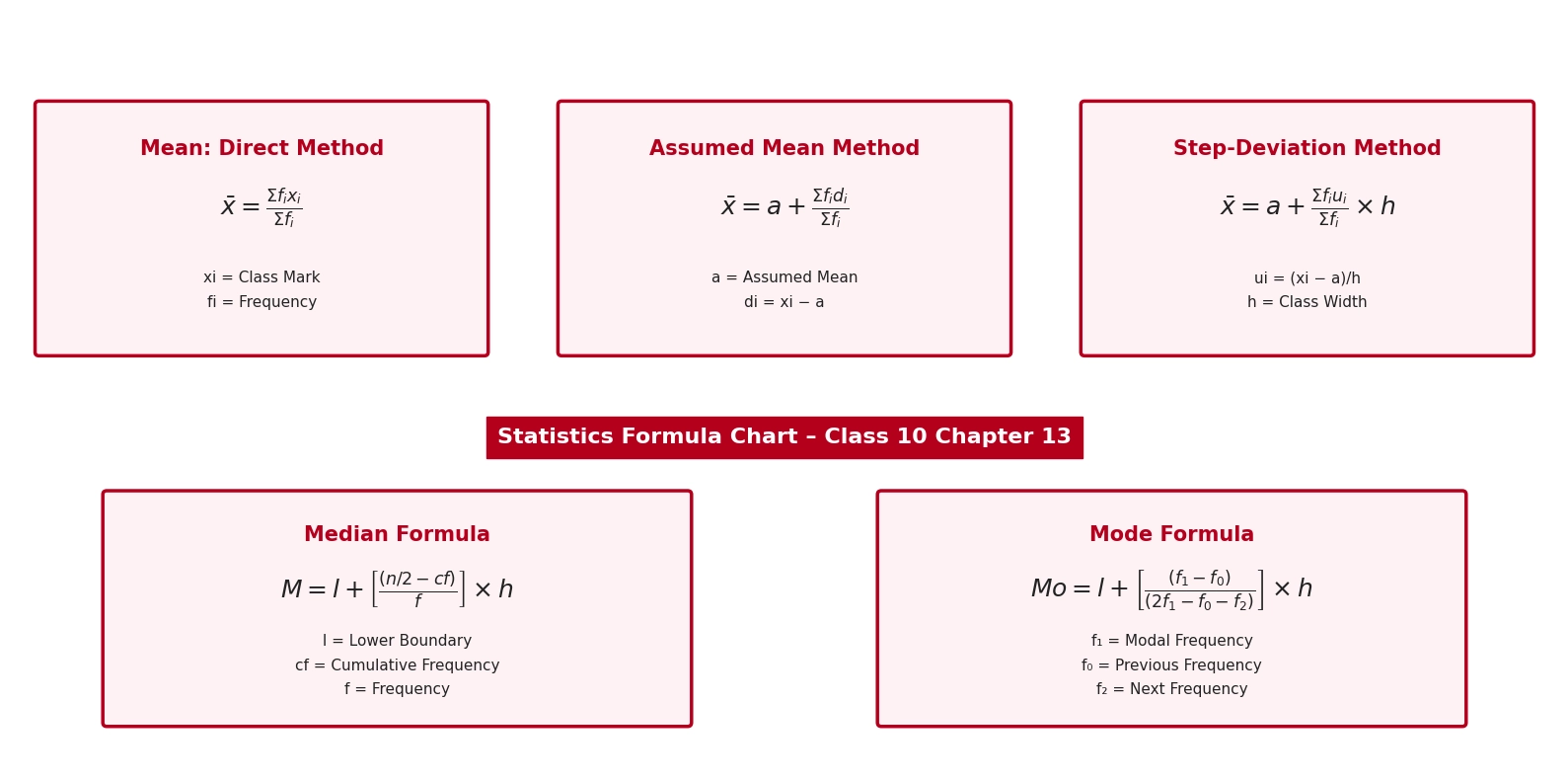
The diagram below shows all five formulas together so you can revise them at a glance.
Mean Revision Notes
Direct Method
List the class marks (xᵢ), multiply each by its frequency (fᵢ), add all products, and divide by the total frequency. This method works well when the numbers are small and easy to multiply.
Assumed Mean Method
Pick a convenient middle value as the assumed mean (a). Find the deviation dᵢ = xᵢ − a for each class. Multiply dᵢ by fᵢ, sum them up, divide by Σfᵢ, and add a. This method reduces the size of the numbers you work with.
Step-Deviation Method
This is the fastest method when all class widths are equal. Divide each deviation dᵢ by the class width h to get uᵢ. Use the formula x̄ = a + (Σfᵢuᵢ / Σfᵢ) × h. In CBSE exams, equal class widths are the norm, so this method saves the most time.
Median Revision Notes
Median of Grouped Data
The median is the middle value of the dataset. For grouped data, you first build a cumulative frequency column, find n/2 (half the total frequency), then identify which class that value falls in. That class is called the median class.
Steps:
-
Build the cumulative frequency (cf) column.
-
Find n/2.
-
Locate the first cf value that is ≥ n/2 that row is the median class.
-
Read off l, cf (of the class before), f, and h.
-
Apply the formula: Median = l + [(n/2 − cf) / f] × h
Always use the cumulative frequency of the class before the median class, not the median class itself. The lower boundary l is the exact lower limit of the median class (not the class mark). A small table drawn in rough work saves errors.
Mode Revision Notes
Mode of Grouped Data
The mode is the value that appears most often. In grouped data, the modal class is simply the class with the highest frequency. You do not need to build a cumulative frequency table for mode.
Mode = l + [(f₁ − f₀) / (2f₁ − f₀ − f₂)] × h
If two classes have the same highest frequency, this formula cannot be applied directly the question will usually make this situation clear. The modal class is identified by the highest frequency, not the highest class mark. Never confuse f₀ and f₂ − f₀ is always the class before the modal class, and f₂ is always the class after.
Cumulative Frequency Distribution Revision Notes
Construction of Cumulative Frequency Table
Start with the frequency column. For the first row, the cumulative frequency equals the frequency. For every row after that, add the current frequency to the previous cumulative frequency. The last cumulative frequency must equal n (total frequency) use this as a self-check.
Here n = 40. The median class is found at n/2 = 20, which first appears in the 20 − 30 row (cf = 25 ≥ 20).
Importance in Statistics
Cumulative frequency is essential for finding the median and for plotting the ogive (cumulative frequency curve). Without this column, neither calculation can proceed.
Graphical Representation of Data
Histogram
A histogram is a bar chart for grouped data. Each bar covers one class interval on the x-axis, and its height equals the frequency of that class. Bars have no gaps between them, unlike a regular bar chart. In CBSE Class 10, histograms are used as a visual check on the data but are not directly tested as a calculation.
Frequency Polygon
A frequency polygon is drawn by connecting the midpoints (class marks) of the tops of each histogram bar with straight lines. It gives a quick picture of how frequency changes across classes.
Ogive Curve
The ogive (pronounced oh-jive) is a smooth curve drawn by plotting cumulative frequency against the upper boundary of each class. It is used to estimate the median graphically: draw a horizontal line from n/2 on the y-axis to the ogive, then drop a vertical line to the x-axis the value on the x-axis is the median. CBSE exams sometimes ask you to draw or read off the median from an ogive.
Difference Between Mean, Median and Mode
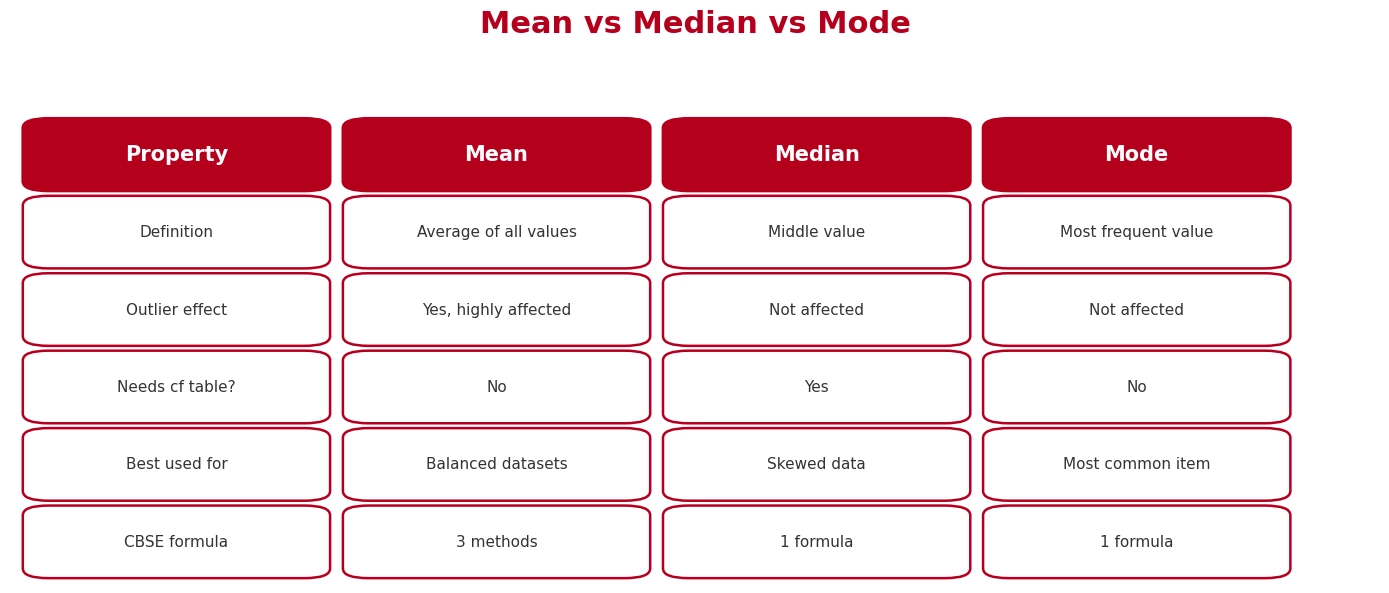
Use the mean when the data is evenly spread and there are no extreme values that would pull the average up or down. Use the median when the data is skewed — for example, income data where a few very high earners would distort the mean. Use the mode when you need the most popular or most common value — for example, the most popular shoe size in a batch.
Solved Examples for Quick Revision
1. Question: Find the mean using the step deviation method.
Solution: Take a = 25, h = 10.
Mean = 25 + (14/50) × 10 = 25 + 2.8 = 27.8
2. Question: Find the median for the same data above.
Solution: n = 50, so n/2 = 25.
Cumulative frequencies: 5, 13, 28, 40, 50. The cf first reaches or exceeds 25 at the 20 − 30 class (cf = 28). So the median class is 20–30.
l = 20, cf = 13, f = 15, h = 10
Median = 20 + [(25 − 13) / 15] × 10 = 20 + (12/15) × 10 = 20 + 8 = 28
3. Question: Find the mode for the same data.
Solution: The class 20 − 30 has the highest frequency (f₁ = 15). So l = 20, f₀ = 8, f₂ = 12, h = 10.
Mode = 20 + [(15 − 8) / (2×15 − 8 − 12)] × 10 = 20 + [7 / 10] × 10 = 20 + 7 = 27
Common Mistakes in Statistics
Errors in Class Mark Calculation
Students sometimes use the lower limit instead of the midpoint as the class mark. Always compute (lower + upper) / 2. For the class 20–30, the class mark is 25, not 20.
Incorrect Frequency Totals
If Σfᵢ is wrong, every formula gives a wrong answer. Always cross-check: the last cumulative frequency must equal the sum of all frequencies. If they differ, recheck your addition before proceeding.
Mistakes in Median Formula Application
The most common error is using cf of the median class itself instead of the class before it. In the formula M = l + [(n/2 − cf) / f] × h, cf refers to the cumulative frequency of the class just before the median class. Label this clearly in rough work to avoid the mix-up.
Errors in Mode Calculation
Students occasionally swap f₀ and f₂. Remember: f₀ is always the frequency of the class that comes before the modal class, and f₂ is always the frequency of the class that comes after. Getting these reversed changes the answer completely.
Statistics Notes PDF
Numbers make sense when they're taught right. To see how Orchids The International School turns Maths from intimidating to intuitive, reach out to our admissions team.
Frequently Asked Questions on Class 10 Maths Chapter 13 Statistics Notes
1. What is Statistics in Class 10 Maths?
Statistics is the branch of mathematics that deals with collecting, organizing, presenting, analyzing, and interpreting data.
2. What are the measures of central tendency?
The measures of central tendency are Mean, Median, and Mode. They represent the central or typical value of a data set.
3. What is the formula for mean?
The mean is calculated by dividing the sum of all observations by the total number of observations.
4. What is the formula for median?
For grouped data, the median is calculated using:
where ll is the lower boundary of the median class,is the total frequency,is the cumulative frequency before the median class,is the frequency of the median class, and hh is the class size.
5. What is cumulative frequency?
Cumulative frequency is the running total of frequencies obtained by successively adding the frequencies of each class interval.
6. What is an ogive curve?
An ogive is a cumulative frequency graph used to represent data visually and determine the median graphically.
7. What is the difference between mean, median and mode?
- Mean: Arithmetic average of all observations.
- Median: Middle value of an ordered data set.
- Mode: Most frequently occurring value in a data set.
8. Is Statistics important for board exams?
Yes, Statistics is an important chapter in Class 10 Maths and frequently appears in board examinations through numerical and application-based questions.
Related Links


Admissions Open for 2026-27
What type of concept pages would you prefer?
CBSE Schools In Popular Cities
- CBSE Schools in Bangalore
- CBSE Schools in Mumbai
- CBSE Schools in Pune
- CBSE Schools in Hyderabad
- CBSE Schools in Chennai
- CBSE Schools in Gurgaon
- CBSE Schools in Kolkata
- CBSE Schools in Indore
- CBSE Schools in Sonipat
- CBSE Schools in Delhi
- CBSE Schools in Rohtak
- CBSE Schools in Bhopal
- CBSE Schools in Aurangabad
- CBSE Schools in Jabalpur
- CBSE Schools in Jaipur
- CBSE Schools in Jodhpur
- CBSE Schools in Nagpur
- CBSE Schools in Ahmednagar
- CBSE School In Tumkur











Orchids The International School is one of India's leading chains of CBSE and ICSE schools, with 130+ schools across the country.