

Chapter 4: Quadratic Equations Notes for Class 10 - The Complete Guide
Quadratic Equations for Class 10 Maths Notes are available in this article.This guide explains quadratic equations in a simple, exam-friendly way. Aligned with the NCERT syllabus and CBSE exam pattern, it covers the standard form and three main methods to solve them: factorization, completing the square, and the quadratic formula. You’ll also learn how the discriminant reveals the nature of roots, and how to approach real-life word problems that use quadratics.
Each topic includes step-by-step worked examples, useful shortcut tips for faster factorization, and quick ways to check your answers. Short revision bullets and practice problems with answers are provided to help you build confidence before tests. You can download a complete PDF version of these Quadratic Equations notes for offline study.
Know more about related topics:
- Class 10 Maths Mcqs Chapter 4 Quadratic Equations
- Class 10 Maths Chapter 4 Quadratic Equations Worksheets
- Important Questions Class 10 Maths Quadratic Equations
- Assertion Reason Questions For Class 10 Maths Chapter 4 Quadratic Equations
- Class 10 Maths Notes Chapter 3 Pair Of Linear Equations In Two Variables
Chapter 4: Quadratic Equations Notes for Class 10
1. What Is a Quadratic Equation
A quadratic equation is any equation of the form:
ax² + bx + c = 0
where a, b, and c are real numbers, and a ≠ 0.
Where,
a = coefficient of x² (also called the quadratic coefficient). It cannot be zero. If it were, the equation would just be linear.
b = coefficient of x (the linear coefficient)
c = the constant term
Converting to Standard Form
Sometimes a quadratic equation won't look like ax² + bx + c = 0. You need to rearrange it. For example:
Example: Is x(x − 4) = −3 a quadratic equation?
Expand: x² − 4x = −3
Rearrange: x² − 4x + 3 = 0
Yes, it's quadratic in standard form with a = 1, b = −4, c = 3.
2. Roots of a Quadratic Equation
The roots (also called solutions or zeroes) of a quadratic equation ax² + bx + c = 0 are the values of x that make the equation true.
A quadratic equation can have the following:
-
Two distinct real roots
-
Two equal real roots (also called a repeated root)
-
No real roots (the roots are complex/imaginary)

Graphical Meaning
When you plot the quadratic polynomial y = ax² + bx + c, you get a parabola.
-
If the parabola crosses the x-axis at two points ⇒ two distinct real roots -
If it just touches the x-axis at one point ⇒ two equal roots
-
If it never touches the x-axis ⇒ no real roots
Roots of a quadratic equation are simply the x-intercepts of the parabola.
3. Solving a Quadratic Equation
3.1 Method 1: Solving by Factorisation
The idea of solving by factorusation is to rewrite the quadratic as a product of two linear factors and then use the zero product property.
Zero Product Property: if A × B = 0, then either A = 0 or B = 0.
The Split-the-Middle-Term Technique
For ax² + bx + c = 0:
-
Find two numbers p and q such that p + q = b and p × q = a × c
-
Rewrite the middle term using p and q
-
Factorise by grouping
Example 1: Solve 2x² − 5x + 3 = 0
Solution: Here, a = 2, b = −5, c = 3. So a × c = 6.
We need two numbers that add to −5 and multiply to 6. That's −2 and −3.
2x² − 2x − 3x + 3 = 0
2x(x − 1) − 3(x − 1) = 0
⇒ (2x − 3)(x − 1) = 0
So: x = 3/2 or x = 1
Example 2: Find two consecutive positive integers whose product is 306.
Solution: Let the integers be x and x + 1.
x(x + 1) = 306
⇒ x² + x − 306 = 0
Find two numbers with sum = 1 and product = −306: 18 and −17
x² + 18x − 17x − 306 = 0
x(x + 18) − 17(x + 18) = 0
⇒ (x + 18)(x − 17) = 0
⇒ x = −18 (rejected ∵ negative) or x = 17
The integers are 17 and 18.
3.2 Method 2: Completing the Square
We transform the equation so that one side becomes a perfect square trinomial of the form (x + k)².
Steps:
-
Write the equation in standard form
-
Move the constant to the right side
-
If a ≠ 1, divide throughout by a
-
Add (half of the coefficient of x)² to both sides
-
Write the left side as a perfect square
-
Take the square root of both sides
-
Solve for x
Example 1: Solve x² + 4x − 5 = 0
Step 1: x² + 4x = 5
Step 2: Add (4/2)² = 4 to both sides
x² + 4x + 4 = 5 + 4
(x + 2)² = 9
x + 2 = ±3
x = 1 or x = −5
3.3 Method 3: The Quadratic Formula
It directly gives you both roots of any quadratic equation.
The Formula:
For ax² + bx + c = 0 (where a ≠ 0):
That ± means you calculate two values:
x₁ = (−b + √(b² − 4ac)) / 2a
x₂ = (−b − √(b² − 4ac)) / 2a
Example 1: Solve x² − 5x + 6 = 0
a = 1, b = −5, c = 6
Discriminant = (−5)² − 4(1)(6) = 25 − 24 = 1
x = (5 ± √1) / 2 = (5 ± 1) / 2
x = 3 or x = 2
4.The Discriminant
The discriminant, denoted by D (or sometimes Δ).
D = b² − 4ac
The discriminant tells you exactly what kind of roots to expect.
The Three Cases:
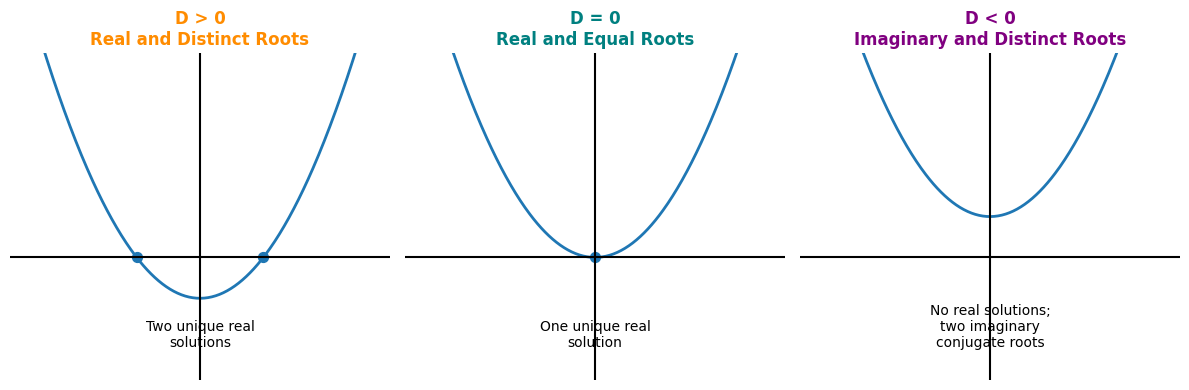
Case 1: D > 0 (Positive Discriminant)
The equation has two distinct real roots.
The square root of a positive number is a real number, giving you two different values.
Case 2: D = 0 (Zero Discriminant)
The equation has two equal real roots (also called a repeated root).
Both roots are the same: x = −b/2a
Case 3: D < 0 (Negative Discriminant)
The equation has no real roots.
You'd be taking the square root of a negative number, which has no real solution.
Example 1: Find the nature of roots of x² − 4x + 4 = 0
D = (−4)² − 4(1)(4) = 16 − 16 = 0
⇒ Two equal real roots. Both roots = −(−4)/2(1) = 2
Example 2: Find the nature of roots of 3x² − 5x + 2 = 0
D = (−5)² − 4(3)(2) = 25 − 24 = 1 > 0
⇒ Two distinct real roots
Example 3: Find the nature of roots of x² + x + 1 = 0
D = (1)² − 4(1)(1) = 1 − 4 = −3 < 0
⇒ No real roots
5. Sum and Product of Roots
If α (alpha) and β (beta) are the two roots of ax² + bx + c = 0, then:
Sum of roots: α + β = −b/a
Product of roots: α × β = c/a
Example: If one root of x² − 5x + k = 0 is 2, find k.
Using sum of roots: 2 + β = 5, so β = 3
Using product of roots: 2 × 3 = k ⇒ k = 6
6. Important Formulas: Quick Reference Card
Click below to download your free Class 10 Maths Chapter 4: Quadratic Equations PDF Notes perfect for last-minute CBSE board exam revision.
Download PDF - Class 10 Maths Chapter 4: Quadratic Equations Notes
Frequently Asked Questions of Chapter 4: Quadratic Equations for Class 10
1. What is a quadratic equation in Class 10 Maths?
A quadratic equation is a polynomial equation of degree 2 in one variable, written in the standard form ax² + bx + c = 0, where a, b, and c are real numbers and a ≠ 0.
2. Is every quadratic equation solvable?
Every quadratic equation has a solution but not always in real numbers. If the discriminant (b² − 4ac) is negative, the roots are complex (imaginary) numbers.
3. What does the discriminant tell you about the roots?
The discriminant determines the nature of roots:
-
D > 0: Two distinct real roots
-
D = 0: Two equal real roots (repeated root)
-
D < 0: No real roots (complex roots)
4. What are equal roots in a quadratic equation?
Equal roots (also called coincident roots or repeated roots) occur when D = 0. Both roots have the same value, given by x = −b / 2a.
5. What are the formulas for the sum and product of roots?
If α and β are the two roots of ax² + bx + c = 0, then:
Sum of roots: α + β = −b/a
Product of roots: α × β = c/a
6. How do you form a quadratic equation when the roots are given?
If roots are α and β, the quadratic equation is:
x² − (α + β)x + αβ = 0
Numbers make sense when they're taught right. To see how Orchids The International School turns Maths from intimidating to intuitive, reach out to our admissions team.


Admissions Open for 2026-27
What type of concept pages would you prefer?
CBSE Schools In Popular Cities
- CBSE Schools in Bangalore
- CBSE Schools in Mumbai
- CBSE Schools in Pune
- CBSE Schools in Hyderabad
- CBSE Schools in Chennai
- CBSE Schools in Gurgaon
- CBSE Schools in Kolkata
- CBSE Schools in Indore
- CBSE Schools in Sonipat
- CBSE Schools in Delhi
- CBSE Schools in Rohtak
- CBSE Schools in Bhopal
- CBSE Schools in Aurangabad
- CBSE Schools in Jabalpur
- CBSE Schools in Jaipur
- CBSE Schools in Jodhpur
- CBSE Schools in Nagpur
- CBSE Schools in Ahmednagar
- CBSE School In Tumkur











Orchids The International School is one of India's leading chains of CBSE and ICSE schools, with 110+ schools across the country.