

Tangent to a Circle: Definition, Properties & Examples
A tangent to a circle is a straight line that touches the circle at exactly one point. Imagine a bicycle tyre rolling along the road. At every single instant, the road touches the tyre at just one point, not two, not zero, exactly one. This contact point changes every split second as the wheel rolls forward, but the relationship stays the same. This is the geometry of a tangent to a circle in real life. In this guide, you will learn about the tangent to a circle, its definition, and properties through solved examples and practice questions.
Table of Contents
- What is the Tangent to a Circle
- Number of Tangents to a Circle from a Point
- Properties of Tangent to a Circle
- Solved Examples on Tangent to a Circle
- Frequently Asked Questions on Tangent to a Circle

What is the Tangent to a Circle
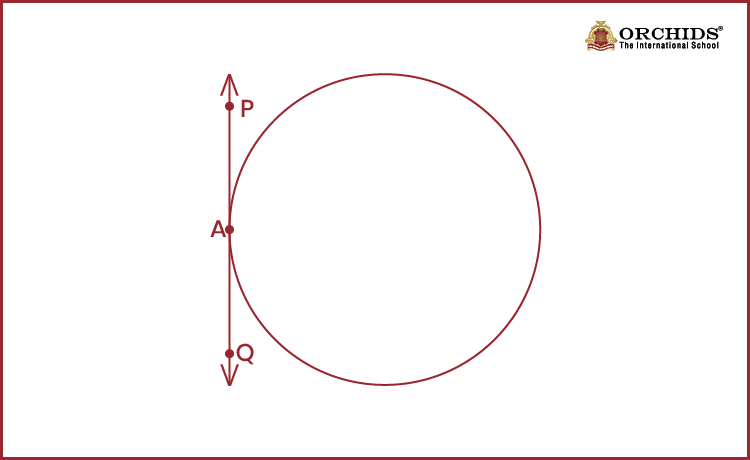
A tangent to a circle is a line that intersects the circle at only one point. The tangent touches the circle at the common point of the tangent and the circle, which is called the 'point of contact'.
Know more about related topics:
Number of Tangents to a Circle from a Point
The number of distinct tangents that can be drawn from a given external point to a circle depends on its position relative to the circle.
Point inside the circle: Every line through an interior point cuts across the circle, entering through one side and exiting through another. Such lines form a secant. No tangent can be drawn from here.
∴ 0 tangents are possible from a point inside the circle. There is no tangent to a circle passing through a point lying inside the circle.
Point on the circle: The point is already sitting on the circumference. You can draw exactly one tangent at this point. The line just grazes the circle at that location without going inside. There is one and only one tangent to a circle passing through a point lying on the circle.
Point outside the circle: From a point beyond the circle, you can draw two distinct tangents. They reach the circle from either side, touching it at two different points of contact. There are exactly two tangents to a circle through a point lying outside the circle.
Properties of Tangent to a Circle
The tangent at any point of a circle is perpendicular to the radius through the point of contact.
If two tangents are drawn from a point outside the circle, their lengths are equal. If P is an external point, and PA and PB are tangents touching the circle at A and B, then PA = PB always.
A circle can have a maximum of two parallel tangents, and they are always drawn at the two ends of a diameter. For two tangents to be parallel, their corresponding radii must both be perpendicular to the same line, meaning the radii must lie along the same direction. This occurs only when the radii form a single diameter, placing the points of contact at opposite ends of that diameter.
Solved Examples on Tangent to a Circle
Example 1: Tangent PQ at point P on a circle (r = 5 cm) meets a line through centre O at Q where OQ = 12 cm. Find PQ.
Solution: PQ is tangent at P. ∴ OP ⊥ PQ and ∠OPQ = 90° (∵ the tangent at any point of a circle is perpendicular to the radius)
In right-angled △OPQ, OQ2 = OP2 + PQ2
122 = 52 + PQ2
144 = 25 + PQ2
PQ2 = 119
PQ = √119 cm
∴ Length of tangent PQ = √119 cm ≈ 10.9 cm
Example 2: From point Q, the length of the tangent to a circle is 24 cm, and the distance of Q from the centre is 25 cm. Find the radius.
Solution: Let tangent touch at P. ∴ OP ⊥ QP and ∠OPQ = 90° (∵ the tangent at any point of a circle is perpendicular to the radius)
OQ2 = OP2 + QP2
252 = r2 + 242
625 = r2 + 576
r2 = 49
r = 7 cm
∴ radius = 7 cm
Example 3: TP and TQ are tangents drawn to a circle with centre O from external point T. Prove that ∠PTQ = 2∠OPQ.
Solution: Let ∠PTQ = θ. Since TP = TQ (∵ two tangents from an external point are equal), ∴ △TPQ is isosceles.
∠TPQ = ∠TQP = (180° − θ) / 2 = 90° − θ/2
∠OPT = 90° (∵ the tangent at any point of a circle is perpendicular to the radius)
∠OPQ = ∠OPT − ∠TPQ = 90° − (90° − θ/2) = θ/2
Therefore, ∠PTQ = θ = 2 × (θ/2) = 2∠OPQ
Example 4: Two concentric circles have radii 5 cm and 3 cm. A chord AB of the larger circle is tangent to the smaller circle at C. Find the length of AB.
Solution: AB is tangent to the smaller circle at C, so OC ⊥ AB (∵ the tangent at any point of a circle is perpendicular to the radius), where O is the common centre.
Since OC ⊥ chord AB of the larger circle, OC bisects AB. So AC = CB = ½ AB.
In right-angled △OCA: OA2 = OC2 + AC2
52 = 32 + AC2
25 − 9 = AC2
AC2 = 16
AC = 4 cm
AB = 2 × AC = 2 × 4 = 8 cm
∴ length of the chord = 8 cm
Numbers make sense when they're taught right. To see how Orchids The International School turns Maths from intimidating to intuitive, reach out to our admissions team.
Frequently Asked Questions on Tangent to a Circle
1. What is a tangent to a circle?
A tangent to a circle is a straight line that touches the circle at exactly one point, called the point of contact.
2. How many tangents can be drawn from a point inside a circle?
None. Any line drawn through a point inside the circle will always cross the boundary at two points, making it a secant.
3. How many parallel tangents can a circle have?
A circle can have a maximum of two parallel tangents, and they are always drawn at the two ends of a diameter.
4. Are tangents from an external point?
Two tangents drawn from any external point to a circle are always equal in length.
Related Links


Admissions Open for 2026-27
What type of concept pages would you prefer?
CBSE Schools In Popular Cities
- CBSE Schools in Bangalore
- CBSE Schools in Mumbai
- CBSE Schools in Pune
- CBSE Schools in Hyderabad
- CBSE Schools in Chennai
- CBSE Schools in Gurgaon
- CBSE Schools in Kolkata
- CBSE Schools in Indore
- CBSE Schools in Sonipat
- CBSE Schools in Delhi
- CBSE Schools in Rohtak
- CBSE Schools in Bhopal
- CBSE Schools in Aurangabad
- CBSE Schools in Jabalpur
- CBSE Schools in Jaipur
- CBSE Schools in Jodhpur
- CBSE Schools in Nagpur
- CBSE Schools in Ahmednagar
- CBSE School In Tumkur











Orchids The International School is one of India's leading chains of CBSE and ICSE schools, with 110+ schools across the country.