

Numbers up to 999 for Class 2: 100s, 10s, 1s and Place Value
Numbers up to 999 lesson helps young learners make sense of three-digit numbers they meet every day. It teaches hundreds, tens and ones through hands-on activities so children learn to read, write, build and compare numbers confidently. Students will practise grouping objects, using place-value charts and base‑10 models, and exchanging between ones, tens and hundreds to see how digits change a number’s value. In this guide you will learn how to identify each digit’s place, represent numbers in expanded form and words, compose and decompose three-digit numbers, and apply place-value understanding to basic problem solving.
Table of Contents
- What Are Numbers up to 999?
- The Concept of Hundreds
- Hundreds, Tens and Ones
- Reading and Writing Numbers up to 999
- Place Value and Face Value of Numbers up to 999
- Comparison of Numbers
- Before, After and In Between Numbers
- Ordering Numbers
- Frequently Asked Questions of Numbers Up to 999 for Class 2

What Are Numbers up to 999?
A 3-digit number is any number that has exactly three digits: a hundreds place, a tens place, and an ones place.
-
The smallest 3-digit number is 100
-
The largest 3-digit number is 999
Numbers up to 999 include all whole numbers from 0 to 999. These numbers can have one, two, or three digits and are used to represent quantities, counts, and values in everyday life.
Know more about related topics:
The Concept of Hundreds
From Ones to Tens to Hundreds
-
10 ones = 1 ten
-
10 tens = 1 hundred
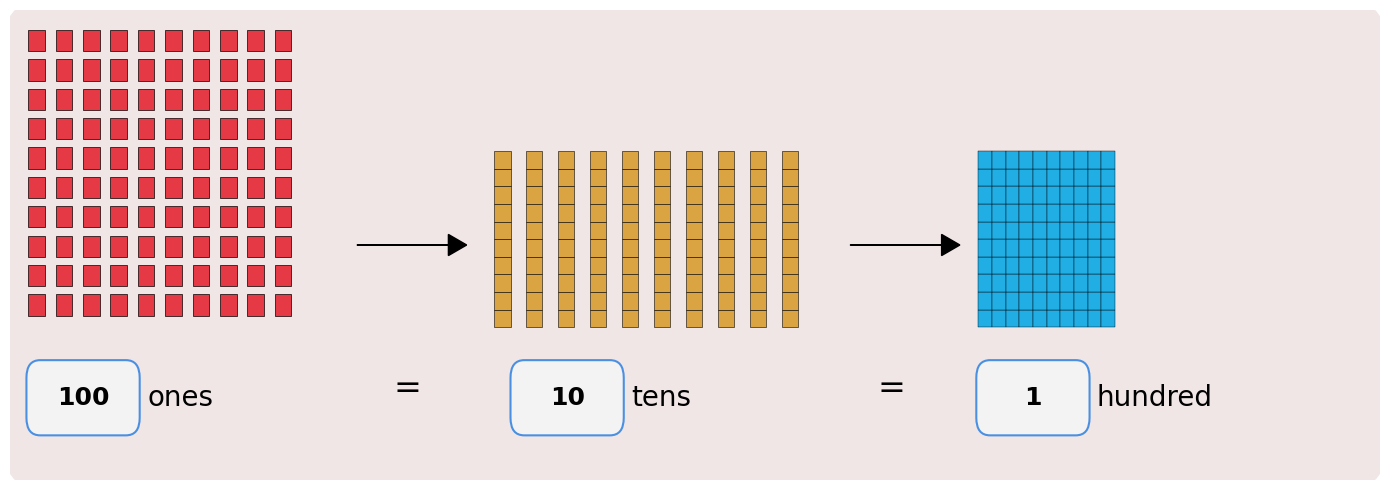
So if you have 10 groups of 10, you get 100. That's one hundred.
-
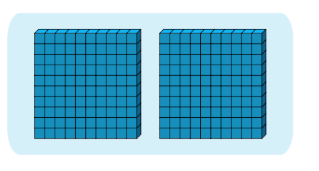
2 hundreds = 20 tens = 200 ones = 200
-
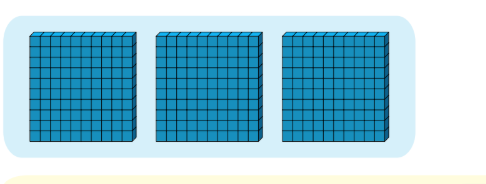
3 hundreds = 30 tens = 300 ones = 300
Hundreds, Tens and Ones
Every three-digit number can be split into hundreds, tens, and ones.
Let's look at a few examples:
Example 1:
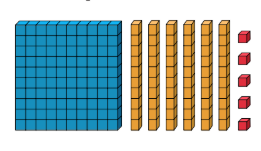
If there are 1 hundred, 6 tens, and 5 ones, the number is 165.
Example 2:
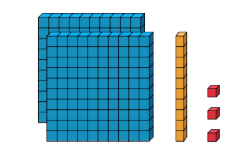
If there are 2 hundreds, 1 ten, and 3 ones, the number is 213.
Example 3:
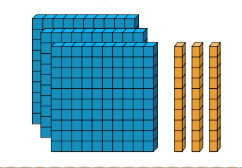
If there are 3 hundreds, 3 tens, and 0 ones, the number is 330.
Reading and Writing Numbers up to 999
Once a child can identify how many hundreds, tens, and ones are in a number, reading and writing it becomes natural.
Example 1: The number 376 has 3 hundreds, 7 tens, and 6 ones.
Number name: three hundred seventy-six
Example 2: The number 209 has 2 hundreds, 0 tens, and 9 ones.
Number name: two hundred nine
Place Value and Face Value of Numbers up to 999
What Is Place Value?
The place value of a digit is the value it carries because of its position in the number.
Let's use the number 521:
So even though the digit is just 5, because it's sitting in the hundreds place, it actually represents 500.
What Is Face Value?
The face value of a digit is simply the digit itself, regardless of where it is in the number.
In 521:
-
Face value of 5 is 5
-
Face value of 2 is 2
-
Face value of 1 is 1
Consider the number 632
Comparison of Numbers
This section gives clear, step-by-step rules to find which number is bigger.
Rule 1: More Digits = Greater Number
A number with more digits is always greater than one with fewer digits.
866 vs 45
866 has 3 digits, 45 has 2 digits ⇒ 866 > 45
Rule 2: Compare the Hundreds Place First
If both numbers have 3 digits, look at the hundreds digit first.
790 vs 529 ⇒ 7 > 5 ⇒ 790 > 529
Rule 3: Same Hundreds, then Compare the Tens
If the hundreds digits are the same, move to the tens place.
229 vs 290 ⇒ Both have 2 in hundreds. Compare tens: 2 < 9 ⇒ 229 < 290
Rule 4: Same Hundreds and Tens then Compare the Ones
475 vs 479 ⇒ Hundreds same (4), Tens same (7). Ones: 5 < 9 ⇒ 475 < 479
Before, After and In Between Numbers
This concept teaches children to understand the neighbourhood of a number: what comes just before it, just after it, and what sits between two numbers.
Just Before
The number that comes just before a given number is 1 less than it.
Just before 400 → 399
Just before 235 → 234
Just before 667 → 666
Just After
The number that comes just after a given number is 1 more than it.
Just after 301 → 302
Just after 254 → 255
Just after 769 → 770
In Between
The number that comes between two consecutive numbers sits right in the middle.
Between 498 and 500 → 499
Between 111 and 113 → 112
Between 309 and 311 → 310
Ordering Numbers
Ascending Order:
When we arrange numbers from smallest to biggest, that's called ascending order.
Example: Arrange 452, 238, and 397 in ascending order.
Step: Compare the hundreds digits: 2 < 3 < 4
So the answer is: 238 < 397 < 452
Descending Order
When we arrange numbers from biggest to smallest, that's called descending order.
Example: Arrange 193, 345, and 568 in descending order.
Step: Compare the hundreds digits: 5 > 3 > 1
So the answer is: 568 > 345 > 193
Here's a set of questions for practice. Solve them in a notebook with a proper layout.
Numbers make sense when they're taught right. To see how Orchids The International School turns Maths from intimidating to intuitive, reach out to our admissions team.
Frequently Asked Questions of Numbers Up to 999 for Class 2
1. What is the smallest 3-digit number?
The smallest 3-digit number is 100.
2. What is the largest 3-digit number?
The largest 3-digit number is 999.
3. What is the difference between place value and face value?
Place value is the value a digit holds because of where it is in the number. Face value is simply the digit itself. In 642, the face value of 6 is 6, but its place value is 600.
4. What is the number just after 999?
The number just after 999 is 1000.
5. How do you compare two 3-digit numbers?
Always start with the hundreds place. If those are equal, move to the tens. If tens are also equal, compare the ones.
Related Links


Admissions Open for 2026-27
What type of concept pages would you prefer?
CBSE Schools In Popular Cities
- CBSE Schools in Bangalore
- CBSE Schools in Mumbai
- CBSE Schools in Pune
- CBSE Schools in Hyderabad
- CBSE Schools in Chennai
- CBSE Schools in Gurgaon
- CBSE Schools in Kolkata
- CBSE Schools in Indore
- CBSE Schools in Sonipat
- CBSE Schools in Delhi
- CBSE Schools in Rohtak
- CBSE Schools in Bhopal
- CBSE Schools in Aurangabad
- CBSE Schools in Jabalpur
- CBSE Schools in Jaipur
- CBSE Schools in Jodhpur
- CBSE Schools in Nagpur
- CBSE Schools in Ahmednagar
- CBSE School In Tumkur











Orchids The International School is one of India's leading chains of CBSE and ICSE schools, with 110+ schools across the country.