

Class 7 - Bar Graph: Definition, Examples and Uses
A bar graph is a graphical representation of data that uses rectangular bars of equal width with varying heights or lengths to show comparisons among different categories. Bar graphs are an effective tool for visualizing and comparing data across different categories. It helps organize, interpret, and analyze data in a clear and structured manner. In this guide, we will learn how to read, interpret, and construct bar graphs step by step with simple examples.
Table of Contents
- What is a Bar Graph?
- Properties of Bar Graph
- Types of Bar Graph
- How to Draw a Bar Graph
- Solved Examples on Bar Graph
- Practice Questions on Bar Graph
- Real-Life Applications of Bar Graph
- Frequently Asked Questions of Bar Graphs

What is a Bar Graph?
A bar graph or bar diagram is a diagram that represents data with the help of bars or rectangles of uniform width. Each bar corresponds to a category, and its height (or length, for horizontal bars) corresponds to the value of that category.
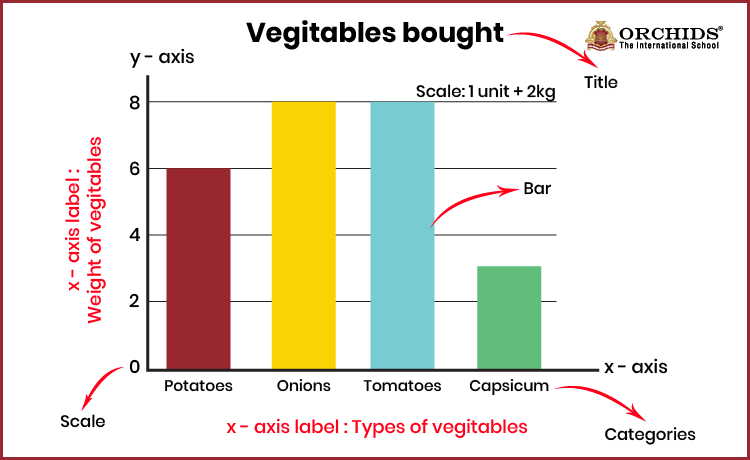
Every proper bar graph has these components:
-
Title: Title tells the reader what the graph is about. E.g., "Monthly Rainfall in Mumbai 2026.
-
X-axis: Typically shows the categories or labels being compared.
-
Y-axis: Shows the scale of measurement i.e.,the numerical values.
-
Scale: The numbered markings on the Y-axis. E.g., 0, 10, 20, 30... Each mark represents a value.
-
Bars: Bars are the rectangular columns. Each bar represents one category. All bars have the same width.
-
Labels: Labels are names written below each bar (X-axis labels) and alongside the Y-axis showing units.
Know more about related topics:
Properties of Bar Graph
There are specific rules that every bar graph must follow. These properties ensure the graph is accurate and easy to read:
-
Common base line: All bars must start from the same baseline (usually the X-axis). No bar can float above the base.
-
Equal width: Every single bar in the graph must have the same width. Only height (or length) varies.
-
Proportional height: The height of each bar must be exactly proportional to the data value it represents.
-
Equal spacing: The gap between consecutive bars must be uniform throughout the graph.
-
Clear scale: The Y-axis must have a consistent, evenly-spaced scale starting from zero (or a clearly indicated value).
-
Title and labels: Every bar graph must have a descriptive title, axis labels, and a unit of measurement indicated.
Types of Bar Graph
Bar graphs can be classified into different types based on how the data is represented and compared. Each type is used to display data depending on whether we are comparing a single set of values or multiple related data sets.
-
Vertical Bar Graph (Column Graph)
In vertical bar graph the bars stand upright. They go from the base upward. The X-axis has the categories and the Y-axis has the values.
-
Horizontal Bar Graph
In a horizontal bar graph, the bars run from left to right instead of bottom to top. The Y-axis has the categories and the X-axis has the values. Everything is just rotated 90°.
-
Grouped Bar Graph (Multiple Bar Graph)
A grouped bar graph (also called a multiple bar graph or clustered bar graph) shows two or more sets of data for each category, side by side. Different colours are used to distinguish each set, and a legend explains what each colour means.
-
Stacked Bar Graph (Composite Bar Graph)
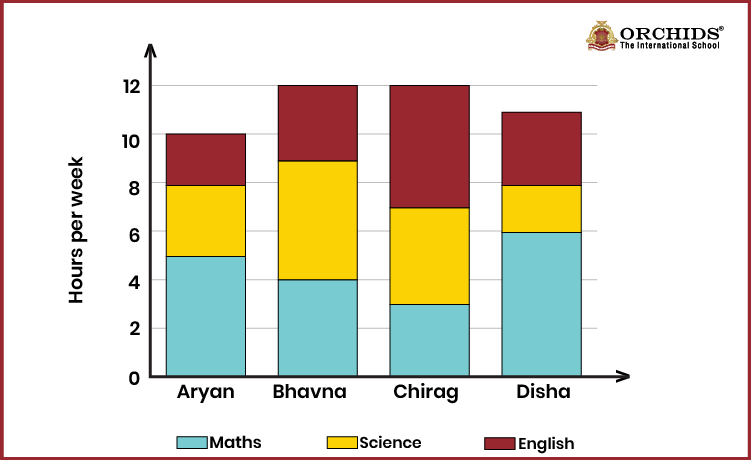
In a stacked bar graph, the bars are divided into segments, with each segment representing a different sub-category. The segments are stacked on top of each other within the same bar, and different colours represent different parts of the whole.
How to Draw a Bar Graph
Here's a clear, step-by-step process to draw a bar graph:
-
Collect and organise your data: Write your data in a table format ,one column for categories, one for values. Make sure all values are in the same unit.
-
Draw and label the axes: The horizontal line is the X-axis (for categories), and the vertical line is the Y-axis (for values). Label both axes with their names and units.
-
Choose and mark your scale: Look at the highest value. Choose a scale that fits all values comfortably on your paper.
-
Mark category positions on X-axis: Mark equally spaced positions along the X-axis for each category. Write the category name below each position. Leave equal gaps between each position so the bars will have uniform spacing.
-
Draw the bars: For each category, draw a rectangular bar with equal width, centered on its position. The height of each bar corresponds to the data value on your scale. All bars must touch the X-axis (start from the base).
-
Add a title: Write a clear, descriptive title at the top of the graph.
Solved Examples on Bar Graph
In this section, we will solve examples based on bar graphs to understand how to read and interpret data. We will also learn how to compare values and answer questions using the graph.
Example 1: Given below is the tiger population of 5 states from the census of 2019. Represent data on a graph.
Tiger population of 5 states:
Solution: To draw the bar graph, follow these steps:
• On graph paper, draw the x-axis and y-axis and their point of intersection.
• Keeping the distance between two sets of joint bars equal, show the classes on the x-axis.
• Choose a scale for the y-axis. For example, 1 cm = 100 tigers
• Mark the number of tigers on the y-axis.
• Using the scale, work out the height of columns required to show the numbers of tigers.
Example 2: A city's weather forecast for a week is displayed. Use a double bar graph to represent the data:
Solution:
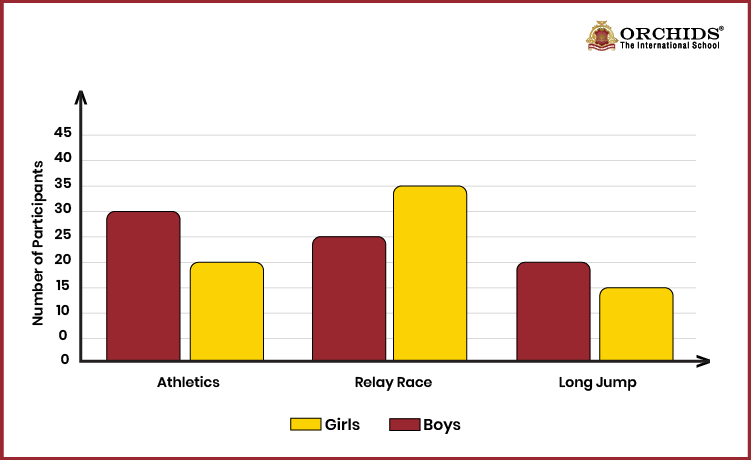
Example 3:The grouped bar graph below shows the number of boys and girls who participated in three events at a school sports day. Answer the questions.
(a) In which event did the maximum number of boys participate?
(b) In which event were girls more than boys?
(c) What is the total participation in the Relay Race?
Solution:
(a) Number of boys in athletics = 30
Number of boys in relay = 25
Number of boys in long jump = 20
Therfore,Athletics had the maximum boys (30).
(b) Athletics: Number of girls = 20, Number of boys = 30.
Relay: Number of girls = 35, Number of boys = 25.
Long Jump: Number of girls = 15, Number of boys = 20
Therefore, relay race had more girls than boys.
(c) Relay Race: Boys = 25, Girls = 35
Therefore, total participants in relay race = 60 participants.
Practice Questions on Bar Graph
-
In a bar graph representing the number of books sold by a library in 5 days, the total number of books sold across all days is 250. The books sold on Monday, Tuesday, Wednesday, and Friday are 40, 60, 55, and 45 respectively. How many books were sold on Thursday? If the scale used is 1 cm = 10 books, what would be the height of Thursday's bar?
-
The following table shows the production of ketchup bottles by a company for 6 months. Draw a bar graph for the given data.
-
The strength of different grades of a school is given below. Represent the data using a bar graph.
Real-Life Applications of Bar Graph
-
News & Media: Election results, COVID case counts, economic data, etc., newspapers and TV news use bar graphs to present complex data quickly.
-
Healthcare: Hospitals use bar graphs to compare patient counts, disease frequency by age group, vaccination rates across districts, etc.
-
Business: Companies compare monthly/yearly sales, product performance, and revenue across branches using bar charts in reports.
-
Weather & Climate: Monthly rainfall, temperature comparisons, and seasonal data are displayed in bar graphs on weather websites and apps.
-
School & Education: Report cards and academic analysis often use bar graphs to show performance across subjects or across exam terms.
-
Elections & Surveys: Vote counts by candidate, survey results, and opinion poll data are among the most common uses of bar graphs in public life.
Numbers make sense when they're taught right. To see how Orchids The International School turns Maths from intimidating to intuitive, reach out to our admissions team.
Frequently Asked Questions of Bar Graphs
1. What is bar graph definition?
A bar graph or bar diagram is a diagram that represents data with the help of bars or rectangles of uniform width.
2. Can a bar graph start from a value other than 0?
Yes, a bar graph can start from a value other than 0, but this is not usually recommended. Starting from a non-zero value may distort the visual comparison and mislead the interpretation of data. If used, a clear break in the axis should be shown to indicate the change in scale.
3. What are bar graphs used for?
Bar graphs are used to compare different groups or categories in a clear and visual way.In everyday life, they are useful for things like showing survey results, sales data, or student marks.
4. How many types of bar graph are there?
There are primarily 5 types of bar graph: (1) Vertical bar graph, (2) Horizontal bar graph, (3) Grouped/multiple bar graph, (4) Stacked/composite bar graph, and (5) Percentage bar graph.
Related Links


Admissions Open for 2026-27
What type of concept pages would you prefer?
CBSE Schools In Popular Cities
- CBSE Schools in Bangalore
- CBSE Schools in Mumbai
- CBSE Schools in Pune
- CBSE Schools in Hyderabad
- CBSE Schools in Chennai
- CBSE Schools in Gurgaon
- CBSE Schools in Kolkata
- CBSE Schools in Indore
- CBSE Schools in Sonipat
- CBSE Schools in Delhi
- CBSE Schools in Rohtak
- CBSE Schools in Bhopal
- CBSE Schools in Aurangabad
- CBSE Schools in Jabalpur
- CBSE Schools in Jaipur
- CBSE Schools in Jodhpur
- CBSE Schools in Nagpur
- CBSE Schools in Ahmednagar
- CBSE School In Tumkur











Orchids The International School is one of India's leading chains of CBSE and ICSE schools, with 130+ schools across the country.