

Class 9 - Heron's Formula
Heron's formula is used to find the area of different types of triangles when the height of triangle is not known. The general formula to calculate the area of a triangle is 1/2 x Base x Height. In cases where the height of the triangle is not given we can use Heron's formula to calculate the area of the triangle using the length of its three sides. This formula is named after a Greek mathematician Alexandria who studied this relationship between the sides of a traingle. This formula is widely applied to solve many geomerty problems especially in 9th grade maths. In this article, we will cover this topic in detail including Heron's formula definition, its derivation, proof and step-by-step process of calculating the area of triangle using heron’s formula along with examples.
Table of Content
- What is Heron's Formula
- History of Heron's Formula
- Definition of Heron's Formula
- Area of Triangle Using Heron's Formula
- Solved Examples on Heron's Formula

What is Heron's Formula
The Heron's formula is highly useful to find the area of a triangle using the length of three sides of a triangle. This formula is applicable for all three types of triangles including: isosceles, equilateral and scalene triangle.
Area = √[s(s − a)(s − b)(s − c)]
Where: a, b, c are the sides of the triangle and s is the semi-perimeter of the triangle
To find the semi-perimeter 's' of a triangle we can use the following formual s =
Know more about related topics:
History of Heron's Formula
Heron's formula was given in 60 CE by a Greek mathematician Alexandria who determined the area of a triangle using only the length of its three sides. He further extended this study to evaluate the area of quadrilaterals and also prove the laws of trigonometry using this formula. Heron was born in about 10AD possibly in Alexandria in Egypt. He worked in applied mathematics. His works on mathematical and physical subjects are so numerous and varied that he is considered to be an encyclopedic writer in these fields.
Definition of Heron's Formula
Heron's formula can be defined as the formula applied to find the area of triangle using the length of three sides: Area = √[s(s − a)(s − b)(s − c)]
where a, b and c are the sides of the triangle, and s = semi-perimeter, i.e., half the perimeter of the triangle = a + b + c
Area of Triangle Using Heron's Formula
To find the area of a triangle using heron's formula we need to know the length of all three sides of a triangle. For example, if a, b and c are three sides of a triangle △ABC then, s is called the semi-perimeter of the triangle such that s = .
Let's see how to use heron’s formula for the area of a triangle when the length of three sides is given as: a = 5, b = 4 and c = 2.
To use heron’s formula = Area = √[s(s − a)(s − b)(s − c)]
First, we need to find the semi-perimeter of the triangle by using formulas. i. e., s = = = = 6
Now, use the value of s = 6 in the formula of Area: √[s(s − a)(s − b)(s − c)] = √[12(12 − 5)(12 − 4)(12 − 3)] = √[12(7) x(8) x (9)] = √6048 = 12√42
Therefore, area of triangle = 12√42
Solved Examples on Heron's Formula
Example 1: Find the area of a triangle with sides a = 6 cm, b = 2 cm and c = 4 cm
Solution: To find the area of given triangle using heron's formula:
First, let's first find the semi-perimeter 's' = = = = 6
Now use the value of semi-perimeter to find the area A = √[s(s − a)(s − b)(s − c)]
= √[12(12 − 6)(12 − 2)(12 − 4)] = √[12(6) x (10) x (8)]
= √5760
= 75.54
Example 2: Find the area of an equilateral triangle with sides as 10 cm
Solution: To find the area of an equilateral triangle using Herons formula we just need the length of only one side because all sides are equal.
So, in given triangle a = 10 cm, b = 10 cm and c = 10 cm
Formula for Area of triangle using Herons formula: A = √[s(s − a)(s − b)(s − c)]
To find the area of an equilateral triangle we first have to find the semi-perimeter 's'
s = = = 15
Therefore, Area A = √15(15 - 10) x (15 -10) x (15 -10)
Area of triangle = √9(5) (5) (5) cm = 25√3
Example 3: A triangular park ABC has sides 120m, 80m and 50m. A gardener Dhania has to put a fence all around it and also plant grass inside. How much area does she need to plant? Find the cost of fencing it with barbed wire at the rate of `20 per metre leaving a space 3m wide for a gate on one side.
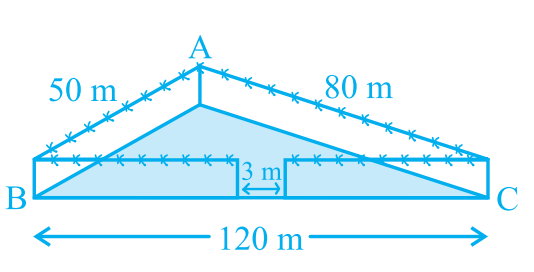
Solution: For finding area of the park, we have
2s = 50 m + 80 m + 120 m = 250 m.
i.e., s = 125 m
Now, s – a = (125 – 120) m = 5 m,
s – b = (125 – 80) m = 45 m,
s – c = (125 – 50) m = 75 m.
Therefore, area of the park = A = √[s(s − a)(s − b)(s − c)]
= A = √[125 x 5 x 45 x 75] m2
= 375 √15
Also, perimeter of the park = AB + BC + CA = 250 m
Therefore, length of the wire needed for fencing = 250 m – 3 m (to be left for gate)
= 247 m
And so the cost of fencing = `20 × 247 = `4940
Numbers make sense when they're taught right. To see how Orchids The International School turns Maths from intimidating to intuitive, reach out to our admissions team.
Frequently Asked Questions on Heron's Formula
1. What is Heron's formula?
Heron's formula is used to find the area of a triangle using the length of sides of a trianlge: Area = √[s(s − a)(s − b)(s − c)], where s is the semi-perimeter of triangle and a, b and c is the length of the triangle.
2. What does s stands for in Heron's formula?
's' stands for the semi-perimeter of a triangle that can be calculated using the formula: s =
3. Who discovered Heron's formula?
Heron's formula was discovered by a Greek mathematician Alexandria.
Related Links


Admissions Open for 2026-27
What type of concept pages would you prefer?
CBSE Schools In Popular Cities
- CBSE Schools in Bangalore
- CBSE Schools in Mumbai
- CBSE Schools in Pune
- CBSE Schools in Hyderabad
- CBSE Schools in Chennai
- CBSE Schools in Gurgaon
- CBSE Schools in Kolkata
- CBSE Schools in Indore
- CBSE Schools in Sonipat
- CBSE Schools in Delhi
- CBSE Schools in Rohtak
- CBSE Schools in Bhopal
- CBSE Schools in Aurangabad
- CBSE Schools in Jabalpur
- CBSE Schools in Jaipur
- CBSE Schools in Jodhpur
- CBSE Schools in Nagpur
- CBSE Schools in Ahmednagar
- CBSE School In Tumkur











Orchids The International School is one of India's leading chains of CBSE and ICSE schools, with 110+ schools across the country.