

Class 9 Maths Chapter 6 Measuring Space: Perimeter and Area Notes with Free PDF Download
Class 9 Maths Chapter 6 Measuring Space: Perimeter and Area Notes Free PDF Download is prepared based on the latest CBSE and NCERT syllabus. These notes will help in school exams, board exams, and quick revision. They help students understand the chapter clearly, revise faster, and prepare for exams with confidence.
Table Of Contents
- Introduction to Measuring Space: Perimeter and Area
- Understanding Perimeter
- Understanding Area
- Perimeter and Area of Squares
- Perimeter and Area of Rectangles
- Perimeter and Area of Triangles
- Perimeter and Area of Parallelograms
- Perimeter and Area of Circles
- Composite Figures and Their Areas
- Applications of Perimeter and Area in Real Life
- Important Formulas from Measuring Space: Perimeter and Area
- Key Concepts to Remember
- Solved Examples for Quick Revision
- Measuring Space: Perimeter and Area Notes PDF
- Frequently Asked Questions on Class 9 Maths Chapter 6 Measuring Space: Perimeter and Area Notes

Introduction to Measuring Space: Perimeter and Area
What Is Perimeter?
Perimeter is the total length of the boundary of a flat shape. In simple words, if you walk along the outer edge of a shape from start to finish and come back to where you started, the total distance you cover is the perimeter.
Think of a football field. If you jog around the entire edge of the field once, the distance you cover is the perimeter of that field. Every flat shape a square, a rectangle, a triangle, a circle has a perimeter.
Perimeter is always measured in units of length such as centimetres, metres, or kilometres.
What Is Area?
Area is the amount of flat surface enclosed within the boundary of a shape. In simple words, it tells you how much space is covered or occupied by a flat shape.
Think of the same football field. The total grass surface inside the boundary the part the players run on is the area of that field. Area tells you how much "filling" a shape has inside it.
Area is always measured in square units such as square centimetres (cm²), square metres (m²), or square kilometres (km²).
Know more about related topics:
- Class 9 Maths Mcqs Chapter 6 Measuring Space Perimeter And Area
- Class 9 Maths Case Study Chapter 6 Measuring Space Perimeter And Area
- Important Questions Class 9 Maths Measuring Space Perimeter And Area
- Assertion Reason Questions For Class 9 Maths Chapter 6 Measuring Space Perimeter And Area
- Area And Perimeter
Understanding Perimeter
Definition of Perimeter
The perimeter of a shape is the total distance around its outer boundary. It is found by adding together the lengths of all the sides of the shape.
General Rule: Perimeter = sum of all sides
This simple rule works for any shape, regardless of how many sides it has.
Perimeter of Regular Shapes
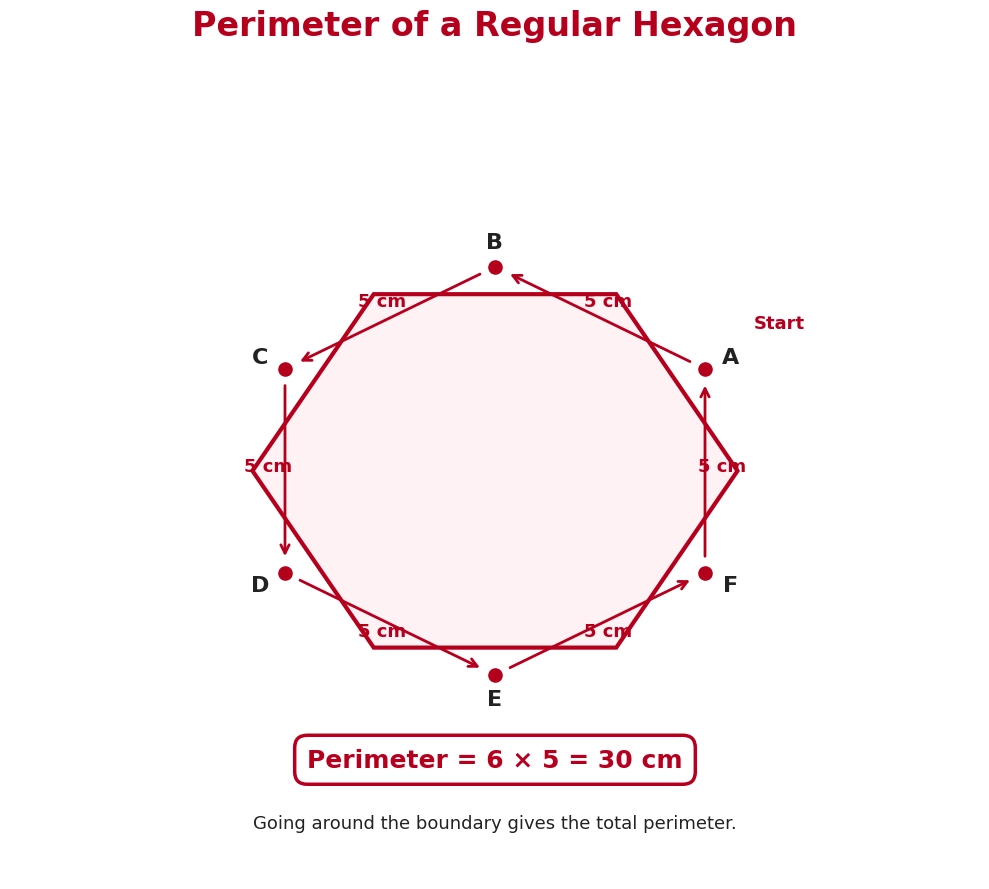
A regular shape is one where all sides are equal in length and all angles are equal. Because the sides are all the same, the perimeter formula for a regular shape is simply:
Perimeter of a regular shape = number of sides × length of one side
For example, a regular hexagon (six equal sides, each 5 cm long) has a perimeter of 6 × 5 = 30 cm.
Perimeter of Irregular Shapes
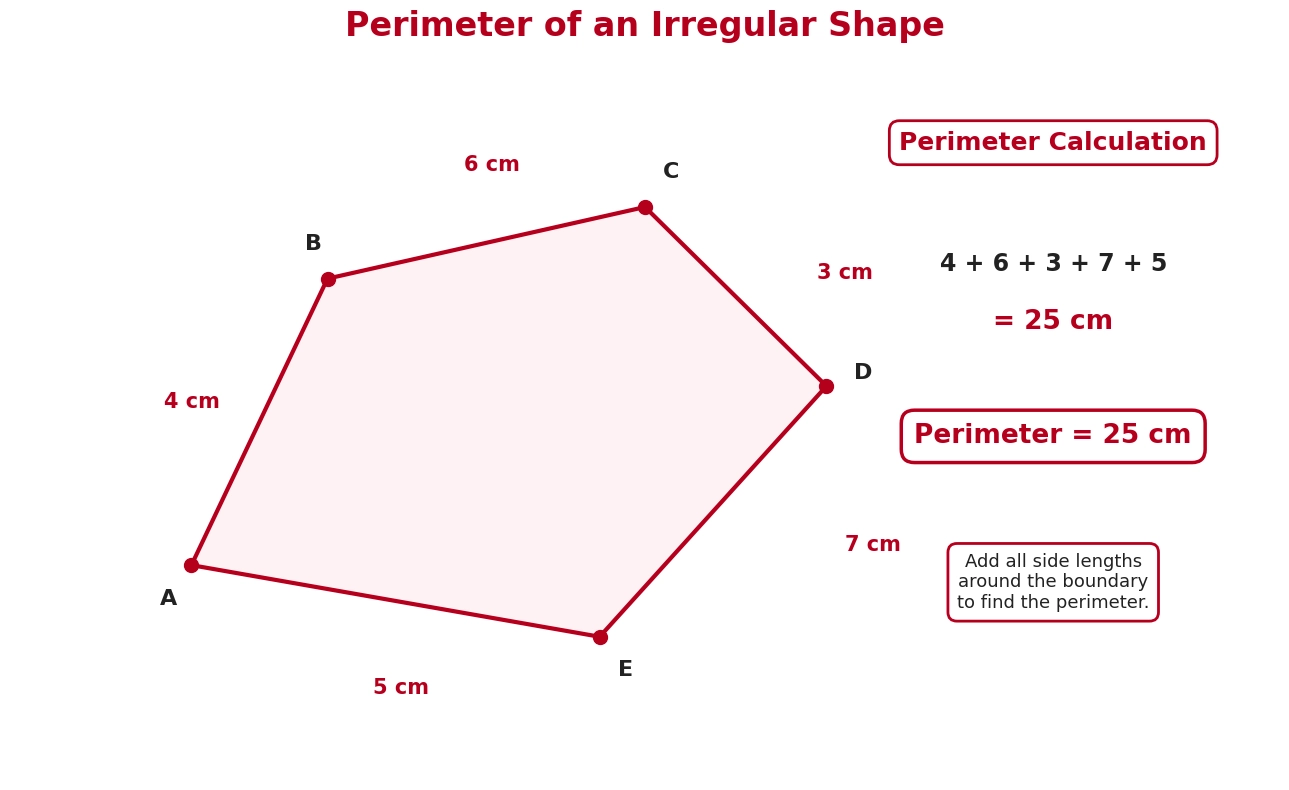
An irregular shape is one where the sides are different lengths. To find the perimeter, you simply measure each side individually and add all the lengths together.
Perimeter of an irregular shape = side 1 + side 2 + side 3 + ... (all sides)
Understanding Area
Definition of Area
The area of a shape is the measure of the flat surface enclosed within its boundary. It tells you how much space is covered by the shape on a flat surface.
Area is found using specific formulas for each shape. The formula varies depending on whether the shape is a square, rectangle, triangle, circle, or some other form.
Units of Area Measurement
Since area involves two dimensions length and width it is always expressed in square units:
-
Square millimetres (mm²), used for very small objects
-
Square centimetres (cm²), used for objects like books, tiles, or notebooks
-
Square metres (m²), used for rooms, floors, and walls
-
Square kilometres (km²), used for large land areas like cities or forests
-
Hectares (ha), used in agriculture and land measurement; 1 hectare = 10,000 m²
Difference Between Area and Perimeter
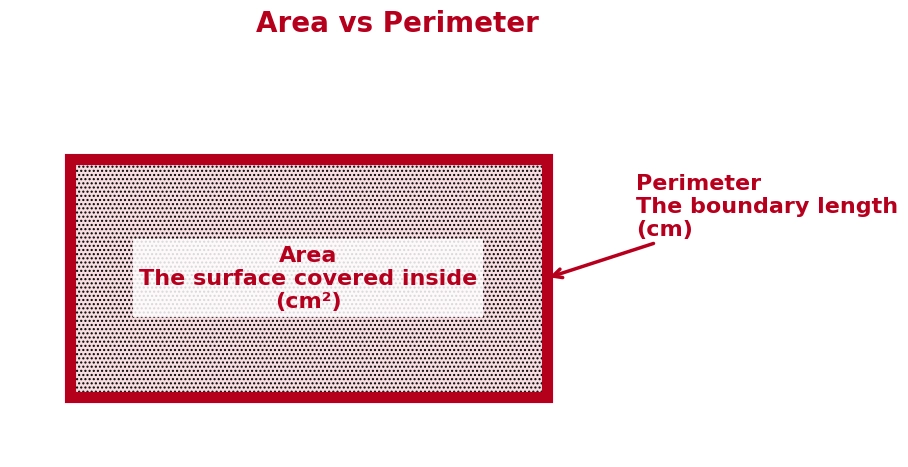
This is one of the most important distinctions in the entire chapter. Many students confuse these two measurements:
Perimeter measures the boundary the distance around the outside edge of a shape. It is measured in simple length units (cm, m, km).
Area measures the surface the space covered inside the shape. It is measured in square units (cm², m², km²).
Perimeter and Area of Squares
Formula for the Perimeter of a Square
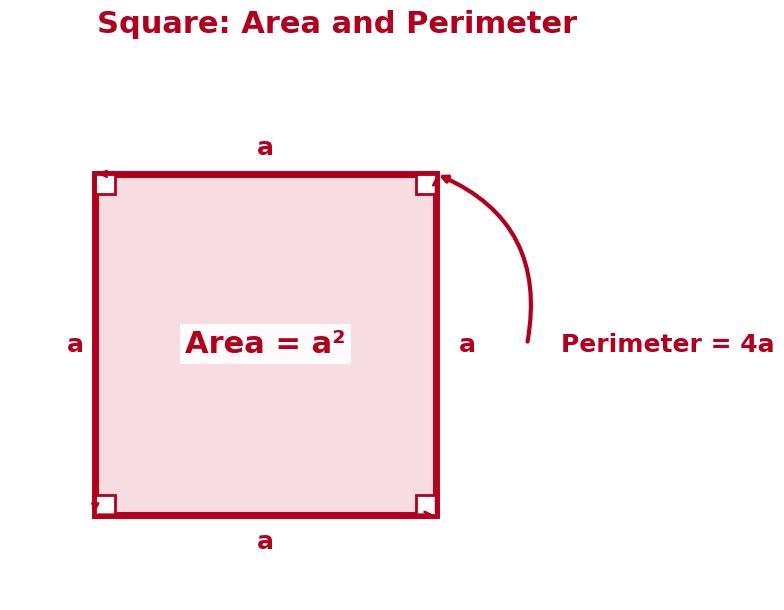
A square has four sides that are all equal in length. The perimeter is simply four times the side length.
Perimeter of a Square = 4 × side
If the side of the square is called "a": P = 4a
Formula for the Area of a Square
The area of a square is the side length multiplied by itself.
Area of a Square = side × side = side²
If the side of the square is called "a": A = a²
Solved Example on Squares
Question: A square garden has a side length of 8 metres. Find its perimeter and area.
Perimeter: P = 4 × side = 4 × 8 = 32 metres
Area: A = side² = 8² = 8 × 8 = 64 m²
The fence needed to go around the garden would be 32 metres long. The amount of grass covering the garden is 64 square metres.
Perimeter and Area of Rectangles
Formula for the Perimeter of a Rectangle
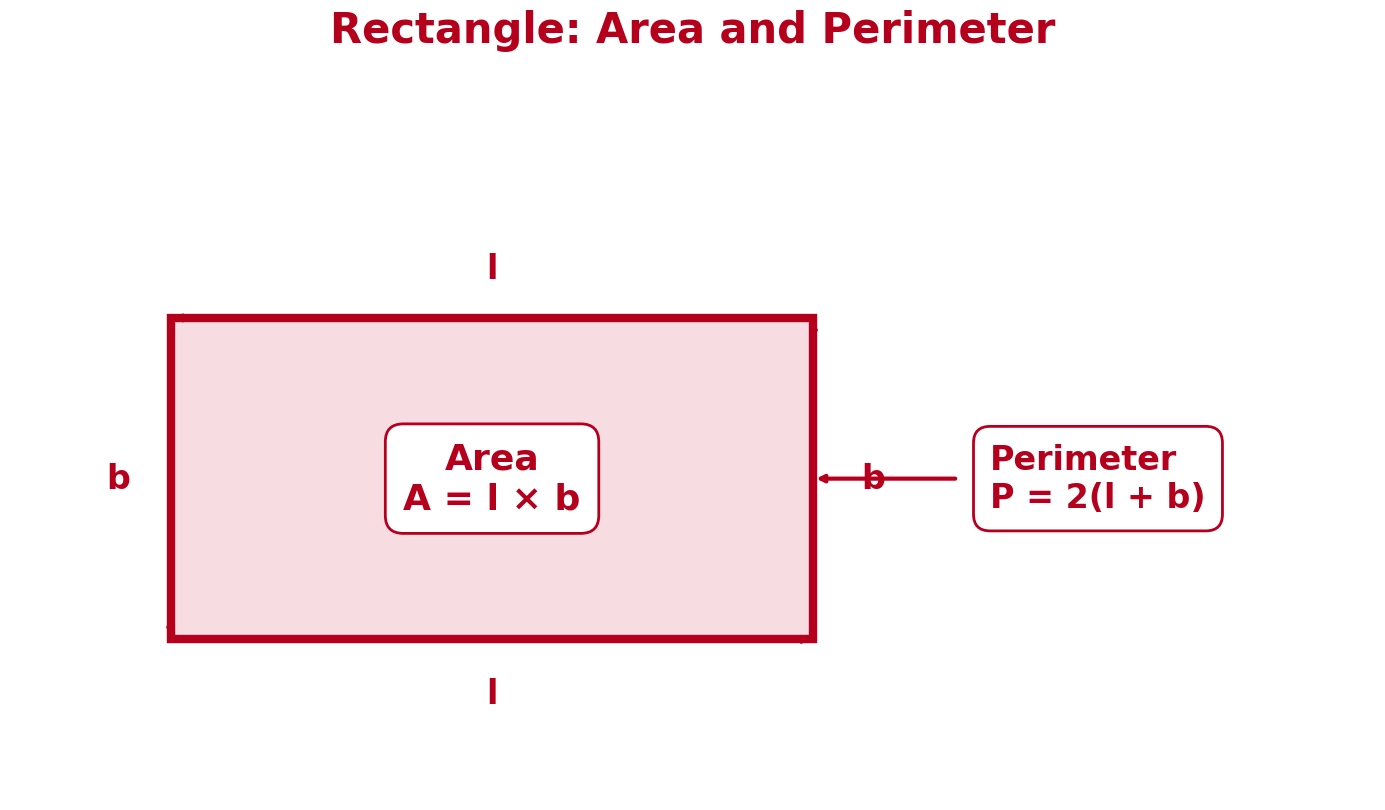
A rectangle has two pairs of equal sides. The longer sides are called the length (l) and the shorter sides are called the width or breadth (b). The perimeter adds all four sides:
Perimeter of a Rectangle = 2 × (length + breadth)
P = 2(l + b)
Formula for the Area of a Rectangle
The area of a rectangle is the length multiplied by the breadth.
Area of a Rectangle = length × breadth
A = l × b
Solved Example on Rectangles
Question: A rectangular room is 12 metres long and 7 metres wide. Find the perimeter and area.
Perimeter: P = 2(l + b) = 2 × (12 + 7) = 2 × 19 = 38 metres
Area: A = l × b = 12 × 7 = 84 m²
Meaning: The total length of the four walls along the floor is 38 metres. The floor space of the room covers 84 square metres.
Perimeter and Area of Triangles
Formula for the Perimeter of a Triangle
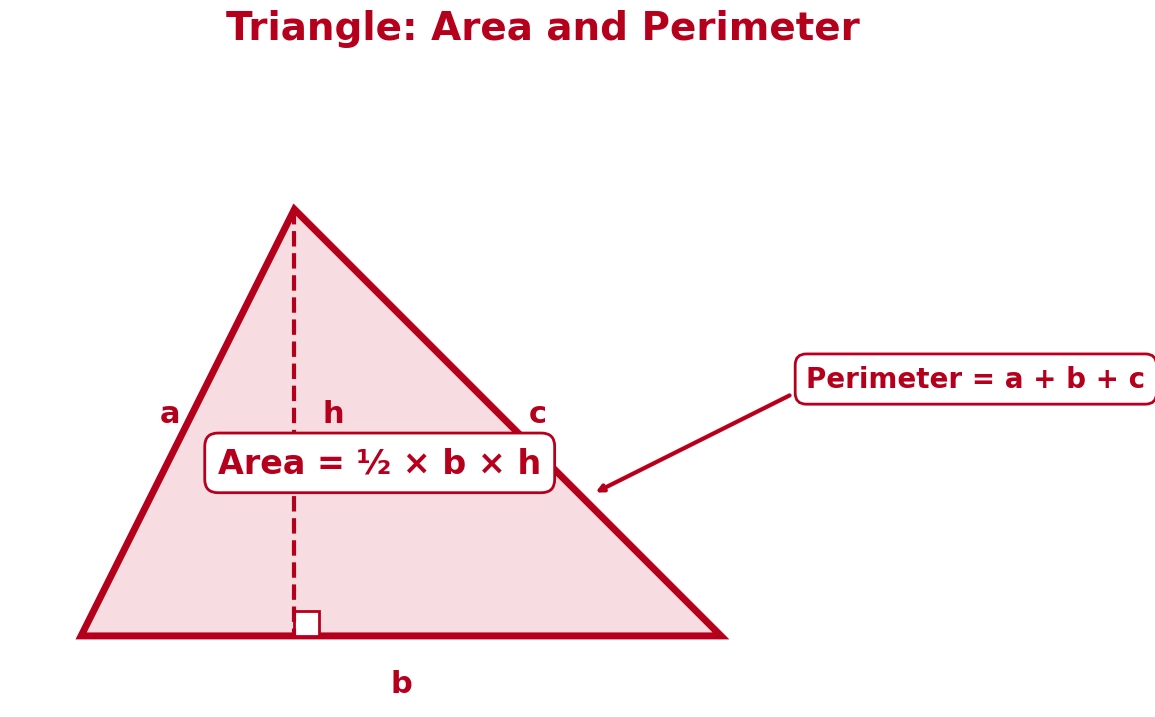
A triangle has three sides. The perimeter is the sum of all three sides. If the sides are labelled a, b, and c:
Perimeter of a Triangle = a + b + c
Formula for the Area of a Triangle
The standard formula for the area of a triangle requires the base length and the perpendicular height the vertical distance from the base to the opposite vertex.
Area of a Triangle = (1/2) × base × height
A = (1/2) × b × h
Solved Example on Triangles
Question: A triangular plot of land has sides of 9 m, 12 m, and 15 m. The base is 12 m and the height is 7.2 m. Find the perimeter and area.
Perimeter: P = 9 + 12 + 15 = 36 metres
Area: A = (1/2) × 12 × 7.2 = (1/2) × 86.4 = 43.2 m²
Perimeter and Area of Parallelograms
Formula for the Perimeter of a Parallelogram
A parallelogram has two pairs of equal opposite sides. If the two different side lengths are a and b:
Perimeter of a Parallelogram = 2 × (a + b)
P = 2(a + b)
Formula for the Area of a Parallelogram
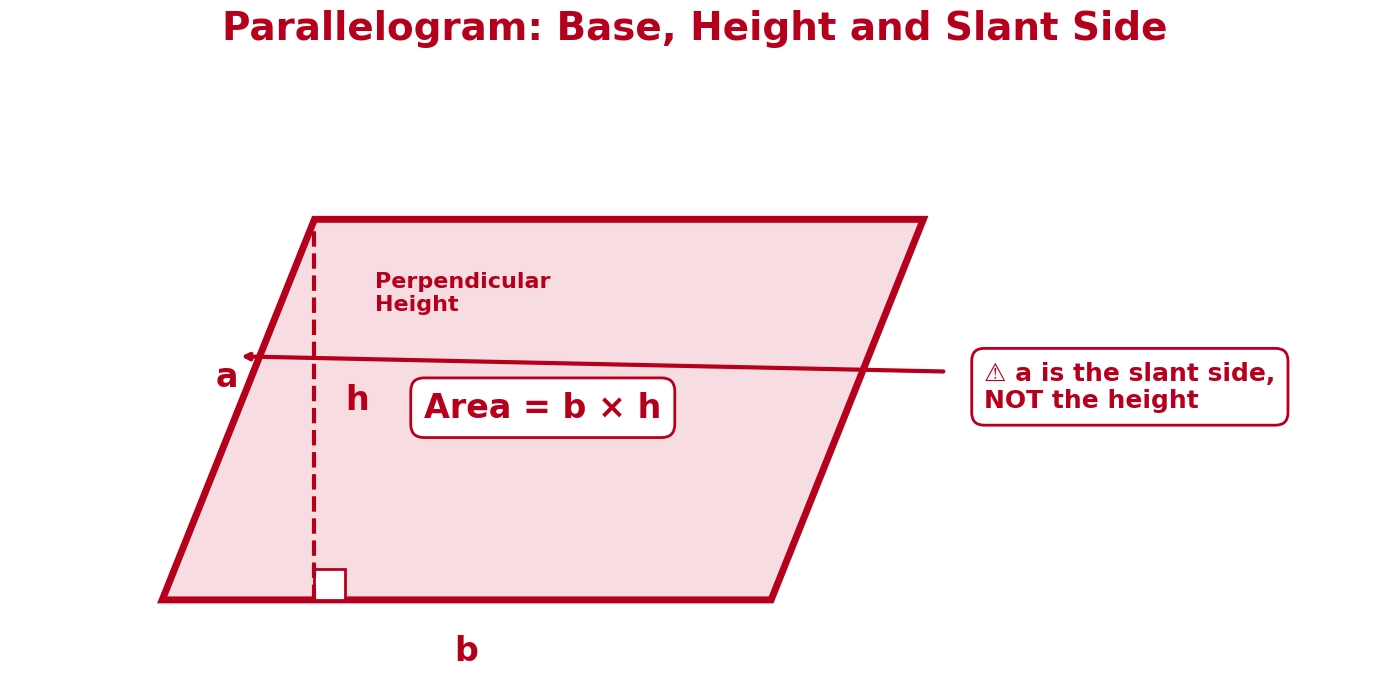
The area of a parallelogram uses the base and the perpendicular height not the slant side. The height is the straight vertical distance between the two parallel bases.
Area of a Parallelogram = base × height
A = b × h
Solved Example on Parallelograms
Question: A parallelogram has a base of 10 cm, a slant side of 8 cm, and a perpendicular height of 6 cm. Find the perimeter and area.
Perimeter: P = 2(a + b) = 2 × (8 + 10) = 2 × 18 = 36 cm
Area: A = base × height = 10 × 6 = 60 cm²
The slant side of 8 cm is used for the perimeter but NOT for the area. The perpendicular height of 6 cm is used only for the area.
Perimeter and Area of Circles
Circumference of a Circle
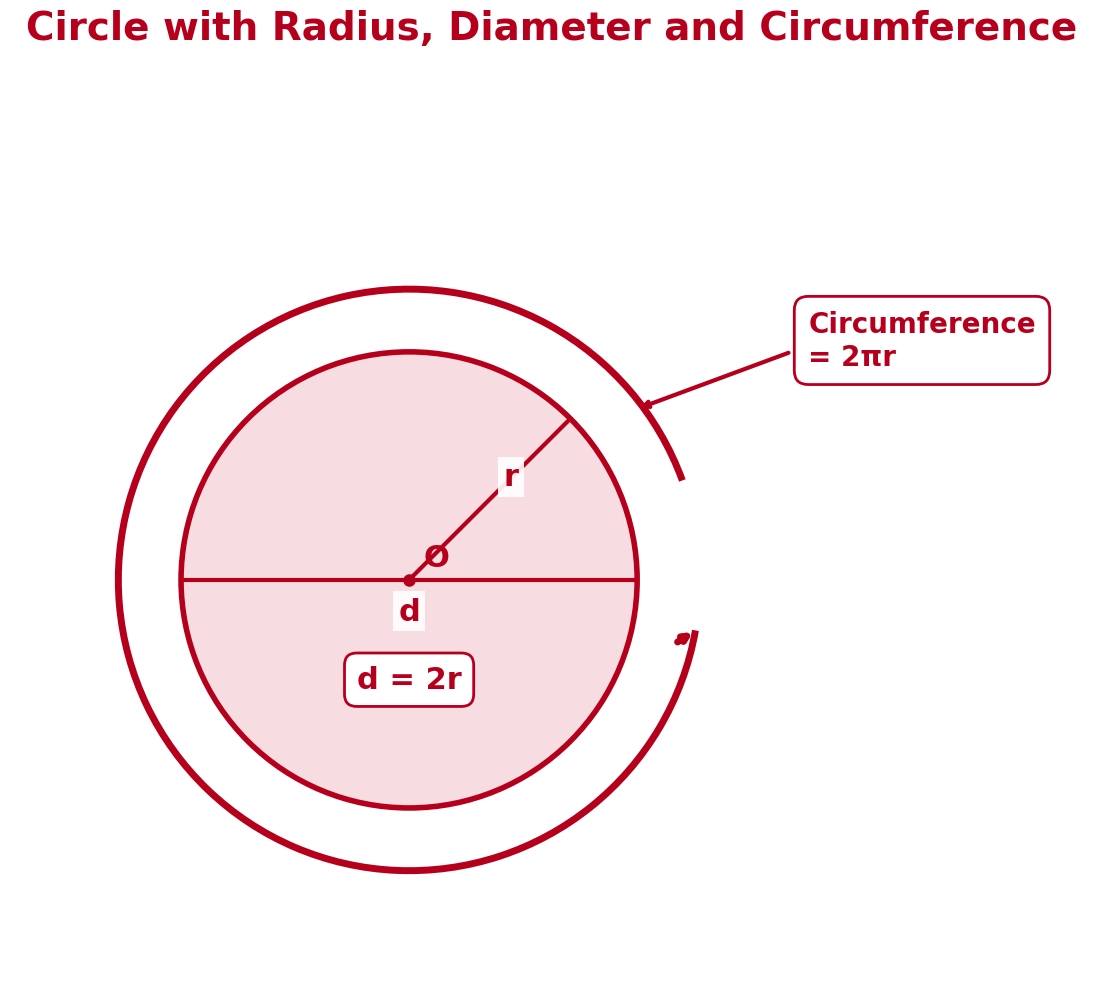
The perimeter of a circle has a special name it is called the circumference. It is the total distance around the curved boundary of the circle.
Circumference = 2 × π × radius
C = 2πr
The value of π (pi) is approximately 3.14159, often rounded to 3.14 or taken as 22/7 in calculations.
Area of a Circle
The area of a circle is the total flat surface enclosed within the circumference.
Area of a Circle = π × radius²
A = πr²
Relationship Between Radius and Diameter
The radius of a circle is the distance from the centre to any point on the circle's edge. The diameter is the distance across the full width of the circle passing through the centre. These two measurements are related by:
Diameter = 2 × radius d = 2r or equivalently: Radius = diameter ÷ 2 r = d/2
Solved Example on Circles
Question: A circular park has a radius of 14 metres. Find its circumference and area. (Use π = 22/7)
Circumference: C = 2πr = 2 × (22/7) × 14 = 2 × 22 × 2 = 88 metres
Area: A = πr²
= (22/7) × 14 × 14
= (22/7) × 196
= 22 × 28 = 616 m²
Composite Figures and Their Areas
What Are Composite Figures?
Composite figures are shapes that are made up of two or more simpler shapes joined together. In real life, most spaces and objects are not perfect squares or circles — they are combinations of several shapes. A composite figure could be a shape that is partly a rectangle and partly a semicircle, or a shape that is made of a square with a triangle on top.
Breaking Complex Shapes into Simpler Shapes
The key strategy for finding the area of a composite figure is to divide it into recognisable shapes whose area formulas you already know. Once divided, calculate the area of each simpler part separately.
Steps to solve composite figure problems:
First, look at the overall shape and identify the simpler shapes within it. Second, draw dotted dividing lines inside the shape to separate the individual parts. Third, find the dimensions of each part from the information given. Fourth, calculate the area of each part using its own formula. Fifth, add all the individual areas together to get the total area of the composite figure.
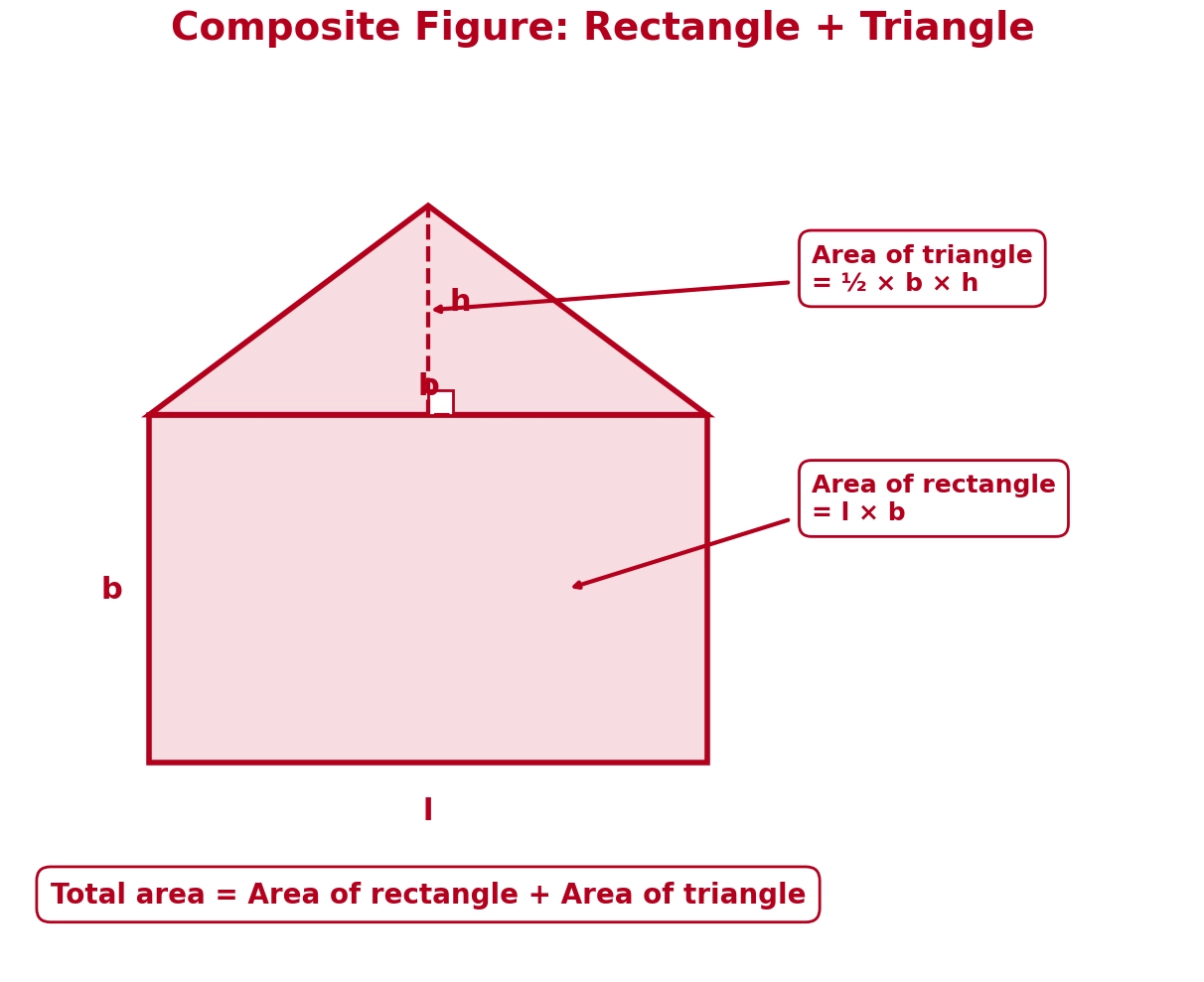
Finding the Total Area of Composite Figures
Solved Example:
Question: A shape consists of a rectangle 8 m long and 5 m wide, with a triangle on top having the same base (8 m) and a height of 3 m. Find the total area.
Area of rectangle: A₁ = l × b = 8 × 5 = 40 m²
Area of triangle: A₂ = (1/2) × base × height = (1/2) × 8 × 3 = 12 m²
Total Area: Total = A₁ + A₂ = 40 + 12 = 52 m²
Applications of Perimeter and Area in Real Life
Measuring Land and Property
When buying or selling land, the area of the plot is one of the most important pieces of information. Land is measured in square metres or hectares. Perimeter is used to find out how much fencing or boundary wall material is needed around the plot.
Construction and Architecture
Architects and civil engineers use area calculations to estimate the amount of materials needed — concrete for a floor, plaster for walls, and roofing material for a roof. Perimeter calculations are used to plan boundary walls, skirting boards, and frames.
Interior Design and Flooring
When laying tiles or carpet on a floor, the area of the floor tells you exactly how many tiles or how much carpet to buy. If the tiles come in standard sizes (such as 30 cm × 30 cm), dividing the floor area by the tile area tells you the number of tiles needed.
Sports Fields and Parks
The dimensions of sports fields are based on both perimeter and area. The area of a cricket pitch, football field, or running track is used to plan turf coverage. The perimeter of a running track determines the distance athletes cover in each lap.
Important Formulas from Measuring Space: Perimeter and Area
Formula Chart for Perimeter
-
Square: P = 4a (where a = side)
-
Rectangle: P = 2(l + b) (where l = length, b = breadth)
-
Triangle: P = a + b + c (where a, b, c are the three sides)
-
Parallelogram: P = 2(a + b) (where a and b are the two different side lengths)
-
Circle (Circumference): C = 2πr (where r = radius)
Formula Chart for Area
-
Square: A = a²
-
Rectangle: A = l × b
-
Triangle: A = (1/2) × base × height
-
Parallelogram: A = base × height
-
Circle: A = πr²
Quick Revision Table
Key Concepts to Remember
Perimeter Measures Boundary Length
Perimeter always refers to the outer boundary of a shape the edge, the border, the fence line. It is a one-dimensional measurement expressed in simple length units: cm, m, or km. To find the perimeter of any shape, trace around the outside edge and add up the lengths of all the sides (or use the circumference formula for a circle).
Area Measures Surface Coverage
Area always refers to the interior surface of a shape the space covered or filled inside the boundary. It is a two-dimensional measurement expressed in square units: cm², m², or km². Each shape has its own area formula, and it is essential to use the correct formula for the correct shape.
Choosing the Correct Formula
Before solving any problem, always identify the shape first is it a square, rectangle, triangle, parallelogram, or circle. Then select the matching formula. A very common error is applying a rectangle formula to a parallelogram or using the slant side of a shape instead of the perpendicular height.
Solved Examples for Quick Revision
Example on Perimeter
Question: A rectangular swimming pool is 25 m long and 10 m wide. What is the total length of fencing needed to surround it?
Since fencing goes around the boundary, we need the perimeter.
P = 2(l + b) = 2 × (25 + 10) = 2 × 35 = 70 metres
A total of 70 metres of fencing is required.
Example on Area
Question: A square tile has a side of 30 cm. How many such tiles are needed to cover a floor of area 27 m²?
Step 1: Convert everything to the same unit. 30 cm = 0.3 m.
Step 2: Area of one tile = 0.3 × 0.3 = 0.09 m²
Step 3: Number of tiles = Total floor area ÷ Area of one tile
Number of tiles = 27 ÷ 0.09 = 300 tiles
Example on Composite Figures
Question: A shape is formed by a semicircle placed on top of a rectangle. The rectangle is 14 m wide and 10 m tall. The semicircle has the same width as the rectangle (14 m), making its diameter 14 m and its radius 7 m. Find the total area. (Use π = 22/7)
Area of rectangle: A₁ = 14 × 10 = 140 m²
Area of semicircle: A₂ = (1/2) × πr² = (1/2) × (22/7) × 7 × 7 = (1/2) × (22/7) × 49 = (1/2) × 154 = 77 m²
Total Area: Total = 140 + 77 = 217 m²
Measuring Space: Perimeter and Area Notes PDF
Download PDF - Class 9 Maths Chapter 6 Measuring Space Perimeter and Area Notes
Related Topics:
Numbers make sense when they're taught right. To see how Orchids The International School turns Maths from intimidating to intuitive, reach out to our admissions team.
Frequently Asked Questions on Class 9 Maths Chapter 6 Measuring Space: Perimeter and Area Notes
1. What is perimeter in mathematics?
Perimeter is the total length of the boundary of a closed figure. It is found by adding the lengths of all its sides.
2. What is area in mathematics?
Area is the amount of surface covered inside a two-dimensional shape. It is measured in square units.
3. What is the difference between perimeter and area?
Perimeter measures the boundary length of a shape, while area measures the space enclosed within the shape.
4. How do you find the perimeter of a rectangle?
The perimeter of a rectangle is calculated by adding all four sides.
Perimeter of a rectangle = 2 × (Length + Breadth)
5. How do you find the area of a rectangle?
The area of a rectangle is the product of its length and breadth.
Area of a rectangle = Length × Breadth
6. What is the perimeter of a square?
The perimeter of a square is four times the length of one side.
Perimeter of a square = 4 × Side
7. What is the area of a square?
The area of a square is equal to the square of its side length.
8. What are the units of perimeter and area?
Perimeter is measured in units such as cm, m, or km, while area is measured in square units such as cm², m², or km².
9. Why are perimeter and area important?
Perimeter and area help measure boundaries and spaces, making them useful in construction, design, architecture, and everyday calculations.
10. What are the most important formulas in Measuring Space?
Important formulas include:
- Rectangle: Area = Length × Breadth
- Rectangle: Perimeter = 2 × (Length + Breadth)
- Square: Area = Side × Side (or Side²)
- Square: Perimeter = 4 × Side
- Triangle: Area = ½ × Base × Height
Related Links


Admissions Open for 2026-27
What type of concept pages would you prefer?
CBSE Schools In Popular Cities
- CBSE Schools in Bangalore
- CBSE Schools in Mumbai
- CBSE Schools in Pune
- CBSE Schools in Hyderabad
- CBSE Schools in Chennai
- CBSE Schools in Gurgaon
- CBSE Schools in Kolkata
- CBSE Schools in Indore
- CBSE Schools in Sonipat
- CBSE Schools in Delhi
- CBSE Schools in Rohtak
- CBSE Schools in Bhopal
- CBSE Schools in Aurangabad
- CBSE Schools in Jabalpur
- CBSE Schools in Jaipur
- CBSE Schools in Jodhpur
- CBSE Schools in Nagpur
- CBSE Schools in Ahmednagar
- CBSE School In Tumkur











Orchids The International School is one of India's leading chains of CBSE and ICSE schools, with 130+ schools across the country.