

Perimeter and Area: Important Questions and Answers on Measuring Space for Class 9
Important questions on Measuring Space: Perimeter and Area for Class 9 is provided in this Maths article. These important questions help students revise key concepts, formulas, and problem-solving techniques related to perimeter and area with ease. Exploring Measuring Space: Perimeter and Area covers important topics such as the perimeter and area of rectangles, squares, triangles, circles, and other plane figures, along with their practical applications aligned with the CBSE syllabus and the NCERT textbook for Class 9. Whether you follow the standard NCERT textbook or the Ganita Manjari, this material supports quick revision and better performance in examinations.
Table of Contents
- Key Concepts on Important Questions on Measuring Space: Perimeter and Area for Class 9
- Important Questions on Triangles (Heron's Formula) for Class 9
- Important Questions on Quadrilaterals for Class 9
- Important Questions on Circles & Sectors for Class 9
- Important Questions on Combined / Composite Figures for Class 9
- Case Study Questions on Perimeter and Area for Class 9
- Frequently Asked Questions of Measuring Space: Perimeter and Area for Class 9

Key Concepts on Important Questions on Measuring Space: Perimeter and Area for Class 9
Make sure these formulas of perimeter and area for Class 9 are at your fingertips. The new Ganita Manjari textbook places special emphasis on Heron's formula, sectors, and composite figures.
Know more about related topics:
- Assertion Reason Questions For Class 9 Maths Chapter 6 Measuring Space Perimeter And Area
- Class 9 Maths Case Study Chapter 6 Measuring Space Perimeter And Area
- Class 9 Maths Mcqs Chapter 6 Measuring Space Perimeter And Area
- Class 9 Maths Notes Chapter 6 Measuring Space Perimeter And Area
- Area And Perimeter
Important Questions on Triangles (Heron's Formula) for Class 9
Q1: A triangular plot has sides of 40 m, 24 m, and 32 m. Find the cost of turfing it at ₹5 per m².
Solution: Sides: a = 40 m, b = 24 m, c = 32 m.
Check: 24² + 32² = 576 + 1024 = 1600 = 40². So this is a right triangle.
Area (right triangle) = ½ × base × height
= ½ × 24 × 32 = 384 m²
Cost of turfing = ₹5 per m²
Cost = 384 × ₹5 = ₹1,920
Cost of turfing = ₹1,920
Q 2: An isosceles triangle has a perimeter of 30 cm and the two equal sides are 12 cm each. Find its area using Heron's formula.
Solution: Let the third (unequal) side = b.
Perimeter = 12 + 12 + b = 30
⇒ b = 6 cm
s = 30/2 = 15 cm
Area = √[15 × (15−12) × (15−12) × (15−6)]
= √[15 × 3 × 3 × 9] = √[1215]
= 9√15 ≈ 34.85 cm²
Area = 9√15 cm² ≈ 34.85 cm²
Q 3: The perimeter of an equilateral triangle is 60 m. Find its area.
Solution: Side a = 60/3 = 20 m
⇒ Area = (√3/4) × a² = (√3/4) × 400 = 100√3 m² ≈ 173.2 m²
Therefore, Area = 100√3 m²
Important Questions on Quadrilaterals for Class 9
Q 4: The diagonal of a square field is 50 m. Find its area and perimeter.
Solution: Given, d = 50 m
Area of square = d²/2 = (50)²/2
= 2500/2 = 1250 m²
Side a = d/√2 = 50/√2 = 25√2 m
Perimeter = 4a = 4 × 25√2
= 100√2 ≈ 141.4 m
Therefore, area = 1250 m² and perimeter = 100√2 m
Q 5: A rhombus-shaped field has diagonals of 18 m and 24 m. Find the cost of fencing its boundary at ₹30 per metre.
Solution: Diagonals of a rhombus bisect each other at right angles.
So each side = √[(d₁/2)² + (d₂/2)²]
Each half-diagonal = 9 m and 12 m
Side = √(9² + 12²) = √(81 + 144) = √225 = 15 m
Perimeter = 4 × 15 = 60 m
Cost = 60 × ₹30 = ₹1,800
Cost of fencing = ₹1,800
Q 6: Find the area of a trapezium with parallel sides 25 cm and 13 cm, and non-parallel sides 10 cm and 10 cm.
Solution: Drop a perpendicular from one end of the shorter parallel side.
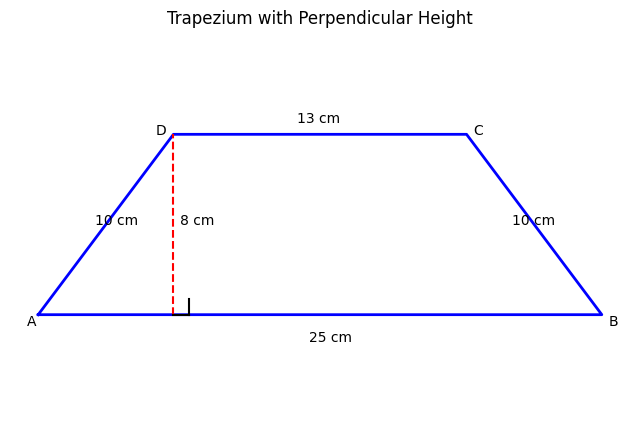
The base of this right triangle = (25 − 13)/2 = 6 cm, hypotenuse = 10 cm.
Height h = √(10² − 6²)
= √(100 − 36) = √64 = 8 cm
Area = ½ × h × (a + b)
= ½ × 8 × (25 + 13) = ½ × 8 × 38 = 152 cm²
Area of trapezium = 152 cm²
Important Questions on Circles & Sectors for Class 9
Q 7: A circular track runs around a circular park. If the difference between the circumference of the track and the park is 66 m, find the width of the track.
Solution: Let R = radius of track, r = radius of park, and width = R − r.
2πR − 2πr = 66
⇒ 2π(R − r) = 66
⇒ R − r = 66 / (2 × 22/7)
⇒ R − r = 66 × 7 / 44 = 10.5 m
Width of the track = 10.5 m
Q 8: Find the area of a sector of a circle with radius 14 cm and angle 90°.
Solution: Given r = 14 cm
Area of sector = (θ/360°) × πr²
= (90/360) × (22/7) × 14²
= (1/4) × (22/7) × 196
= (1/4) × 616 = 154 cm²
Area of sector = 154 cm²
Q 9: A wire of length 176 cm is bent to form a circle. Find its area. (Use π = 22/7)
Solution: Length of wire = Circumference = 176 cm
⇒ 2πr = 176 r = 176 / (2 × 22/7)
= 176 × 7 / 44 = 28 cm
Area = πr² = (22/7) × 28²
= (22/7) × 784 = 2464 cm²
Area = 2464 cm²
Important Questions on Combined / Composite Figures for Class 9
Q10: A figure is made up of a rectangle 20 cm × 14 cm with a semicircle on its shorter side. Find the total area and perimeter of the figure.
Solution: The semicircle sits on the 14 cm side, so its diameter = 14 cm
⇒ radius = 7 cm.
Area of rectangle = 20 × 14 = 280 cm²
Area of semicircle = πr²/2 = (22/7) × 49/2 = 77 cm²
⇒ Total area = 280 + 77 = 357 cm²
Perimeter: Two long sides of rectangle = 2 × 20 = 40 cm
One short side (opposite semicircle) = 14 cm
The curved arc of semicircle = πr = (22/7) × 7 = 22 cm
⇒ Total perimeter = 40 + 14 + 22 = 76 cm
Q11: From a square sheet of side 14 cm, four equal circles of maximum possible size are cut out. Find the remaining area.
Solution: Four equal circles fit in a 2×2 arrangement.
Each circle has diameter = 14/2 = 7 cm
⇒ radius = 3.5 cm.
Area of square = 14² = 196 cm²
Area of 4 circles = 4 × π × (3.5)²
= 4 × (22/7) × 12.25 = 4 × 38.5 = 154 cm²
Remaining area = 196 − 154 = 42 cm²
Remaining area = 42 cm²
Q12: A plot of land is in the shape of a quadrilateral ABCD where AB = 9 m, BC = 40 m, CD = 28 m, DA = 15 m, and ∠ABC = 90°. Find the area of the plot.
Solution: Draw diagonal AC to divide the quadrilateral into triangle ABC and triangle ACD.
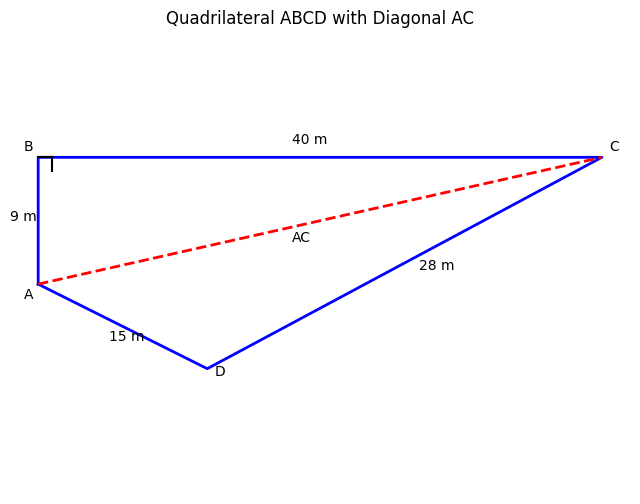
Triangle ABC (right-angled at B):
AC = √(AB² + BC²) = √(9² + 40²) = √(81 + 1600) = √1681 = 41 m
⇒ Area of △ABC = ½ × 9 × 40 = 180 m²
Triangle ACD with sides 41 m, 28 m, 15 m:
s = (41 + 28 + 15)/2 = 84/2 = 42 m
⇒Area = √[42 × (42−41) × (42−28) × (42−15)]
= √[42 × 1 × 14 × 27] = √15876 = 126 m²
Total area: Area of ABCD = 180 + 126 = 306 m²
Area of quadrilateral plot ABCD = 306 m²
Case Study Questions on Perimeter and Area for Class 9
C1: The School Garden Project Case Study
A school has a rectangular ground of dimensions 50 m × 30 m. The school plans to create a garden in one corner shaped like a right triangle with legs 10 m and 12 m. In the centre, a circular fountain of radius 3.5 m is built. The remaining area will be used for a play zone. Fencing is to be put around the entire rectangular ground.
i) What is the area of the rectangular ground?
Area = 50 × 30 = 1500 m²
ii) What is the area of the triangular garden?
Area = ½ × 10 × 12 = 60 m²
iii) What is the area of the circular fountain?
Area = πr² = (22/7) × (3.5)² = (22/7) × 12.25 = 38.5 m²
iv) What is the area of the play zone?
Play zone = 1500 − 60 − 38.5 = 1401.5 m²
v) What length of fencing is needed around the entire ground?
Perimeter of rectangle = 2(50 + 30) = 160 m
C2: Flooring a Heritage Hall Case Study
A heritage hall has a floor shaped like a trapezium with parallel sides of 28 m and 16 m and a height of 10 m. There are two square pillars of side 1.5 m each, whose area must be excluded. Marble tiles of size 60 cm × 60 cm cost ₹250 each.
i) Area of the trapezoidal floor (before pillars)?
Area = ½ × 10 × (28 + 16) = 5 × 44 = 220 m²
ii) Area of both square pillars?
Area = 2 × (1.5)² = 2 × 2.25 = 4.5 m²
iii) Net area to be tiled?
Net area = 220 − 4.5 = 215.5 m²
iv) Area of one tile?
Area = 0.6 × 0.6 = 0.36 m²
v) Number of tiles needed and total cost?
Tiles needed = 215.5 / 0.36 ≈ 599 (round up to 599)
Total cost = 599 × ₹250 = ₹1,49,750
Tiles needed ≈ 599 and Total cost ≈ ₹1,49,750
Numbers make sense when they're taught right. To see how Orchids The International School turns Maths from intimidating to intuitive, reach out to our admissions team.
Frequently Asked Questions of Measuring Space: Perimeter and Area for Class 9
1. What is Heron's Formula and when should I use it?
Heron's Formula lets you find the area of a triangle when all three sides are known but the height is not given. The semi-perimeter s = (a + b + c)/2, then Area = √[s(s−a)(s−b)(s−c)].
2. How do I find the area of a composite figure?
Break the figure into simpler shapes (rectangles, triangles, semicircles, etc.), find each area separately, and add (or subtract, for cut-outs) them.
3. Is Brahmagupta's Formula in the CBSE Class 9 syllabus (2026–27)?
Yes. The new Ganita Manjari textbook (Chapter 6) includes Brahmagupta's Formula for the area of a cyclic quadrilateral. For a cyclic quadrilateral with sides a, b, c, d: s = (a+b+c+d)/2 and Area = √[(s−a)(s−b)(s−c)(s−d)].
4. Are these questions based on NCERT Class 9 Maths?
Yes, the questions are prepared based on the NCERT textbook and CBSE syllabus guidelines.
5. What is the difference between perimeter and area?
Perimeter is the total boundary length of a shape, while area is the space enclosed within the shape.
Related Links


Admissions Open for 2026-27
What type of concept pages would you prefer?
CBSE Schools In Popular Cities
- CBSE Schools in Bangalore
- CBSE Schools in Mumbai
- CBSE Schools in Pune
- CBSE Schools in Hyderabad
- CBSE Schools in Chennai
- CBSE Schools in Gurgaon
- CBSE Schools in Kolkata
- CBSE Schools in Indore
- CBSE Schools in Sonipat
- CBSE Schools in Delhi
- CBSE Schools in Rohtak
- CBSE Schools in Bhopal
- CBSE Schools in Aurangabad
- CBSE Schools in Jabalpur
- CBSE Schools in Jaipur
- CBSE Schools in Jodhpur
- CBSE Schools in Nagpur
- CBSE Schools in Ahmednagar
- CBSE School In Tumkur











Orchids The International School is one of India's leading chains of CBSE and ICSE schools, with 130+ schools across the country.