CLXVII is the Roman numerals represent the number 167, an ancient method used by the Romans to represent numbers. In this form, C means 100, L means 50, X means 10, V means 5, and I means 1. So, CLXVII = 100 + 50 + 10 + 5 + 1 + 1 = 167. Reading and writing CLXVII Roman numerals helps students connect mathematics with Roman history. It improves thinking skills by showing how numbers are added, subtracted, and arranged to form larger numbers. The study of CLXVII Roman numerals is not only a mathematical skill but also a link to the past, making the study of numbers more interesting and meaningful in everyday life.
Table of Contents

How to Write CLXVII Roman Numerals in Numbers?
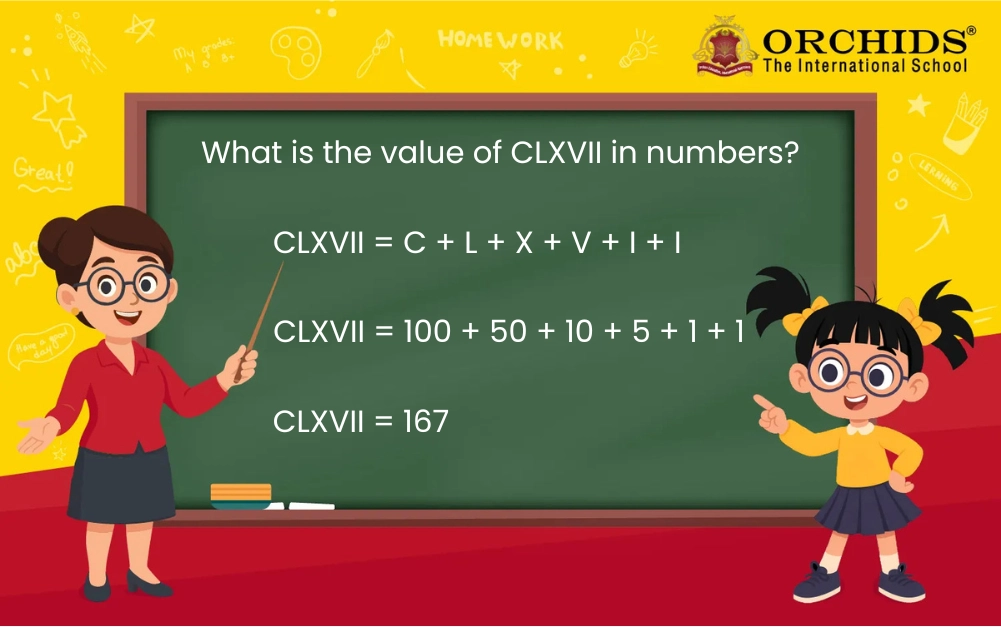
To write CLXVII in numbers, we use the symbols that represent hundreds, tens, and units. The principal Roman numeral symbols are:
Step By Step:
- C = 100
- L = 50
- X = 10
- V = 5
- II = 2
Add them: 100 + 50 + 10 + 5 + 2 = 167.
Therefore, CLXVII Roman numerals in numbers is 167.
Know more about related topics:
Basic Rules to Write CLXVII Roman Numerals in Numbers
To write CLXVII Roman numerals in numbers is 167 you should follow these simple rules based on the Roman numeral system:
1. Know the values:
- I = 1
- V = 5
- X = 10
- L = 50
- C = 100
- D = 500
- M = 1000
2. Write numerals in order from largest to smallest:
- Start with the largest value first (C = 100), then add the smaller parts in descending order: L (50), X (10), V (5), II (2).
3. Add values when smaller numerals follow larger ones.
- C (100) + L (50) + X (10) + V (5) + II (2) = 167.
Therefore, 167 in Roman numerals is CLXVII.
|
Roman Numerals
|
Roman Numerals Expression
|
Expanded Form
|
Numbers
|
|
CLXI
|
C + L + X + I
|
100 + 50 + 10 + 1
|
161
|
|
CLXII
|
C + L + X + I + I
|
100 + 50 + 10 + 1 + 1
|
162
|
|
CLXIII
|
C + L + X + I + I + I
|
100 + 50 + 10 + 1 + 1 + 1
|
163
|
|
CLXIV
|
C + L + X + V - I
|
100 + 50 + 10 + (5 − 1)
|
164
|
|
CLXV
|
C + L + X + V
|
100 + 50 + 10 + 5
|
165
|
|
CLXVI
|
C + L + X + V + I
|
100 + 50 + 10 + 5 + 1
|
166
|
|
CLXVII
|
C + L + X + V + I + I
|
100 + 50 + 10 + 5 + 1 + 1
|
167
|
|
CLXVIII
|
C + L + X + V + I + I + I
|
100 + 50 + 10 + 5 + 1 + 1 + 1
|
168
|
|
CLXIX
|
C + L + X + X - I
|
100 + 50 + 10 + (10 − 1)
|
169
|
|
CLXX
|
C + L + X + X
|
100 + 50 + 10 + 10
|
170
|
Solved Examples on CLXVII Roman Numerals
Example 1: A museum displayed CLX (160) artifacts and VII (7) more were added. Express the total in Roman numerals.
Solution:
160 + 7 = 167
Therefore, 167 = CLXVII.
Example 2: Add C (100), L (50), X (10), V (5), and II (2). Write the total in Roman numerals.
Solution:
100 + 50 + 10 + 5 + 2 = 167
Therefore, 167 = CLXVII.
Example 3: Subtract III (3) from CLXX (170). Express the result in Roman numerals.
Solution:
170 − 3 = 167
Therefore, 167 = CLXVII.
Example 4: Combine and simplify: CLX + VII
Solution:
160 + 7 = 167
Therefore, CLX + VII = CLXVII.
Example 5: Add CLXV (165) and II (2). Write the answer in Roman numerals.
Solution:
165 + 2 = 167
Therefore, CLXV + II = CLXVII.
Facts About CLXVII Roman Numerals
-
Number Form: CLXVII in numbers is written as 167 (= 100 + 50 + 10 + 5 + 1 + 1).
-
Expanded Form: C = 100, L = 50, X = 10, V = 5, II = 2. (100 + 50 + 10 + 5 + 1 + 1 = 167).
-
Subtractive Notation Used: No subtractive notation is used in CLXVII.
-
Symbol Count: The symbols used are C, L, X, V, and I (seven characters total).
-
Number Property: 167 is a prime number (it is divisible only by 1 and 167).
Practice questions on CLXVII Roman Numerals
1. What number does CLXVII represent?
2. Write CLXVII in expanded form?
3. Which Roman symbols are used in CLXVII?
4. Is CLXVII written using the subtraction rule?
5. What Roman numeral comes after CLXVII?
Conclusion
CLXVII in Roman numerals represents 167, formed by adding C (100), L (50), X (10), V (5), and II (2). Understanding CLXVII helps students practise Roman numeral addition, recognise symbols, and connect mathematics with history, making learning both engaging and meaningful.
Explore more articles on CLXVII Roman Numerals and related Maths concepts at Orchids The International School, where learning is made simple with clear explanations and well-structured lessons.



.%20Easy%20to%20understand%20step%20by%20step%20conversion%20rules%2C%20examples%20and%20FAQs%20to%20help%20you%20convert%20quickly.)