

CLXXXVIII Roman Numerals
CLXXXVIII Roman numerals represent the number 188. Roman numerals are written by combining symbols that have fixed values. To understand this number, 188 can be split into 100 + 50 + 30 + 8. In the Roman numeral system, C = 100, L = 50, XXX = 30, and VIII = 8. When these symbols are placed together, they form CLXXXVIII. Learning numbers like CLXXXVIII helps students understand how the Roman numeral system uses addition to build larger values. Roman numerals are still commonly seen on clocks, book chapters, monuments, and special events.
Table of Contents
- How to Write CLXXXVIII Roman Numerals in Numbers?
- Numbers Related to CLXXXVIII Roman Numerals
- Basic Rules for Writing Roman Numerals
- Solved Examples on CLXXXVIII Roman Numerals
- Practice Questions on CLXXXVIII Roman Numerals
- Conclusion
- Frequently Asked Questions on CLXXXVIII Roman Numerals

How to Write CLXXXVIII Roman Numerals in Numbers?
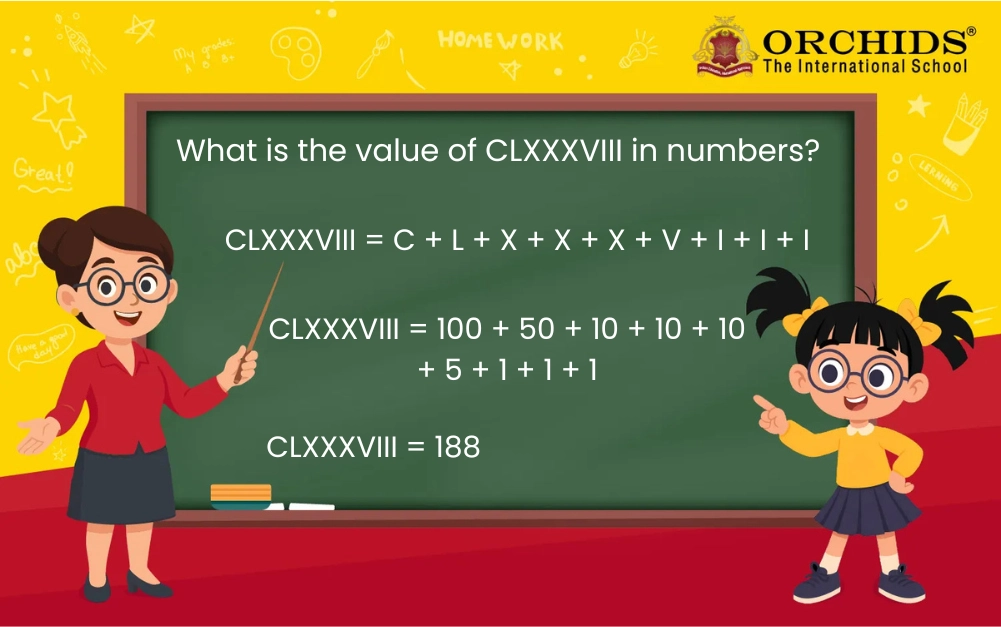
To convert CLXXXVIII Roman numerals into numbers, we use the Roman numeral addition rule. In this rule, the values of all symbols are added because each symbol appears in descending order.
First, identify the value of each Roman symbol:
-
C = 100
-
L = 50
-
X = 10
-
V = 5
-
I = 1
Now separate the symbols in CLXXXVIII:
-
CLXXXVIII = C + L + X + X + X + V + I + I + I
Next, replace the Roman symbols with their numerical values:
-
CLXXXVIII = 100 + 50 + 10 + 10 + 10 + 5 + 1 + 1 + 1
-
CLXXXVIII = 100 + 80 + 8 = 188
Add all the numbers:
-
CLXXXVIII = 188
So, CLXXXVIII in numbers is 188.
Know more about related topics:
Numbers Related to CLXXXVIII Roman Numerals
|
Roman Numerals |
Roman Numerals Expression |
Expanded Form |
Numbers |
|
CLXXXV |
C + L + X + X + X + V |
100 + 50 + 10 + 10 + 10 + 5 |
185 |
|
CLXXXVI |
C + L + X + X + X + V + I |
100 + 50 + 10 + 10 + 10 + 5 + 1 |
186 |
|
CLXXXVII |
C + L + X + X + X + V + I + I |
100 + 50 + 10 + 10 + 10 + 5 + 1 + 1 |
187 |
|
CLXXXVIII |
C + L + X + X + X + V + I + I + I |
100 + 50 + 10 + 10 + 10 + 5 + 1 + 1 + 1 |
188 |
|
CLXXXIX |
C + L + X + X + X + (X − I) |
100 + 50 + 10 + 10 + 10 + (10 − 1) |
189 |
|
CXC |
C + (C − X) |
100 + (100 − 10) |
190 |
|
CXCI |
C + (C − X) + I |
100 + (100 − 10) + 1 |
191 |
|
CXCII |
C + (C − X) + I + I |
100 + (100 − 10) + 1 + 1 |
192 |
|
CXCIII |
C + (C − X) + I + I + I |
100 + (100 − 10) + 1 + 1 + 1 |
193 |
|
CXCIV |
C + (C − X) + (V − I) |
100 + (100 − 10) + (5 − 1) |
194 |
|
CXCV |
C + (C − X) + V |
100 + (100 − 10) + 5 |
195 |
Basic Rules for Writing Roman Numerals
To understand CLXXXVIII in Roman numerals, which equals 188, follow these simple Roman numeral rules.
1. Know the Roman numeral values
-
I = 1
-
V = 5
-
X = 10
-
L = 50
-
C = 100
-
D = 500
-
M = 1000
2. Arrange symbols from larger to smaller values
In CLXXXVIII, the numerals appear from the highest value to the lowest:
-
C (100), L (50), X (10), X (10), X (10), V (5), I (1), I (1), I (1).
3. Add the values together
When smaller numerals come after larger ones, their values are added:
-
100 + 50 + 10 + 10 + 10 + 5 + 1 + 1 + 1 = 188
Therefore, CLXXXVIII represents 188 in numbers in the Roman numeral system.
Solved Examples on CLXXXVIII Roman Numerals
Example 1: Class A has CLXXXVIII students, and Class B has LXII students. How many students are there in total?
Solution:
Convert Roman numerals to numbers:
-
CLXXXVIII = 188
-
LXII = 62
Add the numbers:
-
188 + 62 = 250
Convert 250 into Roman numerals:
-
250 = CC + L = CCL
Answer: The total number of students is CCL.
Example 2: A library has CCC books. If CLXXXVIII books are borrowed, how many books remain in the library?
Solution:
Convert Roman numerals to numbers:
-
CCC = 300
-
CLXXXVIII = 188
Subtract the borrowed books:
-
300 − 188 = 112
Convert 112 into Roman numerals:
-
112 = C + X + II = CXII
Answer: There are CXII books left in the library.
Example 3: A notebook costs V dollars. If a shop sells CLXXXVIII notebooks, what is the total cost?
Solution:
Convert Roman numerals:
-
CLXXXVIII = 188
-
V = 5
Multiply:
-
188 × 5 = 940
Convert 940 into Roman numerals:
-
940 = 900 + 40 = CM + XL = CMXL
Answer: The total cost of the notebooks is CMXL dollars.
Example 4: There are CD gifts, and CLXXXVIII gifts are given to children in the morning. How many gifts remain?
Solution:
Convert Roman numerals:
-
CD = 400
-
CLXXXVIII = 188
Subtract:
-
400 − 188 = 212
Convert 212 into Roman numerals:
-
212 = 200 + 10 + 2 = CC + X + II = CCXII
Answer: CCXII gifts remain.
Example 5: A school has CLXXXVIII pencils. If the pencils are shared equally among XVI students, what is the remainder?
Solution:
Convert Roman numerals:
-
CLXXXVIII = 188
-
XVI = 16
Divide:
-
188 ÷ 16 = 11 remainder 12
Convert the remainder into Roman numerals:
-
12 = X + II = XII
Answer: The remainder are XII pencils.
Practice Questions on CLXXXVIII Roman Numerals
1. Write CLXXXVIII in Hindu-Arabic numerals.
2. A store sold CLXXXVIII pencils in the morning and XXV pencils in the afternoon. How many pencils were sold in total? Write your answer in Roman numerals.
3. Subtract CLXXXVIII from CCC. Write your answer in Roman numerals.
4. Divide CLXXXVIII by XII and write the quotient in Roman numerals.
5. If a box contains CLXXXVIII chocolates and another box contains LXXII chocolates, what is the total number of chocolates? Write your answer in Roman numerals.
Conclusion
CLXXXVIII Roman numerals represent 188, formed by combining C (100) + L (50) + XXX (30) + VIII (8). This numeral shows how Roman numerals express numbers efficiently without using zero. Learning CLXXXVIII helps students understand the logic of Roman numeral formation, recognise patterns, and apply this knowledge in real-life situations like clocks, page numbers, and historical dates, making numbers both meaningful and easy to interpret.
Master CLXXXVIII Roman numerals clearly and confidently with student-friendly lessons at Orchids International School.
Numbers make sense when they're taught right. To see how Orchids The International School turns Maths from intimidating to intuitive, reach out to our admissions team.
Frequently Asked Questions on CLXXXVIII Roman Numerals
1. How do you convert CLXXXVIII into a number?
To convert CLXXXVIII to a number, break it into hundreds, tens, and ones:
-
Hundreds: C = 100
-
Tens: LXXX = 50 + 10 + 10 + 10 = 80
-
Ones: VIII = 5 + 1 + 1 + 1 = 8
Add them together: 100 + 80 + 8 = 188
2. What is CLXXXVIII + XII in Roman numerals?
-
CLXXXVIII = 188
-
XII = 12
Add the numbers: 188 + 12 = 200
Convert 200 into Roman numerals: 200 = CC
So, CLXXXVIII + XII = CC
3. What is the remainder when CLXXXVIII is divided by VI?
-
CLXXXVIII = 188
-
VI = 6
Divide 188 by 6: 188 ÷ 6 = 31 remainder 2
Convert the remainder into Roman numerals: 2 = II
So, the remainder is II
4. What should be subtracted from CLXXXVIII to get CLXIX?
-
CLXXXVIII = 188
-
CLXIX = 169
Subtract the numbers: 188 − 169 = 19
Convert 19 into Roman numerals: 19 = XIX
So, XIX should be subtracted from CLXXXVIII to get CLXIX
5. Why is 188 written as CLXXXVIII in Roman numerals?
Roman numerals follow specific rules:
-
Addition Rule: Larger symbols (C, L) are placed before smaller symbols (X, V, I) to add their values.
-
Repetition Rule: Symbols like X and I can be repeated up to three times, while L and V are never repeated.
So, 188 is written as C + LXXX + VIII = CLXXXVIII, following these rules.
Related Links


Admissions Open for 2026-27
What type of concept pages would you prefer?
CBSE Schools In Popular Cities
- CBSE Schools in Bangalore
- CBSE Schools in Mumbai
- CBSE Schools in Pune
- CBSE Schools in Hyderabad
- CBSE Schools in Chennai
- CBSE Schools in Gurgaon
- CBSE Schools in Kolkata
- CBSE Schools in Indore
- CBSE Schools in Sonipat
- CBSE Schools in Delhi
- CBSE Schools in Rohtak
- CBSE Schools in Bhopal
- CBSE Schools in Aurangabad
- CBSE Schools in Jabalpur
- CBSE Schools in Jaipur
- CBSE Schools in Jodhpur
- CBSE Schools in Nagpur
- CBSE Schools in Ahmednagar
- CBSE School In Tumkur











Orchids The International School is one of India's leading chains of CBSE and ICSE schools, with 110+ schools across the country.