

How to Find Slope of a Line with Two Points
To find the slope of a line with two points, use the slope formula: m = (y2 - y1) / (x2 - x1). First, give your points labels (x1, y1) and (x2, y2), Next, subtract the y-coordinates to find the rise (vertical change) and subtract the x-coordinates to get the run (horizontal change). To find the slope divide rise by run, which measures how steep the line is. This formula works for any two points on a straight line and is essential for understanding linear equations in algebra.
Table of Contents
- What Is the Slope of a Line?
- Slope Formula Using Two Points
- How to Find the Slope of a Line with Two Points Step by Step
- Solved Examples of Finding Slope from Two Points
- Finding Slope on a Coordinate Plane
- Types of Slopes
- Special Cases While Finding Slope
- Practice Problems on Finding Slope from Two Points
- Difference Between Slope Formula and Point Slope Form
- Key Formulas Related to Slope
- Frequently Asked Questions on How to Find Slope of a Line with Two Points

What Is the Slope of a Line?
Definition of Slope
The slope of a line is a number that describes both how steep the line is and in which direction it runs. It tells you exactly how much the line goes up or down for every unit it moves to the right. A steeper line has a larger slope value, and a gentler line has a smaller one. In coordinate geometry, slope is defined as the ratio of vertical change to horizontal change between any two points on the line. This ratio is always the same no matter which two points on the same line you choose that is what makes a line straight.
Why Is Slope Important?
Slope is one of the most fundamental ideas in coordinate geometry. It connects algebra to geometry by turning a visual property (steepness) into a measurable number. Understanding slope is essential for writing the equation of a line, identifying parallel and perpendicular lines, analysing linear graphs in data science, and solving real-world problems in engineering, economics, and physics.
Understanding Steepness and Direction
A positive slope means the line goes upward from left to right. A negative slope means the line goes downward from left to right. A slope of zero means the line is perfectly horizontal. An undefined slope means the line is perfectly vertical. The larger the absolute value of the slope, the steeper the line.
Slope Formula Using Two Points
Understanding the Slope Formula
When two points on a line are known, the slope can be calculated using this formula: m = (y₂ − y₁) / (x₂ − x₁)
The letter m is the standard symbol for slope in mathematics. The formula calculates the ratio of the rise (vertical change) to the run (horizontal change) between the two points.
Meaning of Each Variable in the Formula
-
(x₁, y₁) = the coordinates of the first point
-
(x₂, y₂) = the coordinates of the second point
-
(y₂ − y₁) = the rise, how much the line moves up or down
-
(x₂ − x₁) = the run, how much the line moves left or right
-
m = the slope, the ratio of rise to run
Conditions for Using the Slope Formula
The formula works for any two distinct points on a line. The only restriction is that x₂ must not equal x₁. if both x-coordinates are the same, the run is zero, and dividing by zero is undefined. This special case gives a vertical line with undefined slope.
How to Find the Slope of a Line with Two Points Step by Step
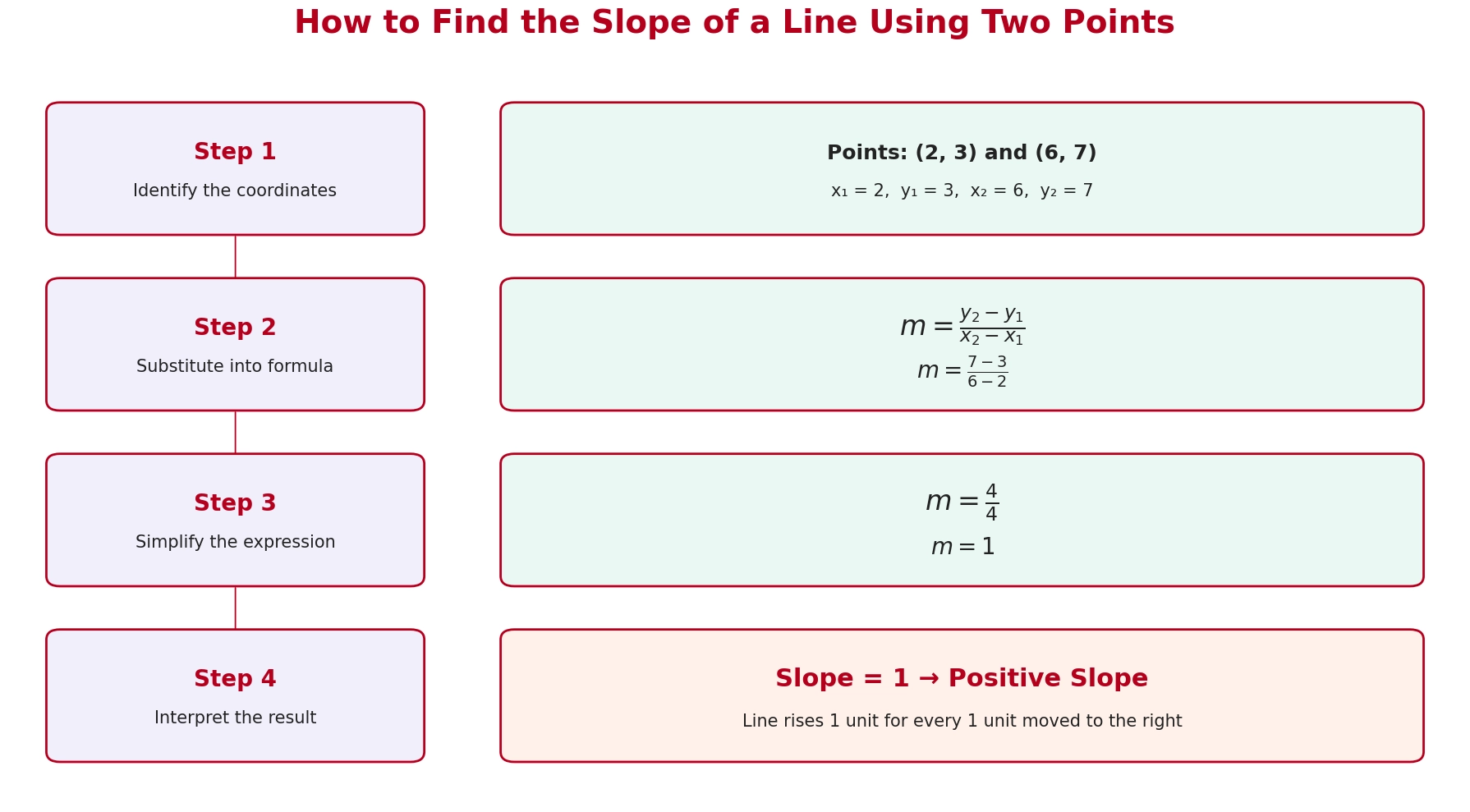
Step 1: Identify the Coordinates
Read the two given points carefully and label them. Call the first point (x₁, y₁) and the second point (x₂, y₂). It does not matter which point you call first the slope comes out the same either way, as long as you are consistent throughout the calculation.
Step 2: Substitute Values into the Formula
Write the slope formula: m = (y₂ − y₁) / (x₂ − x₁). Replace x₁, y₁, x₂, and y₂ with the actual numbers from your two points. Be careful with negative signs write them clearly before simplifying.
Step 3: Simplify the Expression
Perform the subtractions in the numerator and denominator separately. Then divide the numerator by the denominator. If both numbers share a common factor, simplify the fraction to its lowest terms.
Step 4: Interpret the Result
A positive m means the line rises from left to right. A negative m means it falls. m = 0 means horizontal. An undefined result (dividing by zero) means the line is vertical. Always read back the result in the context of the original problem.
Solved Examples of Finding Slope from Two Points
Example 1: Positive Slope
Find the slope of the line passing through (1, 2) and (4, 8).
m = (8 − 2) / (4 − 1) = 6 / 3 = 2
The slope is 2. The line rises 2 units for every 1 unit it moves to the right a fairly steep upward line.
Example 2: Negative Slope
Find the slope of the line through (3, 7) and (6, 1).
m = (1 − 7) / (6 − 3) = −6 / 3 = −2
The slope is −2. The line falls 2 units for every 1 unit it moves to the right a steeply downward line.
Example 3: Zero Slope
Find the slope of the line through (2, 5) and (9, 5).
m = (5 − 5) / (9 − 2) = 0 / 7 = 0
The slope is 0. Both points have the same y-coordinate, so the line is perfectly horizontal with no rise at all.
Example 4: Fractional Slope
Find the slope of the line through (0, 3) and (4, 5).
m = (5 − 3) / (4 − 0) = 2 / 4 = 1/2
The slope is ½. The line rises 1 unit for every 2 units it moves to the right a gentle upward slope.
Types of Slopes
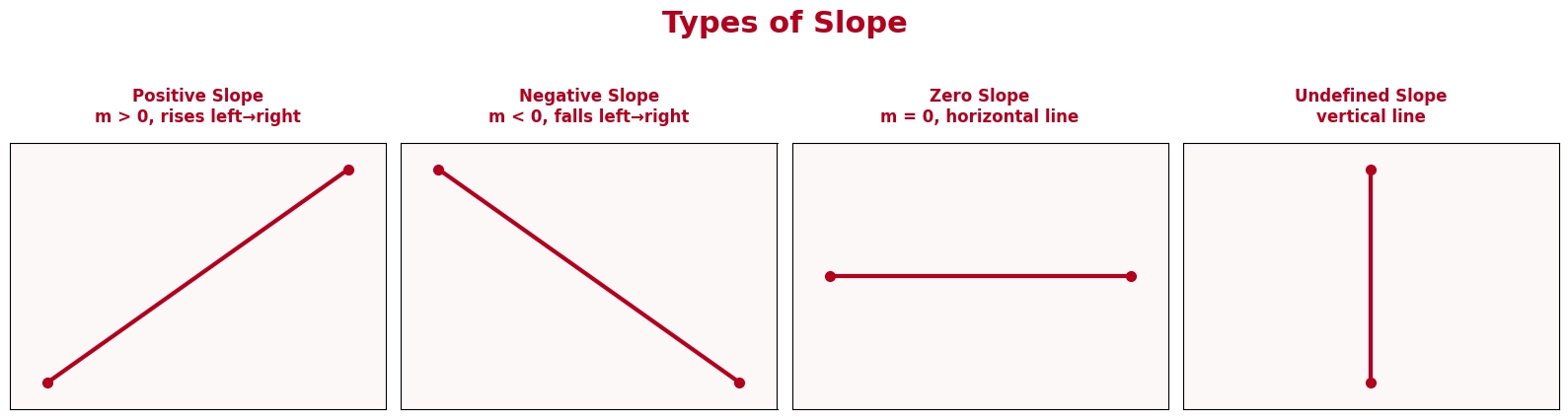
Positive Slope
When m > 0, the line rises from left to right. As x increases, y also increases. The steeper the rise, the larger the value of m. A slope of 5 is much steeper than a slope of 0.5.
Negative Slope
When m < 0, the line falls from left to right. As x increases, y decreases. A slope of −3 falls more steeply than a slope of −0.5.
Zero Slope
When m = 0, there is no rise at all the line is perfectly horizontal. The y-value stays the same at every point, making (y₂ − y₁) = 0 in the numerator.
Undefined Slope
When the two points have the same x-coordinate, the run is zero: (x₂ − x₁) = 0. Dividing by zero is undefined, so the slope is undefined. This corresponds to a vertical line, which is not a function.
Finding Slope on a Coordinate Plane
Using Graphs to Determine Slope
To find the slope directly from a graph, identify two points on the line where the grid lines intersect (lattice points). These are easy to read precisely. Then apply the formula using those two points. Always pick points that are clearly on the line avoid estimating midpoints.
Rise and Run Method
The rise and run method is a visual way to find slope from a graph. Starting from one point, count how many units you move vertically to reach the height of the second point that is the rise. Then count how many units you move horizontally that is the run. Slope = rise ÷ run.
If you move up and then right, both values are positive and the slope is positive. If you move down and then right, the rise is negative and the slope is negative.
Relationship Between Coordinates and Slope
The x-coordinates determine how far apart two points are horizontally (the run). The y-coordinates determine how far apart they are vertically (the rise). The slope formula packages both pieces of information into one ratio. This is why two points and only two are all you need to completely determine the slope of any straight line.
Special Cases While Finding Slope
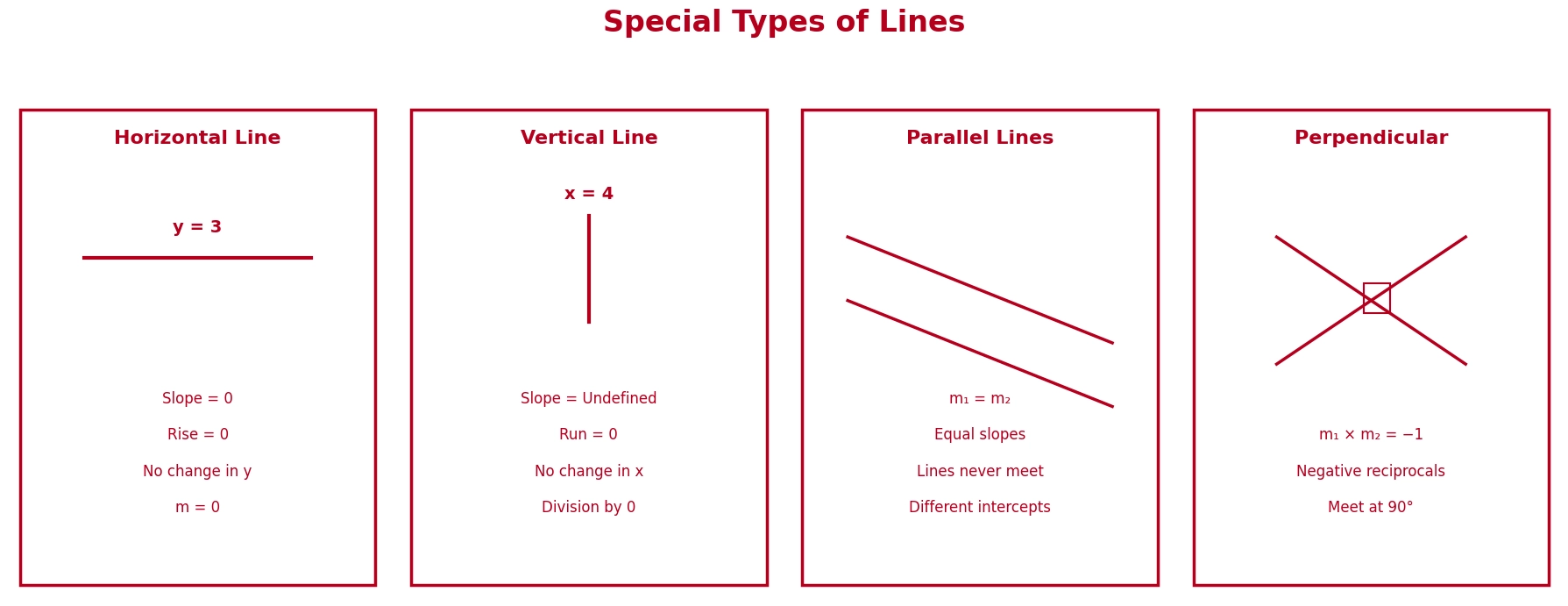
Horizontal Lines
A horizontal line has slope 0. Every point on a horizontal line has the same y-coordinate, so y₂ − y₁ = 0 regardless of how far apart the points are. The equation of a horizontal line is always of the form y = k, where k is the constant y-value.
Vertical Lines
A vertical line has undefined slope. Every point on a vertical line has the same x-coordinate, so x₂ − x₁ = 0, which means we divide by zero. This operation is undefined in mathematics. The equation of a vertical line is always x = k.
Parallel Lines
Two lines are parallel if and only if they have exactly the same slope. Parallel lines never intersect because they rise and run at exactly the same rate. If line 1 has slope m₁ and line 2 has slope m₂, then parallel lines satisfy m₁ = m₂.
Perpendicular Lines
Two lines are perpendicular if they meet at a right angle (90°). Their slopes are negative reciprocals of each other: m₁ × m₂ = −1. For example, a line with slope 3 is perpendicular to a line with slope −⅓.
Practice Problems on Finding Slope from Two Points
Beginner Level Questions
-
Find the slope of the line through (0, 0) and (3, 6).
-
Find the slope of the line through (2, 4) and (5, 4).
-
Find the slope of the line through (1, 5) and (1, 9).
-
Find the slope of the line through (0, 3) and (4, 7).
Answers: 1) m = 2 | 2) m = 0 | 3) undefined | 4) m = 1
Intermediate Level Questions
-
Find the slope of the line through (−2, 3) and (4, −1).
-
A line passes through (0, −5) and (3, 4). Find m and describe the line.
-
Two points on a line are (−3, −2) and (5, 6). Find the slope and determine whether the line is steeper than a line with slope 1.5.
Answers: 1) m = −2/3 | 2) m = 3, steep positive slope | 3) m = 1, less steep than 1.5
Advanced Level Questions
-
Line L passes through (k, 3) and (2, k). Its slope is 2. Find k.
-
Points A(1, 4), B(3, 8), and C(5, t) are collinear. Find t.
-
Two lines have slopes m₁ = 3 and m₂. They are perpendicular. What is m₂?
Answers: 1) k = 1 | 2) t = 12 (same slope 2 throughout) | 3) m₂ = −⅓
Difference Between Slope Formula and Point Slope Form
What Is Point-Slope Form?
Point-slope form is the equation of a line written as: y − y₁ = m(x − x₁). It uses a known point (x₁, y₁) and the slope m to write the equation of the line. It is the natural next step after you have calculated the slope from two points.
When to Use Each Formula
Use the slope formula m = (y₂ − y₁)/(x₂ − x₁) when you want to find the numerical value of the slope from two coordinate pairs. Use the point-slope form when you want to write the equation of the line after you already have the slope and at least one point. They are complementary the slope formula feeds its result directly into the point-slope form.
Key Formulas Related to Slope
Slope Formula
m = (y₂ − y₁) / (x₂ − x₁)
This is the primary formula used to find slope from two given coordinate points. It calculates rise over run directly.
Point-Slope Form
y − y₁ = m(x − x₁)
After finding slope using the slope formula, this form is used to write the full equation of the line. Substitute the slope and either of the two known points.
Slope Intercept Form
y = mx + b
When a line equation is written in this form, the slope m can be read directly as the coefficient of x, and b is the y-intercept (where the line crosses the y-axis). To convert from point-slope to slope-intercept form, simply expand and rearrange the equation.
Frequently Asked Questions on How to Find Slope of a Line with Two Points
1. What is the formula for finding slope from two points?
Slope = (y₂ − y₁) ÷ (x₂ − x₁)
where:
- (x₁, y₁) and (x₂, y₂) are the coordinates of the two points.
- y₂ − y₁ represents the change in the y-values.
- x₂ − x₁ represents the change in the x-values.
In simple words, the slope is found by dividing the difference between the y-coordinates by the difference between the x-coordinates.
2. How do you find the slope of a line using coordinates?
To find the slope, subtract the y-coordinates of the two points and divide the result by the difference of the x-coordinates.
Slope = Change in y ÷ Change in x
3. What does a negative slope mean?
A negative slope means the line falls from left to right. As the value of x increases, the value of y decreases.
4. What is an undefined slope?
A slope is undefined when the line is vertical. This happens when the x-coordinates of both points are the same, making the denominator zero.
5. Can the slope of a line be zero?
Yes. A horizontal line has a slope of zero because there is no change in the y-coordinate.
6. Why is slope important in coordinate geometry?
Slope helps determine the steepness and direction of a line. It is used to analyze graphs, equations, and relationships between variables.
7. How do you identify positive and negative slopes?
- Positive Slope: The line rises from left to right.
- Negative Slope: The line falls from left to right.
A positive slope indicates that y increases as x increases, while a negative slope indicates that y decreases as x increases.
Numbers make sense when they're taught right. To see how Orchids The International School turns Maths from intimidating to intuitive, reach out to our admissions team.


Admissions Open for 2026-27
What type of concept pages would you prefer?
CBSE Schools In Popular Cities
- CBSE Schools in Bangalore
- CBSE Schools in Mumbai
- CBSE Schools in Pune
- CBSE Schools in Hyderabad
- CBSE Schools in Chennai
- CBSE Schools in Gurgaon
- CBSE Schools in Kolkata
- CBSE Schools in Indore
- CBSE Schools in Sonipat
- CBSE Schools in Delhi
- CBSE Schools in Rohtak
- CBSE Schools in Bhopal
- CBSE Schools in Aurangabad
- CBSE Schools in Jabalpur
- CBSE Schools in Jaipur
- CBSE Schools in Jodhpur
- CBSE Schools in Nagpur
- CBSE Schools in Ahmednagar
- CBSE School In Tumkur











Orchids The International School is one of India's leading chains of CBSE and ICSE schools, with 110+ schools across the country.