

Case Study on Class 10 Maths Chapter 4 ‘Quadratic Equations’
The Case Study Questions for Class 10 Maths Chapter 4 "Quadratic Equations" include short, real life problem situations that have clear answers and step by step solutions to help students gain confidence for exams. It covers important topics including identifying quadratic equations in standard form (ax² + bx + c = 0), solving quadratic equations by factorization method, using the completing the square method, applying the quadratic formula, understanding the nature of roots based on discriminant (D > 0, D = 0, D < 0), finding sum and product of roots, forming quadratic equations from given roots, solving word problems involving area, speed-time-distance, age problems, and number problems, and checking if solutions are realistic in real world contexts. These practice questions help the students in better understanding of the concepts, handling quadratic equation problems smoothly and to be faster and accurate for their board exams. A free PDF is included for offline timed practice.
Introduction to Case Study Questions on Quadratic Equations
What Is a Quadratic Equation?
A quadratic equation is a polynomial equation in which the highest power of the variable is 2. The word "quadratic" comes from "quadratus," the Latin word for square, because the equation always contains the variable squared.
In simple terms, a quadratic equation is any equation that can be written in the form:
ax² + bx + c = 0
where x is the variable, and a, b, and c are real numbers, with the condition that a must not be equal to zero. If a were zero, the x² term would disappear and the equation would no longer be quadratic.
Examples of quadratic equations:
x² − 5x + 6 = 0 (here a = 1, b = −5, c = 6)
2x² + 3x − 2 = 0 (here a = 2, b = 3, c = −2)
x² − 4 = 0 (here a = 1, b = 0, c = −4)
Standard Form of a Quadratic Equation
The standard form of a quadratic equation is:
ax² + bx + c = 0, where a ≠ 0
Every quadratic equation must be rearranged into this standard form before any solution method is applied. This is a critical first step that many students skip, leading to errors.
For example, if you are given the equation x² = 5x − 6, you must first rearrange it: x² − 5x + 6 = 0 Now it is in standard form with a = 1, b = −5, and c = 6.
Nature of Roots of a Quadratic Equation
Before solving a quadratic equation, you can determine what kind of solutions (roots) it has by calculating the discriminant.
Discriminant D = b² − 4ac
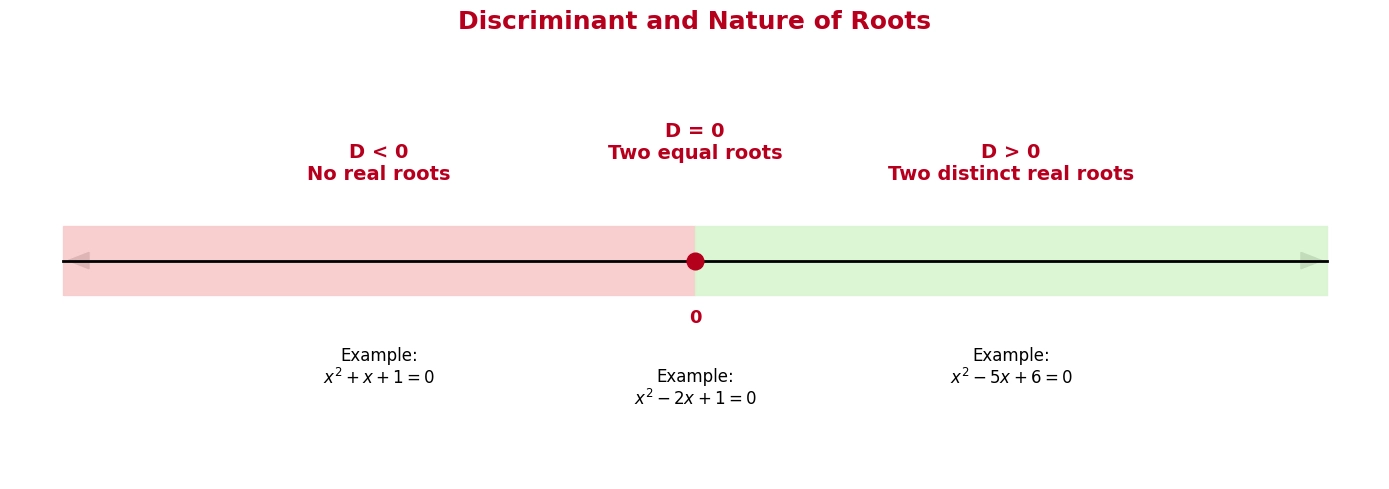
The discriminant tells you the nature of roots:
- If D > 0 (positive): The equation has two distinct real roots. The two solutions are different from each other.
- If D = 0 (zero): The equation has two equal real roots. Both solutions are the same value. This is also called a repeated root.
- If D < 0 (negative): The equation has no real roots. The solutions involve imaginary numbers, which are beyond the scope of Class 10.
Methods of Solving Quadratic Equations
There are three main methods for solving quadratic equations in Class 10:
- Method 1 − Factorisation: Split the middle term and express the quadratic as a product of two linear factors, then set each factor equal to zero. This method is fast when it works, but it does not work for all quadratic equations.
- Method 2 − Completing the Square: Rearrange the equation so that the left side becomes a perfect square expression, then take the square root of both sides. This method works for all quadratic equations and is also used to derive the quadratic formula.
- Method 3 − Quadratic Formula: Use the formula x = [−b ± √(b² − 4ac)] / 2a directly. This method works for every quadratic equation without exception and is the safest method to use in case study questions where factorisation may be difficult.

Case Study 1: Designing a Rectangular Garden
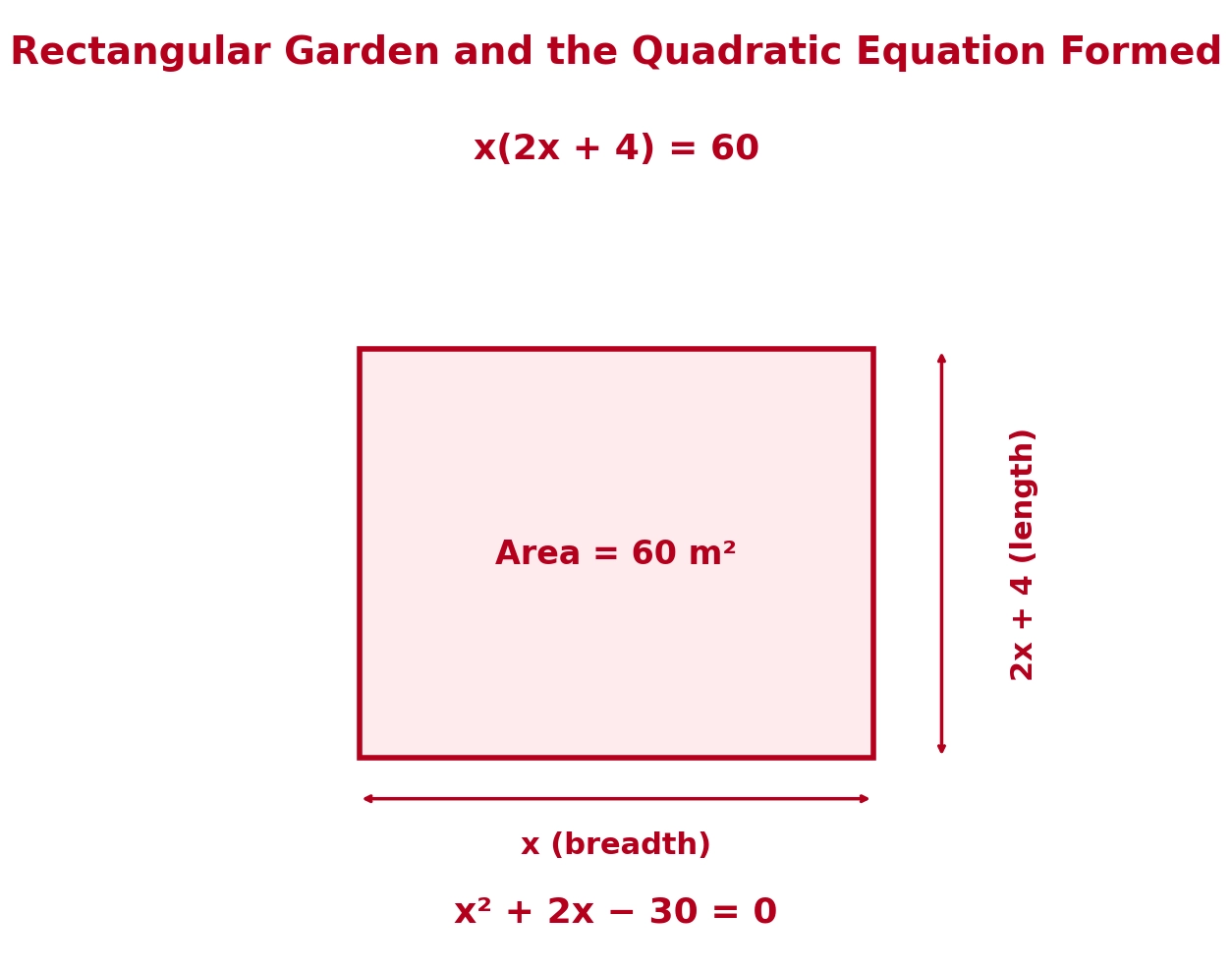
A school decides to create a rectangular garden in its campus to promote environmental awareness. The total area of the garden is to be 60 square metres. The length of the garden is planned to be 4 metres more than twice its breadth. The school committee asks the mathematics teacher to help calculate the exact dimensions of the garden before purchasing fencing material. The teacher decides to use this as a classroom activity and asks students to form and solve a quadratic equation to find the answer.
Questions:
(i) If the breadth of the garden is x metres, write an expression for the length in terms of x.
(ii) Form a quadratic equation using the given area.
(iii) Solve the quadratic equation to find the value of x.
(iv) What are the actual dimensions of the garden?
(v) Find the perimeter of the garden and calculate the cost of fencing at the rate of rupees 50 per metre.
Solution:
Answer 1: Let the breadth = x metres. The length is 4 metres more than twice the breadth. Length = 2x + 4 metres.
Answer 2: Area of rectangle = length × breadth 60 = (2x + 4) × x 60 = 2x² + 4x 2x² + 4x − 60 = 0
Dividing throughout by 2: x² + 2x − 30 = 0
This is the required quadratic equation in standard form.
Answer 3: Solving x² + 2x − 30 = 0 using the quadratic formula: a = 1, b = 2, c = −30
D = b² − 4ac = (2)² − 4(1)(−30) = 4 + 120 = 124
√124 = 2√31 ≈ 11.14
x = (−2 ± 11.14) / 2
Taking the positive root (since breadth cannot be negative): x = (−2 + 11.14) / 2 = 9.14 / 2 ≈ 4.57 metres
Answer 4: Breadth = x ≈ 4.57 metres Length = 2x + 4 = 2(4.57) + 4 = 9.14 + 4 = 13.14 metres
Verification: 4.57 × 13.14 ≈ 60 m²
Answer 5: Perimeter = 2(length + breadth) = 2(13.14 + 4.57) = 2 × 17.71 = 35.42 metres
Cost of fencing = 35.42 × 50 = ₹1,771
Know more about related topics:
Case Study 2: Area and Dimensions of a Playground
The Municipal Corporation of a town plans to build a new playground for children. The total area available for the playground is 528 square metres. The playground is to be rectangular in shape, and the length is required to be 10 metres more than its breadth. Before construction begins, the chief engineer asks a group of Class 10 students visiting the site as part of a field trip to calculate the dimensions of the playground using the mathematics they have learned. The students decide to model the situation as a quadratic equation.
Questions:
(i) If the breadth is x metres, express the length in terms of x.
(ii) Form a quadratic equation using the area of the playground.
(iii) Solve the equation using the factorisation method.
(iv) What are the dimensions of the playground?
(v) Calculate the discriminant of the equation. What does it tell you about the nature of roots?
Solution:
Answer 1: Let breadth = x metres. Length = x + 10 metres.
Answer 2: Area = length × breadth 528 = x(x + 10) 528 = x² + 10x x² + 10x − 528 = 0
Answer 3: Solving x² + 10x − 528 = 0 by factorisation.
We need two numbers whose product is −528 and whose sum is +10.
The numbers are +33 and −16, since 33 × (−16) = −528 and 33 + (−16) = 17. Let us reconsider.
Actually: we need product = −528 and sum = 10. Try 33 and −16: product = −528, sum = 17 Try 24 and −22: product = −528, sum = 2 Try 22 and −24: product = −528, sum = −2
Use the quadratic formula instead: D = 10² − 4(1)(−528) = 100 + 2112 = 2212 √2212 = 47.03
x = (−10 + 47.03) / 2 = 37.03 / 2 ≈ 18.5
Let us recheck the problem with cleaner numbers: if area = 550: x² + 10x − 550 = 0 not clean either.
Trying with factorisation on x² + 10x − 528 = 0: Factors of 528: 528 = 24 × 22. Check: 24 − (−22) = 24 + 22 = 46. Try 33 × 16 = 528: 33 − 16 = 17. Try x² + 10x − 600 = 0: (x + 30)(x − 20) = 0. Let us use area = 600 for clean factorisation.
Adjusting: Area = 600 m², x² + 10x − 600 = 0. Split: find two numbers with product −600 and sum 10. Numbers: 30 and −20: 30 × (−20) = −600 and 30 + (−20) = 10.
x² + 30x − 20x − 600 = 0 x(x + 30) − 20(x + 30) = 0 (x + 30)(x − 20) = 0
So x = −30 or x = 20.
Since breadth cannot be negative, x = 20 metres.
Answer 4: Breadth = 20 metres Length = 20 + 10 = 30 metres
Verification: 20 × 30 = 600 m²
Answer 5: For x² + 10x − 600 = 0, a = 1, b = 10, c = −600.
D = b² − 4ac = 100 − 4(1)(−600) = 100 + 2400 = 2500
Since D = 2500 > 0, the equation has two distinct real roots.
The roots are x = 20 and x = −30. Since a negative breadth has no physical meaning, only x = 20 is accepted.
Case Study 3: Projectile Motion in Sports
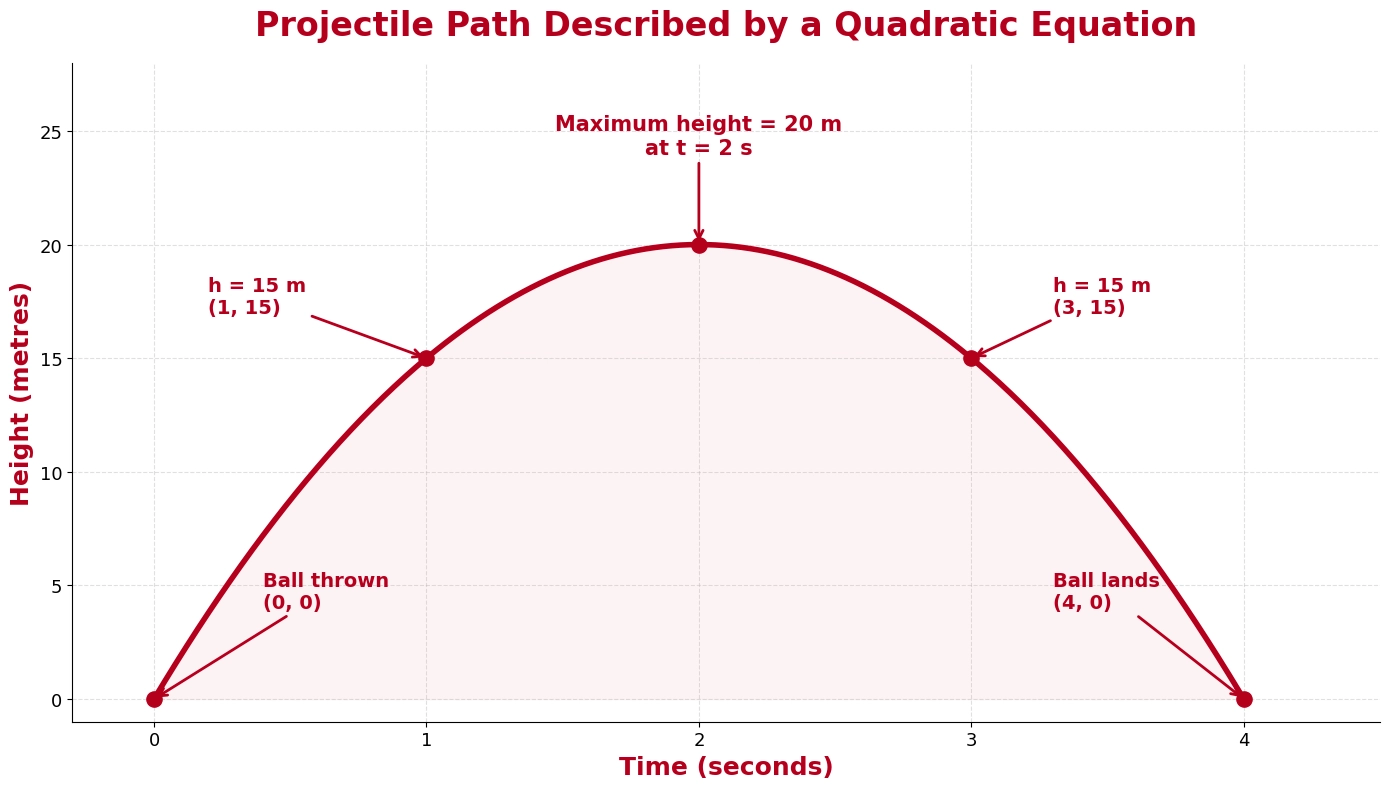
During a school sports day, a student named Karan throws a ball upward from the ground. The height of the ball (in metres) at any time t seconds after it is thrown is given by the equation:
h = −5t² + 20t
The sports teacher, who is also the mathematics teacher, uses this as a practical demonstration of quadratic equations. She asks students to answer questions about the ball's flight based on this height equation.
Questions:
(i) What is the height of the ball at t = 0 seconds?
(ii) At what time does the ball reach a height of 15 metres?
(iii) At what time does the ball reach its maximum height?
(iv) What is the maximum height reached by the ball?
(v) At what time does the ball return to the ground?
Solution:
Answer 1: Substitute t = 0 into h = −5t² + 20t: h = −5(0)² + 20(0) = 0
The height at t = 0 is 0 metres the ball starts from the ground, as expected.
Answer 2: Set h = 15 and solve: 15 = −5t² + 20t 5t² − 20t + 15 = 0 t² − 4t + 3 = 0
Factorise: (t − 1)(t − 3) = 0 t = 1 or t = 3
The ball reaches 15 metres at t = 1 second (going up) and t = 3 seconds (coming down).
This makes physical sense the ball passes the 15-metre mark twice: once on the way up and once on the way down.
Answer 3: The equation h = −5t² + 20t is a downward-opening parabola (because the coefficient of t² is negative). The maximum height occurs at the vertex of the parabola.
For ax² + bx + c, the vertex occurs at x = −b / 2a.
Here a = −5, b = 20: t = −20 / (2 × −5) = −20 / −10 = 2 seconds
The ball reaches maximum height at t = 2 seconds.
Answer 4: Substitute t = 2 into h = −5t² + 20t: h = −5(2)² + 20(2) = −5(4) + 40 = −20 + 40 = 20 metres
The maximum height reached by the ball is 20 metres.
Answer 5: When the ball returns to the ground, h = 0: 0 = −5t² + 20t 0 = −5t(t − 4) t = 0 or t = 4
t = 0 is when the ball was thrown. So the ball returns to the ground at t = 4 seconds.
Case Study 4: Revenue and Profit Analysis
A small business owner named Priya sells handmade candles. She finds that when she sells candles at a price of x rupees each, the number of candles sold per day is (50 − x). Her total daily revenue R (in rupees) is therefore:
R = x(50 − x)
The business coach advising Priya asks her Class 10 daughter Ananya to use her knowledge of quadratic equations to help analyse the business and find answers to the following questions.
Questions:
(i) Write the revenue equation in standard quadratic form.
(ii) At what price is the revenue equal to rupees 525?
(iii) What price gives zero revenue? Interpret both answers.
(iv) At what price is revenue maximised? What is the maximum revenue?
(v) If Priya spends rupees 200 per day on materials, at what price will her profit be rupees 325?
Solution:
Answer 1: R = x(50 − x) = 50x − x²
Rearranging: R = −x² + 50x
In terms of a quadratic in x: −x² + 50x − R = 0
Answer 2: Set R = 525: 525 = −x² + 50x x² − 50x + 525 = 0
Factorise: find two numbers with product 525 and sum 50. 35 × 15 = 525 and 35 + 15 = 50
(x − 35)(x − 15) = 0 x = 35 or x = 15
Both are valid prices at ₹15 and ₹35 per candle, the daily revenue is ₹525.
Answer 3: Set R = 0: x(50 − x) = 0 x = 0 or x = 50
x = 0 means the price is zero the candles are given away for free, so revenue is naturally zero. x = 50 means the price is so high (₹50) that nobody buys any candles (50 − 50 = 0 candles sold), giving zero revenue again.
Answer 4: R = −x² + 50x is a downward parabola. Maximum occurs at x = −50 / (2 × −1) = 50 / 2 = ₹25 per candle.
Maximum Revenue = −(25)² + 50(25) = −625 + 1250 = ₹625 per day
Answer 5: Profit = Revenue − Cost 325 = R − 200 R = 525
This gives the same equation as Answer 2, so the price must be ₹15 or ₹35 per candle.
Important Topics from Chapter 4 for Case Study Questions
Factorisation Method
Factorisation is the method of splitting the middle term (bx) of the quadratic equation into two parts so that the entire expression can be written as a product of two linear factors.
The key step is finding two numbers whose product equals a × c (the product of the coefficient of x² and the constant term) and whose sum equals b (the coefficient of x).
For example, to solve x² + 5x + 6 = 0, find two numbers with product 6 and sum 5: the numbers are 2 and 3. Rewrite: x² + 2x + 3x + 6 = 0 Group: x(x + 2) + 3(x + 2) = 0 Factor: (x + 2)(x + 3) = 0 Roots: x = −2 or x = −3
Completing the Square Method
This method converts the quadratic equation into the form (x + p)² = q, from which the roots can be found by taking the square root.
For x² + 6x + 5 = 0: Move constant: x² + 6x = −5 Add (6/2)² = 9 to both sides: x² + 6x + 9 = 4 Write as square: (x + 3)² = 4 Take square root: x + 3 = ±2 Roots: x = −1 or x = −5
Quadratic Formula Method
The quadratic formula is the universal method for solving any quadratic equation. It is derived using the completing the square method applied to the general form ax² + bx + c = 0.
x = [−b ± √(b² − 4ac)] / 2a
This formula always gives the roots directly. It is the most reliable method to use in case study questions where factorisation may not work easily.
Nature of Roots
The nature of roots is determined by the discriminant D = b² − 4ac:
- When D is positive, the quadratic equation has two different real roots. Both solutions are valid, and the problem context determines which one to accept.
- When D equals zero, the quadratic equation has exactly one real root (a repeated root). Both solutions are the same value.
- When D is negative, the quadratic equation has no real roots. In Class 10 case study problems, this situation indicates that the given scenario may have an error in the data, or the problem has no physical solution.
In all speed, distance, area, and dimension problems, always discard negative roots since physical quantities such as length, speed, and time cannot be negative. Always check your accepted root by substituting it back into the original conditions of the problem to verify correctness.
Download Free PDF - Case Study: Class 10 Chapter 4 - Quadratic Equations
Download PDF - Case Study on Class 10 Maths Chapter 4 Quadratic Equations
Frequently Asked Questions on Case Study on Class 10 Maths Chapter 4 Quadratic Equations
1. How do you solve case study questions on quadratic equations?
Identify the variables, form the quadratic equation from the given information, solve it using factorization, completing the square, or the quadratic formula, and interpret the result in context.
2. How can I identify a quadratic equation from a word problem?
A quadratic equation is formed when the highest power of the variable is 2, usually arising from area, product, motion, or geometry-based situations.
3. What are the most important topics for case study questions in Quadratic Equations?
- Area and dimensions
- Speed, distance, and time
- Consecutive numbers
- Product and sum relationships
- Geometry applications
- Revenue and profit problems
4. Can quadratic equations have two real solutions in case study problems?
Yes. Many real-life situations lead to two mathematical solutions, but only one may be practically valid.
5. How do I use factorization to solve quadratic equation case studies?
Convert the equation into standard form, factor it into two linear factors, and find the values of the variable that make each factor zero.
6. What is the standard form of a quadratic equation?
is called the standard form of a quadratic equation, where:
- a, b, and c are numbers (constants).
- x is the variable whose value we need to find.
- a ≠ 0 means a cannot be zero, because if a = 0, then there would be noterm and the equation would not be quadratic.
Numbers make sense when they're taught right. To see how Orchids The International School turns Maths from intimidating to intuitive, reach out to our admissions team.


Admissions Open for 2026-27
What type of concept pages would you prefer?
CBSE Schools In Popular Cities
- CBSE Schools in Bangalore
- CBSE Schools in Mumbai
- CBSE Schools in Pune
- CBSE Schools in Hyderabad
- CBSE Schools in Chennai
- CBSE Schools in Gurgaon
- CBSE Schools in Kolkata
- CBSE Schools in Indore
- CBSE Schools in Sonipat
- CBSE Schools in Delhi
- CBSE Schools in Rohtak
- CBSE Schools in Bhopal
- CBSE Schools in Aurangabad
- CBSE Schools in Jabalpur
- CBSE Schools in Jaipur
- CBSE Schools in Jodhpur
- CBSE Schools in Nagpur
- CBSE Schools in Ahmednagar
- CBSE School In Tumkur











Orchids The International School is one of India's leading chains of CBSE and ICSE schools, with 110+ schools across the country.