

HOTS Questions on Class 9 Maths Chapter 5 I'm Up and Down, and Round and Round
HOTS Questions on Class 9 Maths Chapter 5 I'm Up and Down, and Round and Round is an easy way for students to learn about mensuration and shapes in a simple way. It helps them understand triangles, quadrilaterals, circles, and basic geometry concepts with ease. This chapter builds a strong base for solving shape-based problems and improving math skills. A downloadable PDF is also available for easy revision and practice.
HOTS Questions Based on Circles and Circular Paths
Question 1: A circular path has a radius of 21 metres. A student claims that if the radius is doubled, the circumference also doubles. Another student claims the area becomes four times. Who is correct, and why?
Answer 1: Both students are correct, and here is the reasoning for each.
- First student's claim circumference doubles when radius doubles: Original circumference = 2πr New circumference (with 2r) = 2π(2r) = 4πr = 2 × (2πr)
- Since the new circumference is exactly 2 times the original, the first student is correct. Circumference is directly proportional to radius, so doubling the radius doubles the circumference.
- Second student's claim area becomes four times when radius doubles: Original area = πr² New area = π(2r)² = π × 4r² = 4πr²
- Since the new area is exactly 4 times the original, the second student is also correct. Area is proportional to the square of the radius, so doubling the radius multiplies the area by 2² = 4.
- Both claims are correct, but they describe different properties of the circle. Circumference scales linearly with radius, while area scales quadratically.
Question 2: Two circles have the same centre (they are concentric). The inner circle has radius 7 cm and the outer circle has radius 14 cm. A point moves from the inner circle to the outer circle along a straight line passing through the centre. How far does the point travel? Does the path of this movement form part of any known line in circle geometry?
Answer 2: The distance from a point on the inner circle to the corresponding point on the outer circle, measured along a straight line through the centre, is simply the difference in the two radii.
Distance = Outer radius − Inner radius = 14 − 7 = 7 cm
This straight line from the inner circle to the outer circle, passing through the centre, is part of the radius of the outer circle. The segment that lies between the two circles (7 cm long) is called an annular radius segment the same type of measurement used when calculating the width of a ring-shaped region (annulus) between two concentric circles.
Question 3: A circular garden has a diameter of 28 metres. A gardener wants to walk along the boundary of the garden 5 times. How much total distance does the gardener cover? If the gardener walks at 1.4 metres per second, how long does this take? (Use π = 22/7)
Answer 3: Diameter = 28 m, so radius = 14 m.
Circumference = 2πr = 2 × (22/7) × 14 = 88 metres.
Distance for 5 laps = 5 × 88 = 440 metres.
Time = Distance ÷ Speed = 440 ÷ 1.4 = 314.28 seconds, approximately 5 minutes and 14 seconds.
Question 4: A wheel of radius 35 cm is attached to a bicycle. In one complete rotation of the wheel, how far does the bicycle move? If the bicycle completes 200 rotations of the wheel, what total distance does it cover? (Use π = 22/7)
Answer 4: Radius = 35 cm.
Distance per rotation = Circumference = 2πr = 2 × (22/7) × 35 = 220 cm = 2.2 metres.
Distance for 200 rotations = 200 × 220 = 44,000 cm = 440 metres.
Question 5: A race track is in the shape of a circle with radius 70 metres. An athlete runs 3 full laps and then stops halfway through the fourth lap. What total distance has the athlete covered? (Use π = 22/7)
Answer 5: Radius = 70 m. Circumference = 2 × (22/7) × 70 = 440 metres.
Distance for 3 full laps = 3 × 440 = 1320 metres.
Half lap = 440 ÷ 2 = 220 metres.
Total distance = 1320 + 220 = 1540 metres (or 1.54 km).
HOTS Questions Based on Arc Length and Circular Motion
Question 1: A sector of a circle has a central angle of 90° and a radius of 14 cm. Find the length of the arc. Now, if the central angle is tripled (to 270°) but the radius stays the same, does the arc length triple? Justify your answer mathematically. (Use π = 22/7)
Answer 1: Arc length formula: Arc length = (θ/360°) × 2πr
For θ = 90°, r = 14 cm: Arc length = (90/360) × 2 × (22/7) × 14 = (1/4) × 88 = 22 cm
For θ = 270°, r = 14 cm: Arc length = (270/360) × 2 × (22/7) × 14 = (3/4) × 88 = 66 cm
Yes, the arc length does triple when the angle triples (22 × 3 = 66), and here is the mathematical justification. Arc length = (θ/360) × 2πr. Since r is constant, arc length is directly proportional to θ. Tripling θ therefore triples the arc length. This is because arc length scales linearly with central angle double the angle, double the arc; triple the angle, triple the arc.
Question 2: A minute hand of a clock is 10.5 cm long. How far does the tip of the minute hand travel in 20 minutes? In 40 minutes? Does the distance covered in 40 minutes exactly double the distance covered in 20 minutes? Why or why not? (Use π = 22/7)
Answer 2: The minute hand completes one full rotation (360°) in 60 minutes.
In 20 minutes, it sweeps through an angle = (20/60) × 360° = 120°.
Arc length in 20 minutes = (120/360) × 2 × (22/7) × 10.5 = (1/3) × 66 = 22 cm
In 40 minutes, angle swept = (40/60) × 360° = 240°.
Arc length in 40 minutes = (240/360) × 2 × (22/7) × 10.5 = (2/3) × 66 = 44 cm
Yes, the distance in 40 minutes (44 cm) is exactly double the distance in 20 minutes (22 cm). This is consistent with Answer 1 arc length is directly proportional to angle, and 40 minutes involves exactly double the angle of 20 minutes (240° vs 120°). Since the radius is constant, the arc length doubles exactly.
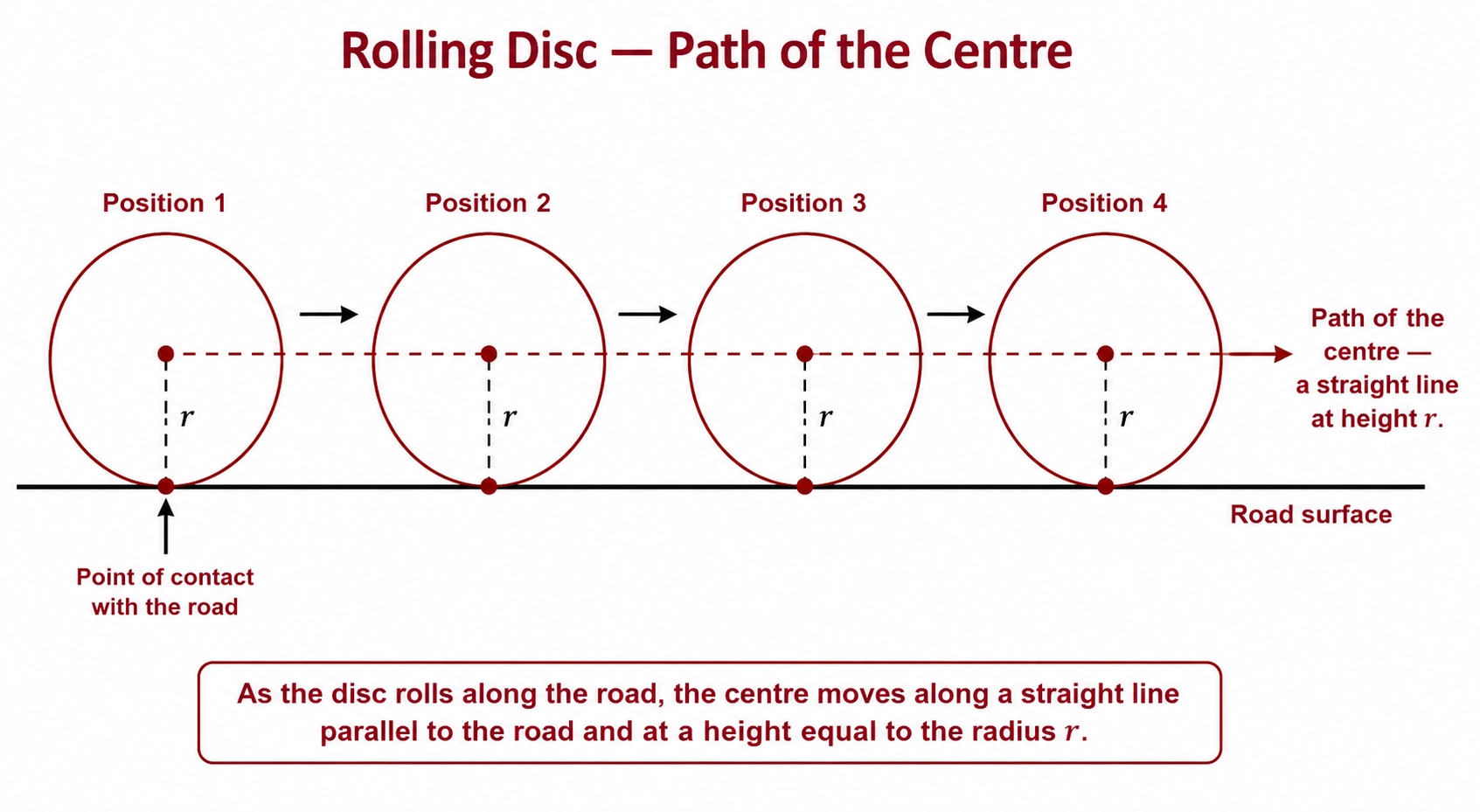
Question 3: A circular disc of radius 7 cm is rolling along a straight road. After 10 complete rotations, how far has the centre of the disc travelled? What path does the centre of the disc trace, and why is this path a straight line rather than a circle? (Use π = 22/7)
Answer 3: Circumference of disc = 2πr = 2 × (22/7) × 7 = 44 cm.
After 10 rotations, distance covered = 10 × 44 = 440 cm.
The centre of the disc traces a straight line parallel to the road surface, at a constant height equal to the radius (7 cm) above the road. The centre traces a straight line (not a circle) because the disc is rolling along a flat surface. As the disc rolls, the centre moves horizontally forward while remaining at a constant vertical height of 7 cm. There is no vertical oscillation and no change in height, so the path is a perfectly straight horizontal line at height r above the surface.
Question 4: A bicycle wheel has a radius of 28 cm. A car wheel has a radius of 35 cm. Both wheels begin rolling at the same time. After the car wheel has completed 100 rotations, how many rotations has the bicycle wheel completed if they have both travelled the same distance? (Use π = 22/7)
Answer 4: Bicycle wheel radius = 28 cm. Distance per rotation = 2π × 28 = 2 × (22/7) × 28 = 176 cm.
Car wheel radius = 35 cm. Distance per rotation = 2π × 35 = 2 × (22/7) × 35 = 220 cm.
Total distance covered by car wheel in 100 rotations = 100 × 220 = 22,000 cm.
Number of bicycle wheel rotations for same distance = 22,000 ÷ 176 = 125 rotations.
The bicycle wheel completes 125 rotations in the same distance that the car wheel completes 100 rotations. This makes sense because the bicycle wheel is smaller, so it needs more rotations to cover the same distance.
Question 5: A wheel starts at a point P on the ground and rolls along a flat surface. After 5 complete rotations, the wheel is at point Q. The radius of the wheel is 21 cm. Find the distance PQ. (Use π = 22/7)
Answer 5: Circumference = 2πr = 2 × (22/7) × 21 = 132 cm.
Distance PQ = 5 × 132 = 660 cm (or 6.6 metres).
Since the wheel rolls in a straight line from P to Q, the distance PQ is simply 5 times the circumference of the wheel — one circumference length per full rotation.
HOTS Questions Based on Geometry in Daily Life
Question 1: A circular fountain in a park has a radius of 3.5 metres. The park authorities want to put a decorative rope along the boundary of the fountain and also across the diameter to divide it. How much rope is needed in total? (Use π = 22/7)
Answer 1: Circumference = 2πr = 2 × (22/7) × 3.5 = 22 metres (rope along boundary).
Diameter = 2r = 2 × 3.5 = 7 metres (rope across diameter).
Total rope needed = 22 + 7 = 29 metres.
Question 2: A coin has a diameter of 2.8 cm. If you roll it in a straight line 50 times (50 complete rotations), what distance does it travel? Express your answer in metres. (Use π = 22/7)
Answer 2: Radius = diameter ÷ 2 = 2.8 ÷ 2 = 1.4 cm.
Circumference = 2 × (22/7) × 1.4 = 8.8 cm.
Distance in 50 rotations = 50 × 8.8 = 440 cm = 4.4 metres.
Question 3: A circular running track has a circumference of 400 metres — the standard length used in athletics. What is the radius of the track? A runner completes a race of 1600 metres (four laps). How many metres does she cover per lap? (Use π = 22/7)
Answer 3: Circumference = 400 m. Formula: 2πr = 400.
r = 400 ÷ (2 × 22/7) = 400 ÷ (44/7) = 400 × (7/44) = 2800/44 = 63.64 metres (approximately).
Each lap = 400 metres. A 1600 metre race = 4 × 400 = 4 laps, each exactly 400 metres.
Question 4: A student says: "If I double the circumference of a circle, I double the diameter too." Is this logically correct? What happens to the area if the circumference is doubled? Justify your answer.
Answer 4: Yes, the student is logically correct that doubling the circumference also doubles the diameter. Here is the mathematical proof.
Circumference C = πd. If C doubles to 2C, then 2C = πd₂, so d₂ = 2C/π = 2 × (πd)/π = 2d. So the diameter doubles.
Now, what happens to area?
Original area = πr² = π(d/2)² = πd²/4.
New diameter = 2d, so new area = π(2d)²/4 = π × 4d²/4 = πd².
New area = πd², original area = πd²/4. So new area is 4 times the original.
Doubling the circumference also doubles the diameter (correct), but the area becomes 4 times, not 2 times, because area scales as the square of the linear dimension.
Question 5: A circular disc covers a distance of 440 cm after exactly 10 complete rotations. What is the radius of the disc? If a second disc with twice the radius rolls the same 440 cm, how many rotations does it make? (Use π = 22/7)
Answer 5: Distance per rotation = Total distance ÷ Number of rotations = 440 ÷ 10 = 44 cm.
Circumference = 44 cm. So 2πr = 44.
r = 44 ÷ (2 × 22/7) = 44 ÷ (44/7) = 44 × (7/44) = 7 cm.
Second disc has radius = 2 × 7 = 14 cm.
Circumference of second disc = 2 × (22/7) × 14 = 88 cm.
Rotations for 440 cm = 440 ÷ 88 = 5 rotations.
The second disc makes exactly half as many rotations because it is twice the size. This confirms that the number of rotations is inversely proportional to the radius when distance is fixed.
HOTS Questions Involving Measurement and Estimation
Question 1: A circular road around a park has an inner radius of 56 metres and an outer radius of 63 metres. Find the area of the road. If it costs ₹50 per square metre to pave the road, find the total cost. (Use π = 22/7)
Answer 1: Inner radius r = 56 m, Outer radius R = 63 m.
Area of road = π(R² − r²) = (22/7) × (63² − 56²)
= (22/7) × (3969 − 3136)
= (22/7) × 833
= 22 × 119
= 2618 m²
Total cost = 2618 × 50 = ₹1,30,900
Question 2: A clock has a minute hand of length 14 cm. Find the distance travelled by the tip of the minute hand in one complete day (24 hours). (Use π = 22/7)
Answer 2: Length of minute hand (radius) = 14 cm.
In one hour, the minute hand completes one full rotation.
Circumference = 2πr = 2 × (22/7) × 14 = 88 cm per hour.
In 24 hours = 24 × 88 = 2112 cm (or 21.12 metres).
Question 3: A wire of length 88 cm is bent to form a circle. What is the radius of the circle? If the same wire is bent to form a square instead, what is the side of the square? Which shape has the greater area?
Answer 3: Wire length = 88 cm. This becomes the circumference of the circle.
2πr = 88, so r = 88 ÷ (2 × 22/7) = 88 × 7/44 = 14 cm.
Area of circle = πr² = (22/7) × 14 × 14 = 616 cm².
If bent into a square: perimeter = 88 cm, so each side = 88 ÷ 4 = 22 cm.
Area of square = 22 × 22 = 484 cm².
The circle has a greater area (616 cm² > 484 cm²). This illustrates a fundamental geometric truth: for a given perimeter (fixed length of material), a circle always encloses more area than any other shape. This property is called the Isoperimetric Inequality and has important applications in engineering and design.
Question 4: A sector has an arc length of 44 cm and a central angle of 90°. Find the radius and then find the area of the sector. (Use π = 22/7)
Answer 4: Arc length = (θ/360°) × 2πr
44 = (90/360) × 2 × (22/7) × r
44 = (1/4) × (44/7) × r
44 = (11/7) × r
r = 44 × 7/11 = 28 cm
Area of sector = (θ/360°) × πr² = (90/360) × (22/7) × 28 × 28
= (1/4) × (22/7) × 784
= (1/4) × 2464
= 616 cm²
Question 5: The diameter of a wheel of a car is 70 cm. The car travels at a constant speed of 66 km/h. How many complete rotations does the wheel make in one minute? (Use π = 22/7)
Answer 5: Diameter = 70 cm, so radius = 35 cm.
Circumference = 2 × (22/7) × 35 = 220 cm = 2.2 metres per rotation.
Speed = 66 km/h = 66,000 metres per hour = 66,000 ÷ 60 = 1100 metres per minute.
Rotations per minute = 1100 ÷ 2.2 = 500 rotations per minute.
Download PDF - HOTS Questions on Class 9 Maths Chapter 5 I'm Up and Down and Round and Round pdf
Frequently Asked Questions on HOTS Questions on Class 9 Maths Chapter 5 I'm Up and Down, and Round and Round
1. What concepts are covered in this chapter?
This chapter mainly covers:
- Circles and their parts
- Radius, diameter, and chord
- Arcs and sectors
- Angles in a circle
- Symmetry and circular motion
- Properties of circles
2. What are the most important circle properties for HOTS questions?
Important properties include:
- Equal chords of a circle are equidistant from the center.
- The perpendicular from the center to a chord bisects the chord.
- Angles subtended by the same chord are equal.
- The angle subtended by a diameter at the circumference is 90°.
3. Are diagrams necessary for solving HOTS questions?
Yes, drawing accurate diagrams often makes it easier to visualize the problem and identify the correct geometric relationships.
4. How can HOTS questions improve exam performance?
Regular practice of HOTS questions improves conceptual understanding, boosts confidence, and helps students tackle challenging exam questions effectively.
Numbers make sense when they're taught right. To see how Orchids The International School turns Maths from intimidating to intuitive, reach out to our admissions team.


Admissions Open for 2026-27
Admissions Open for 2026-27
CBSE Schools In Popular Cities
- CBSE Schools in Bangalore
- CBSE Schools in Mumbai
- CBSE Schools in Pune
- CBSE Schools in Hyderabad
- CBSE Schools in Chennai
- CBSE Schools in Gurgaon
- CBSE Schools in Kolkata
- CBSE Schools in Indore
- CBSE Schools in Sonipat
- CBSE Schools in Delhi
- CBSE Schools in Rohtak
- CBSE Schools in Bhopal
- CBSE Schools in Aurangabad
- CBSE Schools in Jabalpur
- CBSE Schools in Jaipur
- CBSE Schools in Jodhpur
- CBSE Schools in Nagpur
- CBSE Schools in Ahmednagar
- CBSE School In Tumkur












Orchids The International School is one of India's leading chains of CBSE and ICSE schools, with 110+ schools across the country.