

MDCCCLXXXVII Roman Numerals
MDCCCLXXXVII Roman numerals represent the number 1887. It is written by combining the symbols M (1000), D (500), C (100), L (50), X (10), V (5), and I (1) using the addition rule. To convert MDCCCLXXXVII Roman numerals to Hindu-Arabic numerals, we first break it into M + DCCC + LXXX + VII. Replacing each component with its respective value, we have 1000 + 800 + 80 + 7 = 1887. Learning to interpret Roman numerals like MDCCCLXXXVII helps recognise numeral patterns and makes conversion between Roman and Arabic numbers easier.
In this guide, you’ll learn the value of MDCCCLXXXVII, step-by-step conversion, rules and related examples.
Table of Contents
- How to Write MDCCCLXXXVII Roman Numerals in Numbers?
- Numbers Related to MDCCCLXXXVII Roman Numerals
- Basic Rules for Writing Roman Numerals
- Facts About MDCCCLXXXVII Roman Numerals
- Solved Examples on MDCCCLXXXVII Roman Numerals
- Practice Questions on MDCCCLXXXVII Roman Numerals
- Conclusion
- Frequently Asked Questions on MDCCCLXXXVII Roman Numerals

How to Write MDCCCLXXXVII Roman Numerals in Numbers?
In this section, we will learn how to convert MDCCCLXXXVII Roman numerals into their numerical value using easy steps.
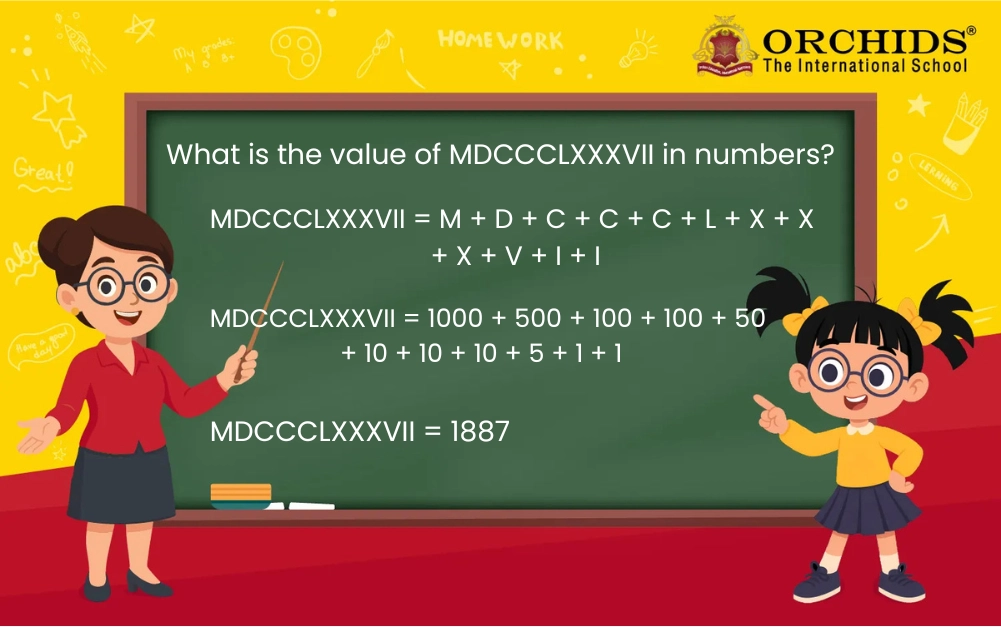
Here, we expand each group into individual symbols to show the value of each one clearly.
First, we break down MDCCCLXXXVII into components
MDCCCLXXXVII = M + D + C + C + C + L + X + X + X + V + I + I
The Roman numeral MDCCCLXXXVII is formed by combining seven symbols:
- M stands for 1000
- D stands for 500
- C stands for 100
- L stands for 50
- X stands for 10
- V stands for 5
- I stands for 1
Now, add the values together:
MDCCCLXXXVII = M + D + C + C + C + L + X + X + X + V + I + I
= 1000 + 500 + 100 + 100 + 100 + 50 + 10 + 10 + 10 + 5 + 1 + 1
= 1887
So, the numerical value of the Roman numeral MDCCCLXXXVII is 1887.
Know more about related topics:
Numbers Related to MDCCCLXXXVII Roman Numerals
|
MDCCCLXXX |
M + D + C + C + C + L + X + X + X |
1000 + 500 + 100 + 100 + 100 + 50 + 10 + 10 + 10 |
1880 |
|
MDCCCLXXXI |
M + D + C + C + C + L + X + X + X + I |
1000 + 500 + 100 + 100 + 100 + 50 + 10 + 10 + 10 + 1 |
1881 |
|
MDCCCLXXXII |
M + D + C + C + C + L + X + X + X + I + I |
1000 + 500 + 100 + 100 + 100 + 50 + 10 + 10 + 10 + 1 + 1 |
1882 |
|
MDCCCLXXXIII |
M + D + C + C + C + L + X + X + X + I + I + I |
1000 + 500 + 100 + 100 + 100 + 50 + 10 + 10 + 10 + 1 + 1 + 1 |
1883 |
|
MDCCCLXXXIV |
M + D + C + C + C + L + X + X + X + (V - I) |
1000 + 500 + 100 + 100 + 100 + 50 + 10 + 10 + 10 + (5 - 1) |
1884 |
|
MDCCCLXXXV |
M + D + C + C + C + L + X + X + X + V |
1000 + 500 + 100 + 100 + 100 + 50 + 10 + 10 + 10 + 5 |
1885 |
|
MDCCCLXXXVI |
M + D + C + C + C + L + X + X + X + V + I |
1000 + 500 + 100 + 100 + 100 + 50 + 10 + 10 + 10 + 5 + 1 |
1886 |
|
MDCCCLXXXVII |
M + D + C + C + C + L + X + X + X + V + I + I |
1000 + 500 + 100 + 100 + 100 + 50 + 10 + 10 + 10 + 5 + 1 + 1 |
1887 |
|
MDCCCLXXXVIII |
M + D + C + C + C + L + X + X + X + V + I + I + I |
1000 + 500 + 100 + 100 + 100 + 50 + 10 + 10 + 10 + 5 + 1 + 1 + 1 |
1888 |
|
MDCCCLXXXIX |
M + D + C + C + C + L + X + X + X + (X - I) |
1000 + 500 + 100 + 100 + 100 + 50 + 10 + 10 + 10 + (10 - 1) |
1889 |
|
MDCCCXC |
M + D + C + C + C + (C - X) |
1000 + 500 + 100 + 100 + 100 + (100 - 10) |
1890 |
Basic Rules for Writing Roman Numerals
- Roman numerals use seven symbols: I, V, X, L, C, D, and M, representing 1, 5, 10, 50, 100, 500, and 1000.
- Addition rule: When a smaller numeral is placed after a larger one, the values are added (VI = 5 + 1 = 6).
- Subtraction rule: When a smaller numeral is placed before a larger one, it is subtracted (IV = 5 - 1 = 4).
- Repetition rule: I, X, C, and M can be repeated up to three times in a row; however, V, L, and D are never repeated.
- Order rule: Roman numerals are generally written from left to right in descending order of value.
Facts About MDCCCLXXXVII Roman Numerals
Here is a simple and easy explanation of the key facts about MDCCCLXXXVII Roman numerals:
- MDCCCLXXXVII Roman numerals equal 1887. It is written using all seven Roman symbols: M (1000), D (500), C (100), L (50), X (10), V (5), and I (1).
- The Roman numeral MDCCCLXXXVII represents 1887 and is an odd composite number with factors 1, 3, 17, 37, 51, 111, 629, and 1887.
- The Roman numeral MDCCCLXXXVII uses only additive notation. MDCCCLXXXVII = M + D + C + C + C + L + X + X + X + V + I + I.
- The Roman numeral MDCCCLXXXVII follows the repetition rule. The symbols C (100) and X (10) are repeated three times. Repeating C three times gives C + C + C = 100 + 100 + 100 = 300, and repeating X three times gives X + X + X = 10 + 10 + 10 = 30.
- MDCCCLXXXVII Roman numerals is still widely used today in copyright dates for films and books, on building cornerstones, in movie sequels, and in formal documents, etc.
Solved Examples on MDCCCLXXXVII Roman Numerals
Example 1: A book was written in the year MDCCCLXXXVII. What year is this in the modern number system?
Solution: A book was written in the year MDCCCLXXXVII, i.e., the book was written in 1887 according to the modern numbering system.
Example 2: Write 1887 in Roman numerals.
Solution: Break down 1887 into 1000 + 800 + 80 + 7 = 1000 + 500 + 100 + 100 + 100 + 50 + 10 + 10 + 10 + 5 + 1 + 1
1000 = M, 500 = D, 100 = C, 50 = L, 10 = X, 5 = V and 1 = I
Combining the symbols, we get M + D + C + C + C + L + X + X + X + V + I + I = MDCCCLXXXVII
1887 in Roman numerals is MDCCCLXXXVII.
Example 3: Meena saved DCXXIX rupees each month for 3 months. What is her total savings?
Solution: Amount saved each month = DCXXIX = 629
Amount saved in 3 months = 629 × 3 = 1887
∴ Total savings for 3 months is MDCCCLXXXVII.
Example 4: A history book mentions an event that happened in the year MDCCCLXXXVII and another event in the year MDCCC. How many years apart are the two events?
Solution: MDCCCLXXXVII = 1887 and MDCCC = 1000 + 500 + 100 + 100 + 100 = 1800.
MDCCCLXXXVII − MDCCC = 1887 − 1800 = 87.
∴ The events are 87 years apart.
Example 5: A library has M old books, buys DCCC new books, and gets LXXXVII books as a donation. How many books are there in total?
Solution: Number of old books = M = 1000
Number of new books = DCCC = 500 + 100 + 100 + 100 = 800
Number of books donated = LXXXVII = 50 + 10 + 10 + 10 + 5 + 1 + 1 = 87
∴ Total number of books = M + DCCC + LXXXVII = 1000 + 800 + 87 = 1887.
i.e., MDCCCLXXXVII books are there in total.
Practice Questions on MDCCCLXXXVII Roman Numerals
1. Add MDCCCLXXXVII and CXIII
2. A school was founded in MDCCCLXXXVII and renovated XIII years later. In which year was the renovation?
3. Subtract DCCLXX from MDCCCLXXXVII.
4. Write the Roman numerals for three years following MDCCCLXXXVII.
5. MDCCCLXXX × II = ____
Conclusion
MDCCCLXXXVII is not just a number written differently. It represents a traditional numbering system that is still meaningful and widely used in modern society in books, movie sequels, building cornerstones, clock faces, etc. Learning numerals like MDCCCLXXXVII makes Roman numeral conversion easier and helps you recognise patterns used in historical dates and classical numbering systems. It also enhances comprehension of Roman numerals, strengthens problem-solving skills, and reinforces the historical foundations of mathematics.
Learn MDCCCLXXXVII in Roman numerals in a simple and student-friendly way at Orchids International School.
Frequently Asked Questions on MDCCCLXXXVII Roman Numerals
1. What is MDCCCLXXXVII in numbers?
MDCCCLXXXVII = M + D + C + C + C + L + X + X + X + V + I + I
= 1000 + 500 + 100 + 100 + 100 + 50 + 10 + 10 + 10 + 5 + 1 + 1 = 1887
The Roman numeral MDCCCLXXXVII is equivalent to 1887.
2. How do you break down MDCCCLXXXVII?
MDCCCLXXXVII = M(1000) + DCCC(800) + LXXX(80) + VII(7)
3. What number comes before and after the Roman numeral MDCCCLXXXVII?
The Roman numeral MDCCCLXXXVII equals 1887.
Before = MDCCCLXXXVI = 1886
After = MDCCCLXXXVIII = 1888
4. How do you read MDCCCLXXXVII in English?
MDCCCLXXXVII is read as ‘One thousand eight hundred and eighty-seven’.
5. Where is MDCCCLXXXVII commonly seen today?
In modern days, MDCCCLXXXVII is used in copyright dates for films and books, in royal titles, on building/monument cornerstones, in movie sequels, in formal documents, or to denote volume or chapter in a series or books, etc.
Numbers make sense when they're taught right. To see how Orchids The International School turns Maths from intimidating to intuitive, reach out to our admissions team.


Admissions Open for 2026-27
What type of concept pages would you prefer?
CBSE Schools In Popular Cities
- CBSE Schools in Bangalore
- CBSE Schools in Mumbai
- CBSE Schools in Pune
- CBSE Schools in Hyderabad
- CBSE Schools in Chennai
- CBSE Schools in Gurgaon
- CBSE Schools in Kolkata
- CBSE Schools in Indore
- CBSE Schools in Sonipat
- CBSE Schools in Delhi
- CBSE Schools in Rohtak
- CBSE Schools in Bhopal
- CBSE Schools in Aurangabad
- CBSE Schools in Jabalpur
- CBSE Schools in Jaipur
- CBSE Schools in Jodhpur
- CBSE Schools in Nagpur
- CBSE Schools in Ahmednagar
- CBSE School In Tumkur











Orchids The International School is one of India's leading chains of CBSE and ICSE schools, with 110+ schools across the country.