

Mid-Point Theorem
The mid-point theorem establishes a fundamental relationship between the midpoints of two sides of a triangle and the third side. The mid-point Theorem can be seen as a special case of the Basic Proportionality Theorem (also called Thales’ Theorem). Here, a line cuts two sides of a triangle exactly at their midpoints, so each side is divided in the ratio 1:1. This idea is used quite often in geometry. It’s useful when working with parallelograms, constructing geometric figures, and even while solving problems in coordinate geometry. This guide will help you master the mid-point theorem with clear explanations and practical examples.
Table of Contents
- What is the Mid-Point Theorem
- Proof of Mid-Point Theorem
- Converse of the Mid-Point Theorem
- Solved Examples of Mid-Point Theorem
- Frequently Asked Questions on Mid-Point Theorem

What is the Mid-Point Theorem
The mid-point theorem states that in a triangle, the line segment joining the midpoints of two sides is parallel to the third side and is half of its length.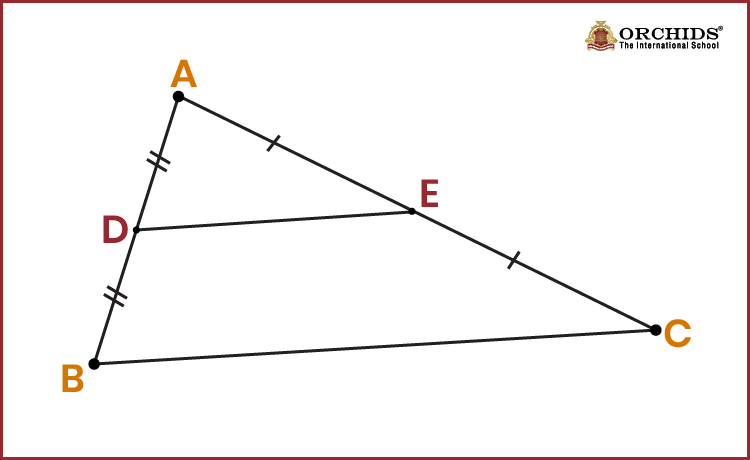
Let ∆ABC be a triangle. Let D be the midpoint of AB and E be the midpoint of AC.
Then: DE ∥ BC and DE = ½ BC
Know more about related topics:
Proof of Mid-Point Theorem
Statement: In a triangle, the line segment joining the midpoints of two sides is parallel to the third side and is half of its length.
Proof: Consider ΔABC. Let D and E be the mid-points of sides AB and AC of ΔABC, respectively.
To Prove: DE || BC and DE = 1/2 × BC
Construction: In ΔABC, through C, draw a line parallel to BA and extend DE such that it meets this parallel line at F.
Compare ΔAED with ΔCEF:
AE = EC (∵ E is the midpoint of AC)
∠DAE = ∠FCE (∵ alternate interior angles)
∠DEA = ∠FEC (∵ vertically opposite angles)
∴ ΔAED ≅ ΔCEF (∵ ASA criterion)
DE = EF and AD = CF (by CPCTC (corresponding parts of congruent triangles are congruent)). ------------ (1)
AD = BD (∵ D is the midpoint of AB) ---------- (2)
From (1) and (2), BD = CF.
∴ BCFD is a parallelogram.
⇒ DF || BC and DF = BC
⇒ DE || BC and DE + EF = BC
2DE = BC (∵ DE = EF)
∴DE = 1/2 × BC
Hence, the mid-point theorem is proved.
Converse of the Mid-Point Theorem
Statement: If a line is drawn through the midpoint of one side of a triangle, parallel to another side, then it bisects the third side.
In Δ ABC, if D is the midpoint of AB and DE ∥ BC, then E is the midpoint of AC.
Solved Examples of Mid-Point Theorem
Example 1: In ΔABC, the midpoints of BC, CA, and AB are D, E, and F, respectively. Find the value of EF if the value of BC = 18 cm.
Solution: Given BC = 18 cm.
By the midpoint theorem, EF ∥ BC and EF = 1/2 × BC
∴ EF = 1/2 × 18 = 9 cm.
Example 2: In ΔPQR, M and N are midpoints of PQ and PR, respectively. If MN = 6.5 cm, find QR.
Solution: In ΔPQR, M and N are midpoints of PQ and PR, respectively.
Given MN = 6.5 cm.
By the midpoint theorem, MN ∥ QR and MN = 1/2 × QR
∴ QR = 2 × MN = 2 × 6.5 = 13 cm.
Numbers make sense when they're taught right. To see how Orchids The International School turns Maths from intimidating to intuitive, reach out to our admissions team.
Frequently Asked Questions on Mid-Point Theorem
1. What is the mid-point theorem?
The mid-point theorem states that in a triangle, the line segment joining the midpoints of two sides is parallel to the third side and is half of its length.
2. What is the converse of the Mid-Point Theorem?
The converse of the mid-point theorem states that if a line is drawn through the midpoint of one side of a triangle, parallel to another side, then it bisects the third side.
3. Where is the mid-point theorem used?
The mid-point theorem is mainly used when working with triangles to understand how lines behave when you join the mid-points of sides. It also helps in solving coordinate geometry problems, congruency of triangles, finding coordinates, and proving properties of shapes like parallelograms.
Related Links


Admissions Open for 2026-27
What type of concept pages would you prefer?
CBSE Schools In Popular Cities
- CBSE Schools in Bangalore
- CBSE Schools in Mumbai
- CBSE Schools in Pune
- CBSE Schools in Hyderabad
- CBSE Schools in Chennai
- CBSE Schools in Gurgaon
- CBSE Schools in Kolkata
- CBSE Schools in Indore
- CBSE Schools in Sonipat
- CBSE Schools in Delhi
- CBSE Schools in Rohtak
- CBSE Schools in Bhopal
- CBSE Schools in Aurangabad
- CBSE Schools in Jabalpur
- CBSE Schools in Jaipur
- CBSE Schools in Jodhpur
- CBSE Schools in Nagpur
- CBSE Schools in Ahmednagar
- CBSE School In Tumkur











Orchids The International School is one of India's leading chains of CBSE and ICSE schools, with 130+ schools across the country.