

Trigonometric Ratios of Complementary Angles: Formula, Proof, Examples and Questions
Trigonometric ratios of complementary angles describe the relationship between the trigonometric functions of two angles whose sum is 90°. These identities make it easier to simplify expressions, solve trigonometric equations and find unknown angles without doing long calculations. In this article, you’ll explore the six complementary angle identities, understand their proofs and work through solved examples and practice questions designed for CBSE Class 10 students.
Table of Contents
- What are Trigonometric Ratio of Complementary Angles?
- Formula for Trigonometric Ratios of Complementary Angles
- Finding Trigonometric Ratios of Complementary Angles
- Proof of Trigonometric Ratios of Complementary Angles
- Solved Examples on Trigonometric Ratios of Complementary Angles
- Practice Questions on Trigonometric Ratios of Complementary Angles
- Conclusion
- Frequently Asked Questions on Trigonometric Ratios of Complementary Angles

What are Trigonometric Ratio of Complementary Angles
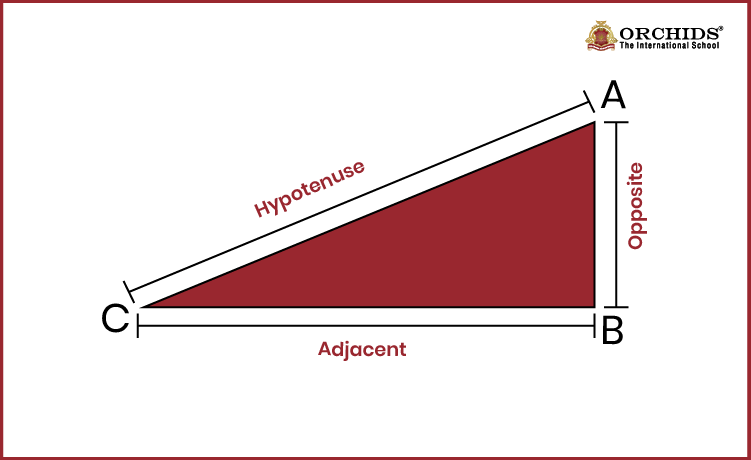
In a right triangle, two angles are always complementary to each other, meaning they add up to 90°. When we look at the trigonometric ratios of these angles, we can see a clear and simple pattern between them.
If A and B are two complementary angles, then: A + B = 90°, which means B = 90° − A.
Formula for Trigonometric Ratios of Complementary Angles
The six trigonometric ratios of complementary angles are:
|
Trigonometric Ratio |
Complementary Angle Relation |
|---|---|
|
sin A |
= cos (90° − A) |
|
cos A |
= sin (90° − A) |
|
tan A |
= cot (90° − A) |
|
cot A |
= tan (90° − A) |
|
sec A |
= cosec (90° − A) |
|
cosec A |
= sec (90° − A) |
These relations show that sine and cosine, tangent and cotangent, and secant and cosecant are pairs. Each one is the complementary ratio of the other.
Finding Trigonometric Ratios of Complementary Angles
To find the trigonometric ratio of a complementary angle, follow these simple steps:
Step 1: Check the given angle and the trigonometric function.
Step 2: Use the identity to convert it. For example, sin(60°) = cos(90° − 60°) = cos(30°).
Step 3: Write the final value using a standard table or known values.
Here are a few quick conversions to remember:
- sin(30°) = cos(60°) = 1/2
- sin(45°) = cos(45°) = 1/√2
- sin(60°) = cos(30°) = √3/2
- tan(30°) = cot(60°) = 1/√3
- tan(45°) = cot(45°) = 1
- tan(60°) = cot(30°) = √3
These values come directly from the complementary angle relationship and are very useful in solving problems quickly.
Proof of Trigonometric Ratios of Complementary Angles
Consider the right-angled triangle ABC given above, where:
- ∠B = 90°
- ∠A = θ
- ∠C = (90° − θ)
Since the sum of the angles in a triangle is 180°,
∠A + ∠B + ∠C = 180°
Substituting ∠B = 90°,
∠A + ∠C = 90°
Hence, ∠A and ∠C are complementary angles.
Proof of sinA=cos(90° − A)
From the definition of trigonometric ratios,
For angle A,
sinA =
For angle C,
cosC =
Since C = 90° − A
we get sinA=cos(90°−A)
Similarly,
For angle A,
For angle C,
Therefore, cosA = sin(90°−A)
Using the same right triangle, we can similarly prove the remaining complementary angle identities
Solved Examples
Example 1: Find the value of sin(70°) using complementary angles.
Solution:
We know that sin A = cos(90° − A)
So, sin(70°) = cos(90° − 70°) = cos(20°)
Example 2: Simplify: tan(35°) / cot(55°)
Solution:
We know that cot(55°) = cot(90° − 35°) = tan(35°)
So, tan(35°) / cot(55°) = tan(35°) / tan(35°) = 1
Example 3: If sin(3A) = cos(A − 10°), find the value of A.
Solution: Since sin(3A) = cos(90° − 3A), we can write:
cos(90° − 3A) = cos(A − 10°)
So, 90° − 3A = A − 10°
90° + 10° = A + 3A
100° = 4A
A = 25°
Example 4: Find the value of: sin(65°) / cos(25°)
Solution:
We know that cos(25°) = cos(90° − 65°) = sin(65°)
So, sin(65°) / cos(25°) = sin(65°) / sin(65°) = 1
Example 5: Show that tan(48°) × tan(42°) = 1
Solution:
We know that tan(42°) = tan(90° − 48°) = cot(48°)
So, tan(48°) × tan(42°) = tan(48°) × cot(48°)
Since tan × cot = 1,
tan(48°) × tan(42°) = 1
Practice Questions
Try solving these questions on your own to test your understanding:
- Find the value of cos(80°) using complementary angle identity.
- Simplify: sin(50°) / cos(40°)
- If cos(2A) = sin(A + 15°), find the value of A.
- Prove that: sin(30°) × sec(60°) = 1
- Find the value of: tan(27°) × tan(63°)
- Simplify: (sin 35° × cos 55°) + (cos 35° × sin 55°)
- If tan(4A) = cot(A − 5°), find the value of A.
- Show that: cosec(72°) − sec(18°) = 0
Conclusion
Trigonometric ratios of complementary angles help simplify calculations by converting one trigonometric function into its complementary function. Remember that sine pairs with cosine, tangent pairs with cotangent and secant pairs with cosecant. Once you master these identities, solving Class 10 trigonometry questions becomes much quicker and easier.
Know more about related topics:
Frequently Asked Questions on Trigonometric Ratios of Complementary Angles
1. What are trigonometric ratios of complementary angles?
Trigonometric ratios of complementary angles show the relationship between angles that add up to 90°.
For example:
2. What is the formula for complementary angles in trigonometry?
The main formulas are:
- sin(90° − θ) = cosθ
- cos(90° − θ) = sinθ
- tan(90° − θ) = cotθ
- cot(90° − θ) = tanθ
- sec(90° − θ) = cosecθ
- cosec(90° − θ) = secθ
3. Why are sine and cosine called complementary ratios?
Because the sine of an angle is equal to the cosine of its complementary angle, and vice versa.
4. How do you find trigonometric ratios of complementary angles?
Replace the angle θ with (90° − θ) and use the identity formulas to convert one ratio into its complementary pair.
5. What is the relationship between tan and cot in complementary angles?
6. What are some examples of complementary angles?
Examples include:
- 30° and 60°
- 45° and 45°
- 20° and 70°
7. Where are complementary trigonometric ratios used?
They are used in solving trigonometric equations, simplifying expressions, and real life applications like heights and distances.
Numbers make sense when they're taught right. To see how Orchids The International School turns Maths from intimidating to intuitive, reach out to our admissions team.


Admissions Open for 2026-27
What type of concept pages would you prefer?
CBSE Schools In Popular Cities
- CBSE Schools in Bangalore
- CBSE Schools in Mumbai
- CBSE Schools in Pune
- CBSE Schools in Hyderabad
- CBSE Schools in Chennai
- CBSE Schools in Gurgaon
- CBSE Schools in Kolkata
- CBSE Schools in Indore
- CBSE Schools in Sonipat
- CBSE Schools in Delhi
- CBSE Schools in Rohtak
- CBSE Schools in Bhopal
- CBSE Schools in Aurangabad
- CBSE Schools in Jabalpur
- CBSE Schools in Jaipur
- CBSE Schools in Jodhpur
- CBSE Schools in Nagpur
- CBSE Schools in Ahmednagar
- CBSE School In Tumkur











Orchids The International School is one of India's leading chains of CBSE and ICSE schools, with 130+ schools across the country.