

Ratio and Proportion - Meaning, Formula, Types and Examples
Have you ever shared a pizza with your friends in such a way that everyone received an equal share? Have you tried following a recipe where 2 cups of flour is required for 1 cup of sugar? These examples illustrate the use of ratios and proportions in our daily life.
Ratios and proportions enable us to compare the quantities involved and find their relationship. This concept can be applied in many scenarios of our day-to-day life like shopping, map reading, cooking, price comparison, and even cricket statistics.
In this chapter, you will study about the concept of ratios and proportions in detail. You will learn how to calculate the value of a ratio and a proportion, along with examples. All the topics covered in this chapter have been taken from the CBSE NCERT syllabus of Class 6 and Class 7.
Table of Contents
- What is Ratio and Proportion?
- Ratios and Proportions Examples
- Ratio Proportion Formula
- Direct and Inverse Proportion
- Difference Between Ratios and Proportion
- How to Solve Ratio and Proportion Problems
- Fun Facts and Real-Life Applications of Ratio and Proportion
- Solved Examples on Ratio and Proportion
- Practice Questions on Ratio and Proportion
- Frequently Asked Questions on Ratios and Proportion

What is Ratio and Proportion?
A ratio is a comparison that shows how two quantities relate to each other by division. Written as a:b or a/b.
A proportion is an equality which states that two ratios are equal to each other. Written as a:b = c:d.
If a class has 30 students who prefer cricket and 20 who prefer football, the ratio is 30:20, which simplifies to 3:2. This means there are 3 students who prefer cricket for every 2 students who prefer football. If another class has the same 3:2 split, we say the two ratios are in proportion.
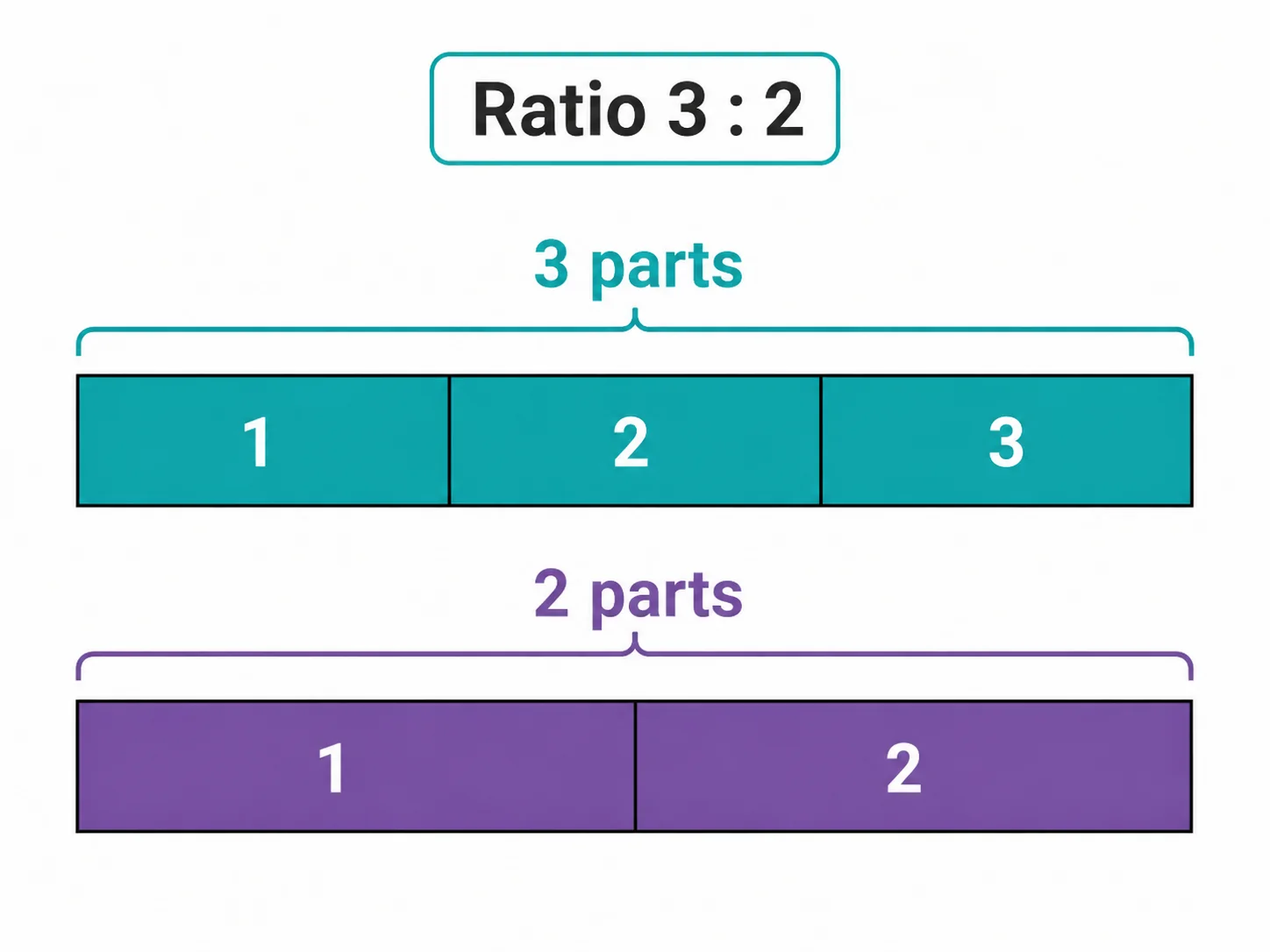 There are a few important things to keep in mind when working with ratios and proportions:
- Ratios have no units. Both quantities must be in the same unit before you write the ratio.
- Order matters in a ratio. 2:5 and 5:2 are not the same. Always check which quantity comes first.
- A proportion is an equation, not just a number. It states that two ratios are equal: a/b = c/d.
- Ratios can be simplified like fractions. 4:6 simplifies to 2:3 by dividing both sides by 2.
- A ratio compares two things. A proportion says two ratios are equal.
Note: A ratio and a proportion are not the same thing. A ratio compares two quantities. A proportion says two ratios are equal.
Note: Ratios do not always have to be simplified unless the question asks for the simplest form.
Know more about related topics:
Ratios and Proportions Examples
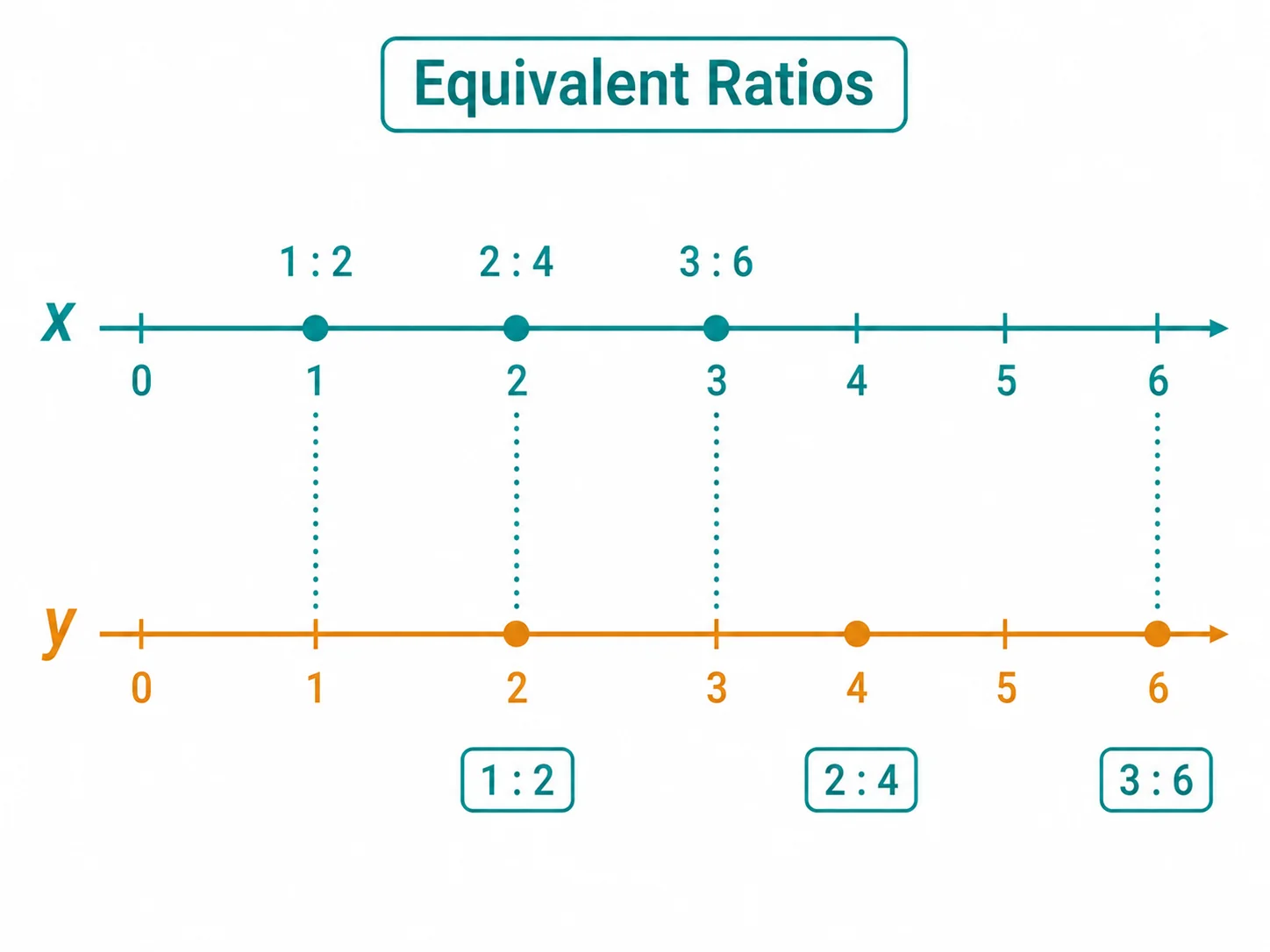
- If a bag has 3 red balls and 6 blue balls, the ratio of red to blue is 3:6 = 1:2.
- If a 12-inch rope is divided in the ratio 3:1, the parts are 9 inches and 3 inches.
- Ratio in recipes: 2 cups of flour to 1 cup of sugar = 2:1.
- A mango juice recipe calls for 2 parts mango pulp and 5 parts water. The ratio of pulp to water is 2:5.
- Small parts: 2 parts pulp, 5 parts water. Large parts: 4 parts pulp, 10 parts water. Since 2:5 = 4:10, both are in proportion and the taste will be identical.
Practice Ratio and Proportion with Ratio and Proportion Exercises
Ratio Proportion Formula
Ratio Formula:
If a and b are two quantities, then Ratio = a:b or a/b
Proportion Formula:
If a/b = c/d, then a:b :: c:d
Cross-Multiplication Rule:
In a/b = c/d, then a × d = b × c
Note: The order of a ratio matters. 3:2 and 2:3 are different ratios and cannot be used interchangeably.
Note: Ratios do not have to be whole numbers. A ratio like 1.5:2.5 is perfectly valid.
Direct and Inverse Proportion
What is Direct Proportion?
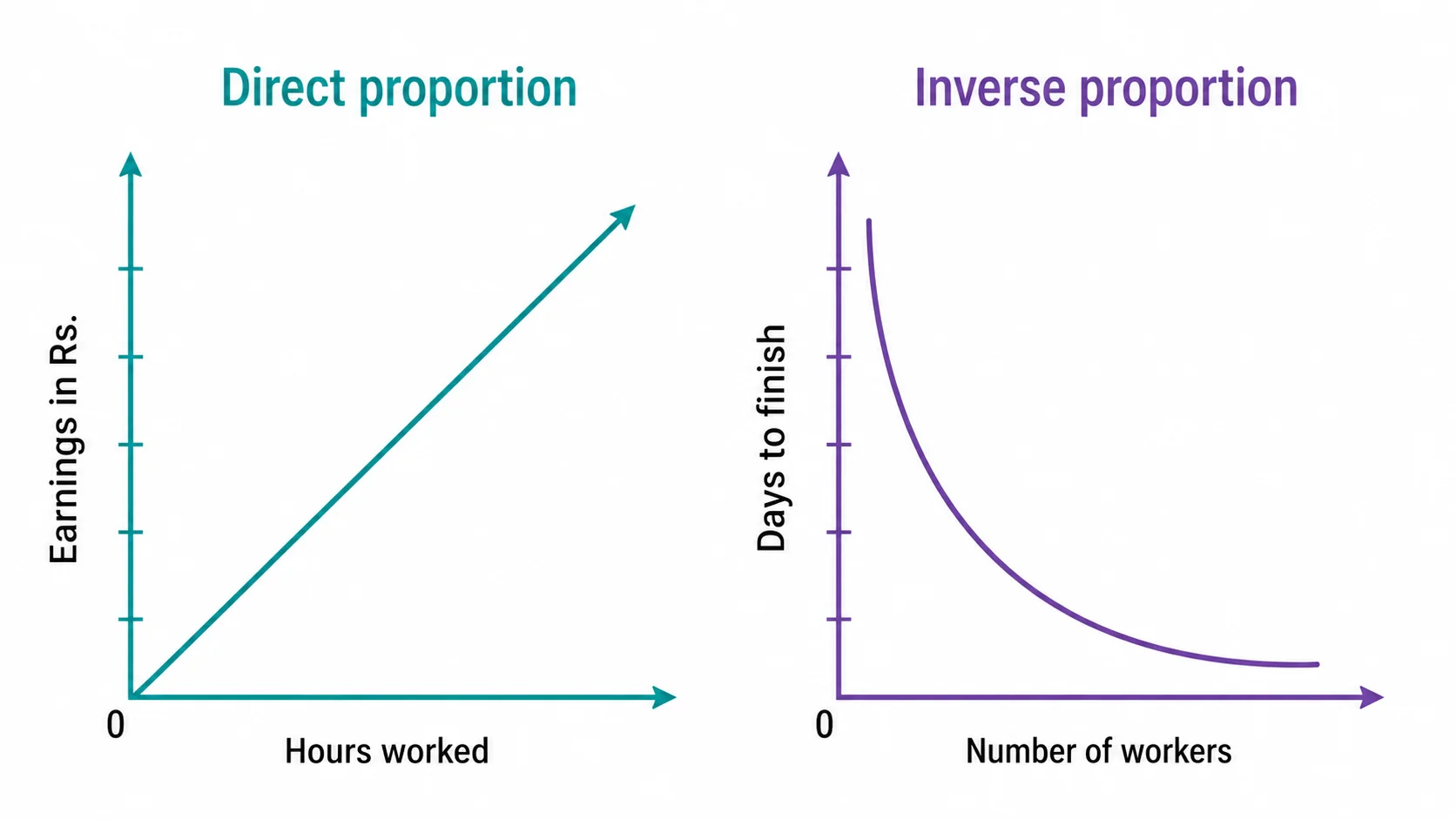
Two quantities are in direct proportion if they increase or decrease together, and their ratio always stays the same. We write this as x ∝ y, which means "x is directly proportional to y."
Formula: y / x = k (where k is a constant)
Example: You earn Rs. 150 for every hour you tutor.
Work 2 hours = Rs. 300. Work 5 hours = Rs. 750. The number of hours and earnings always have the same ratio - 150:1. This is direct proportion.
How to solve a direct proportion problem
Step 1: Check that as one quantity goes up, the other goes up too.
Step 2: Set up the proportion: x1 / y1 = x2 / y2
Step 3: Cross-multiply to find the unknown: x1 × y2 = x2 × y1
Solved Example: If 4 kg of apples cost Rs. 200, how much will 10 kg cost?
Step 1: More apples means more cost. Direct proportion.
Step 2: 4/200 = 10/x
Step 3: 4 × x = 200 × 10
x = 2000 / 4 = Rs. 500
What is Inverse Proportion?
Two quantities are in inverse proportion if one increases while the other decreases, and their product always stays the same. We write this as x ∝ 1/y, which means "x is inversely proportional to y."
Formula: x × y = k (where k is a constant)
Solved Example: 4 workers can paint a wall in 6 days. 8 workers complete it in 3 days. 12 workers in 2 days. As workers increase, days decrease. Their product always stays the same: 4 × 6 = 8 × 3 = 12 × 2 = 24. That is inverse proportion.
How to solve an inverse proportion problem
Step 1: Check that as one quantity goes up, the other goes down.
Step 2: Set the proportion equation: x1 × y1 = x2 × y2
Step 3: Substitute the known values and solve for the unknown.
Solved Example: 6 pipes can fill a tank in 12 hours. How long will 9 pipes take?
Step 1: More pipes = less time. Inverse proportion.
Step 2: 6 × 12 = 9 × x
Step 3: 72 = 9x
x = 72 / 9 = 8 hours
Note: Not every relationship between two quantities is proportional. Always check whether the ratio or product stays constant before assuming direct or inverse proportion.
Direct vs Inverse - Quick Comparison
| Feature | Direct Proportion | Inverse Proportion |
|---|---|---|
| What happens | Both increase or both decrease | One increases, the other decreases |
| What stays constant | The ratio y/x | The product x × y |
| Formula | x1/y1 = x2/y2 | x1 × y1 = x2 × y2 |
| Written as | x ∝ y | x ∝ 1/y |
| Example | More km driven = more fuel used | More workers = fewer days to finish |
Read more - Trigonometric Ratios
Difference Between Ratios and Proportion
| Aspect | Ratio | Proportion |
|---|---|---|
| Definition | Comparison between two quantities | Equality between two ratios |
| Form | a : b | a : b :: c : d |
| Type | Number or fraction | Equation |
| Use | To compare values | To check if two ratios are equal |
| Symbol | Colon (:) | Double colon (::) or equals (=) |
How to Solve Ratio and Proportion Problems
Step 1: Identify the ratio or proportion.
Step 2: Use the cross-multiplication method.
Step 3: Simplify the answer if needed.
Example: If 2 pens cost Rs. 10, how much will 5 pens cost?
Set the proportion: 2/10 = 5/x
Cross-multiply: 2 × x = 10 × 5
x = 50 / 2 = Rs. 25
Fun Facts and Real-Life Applications of Ratio and Proportion
-
Example of Golden Ratio in Nature and Art: The golden ratio is seen in flowers, shells, and works of art.
-
Ratios in Vehicles: Gear ratios in cars help control speed and torque.
-
Ratios in Photography: Photographs are taken in aspect ratios such as 4:3 and 16:9.
-
Ratios in Fashion: Designers apply ratios in the creation of symmetry and balance in fashion designs.
-
Body Mass Index (BMI): BMI is a ratio between weight and the square of height.
Solved Examples on Ratio and Proportion
Example 1: Divide Rs. 200 between A and B in the ratio 3:2.
Solution:
Total parts = 3 + 2 = 5
A's share = (3/5) × 200 = Rs. 120
B's share = (2/5) × 200 = Rs. 80
Example 2: If 5 kg rice costs Rs. 250, what is the cost of 8 kg?
Solution:
5/250 = 8/x
5 × x = 250 × 8
x = 2000 / 5 = Rs. 400
Example 3: Check if 2:5 and 6:15 are in proportion.
Solution:
2/5 = 0.4 and 6/15 = 0.4 → Equal
So, they are in proportion.
Example 4: Find the fourth term: 3:9 :: 4:x
Solution:
3/9 = 4/x
3 × x = 9 × 4
x = 36 / 3 = 12
Example 5: The ratio of boys to girls is 4:3. If there are 21 girls, find the number of boys.
Solution:
4/3 = x/21
3x = 84
x = 28 boys
Practice Questions on Ratio and Proportion
Q1. A bag has 4 red balls and 8 blue balls. What is the ratio of red to blue balls in its simplest form?
a) 1:2 b) 2:1 c) 1:3 d) 4:8
Q2. If 3 pens cost Rs. 24, how much will 7 pens cost?
a) Rs. 48 b) Rs. 56 c) Rs. 60 d) Rs. 72
Q3. Are 2:3 and 8:12 in proportion?
a) Yes b) No c) Cannot determine d) Only if simplified
Q4. Divide Rs. 360 between Riya and Sam in the ratio 4:5. How much does Riya get?
a) Rs. 144 b) Rs. 160 c) Rs. 180 d) Rs. 200
Q5. On a map, 1 cm represents 5 km. Two cities are 13 cm apart on the map. What is the actual distance?
a) 60 km b) 65 km c) 70 km d) 75 km
Q6. 8 workers can build a wall in 12 days. How many days will 6 workers take?
a) 9 days b) 14 days c) 16 days d) 18 days
Q7. If x:y = 3:4 and y:z = 2:5, what is x:z?
a) 3:10 b) 6:20 c) 3:5 d) 6:10
Q8. A car travels 240 km in 4 hours. At the same speed, how far will it travel in 7 hours?
a) 380 km b) 400 km c) 420 km d) 440 km
Q9. 15 pipes fill a tank in 8 hours. How many pipes are needed to fill the same tank in 6 hours?
a) 18 b) 20 c) 22 d) 24
Q10. The ratio of boys to girls in a school is 7:5. If there are 252 boys, what is the total number of students?
a) 360 b) 396 c) 420 d) 432
Answer Key:
- a) 1:2 - 4:8 simplifies to 1:2 by dividing both sides by 4.
- b) Rs. 56 - Cost per pen = 24 ÷ 3 = Rs. 8. So 7 pens = 7 × 8 = Rs. 56.
- a) Yes - 2/3 = 0.667 and 8/12 = 0.667. Both are equal, so they are in proportion.
- b) Rs. 160 - Total parts = 9. Riya's share = (4/9) × 360 = Rs. 160.
- b) 65 km - Actual distance = 13 × 5 = 65 km.
- c) 16 days - Inverse proportion: 8 × 12 = 6 × x. So x = 96 ÷ 6 = 16 days.
- a) 3:10 - Make y common: x:y = 6:8 and y:z = 8:20. So x:z = 6:20 = 3:10.
- c) 420 km - Speed = 240 ÷ 4 = 60 km/h. Distance in 7 hours = 60 × 7 = 420 km.
- b) 20 pipes - Inverse proportion: 15 × 8 = x × 6. So x = 120 ÷ 6 = 20 pipes.
- d) 432 - 7 parts = 252, so 1 part = 36. Total parts = 12. Total students = 12 × 36 = 432.
Frequently Asked Questions on Ratios and Proportion
1. What is a ratio and a proportion?
Answer: A ratio compares two quantities by division and is written as a:b. A proportion states that two ratios are equal and is written as a:b = c:d. For example, if a class has 20 boys and 10 girls, the ratio is 2:1. If another class has the same split, the two ratios are in proportion.
2. What is the ratio formula?
Answer: The formula for a ratio is a:b or a/b, where a and b are two quantities being compared. Both quantities must be in the same unit before writing the ratio.
3. What is the formula for proportion?
Answer: The proportion formula is a:b = c:d or a/b = c/d. This means the two ratios are equal. You can verify this using cross-multiplication: a × d = b × c.
4. How do you solve a proportion?
Answer: Use cross-multiplication. If a/b = c/d, then a × d = b × c. Substitute the known values, then solve for the unknown. For example, if 2/10 = 5/x, then 2 × x = 10 × 5, so x = 25.
5. What is the difference between direct and inverse proportion?
Answer: In direct proportion, both quantities increase or decrease together. As one goes up, so does the other. The ratio y/x stays constant. Example: more hours worked means more pay.
In inverse proportion, one quantity increases while the other decreases. Their product x × y stays constant. Example: more workers means fewer days to finish a job.
6. How do you simplify a ratio?
Answer: Divide both sides of the ratio by their highest common factor (HCF). For example, to simplify 12:18, the HCF is 6. Dividing both sides by 6 gives 2:3. A ratio in its simplest form has no common factor other than 1.
7. Can a ratio be written as a fraction?
Answer: Yes. A ratio a:b can always be written as the fraction a/b. For example, the ratio 3:4 is the same as 3/4. This is why ratios can be simplified the same way fractions are simplified - by dividing both terms by a common factor.
8. How is proportion used in maps and scales?
Answer: Maps use a scale ratio to represent real distances. For example, if a map scale is 1:500,000, it means 1 cm on the map equals 500,000 cm (or 5 km) in real life. This is direct proportion - the larger the map distance, the larger the actual distance.
9. Is proportion the same as percentage?
Answer: No. A proportion compares two ratios and checks if they are equal, written as a:b = c:d. A percentage is a ratio where the second quantity is always 100, written as x%. For example, 3 out of 4 as a proportion is 3:4, and as a percentage it is 75%.
Explore more maths concepts explained simply at Orchids The International School!
Numbers make sense when they're taught right. To see how Orchids The International School turns Maths from intimidating to intuitive, reach out to our admissions team.
Related Links


Admissions Open for 2026-27
What type of concept pages would you prefer?
CBSE Schools In Popular Cities
- CBSE Schools in Bangalore
- CBSE Schools in Mumbai
- CBSE Schools in Pune
- CBSE Schools in Hyderabad
- CBSE Schools in Chennai
- CBSE Schools in Gurgaon
- CBSE Schools in Kolkata
- CBSE Schools in Indore
- CBSE Schools in Sonipat
- CBSE Schools in Delhi
- CBSE Schools in Rohtak
- CBSE Schools in Bhopal
- CBSE Schools in Aurangabad
- CBSE Schools in Jabalpur
- CBSE Schools in Jaipur
- CBSE Schools in Jodhpur
- CBSE Schools in Nagpur
- CBSE Schools in Ahmednagar
- CBSE School In Tumkur











Orchids The International School is one of India's leading chains of CBSE and ICSE schools, with 110+ schools across the country.