

Square Root Questions And Answers
Square Root Questions is a useful topic for students who want to learn maths in a simple way. Square Root Questions help us find the number that gives a square when multiplied by itself. This topic is important because it builds a strong base in maths and improves problem solving skills. Students can practise different questions to understand how square roots work in real sums.
Square Root Formula and Rules
If x² = y, then √y = x
√y means "what number multiplied by itself gives y?"
Example:
√25 = 5 because 5 × 5 = 25
√81 = 9 because 9 × 9 = 81
Important Square Root Rules
- Rule 1: √(a × b) = √a × √b
- Rule 2: √(a/b) = √a / √b
- Rule 3: √(a²) = a (for positive a)
- Rule 4: (√a)² = a
- Rule 5: √0 = 0
- Rule 6: √1 = 1
- Rule 7: Square root of negative numbers is NOT real.
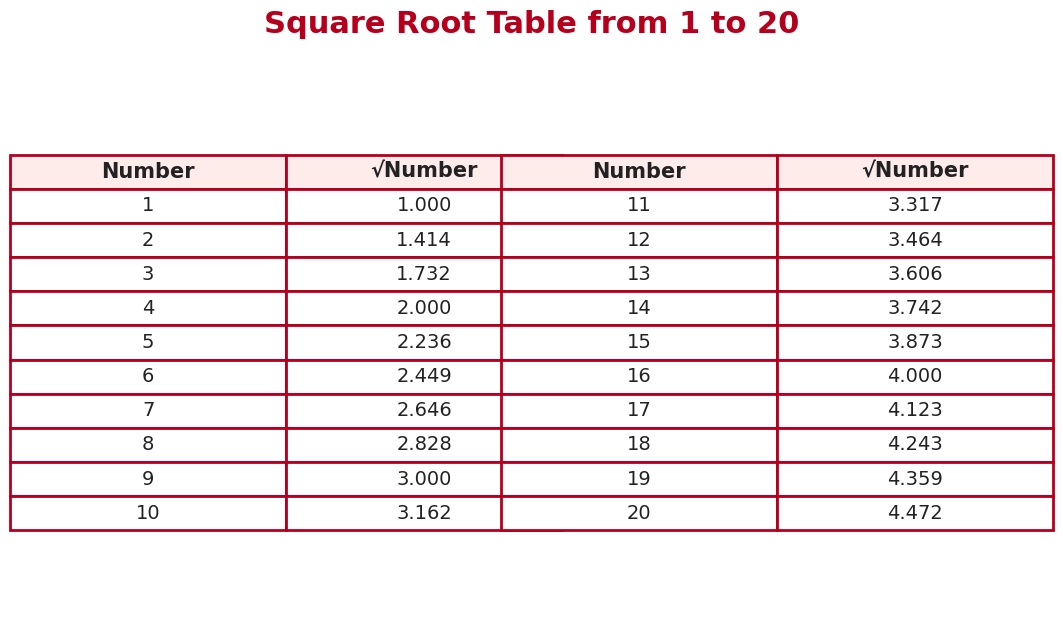
Square Root Chart 1 to 20

Basic Square Root Questions
Question 1: Find the value of each:
a) √36 b) √144 c) √225 d) √400 e) √169
Solutions:
a) √36 = 6 (6 × 6 = 36)
b) √144 = 12 (12 × 12 = 144)
c) √225 = 15 (15 × 15 = 225)
d) √400 = 20 (20 × 20 = 400)
e) √169 = 13 (13 × 13 = 169)
Question 2: Evaluate:
a) √(64 × 9) b) √(25 × 16)
a) √(64 × 9) = √64 × √9 = 8 × 3 = 24
b) √(25 × 16) = √25 × √16 = 5 × 4 = 20
Fill in the Missing Number
Question 3:
a) √___ = 7
7 × 7 = 49
Answer: 49
b) √___ = 11
11 × 11 = 121
Answer: 121
c) √___ = 16
16 × 16 = 256
Answer: 256
d) √___ = 25
25 × 25 = 625
Answer: 625
e) ___² = 196
√196 = 14
Answer: 14
True or False Questions
Question 4:
a) √49 = 7
b) √100 = 50
c) √(4×9) = √4+√9
d) (√15)² = 15
e) √0 = 0
f) √(-16) is real
g) √81 × √4 = 18
Answer:
a) TRUE (7 × 7 = 49)
b) FALSE (√100 = 10, not 50)
c) FALSE (√36 = 6, not 2 + 3 = 5)
d) TRUE
e) TRUE
f) FALSE (negative number)
g) TRUE (9×2=18)
Simplifying Square Root Questions
Question 5: Simplify each expression:
a) √72
√72 = √(36 × 2)
= √36 × √2
= 6√2
b) √200
√200 = √(100 × 2)
= √100 × √2
= 10√2
c) √48
√48 = √(16 × 3)
= √16 × √3
= 4√3
d) √180
√180 = √(36 × 5)
= √36 × √5
= 6√5
Question 6: Simplify:
a) √(75/3)
= √25 = 5
b) √(98/2)
= √49 = 7
c) 3√12 + 2√27
3√12 = 3 × √(4×3)
= 3 × 2√3
= 6√3
2√27 = 2 × √(9×3)
= 2 × 3√3
= 6√3
Total = 6√3 + 6√3 = 12√3
Square Root Factorization Questions
Question 7: Find square root using prime factorisation:
a) √324
Step 1: Prime factorisation of 324
324 = 2 × 162
= 2 × 2 × 81
= 2 × 2 × 9 × 9
= 2² × 3² × 3²
= 2² × 3⁴
Step 2: Pair the factors
324 = (2 × 3²)²
= (2 × 9)²
= 18²
Step 3: √324 = 18
Verify: 18 × 18 = 324
b) √1764
1764 = 2 × 882
= 2 × 2 × 441
= 4 × 441
= 4 × 21 × 21
= 2² × 21²
= (2 × 21)²
= 42²
√1764 = 42
Verify: 42 × 42 = 1764
Estimate Square Roots
Question 8: Estimate the value of √50.
We know:
√49 = 7 (just below 50)
√64 = 8 (just above 50)
So √50 is between 7 and 8.
Since 50 is very close to 49:
√50 ≈ 7.07 (more precisely)
Method:
7² = 49
8² = 64
50 − 49 = 1
64 − 49 = 15
Estimate = 7 + (1/15) ≈ 7.07
Square Root Word Problems
Question 9: A square garden has area 256 m². Find the length of each side.
Area = side²
256 = side²
side = √256
side = 16 m
Answer: Each side = 16 m
Question 10: A square floor tile has area 196 cm². How long is each side of the tile?
side = √196
side = 14 cm
Answer: Each side = 14 cm
Question 11: 729 students are arranged in a square formation. How many students are in each row?
Students per row = √729
√729 = √(9 × 81) = 3 × 9 = 27
Answer: 27 students in each row
Verify: 27 × 27 = 729
Question 12: The area of a square is 1225 cm². Find its perimeter.
Step 1: Find side
side = √1225
√1225 = √(25 × 49) = 5 × 7 = 35 cm
Step 2: Find perimeter
Perimeter = 4 × side = 4 × 35 = 140 cm
Answer: Perimeter = 140 cm
Question 13: A right triangle has legs of 9 cm and 12 cm. Find the hypotenuse.
By Pythagoras theorem:
h² = 9² + 12²
h² = 81 + 144
h² = 225
h = √225
h = 15 cm
Answer: Hypotenuse = 15 cm
Question 14: The area of a square room is 441 m². Find the cost of laying carpet at ₹80 per m².
Step 1: Find side
side = √441 = 21 m
Step 2: Area = 441 m² (already given)
Step 3: Cost = 441 × 80 = ₹35,280
Answer: Cost = ₹35,280
Square Root MCQs
Q1: √169 = ?
a) 11 b) 12 c) 13 d) 14
Answer: c) 13
Q2: Which of the following is a perfect square?
a) 50 b) 72 c) 144 d) 200
Answer: c) 144 (12² = 144)
Q3: √(0.25) = ?
a) 0.5 b) 0.05 c) 5 d) 50
Answer: a) 0.5
(0.5 × 0.5 = 0.25)
Q4: If √x = 15, then x = ?
a) 225 b) 125 c) 30 d) 150
Answer: a) 225 (15² = 225)
Q5: √72 simplified is:
a) 6√2 b) 8√2 c) 4√3 d) 6√3
Answer: a) 6√2
(√72 = √36×2 = 6√2)
Q6: A square has perimeter 60 cm. Its area is:
a) 225 cm² b) 200 cm² c) 144 cm² d) 100 cm²
Solution: Side = 60/4 = 15 cm; Area = 15² = 225 cm²
Answer: a) 225 cm²
Q7: Between which two integers does √55 lie?
a) 6 and 7 b) 7 and 8 c) 8 and 9 d) 5 and 6
Solution: 7² = 49, 8² = 64; 49 < 55 < 64
Answer: b) 7 and 8
Q8: √(x²) = ?
a) x² b) x/2 c) 2x d) x (for positive x)
Answer: d) x
Q9: If √(x+5) = 4, find x.
Square both sides:
x + 5 = 16
x = 11
a) 9 b) 11 c) 13 d) 15
Answer: b) 11
Q10: √(1 + √(1 + √(1))) simplified:
Step 1: Innermost = √1 = 1
Step 2: 1 + 1 = 2 → √2
Step 3: 1 + √2 ≈ 1 + 1.414 = 2.414 → √2.414 ≈ 1.554
Approximate answer ≈ 1.55
This is an approximation question.
Q11: √5625 = ?
5625 = 25 × 225 = 5² × 15² = 75²
√5625 = 75
a) 65 b) 70 c) 75 d) 80
Answer: c) 75
Square Root Worksheet Questions
Fill in the Blanks
1. √___ = 19
2. √484 = ___
3. √(4 × 25) = ___
4. (√13)² = ___
5. √___ = 25
6. √1 = ___
7. √0.49 = ___
8. √(100/4) = ___
Answer:
1. Answer: 361
2. Answer: 22
3. Answer: 10
4. Answer: 13
5. Answer: 625
6. Answer: 1
7. Answer: 0.7
8. Answer: 5
Match the Following
Column A Column B
√196 → 14
√289 → 17
√441 → 21
√625 → 25
√961 → 31
Answers:
√196 = 14
√289 = 17
√441 = 21
√625 = 25
√961 = 31
Short Answer Questions
Q12: Is 500 a perfect square? Show working.
√500 = √(100 × 5) = 10√5
Since 10√5 is not a whole number,
500 is NOT a perfect square.
Q13: Find √0.0016.
√0.0016 = √(16/10000)
= √16/√10000
= 4/100
= 0.04
Answer: 0.04
Download PDF - Square Root Questions
Related Topics:
Frequently Asked Questions on Square Root Questions
1. What is a square root?
A square root of a number is a value that, when multiplied by itself, gives the original number.
For example, √25 = 5 because 5 × 5 = 25.
2. How do you find the square root of a number?
You can find the square root using prime factorization, the long division method, or by recognizing perfect squares.
3. What is the square root formula?
For any number x, if y × y = x, then √x = y.
4. What is the square root of 144?
The square root of 144 is 12 because 12 × 12 = 144.
5. What is the square root of 225?
The square root of 225 is 15 because 15 × 15 = 225.
6. What are perfect square numbers?
Perfect squares are numbers obtained by multiplying a whole number by itself, such as 1, 4, 9, 16, 25, 36, 49, and 64.
Numbers make sense when they're taught right. To see how Orchids The International School turns Maths from intimidating to intuitive, reach out to our admissions team.


Admissions Open for 2026-27
What type of concept pages would you prefer?
CBSE Schools In Popular Cities
- CBSE Schools in Bangalore
- CBSE Schools in Mumbai
- CBSE Schools in Pune
- CBSE Schools in Hyderabad
- CBSE Schools in Chennai
- CBSE Schools in Gurgaon
- CBSE Schools in Kolkata
- CBSE Schools in Indore
- CBSE Schools in Sonipat
- CBSE Schools in Delhi
- CBSE Schools in Rohtak
- CBSE Schools in Bhopal
- CBSE Schools in Aurangabad
- CBSE Schools in Jabalpur
- CBSE Schools in Jaipur
- CBSE Schools in Jodhpur
- CBSE Schools in Nagpur
- CBSE Schools in Ahmednagar
- CBSE School In Tumkur











Orchids The International School is one of India's leading chains of CBSE and ICSE schools, with 110+ schools across the country.