

Surface Area Of A Triangular Prism
Surface area of a triangular prism is the total area of all its external faces. It means adding the two triangle ends and the three sides of the rectangle together. Surface area of a triangular prism is easy to find when you know the base, height and length of the shape. This is an interesting topic for geometry, and it helps the students to learn the 3D shapes easily.
Table of Contents
- What Is the Surface Area of a Triangular Prism?
- Surface Area of a Triangular Prism Formula
- How to Find the Surface Area of a Triangular Prism
- Derivation of the Surface Area Formula
- Solved Examples on Surface Area of a Triangular Prism
- Difference Between Lateral Surface Area and Total Surface Area
- Practice Questions on Surface Area of a Triangular Prism
- Frequently Asked Questions on Surface Area Of A Triangular Prism

What Is the Surface Area of a Triangular Prism?
The surface area of a triangular prism is the sum of the areas of all its outer faces. It measures the total flat surface that covers the solid from the outside. Surface area is always expressed in square units such as cm², m², or mm². A triangular prism is a three-dimensional solid with two parallel, identical triangular faces at each end and three rectangular faces connecting them along the length.
Parts of a Triangular Prism
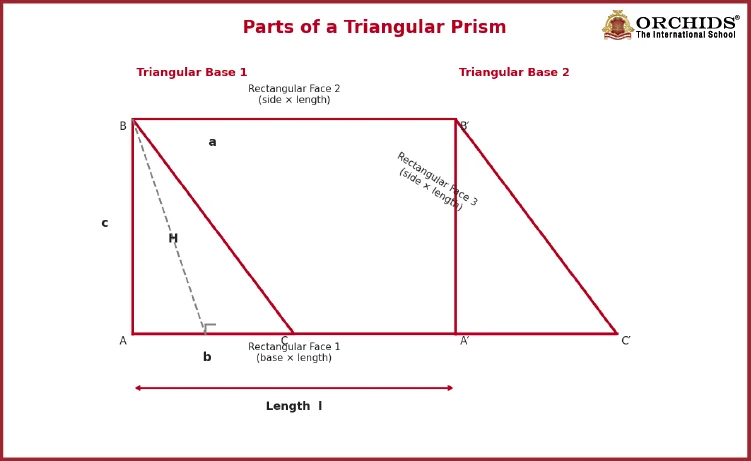
The five faces are:
-
2 triangular bases: identical, one at each end
-
3 rectangular lateral faces: one for each side of the triangle, running along the full length
The key measurements are:
-
a, b, c - the three sides of the triangular base
-
l - the length (or height) of the prism
-
H - the perpendicular height of the triangular base
-
s - the semi-perimeter (used in Heron's formula when needed)
Surface Area of a Triangular Prism Formula
Total Surface Area (TSA) Formula
The Total Surface Area of a triangular prism includes both triangular bases and all three rectangular faces.
TSA = (b × H) + (a + b + c) × l
or equivalently:
TSA = 2 × Area of Triangle + Perimeter of Triangle × l
TSA = 2A + (a + b + c) × l
where:
-
A = area of one triangular base = (1/2) × b × H
-
a, b, c = the three sides of the triangular base
-
l = the length of the prism
Lateral Surface Area (LSA) Formula
The Lateral Surface Area covers only the three rectangular faces excluding the two triangular bases.
LSA = (a + b + c) × l
LSA = Perimeter of triangular base × length of prism
Meaning of Each Variable
How to Find the Surface Area of a Triangular Prism
Step 1: Find the Area of the Triangular Base
Use the formula: Area of Triangle (A) = (1/2) × base × height = (1/2) × b × H
If all three sides are known but height is not given, use Heron's Formula: s = (a + b + c) / 2 A = √[s(s−a)(s−b)(s−c)]
Step 2: Find the Perimeter of the Base
Perimeter (P) = a + b + c
Add all three side lengths of the triangular base.
Step 3: Calculate the Lateral Surface Area
LSA = P × l = (a + b + c) × l
Multiply the perimeter of the triangular base by the length of the prism.
Step 4: Add the Areas to Get the Total Surface Area
TSA = 2A + LSA = 2A + (a + b + c) × l
Add the area of both triangular bases (2A) to the lateral surface area.
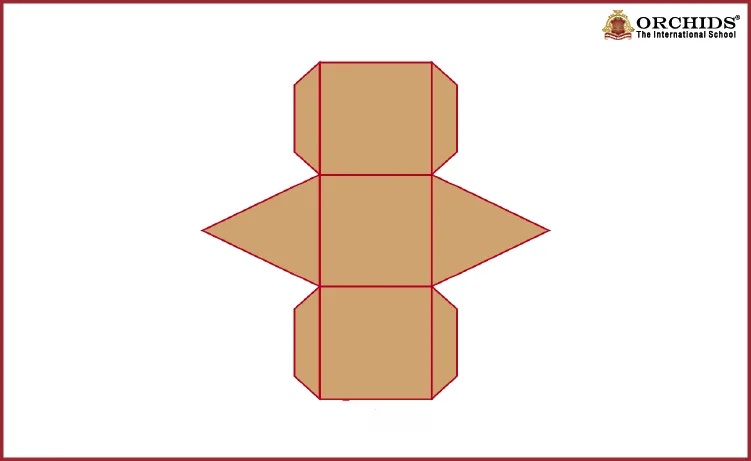
Derivation of the Surface Area Formula
Area of Two Triangular Bases
A triangular prism has exactly two triangular bases one at each end. Both are identical.
Area of one triangle = (1/2) × b × H
Area of two triangles = 2 × (1/2) × b × H = b × H
This can also be written as 2A, where A is the area of one triangular base.
Area of the Three Rectangular Faces
Each rectangular face has:
-
Width = one side of the triangular base
-
Length = l (the length of the prism)
Area of Rectangle 1 = a × l Area of Rectangle 2 = b × l Area of Rectangle 3 = c × l
Total area of three rectangles = al + bl + cl = (a + b + c) × l = P × l
Final Formula
Adding both components:
TSA = 2A + (a + b + c) × l
or
TSA = bH + (a + b + c) × l
where bH = 2 × area of one triangle = b × H (not (1/2)bH, because there are two bases).
Solved Examples on Surface Area Of A Triangular Prism
Example 1: Right Triangular Prism
Question: A right triangular prism has a triangular base with base = 6 cm, height = 4 cm, and the two other sides are 5 cm and 5 cm. The length of the prism is 10 cm. Find the TSA.
Solution:
Step 1: Area of triangular base A = (1/2) × 6 × 4 = 12 cm²
Step 2: Perimeter of triangular base P = 6 + 5 + 5 = 16 cm
Step 3: Lateral Surface Area LSA = P × l = 16 × 10 = 160 cm²
Step 4: Total Surface Area TSA = 2A + LSA = 2(12) + 160 = 24 + 160 = 184 cm²
Example 2: Isosceles Triangular Prism
Question: An isosceles triangular prism has base sides of 8 cm, 8 cm, and 6 cm, with a triangular height of 5.29 cm. The prism length is 12 cm. Find TSA and LSA.
Solution:
Step 1: Area of base A = (1/2) × 6 × 5.29 = 15.87 cm²
Step 2: Perimeter P = 8 + 8 + 6 = 22 cm
Step 3: LSA LSA = 22 × 12 = 264 cm²
Step 4: TSA TSA = 2(15.87) + 264 = 31.74 + 264 = 295.74 cm²
Example 3: Prism with Given Side Lengths
Question: A triangular prism has sides 3 cm, 4 cm, and 5 cm, and a length of 8 cm. Use Heron's Formula to find the area of the base, then find TSA.
Solution:
Step 1: Find area using Heron's Formula s = (3 + 4 + 5)/2 = 6
A = √[6(6−3)(6−4)(6−5)] = √[6 × 3 × 2 × 1] = √36 = 6 cm²
Step 2: Perimeter P = 3 + 4 + 5 = 12 cm
Step 3: LSA LSA = 12 × 8 = 96 cm²
Step 4: TSA TSA = 2(6) + 96 = 12 + 96 = 108 cm²
Example 4: Word Problem
Question: A tent is shaped like a triangular prism. The triangular front face has a base of 3 m and a height of 2 m. The tent is 5 m long. Find the total canvas needed to make the tent (including the two triangular ends but excluding the floor).
Solution:
Step 1: Area of one triangular end A = (1/2) × 3 × 2 = 3 m²
Two triangular ends = 2 × 3 = 6 m²
Step 2: The tent has three sides the floor is excluded, so only two rectangular slant sides are covered.
For a triangular prism tent with a base of 3 m and equal slant sides:
Using Pythagoras (slant height): each slant = √(1.5² + 2²) = √(2.25 + 4) = √6.25 = 2.5 m
Two slant rectangles = 2 × (2.5 × 5) = 2 × 12.5 = 25 m²
Step 3: Total canvas = two triangular ends + two slant sides = 6 + 25 = 31 m²
Difference Between Lateral Surface Area and Total Surface Area
Comparison Table
When to Use Each Formula
Use LSA when:
-
Only the side surfaces need to be covered or painted
-
The two ends (bases) are open or not being considered
-
A tunnel or pipeline is being lined on the sides only
Use TSA when:
-
The complete outer surface must be covered
-
Calculating material to wrap or coat the entire prism
-
Finding the area for painting or manufacturing a closed box
Practice Questions on Surface Area Of A Triangular Prism
Q1: Find the TSA of a triangular prism with triangle base = 4 cm, triangle height = 3 cm, all three triangle sides = 4 cm, and prism length = 7 cm.
Answer: A = (1/2)(4)(3) = 6 cm². P = 4 + 4 + 4 = 12 cm. TSA = 2(6) + 12 × 7 = 12 + 84 = 96 cm²
Q2: Find the LSA of a prism with triangular base sides 5 cm, 7 cm, 9 cm and prism length 10 cm.
Answer: LSA = (5 + 7 + 9) × 10 = 21 × 10 = 210 cm²
Q3: A triangular prism has TSA = 240 cm² and LSA = 180 cm². Find the area of each triangular base.
Answer: 2A = TSA − LSA = 240 − 180 = 60 cm² A = 30 cm² per triangular base.
Q4: A triangular prism has a right-angled triangular base with legs 9 cm and 12 cm (hypotenuse = 15 cm). The length of the prism is 20 cm. Find the TSA.
Answer: A = (1/2)(9)(12) = 54 cm² P = 9 + 12 + 15 = 36 cm TSA = 2(54) + 36×20 = 108 + 720 = 828 cm²
Q5: Find the total surface area of a prism whose triangular base has sides 6 cm, 8 cm, 10 cm and height 4.8 cm (for the 10 cm base), and the prism length is 15 cm.
Answer: A = (1/2)(10)(4.8) = 24 cm² P = 6 + 8 + 10 = 24 cm TSA = 2(24) + 24×15 = 48 + 360 = 408 cm²
Q6: A triangular prism has an equilateral triangular base with side 6 cm. The length of the prism is 14 cm. Find the TSA. (Height of equilateral triangle = 3√3 cm)
Answer: A = (1/2)(6)(3√3) = 9√3 cm² P = 6 + 6 + 6 = 18 cm TSA = 2(9√3) + 18 × 14 = 18√3 + 252 ≈ 31.18 + 252 = 283.18 cm²
Q7: The LSA of a triangular prism is 360 cm² and the prism length is 12 cm. Find the perimeter of the triangular base.
Answer: LSA = P × l 360 = P × 12 P = 30 cm
Q8: A chocolate manufacturer makes Toblerone-shaped boxes. Each box is a triangular prism with an equilateral triangular cross-section of side 4 cm and a length of 20 cm. Find the total cardboard needed for one box. (Height of equilateral triangle ≈ 3.46 cm)
Answer: A = (1/2)(4)(3.46) = 6.92 cm² P = 4 + 4 + 4 = 12 cm TSA = 2(6.92) + 12 × 20 = 13.84 + 240 = 253.84 cm²
Q9: A swimming pool has a triangular cross-section with base 10 m and height 2 m. The pool is 25 m long. Find the area of the walls and floor (exclude the open top, exclude one triangular end that is the entry point include only 1 triangular end wall, 3 rectangular sides).
Answer: Area of 1 triangular end = (1/2)(10)(2) = 10 m²
For a triangular prism with base = 10 m, height = 2 m, and slant sides: Slant = √(5² + 2²) = √29 ≈ 5.39 m
Rectangular faces: Floor = 10 × 25 = 250 m² Left slant wall = 5.39 × 25 = 134.75 m² Right slant wall = 5.39 × 25 = 134.75 m²
Total = 10 + 250 + 134.75 + 134.75 = 529.5 m²
Q10: The surface area of a triangular prism is 550 cm². The triangular base has an area of 30 cm² and a perimeter of 22 cm. Find the length of the prism.
Answer: TSA = 2A + P × l 550 = 2(30) + 22 × l
550 = 2 × 30 + 22 × l
550 = 60 + 22l
22l = 550 − 60
22l = 490
l = 490 ÷ 22
l = 245/11 ≈ 22.27 cm
Frequently Asked Questions on Surface Area Of A Triangular Prism
1. What is the surface area of a triangular prism?
The surface area of a triangular prism is the total area of all its faces, including the two triangular bases and the three rectangular faces.
2. What is the formula for the surface area of a triangular prism?
The surface area is found by adding the areas of the two triangular bases and the three rectangular faces.
3. How do you calculate the surface area of a triangular prism?
Find the area of one triangular base, multiply it by 2, calculate the area of each rectangular face, and add all the areas together.
4. What is the difference between lateral surface area and total surface area?
The lateral surface area includes only the three rectangular faces, while the total surface area includes both the rectangular faces and the two triangular bases.
5. What units are used to measure the surface area of a triangular prism?
Surface area is measured in square units, such as cm², m², or in².
6. Where is the surface area of a triangular prism used in real life?
It is used in architecture, construction, packaging, engineering, roof design, and manufacturing to calculate the amount of material needed to cover prism-shaped objects.
Numbers make sense when they're taught right. To see how Orchids The International School turns Maths from intimidating to intuitive, reach out to our admissions team.


Admissions Open for 2026-27
What type of concept pages would you prefer?
CBSE Schools In Popular Cities
- CBSE Schools in Bangalore
- CBSE Schools in Mumbai
- CBSE Schools in Pune
- CBSE Schools in Hyderabad
- CBSE Schools in Chennai
- CBSE Schools in Gurgaon
- CBSE Schools in Kolkata
- CBSE Schools in Indore
- CBSE Schools in Sonipat
- CBSE Schools in Delhi
- CBSE Schools in Rohtak
- CBSE Schools in Bhopal
- CBSE Schools in Aurangabad
- CBSE Schools in Jabalpur
- CBSE Schools in Jaipur
- CBSE Schools in Jodhpur
- CBSE Schools in Nagpur
- CBSE Schools in Ahmednagar
- CBSE School In Tumkur











Orchids The International School is one of India's leading chains of CBSE and ICSE schools, with 110+ schools across the country.