

Surface Area of Combined Solids
When two or more solid shapes are joined together, the result is called a combined solid. To find its surface area, you add up all the outer surfaces that are visible from the outside. Any surface that is hidden where the two shapes meet must be removed, since it is no longer part of the outer covering.
Table of Contents
- What is the Surface Area of Combined Solids?
- Surface Area of a Combination of Solids Formula
- Surface Area of a Combination of Solids Examples
- Surface Area of a Combination of Solids Practice Problems
- Frequently Asked Questions on Surface Area of a Combination of Solids

What is the Surface Area of Combined Solids?
Surface area is the total outer area of a solid shape. When two shapes are joined, one part of each shape gets covered at the joint. You must remove those hidden parts and add only what remains exposed on the outside.
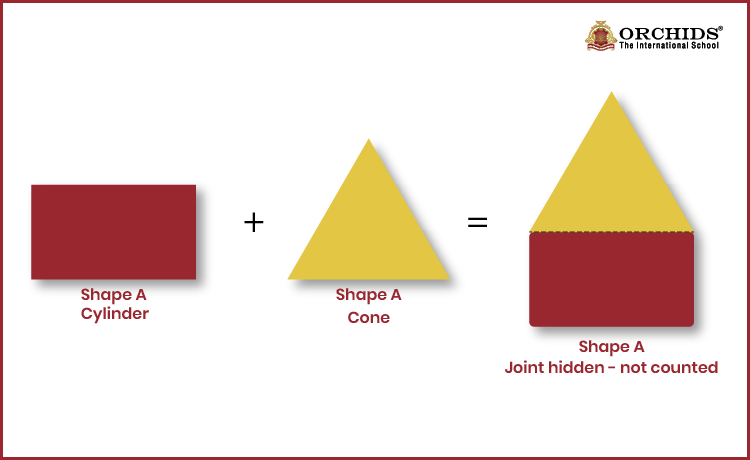
Total surface area = sum of all outer surfaces − the hidden (joined) surfaces.
The red dashed line above shows the joint between a cone and a cylinder. That circular edge is inside the shape it does not appear on the outer surface, so it is not included in the surface area.
Surface Area of a Combination of Solids Formula
There is no single formula for every combined solid because the answer depends on which shapes are joined. However, the rule is always the same:
Surface area of combined solid = (surface area of shape A + surface area of shape B) − 2 × (area of the joined face)
You subtract the joined face twice once from each shape because both shapes lose that face at the point of contact.
Here are the most common combinations and how the rule applies to each:
- Cylinder + Cone:
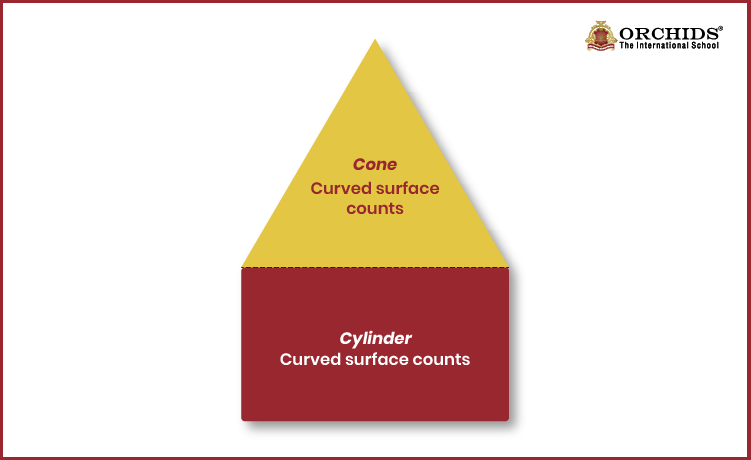
The cone sits on top of the cylinder. The flat circular base of the cone and the top circle of the cylinder are both hidden at the joint.
Surfaces that count: Curved surface of cone + curved surface of cylinder + base circle of cylinder
Surface that does NOT count: The circular face where the cone and cylinder meet (hidden inside)
2. Cylinder + Hemisphere:
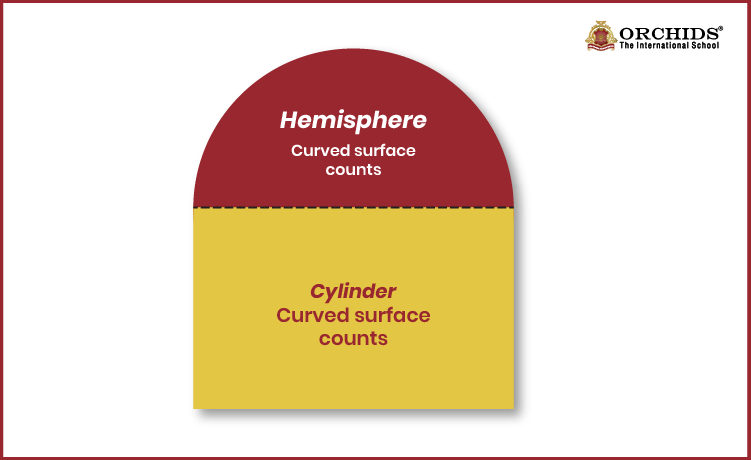
The hemisphere (half-sphere) sits on top of the cylinder. The flat circular face of the hemisphere and the top circle of the cylinder disappear at the joint.
Surfaces that count: Curved surface of hemisphere + curved surface of cylinder + base circle of cylinder
Surface that does NOT count: The flat circular face of the hemisphere where it sits on the cylinder
3. Cone + Hemisphere:
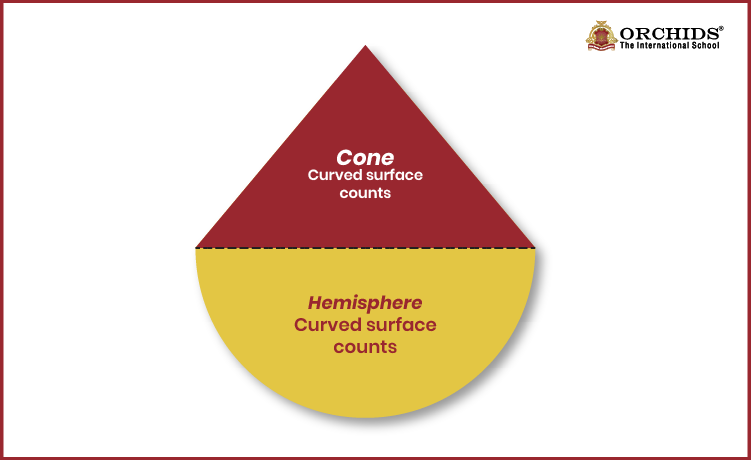
The cone sits on top of the flat side of the hemisphere. Both shapes share a circular face at the joint which becomes hidden.
Surfaces that count: Curved surface of cone + curved surface of hemisphere
Surface that does NOT count: The flat circular face shared by both shapes at the joint. There is no flat base here at all the hemisphere itself forms the rounded bottom.
Surface Area of a Combination of Solids Examples
Example 1: Cylinder + Cone (like a rocket or tent)
A cylinder of radius 7 cm and height 10 cm has a cone of the same radius and slant height 13 cm placed on top.
Step 1: Identify the visible surfaces:
- Curved surface of the cone
- Curved surface of the cylinder
- Base circle of the cylinder (bottom flat face)
Step 2: The hidden surface:
- The top circle of the cylinder and the base of the cone are the same circle they touch at the joint and are both hidden.
Step 3: Apply the values (r = 7, h = 10, l = 13):
- Curved surface of cone = π × 7 × 13 = 286 cm²
- Curved surface of cylinder = 2 × π × 7 × 10 = 440 cm²
- Base of cylinder = π × 7² = 154 cm²
Total surface area ≈ 880 cm²
Example 2: Cylinder + Hemisphere (like a water tank)
A cylinder of radius 3.5 m and height 8 m has a hemispherical dome of the same radius on top.
Step 1: Identify the visible surfaces:
- Curved surface of the hemisphere
- Curved surface of the cylinder
- Base circle of the cylinder
Step 2: The hidden surface:
- The flat face of the hemisphere sits on the top circle of the cylinder both are hidden at the joint.
Step 3: Apply the values (r = 3.5, h = 8):
- Curved surface of hemisphere = 2 × π × 3.5² = 77 m²
- Curved surface of cylinder = 2 × π × 3.5 × 8 = 176 m²
- Base circle = π × 3.5² = 38.5 m²
Total surface area ≈ 291.5 m²
Example 3: Cone + Hemisphere (like a spinning top)
A hemisphere of radius 6 cm has a cone of the same radius and slant height 10 cm placed on top.
Step 1: Identify the visible surfaces:
- Curved surface of the cone
- Curved surface of the hemisphere
Step 2: The hidden surface:
- The flat face where the cone base meets the hemisphere is hidden. There is no flat base circle here at all.
Step 3: Apply the values (r = 6, l = 10):
- Curved surface of cone = π × 6 × 10 = 188.5 cm²
- Curved surface of hemisphere = 2 × π × 6² = 226.2 cm²
Total surface area = 414.7 cm²
Surface Area of a Combination of Solids Practice Problems
1. A cylinder of radius 5 cm and height 12 cm has a hemisphere attached on top. Find the total surface area of the solid?
2. A cone is placed on a cylinder. Both have the same base radius of 3 cm. The height of the cylinder is 8 cm, and the slant height of the cone is 5 cm. Calculate the total surface area?
3. A solid is formed by joining two hemispheres to the ends of a cylinder. The radius is 4 cm, and the height of the cylinder is 10 cm. Find the total surface area?
4. A cube of side 10 cm has a hemisphere carved out from one face. Find the surface area of the remaining solid?
5. A cylinder is surmounted by a cone of the same radius, 6 cm. The height of the cylinder is 15 cm, and the slant height of the cone is 10 cm. Find the total surface area of the combined solid?
Frequently Asked Questions on Surface Area of a Combination of Solids
1. What is the surface area of a combination of solids?
It is the total outer area of a solid formed by combining two or more 3D shapes like cylinders, cones, or spheres.
2. What is the formula for surface area of combined solids?
Total Surface Area = (Sum of the individual surface areas) – (2 × Area of the overlapping/hidden faces).
3. Why do we subtract the overlapping surfaces?
Because the joined surfaces are not exposed outside, so they should not be included in the total surface area.
4. Can combined solids have different shapes?
Yes, they can be made from different 3D shapes joined together.
5. What are common examples of combined solids?
-
Cylinder + Hemisphere
-
Cone + Cylinder
-
Cylinder + Two Hemispheres
Numbers make sense when they're taught right. To see how Orchids The International School turns Maths from intimidating to intuitive, reach out to our admissions team.


Admissions Open for 2026-27
What type of concept pages would you prefer?
CBSE Schools In Popular Cities
- CBSE Schools in Bangalore
- CBSE Schools in Mumbai
- CBSE Schools in Pune
- CBSE Schools in Hyderabad
- CBSE Schools in Chennai
- CBSE Schools in Gurgaon
- CBSE Schools in Kolkata
- CBSE Schools in Indore
- CBSE Schools in Sonipat
- CBSE Schools in Delhi
- CBSE Schools in Rohtak
- CBSE Schools in Bhopal
- CBSE Schools in Aurangabad
- CBSE Schools in Jabalpur
- CBSE Schools in Jaipur
- CBSE Schools in Jodhpur
- CBSE Schools in Nagpur
- CBSE Schools in Ahmednagar
- CBSE School In Tumkur











Orchids The International School is one of India's leading chains of CBSE and ICSE schools, with 130+ schools across the country.