

Areas of Combination of Plane Figures
A combination figure is a shape that is made up of two or more simple shapes put together. Sometimes a smaller shape is also cut out from a bigger one. These kinds of figures show up a lot in real life, such as a window with a curved top, a running track, a decorative tile, or a swimming pool with rounded ends.
Table of Content
- Definition
- Formulas For Areas of Combination of Plane Figures
- Types of Combination Figures
- Solved Examples
- Practice Problems

Definition
When two or more shapes are joined together to form one big figure, you simply add their areas. When one shape is removed or cut out from another, you subtract the area of the smaller shape from the bigger one. In some problems, you may have to both add and subtract in the same question
Formulas For Areas of Combination of Plane Figures
Before combining, it is essential to know the individual area formulas:
- Area of a circle = πr²
- Area of a semicircle = πr² ÷ 2
- Area of a quadrant (quarter circle) = πr² ÷ 4
- Area of a rectangle = length × breadth
- Area of a square = side × side
- Area of a triangle = ½ × base × height
- Use π = 22/7 when the radius is a multiple of 7. Use π = 3.14 in all other cases.
Related Topics:
Types of Combination Figures
A combination figure is a 3D shape made by joining two or more basic solid shapes together. For example, a pencil is a cylinder with a cone on top. These shapes appear in everyday life ice cream cones, rockets, silos, and tents.
1. Cylinder + Cone
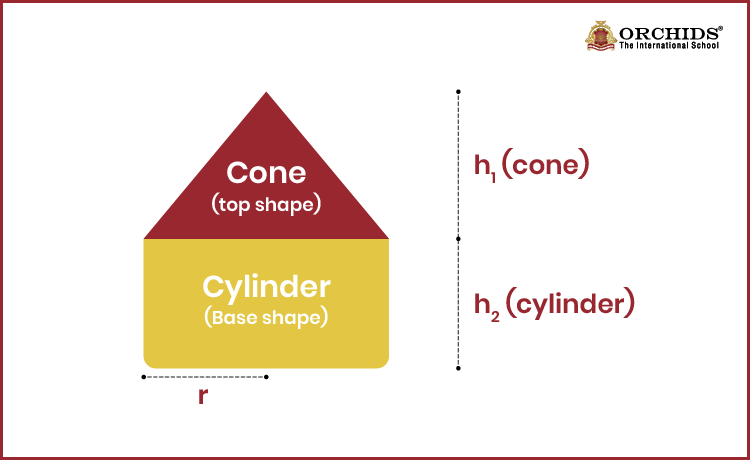
A cylinder sits at the bottom, and a cone sits on top of it like a rocket or a sharpened pencil.
Total Surface Area = Curved surface of cone + base area of cylinder + curved surface of cylinder = πrl + πr² + 2πrh
Total Volume = Volume of cylinder + Volume of cone = πr²h + (1/3)πr²h₁
2. Cylinder + Hemisphere
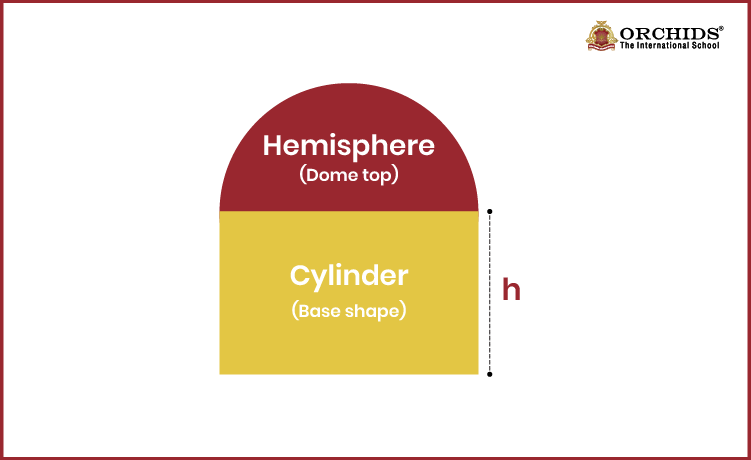
A cylinder with a dome (half-sphere) placed on top like a water tank or a medicine capsule.
Total Surface Area = Curved surface of hemisphere + curved surface of cylinder + base circle of cylinder = 2πr² + 2πrh + πr²
Total Volume = Volume of cylinder + Volume of hemisphere = πr²h + (2/3)πr³
3. Cone + Hemisphere
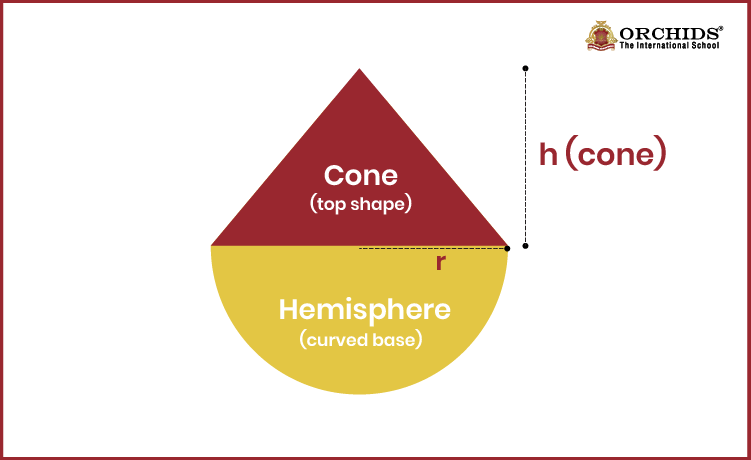
A dome (hemisphere) sits at the bottom, and a cone rises from it like an ice cream scoop on a cone, or a spinning top.
Total Surface Area = Curved surface of cone + curved surface of hemisphere = πrl + 2πr² (Note: there is no flat base both shapes share the same circular edge.)
Total Volume = Volume of hemisphere + Volume of cone = (2/3)πr³ + (1/3)πr²h
4. Cylinder + Two Hemispheres (Capsule Shape)
.webp "Cylinder & Two-Hemispheres-(Capsule-Shape)")
A cylinder in the middle with a dome on each end like a medicine tablet, a propane tank, or a hot dog.
Total Surface Area = Curved surface of cylinder + 2 × curved surface of hemisphere = 2πrh + 2(2πr²) = 2πrh + 4πr²
Total Volume = Volume of cylinder + 2 × volume of hemisphere = πr²h + (4/3)πr³
5. Frustum (Truncated Cone) + Cylinder
-+-Cylinder.webp "Frustum-(Truncated-Cone)-Cylinder")
A cylinder at the bottom with a frustum (a cone with its tip cut off) on top like a grain silo or a bucket sitting on a drum.
Total Surface Area = Base of cylinder + curved surface of cylinder + curved surface of frustum + top circle of frustum = πR² + 2πRh₂ + π(R+r)l + πr² where l = slant height of frustum
Total Volume = Volume of cylinder + Volume of frustum = πR²h₂ + (πh₁/3)(R² + Rr + r²)
Solved Examples On Areas of Combination of Plane Figures
Example 1: Joined Shapes (Rectangle + Semicircle)
.webp "Example-1--Joined-Shapes-(Rectangle-+-Semicircle)")
Question: A figure is made of a rectangle that is 14 cm long and 7 cm wide, with a semicircle sitting on top of the longer side. Find the total area. Use π = 22/7.
Step 1: Look at the semicircle. Its flat edge sits along the 14 cm side of the rectangle. That flat edge is the diameter. So the diameter = 14 cm, which means the radius r = 7 cm.
Step 2: Find the area of the rectangle. Area = length × breadth = 14 × 7 = 98 cm²
Step 3: Find the area of the semicircle. Area = πr² ÷ 2 = (22/7 × 7 × 7) ÷ 2 = 154 ÷ 2 = 77 cm²
Step 4: Add both areas. Total area = 98 + 77 = 175 cm²
Example 2: Cut Out Shape (Square minus Circle)
.webp "Cut Out Shape (Square-minus-Circle)")
Question: A square has a side of 14 cm. A circle is drawn inside it so that the circle just touches all four sides. Find the area of the square that is not covered by the circle. Use π = 22/7.
Step 1: Since the circle fits exactly inside the square and touches all four sides, the diameter of the circle equals the side of the square. So diameter = 14 cm and radius r = 7 cm.
Step 2: Find the area of the square. Area = 14 × 14 = 196 cm²
Step 3: Find the area of the circle. Area = πr² = 22/7 × 7 × 7 = 154 cm²
Step 4: Subtract to find the leftover (shaded) area. Shaded area = 196 − 154 = 42 cm²
This leftover area is the four small curved corners of the square that the circle does not cover.
Example 3: Running Track (Mixed Shapes)
.webp "Running Track (Mixed Shapes)")
Question: A running track has two straight sections, each 70 m long and 7 m wide, with semicircular ends. The inner radius of the semicircular ends is 35 m. Find the total area of the track. Use π = 22/7.
Step 1: Identify the parts. The track is made of two straight rectangular strips and two semicircular rings at each end. The inner radius of the semicircular part is 35 m. Since the track is 7 m wide, the outer radius is 35 + 7 = 42 m.
Step 2: Find the area of the two straight sections. Area = 2 × (70 × 7) = 2 × 490 = 980 m²
Step 3: Find the area of the two semicircular ends. Together they form one full circular ring. Area = π × (R² − r²) = 22/7 × (42² − 35²) = 22/7 × (1764 − 1225) = 22/7 × 539 = 1694 m²
Step 4: Add both parts. Total track area = 980 + 1694 = 2674 m²
Example 4: Rectangle with a Triangle on Top
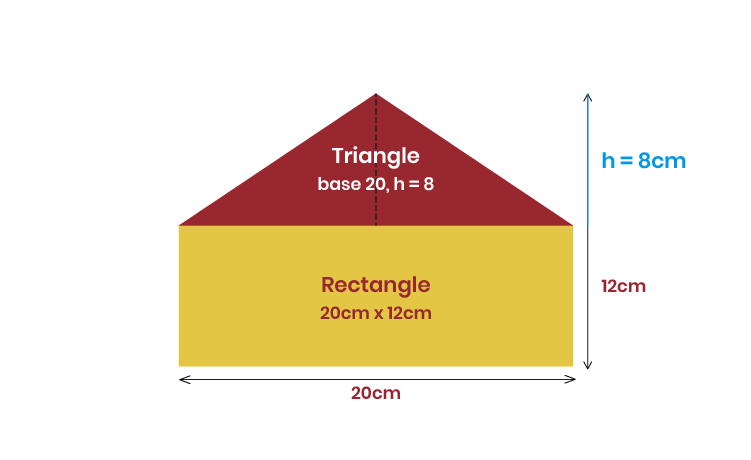
Question: A figure is shaped like a house. It has a rectangular base that is 20 cm wide and 12 cm tall. On top of the rectangle sits a triangle with a base of 20 cm and a height of 8 cm. Find the total area of the figure.
Step 1: Confirm the base of the triangle. The triangle sits directly on top of the rectangle. Its base is therefore the same as the length of the rectangle, which is 20 cm. The height of the triangle is given as 8 cm.
Step 2: Find the area of the rectangle. Area of rectangle = length × breadth = 20 × 12 = 240 cm²
Step 3: Find the area of the triangle. Area of triangle = ½ × base × height = ½ × 20 × 8 = 80 cm²
Step 4: Add both areas. Total area = 240 + 80 = 320 cm²
Example 5: Square with Four Corner Quadrants Cut Away
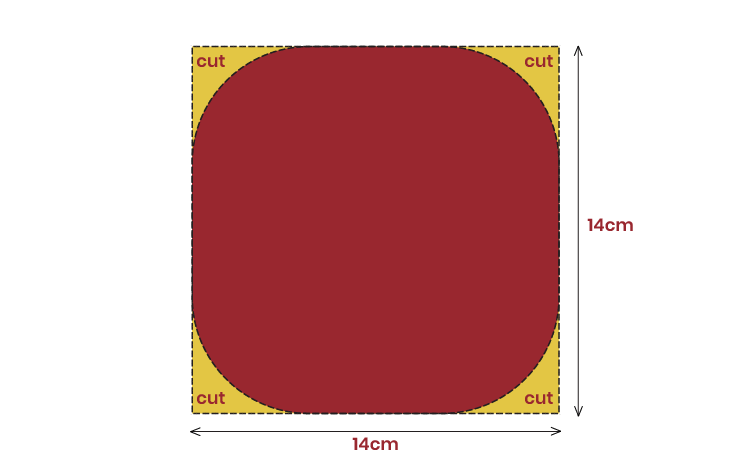
Question: A square tile has a side of 14 cm. A quadrant (quarter circle) of radius 7 cm is cut from each of its four corners. Find the area of the tile that remains. Use π = 22/7.
Step 1: Use the key fact about four quadrants. Each corner has one quadrant, which is a quarter of a circle. Since there are four corners, four quarter circles together make exactly one complete circle. So instead of calculating each quadrant separately, we simply find the area of one full circle with radius 7 cm.
Step 2: Find the area of the square. Area of square = side × side = 14 × 14 = 196 cm²
Step 3: Find the total area of the four quadrants (one full circle). Area of four quadrants = πr² = 22/7 × 7 × 7 = 22 × 7 = 154 cm²
Step 4: Subtract to find the remaining area. Remaining area = Area of square − Area of four quadrants = 196 − 154 = 42 cm²
Practice Problems On Areas of Combination of Plane Figures
1: A square tile has a side of 10 cm. A quadrant (quarter circle) of radius 5 cm is cut from each of its four corners. Find the area that remains. Use π = 3.14.
Hint: Four quadrants together make one complete circle. Subtract that circle's area from the square's area.
2: A rectangular lawn is 40 m long and 20 m wide. A circular pond of radius 7 m is dug in the middle of it. Find the area of grass left around the pond. Use π = 22/7.
Hint: Subtract the area of the circular pond from the area of the rectangle.
3: A figure is made of a rectangle 20 cm × 12 cm with a triangle placed on top of it. The triangle has a base of 20 cm and a height of 8 cm. Find the total area of the figure.
Hint: Add the area of the rectangle and the area of the triangle.
4: A square of side 7 cm has a semicircle drawn on each of its four sides, all on the outside. Find the total area of the figure. Use π = 22/7.
Hint: Find the area of the square first. Then find the area of four semicircles, which together make two full circles. Add them.
Frequently Asked Questions on Area of Plane Figures
1. What is the area of plane figures?
The area of plane figures is the amount of space enclosed within a two-dimensional shape like a circle, square, rectangle, or triangle.
2. What are the formulas for area of common plane figures?
-
Circle: πr²
-
Rectangle: length × breadth
-
Square: side²
-
Triangle: ½ × base × height
3. What is the area of a square?
Area of a square = side × side.
4. How do you find the area of a triangle?
Area of triangle: ½ × base × height.
5. What is the area of a semicircle?
The area of a semicircle is half of a circle: (πr²) ÷ 2.
Numbers make sense when they're taught right. To see how Orchids The International School turns Maths from intimidating to intuitive, reach out to our admissions team.


Admissions Open for 2026-27
What type of concept pages would you prefer?
CBSE Schools In Popular Cities
- CBSE Schools in Bangalore
- CBSE Schools in Mumbai
- CBSE Schools in Pune
- CBSE Schools in Hyderabad
- CBSE Schools in Chennai
- CBSE Schools in Gurgaon
- CBSE Schools in Kolkata
- CBSE Schools in Indore
- CBSE Schools in Sonipat
- CBSE Schools in Delhi
- CBSE Schools in Rohtak
- CBSE Schools in Bhopal
- CBSE Schools in Aurangabad
- CBSE Schools in Jabalpur
- CBSE Schools in Jaipur
- CBSE Schools in Jodhpur
- CBSE Schools in Nagpur
- CBSE Schools in Ahmednagar
- CBSE School In Tumkur











Orchids The International School is one of India's leading chains of CBSE and ICSE schools, with 130+ schools across the country.