

Table of 47
Table of 47 lists the results you get when 47 is multiplied by numbers 1 through 20. Since 47 is a prime number, its multiples follow a unique pattern that helps students improve their calculation skills. Reading the table helps learners understand how multiplying by 47 moves the number line forward in equal steps. To make learning smoother, we also include a Table of 47 PDF that students can save and revise anytime, especially during exam preparation.
Table of 47 Chart
The Table of 47 chart presents the 47 times table in an organised and colourful format, making it easier for students to follow each step. With every product placed neatly in its row, learners can understand how the values grow with each multiplication. This chart is perfect for display or as a handy reference during study sessions.
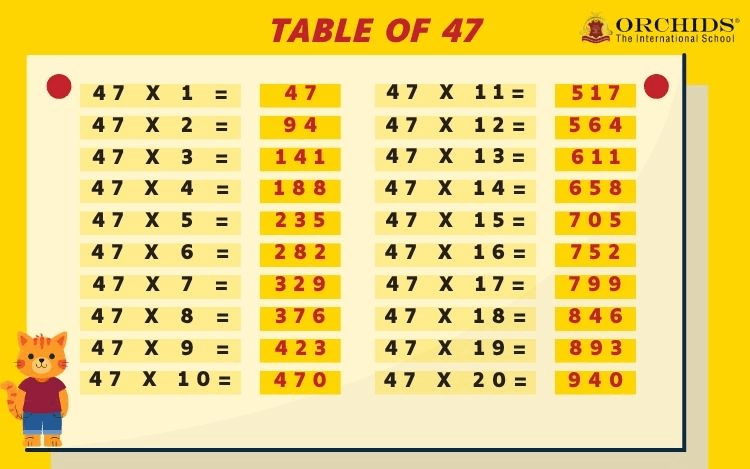

Multiplication Table of 47
The table of 47 presents multiplication with numbers 1 to 20 step by step. Students can observe how the results grow steadily and understand repeated addition. This layout aids learning through visual patterns. It is helpful for mental maths practice and exam preparation.
| Multiplicand | Operation | Multiplier | Result | |
| 47 | x | 1 | = | 47 |
| 47 | x | 2 | = | 94 |
| 47 | x | 3 | = | 141 |
| 47 | x | 4 | = | 188 |
| 47 | x | 5 | = | 235 |
| 47 | x | 6 | = | 282 |
| 47 | x | 7 | = | 329 |
| 47 | x | 8 | = | 376 |
| 47 | x | 9 | = | 423 |
| 47 | x | 10 | = | 470 |
| 47 | x | 11 | = | 517 |
| 47 | x | 12 | = | 564 |
| 47 | x | 13 | = | 611 |
| 47 | x | 14 | = | 658 |
| 47 | x | 15 | = | 705 |
| 47 | x | 16 | = | 752 |
| 47 | x | 17 | = | 799 |
| 47 | x | 18 | = | 846 |
| 47 | x | 19 | = | 893 |
| 47 | x | 20 | = | 940 |
Download the Table of 47 PDF for simple and effective practice. This chart allows learners to revisit 47’s multiples anytime, reinforcing memory and confidence in maths.
Know more about related topics:
Download PDF -Table of 47
How do you read the multiplication table of 47?
Look at each line carefully as 47 is multiplied by 1 through 20. Notice how the results increase steadily by 47 each time. Recognising this pattern makes learning quicker and improves mental calculation skills.
47 times 1 equals 47
47 times 2 equals 94
47 times 3 equals 141
47 times 4 equals 188
47 times 5 equals 235
47 times 6 equals 282
47 times 7 equals 329
47 times 8 equals 376
47 times 9 equals 423
47 times 10 equals 470
47 times 11 equals 517
47 times 12 equals 564
47 times 13 equals 611
47 times 14 equals 658
47 times 15 equals 705
47 times 16 equals 752
47 times 17 equals 799
47 times 18 equals 846
47 times 19 equals 893
47 times 20 equals 940
Table of 47 in words
The table of 47 in words turns every multiplication step into a spoken form. By reading each multiple aloud, learners can grasp the pattern of increasing values and strengthen their memory for mental calculations.
Forty-seven times one equals forty-seven
Forty-seven times two equals ninety-four
Forty-seven times three equals one hundred forty-one
Forty-seven times four equals one hundred eighty-eight
Forty-seven times five equals two hundred thirty-five
Forty-seven times six equals two hundred eighty-two
Forty-seven times seven equals three hundred twenty-nine
Forty-seven times eight equals three hundred seventy-six
Forty-seven times nine equals four hundred twenty-three
Forty-seven times ten equals four hundred seventy
Forty-seven times eleven equals five hundred seventeen
Forty-seven times twelve equals five hundred sixty-four
Forty-seven times thirteen equals six hundred eleven
Forty-seven times fourteen equals six hundred fifty-eight
Forty-seven times fifteen equals seven hundred five
Forty-seven times sixteen equals seven hundred fifty-two
Forty-seven times seventeen equals seven hundred ninety-nine
Forty-seven times eighteen equals eight hundred forty-six
Forty-seven times nineteen equals eight hundred ninety-three
Forty-seven times twenty equals nine hundred forty
Table of 47 Using Repeated Addition
Imagine walking forward in jumps of 47. Each jump lands on the next multiple: 47, 94, 141… This jumping method shows students the regular rhythm in the table and makes it easy to remember.
|
Multiplication |
Repeated Addition |
Result |
|
47 × 1 |
47 |
47 |
|
47 × 2 |
47 + 47 |
94 |
|
47 × 3 |
47 + 47 + 47 |
141 |
|
47 × 4 |
47 + 47 + 47 + 47 |
188 |
|
47 × 5 |
47 + 47 + 47 + 47 + 47 |
235 |
|
47 × 6 |
47 + 47 + 47 + 47 + 47 + 47 |
282 |
|
47 × 7 |
47 + 47 + 47 + 47 + 47 + 47 + 47 |
329 |
|
47 × 8 |
47 + 47 + 47 + 47 + 47 + 47 + 47 + 47 |
376 |
|
47 × 9 |
47 + 47 + 47 + 47 + 47 + 47 + 47 + 47 + 47 |
423 |
|
47 × 10 |
47 + 47 + 47 + 47 + 47 + 47 + 47 + 47 + 47 + 47 |
470 |
Solved Examples on Table of 47
1. A collection of vintage cars has 47 models. If a museum acquires 4 such collections, how many vintage cars do they have?
Answer: 47×4=188 vintage cars
2. A specific type of tree grows 47 centimeters per year. How much will it grow in 10 years?
Answer: 47×10=470 centimeters
3. A factory produces 47 items per production line per hour. If there are 7 production lines, how many items are produced per hour?
Answer: 47×7=329 items
4. A person saves 47 rupees every day. How much money will they save in 14 days?
Answer: 47×14=658 rupees
5. A classroom has 47 desks. If there are 18 such classrooms in a school, how many desks are there in total?
Answer: 47×18=846 desks
Learn More Multiplication Tables
Numbers make sense when they're taught right. To see how Orchids The International School turns Maths from intimidating to intuitive, reach out to our admissions team.
Frequently Asked Questions on the Table of 47
1. What does the Table of 47 show?
The Table of 47 shows the results obtained when 47 is multiplied by numbers from 1 to 20, helping students understand repeated multiplication of 47.
2. How does the Table of 47 increase?
Each new multiple in the table is increased by adding 47 to the previous result, creating a steady and predictable pattern.
3. What is an easy way to practise the Table of 47?
Students can practise by learning five multiples at a time and revising them daily through writing and oral repetition.
4. Where can the Table of 47 be useful in daily calculations?
It can be useful when calculating totals involving groups of 47 items, such as counting products, scores, or repeated quantities.
5. Why should students memorise the Table of 47?
Memorizing the Table of 47 helps students solve multiplication and division problems more quickly and improves overall math accuracy.
Related Links


Admissions Open for 2026-27
What type of concept pages would you prefer?
CBSE Schools In Popular Cities
- CBSE Schools in Bangalore
- CBSE Schools in Mumbai
- CBSE Schools in Pune
- CBSE Schools in Hyderabad
- CBSE Schools in Chennai
- CBSE Schools in Gurgaon
- CBSE Schools in Kolkata
- CBSE Schools in Indore
- CBSE Schools in Sonipat
- CBSE Schools in Delhi
- CBSE Schools in Rohtak
- CBSE Schools in Bhopal
- CBSE Schools in Aurangabad
- CBSE Schools in Jabalpur
- CBSE Schools in Jaipur
- CBSE Schools in Jodhpur
- CBSE Schools in Nagpur
- CBSE Schools in Ahmednagar
- CBSE School In Tumkur











Orchids The International School is one of India's leading chains of CBSE and ICSE schools, with 130+ schools across the country.