

Volume of Rectangular Tank
Volume of a Rectangular Tank is an easy math topic for the students. Volume of a rectangular tank helps us to find out the space a tank can hold with the help of easy steps and simple formula. It can be used by students in real life to better understand water tanks, storage boxes and containers.
What Is the Volume of a Rectangular Tank?
The volume of a rectangular tank is the total amount of space inside the tank. It tells you the maximum quantity of liquid the tank can hold when completely filled.
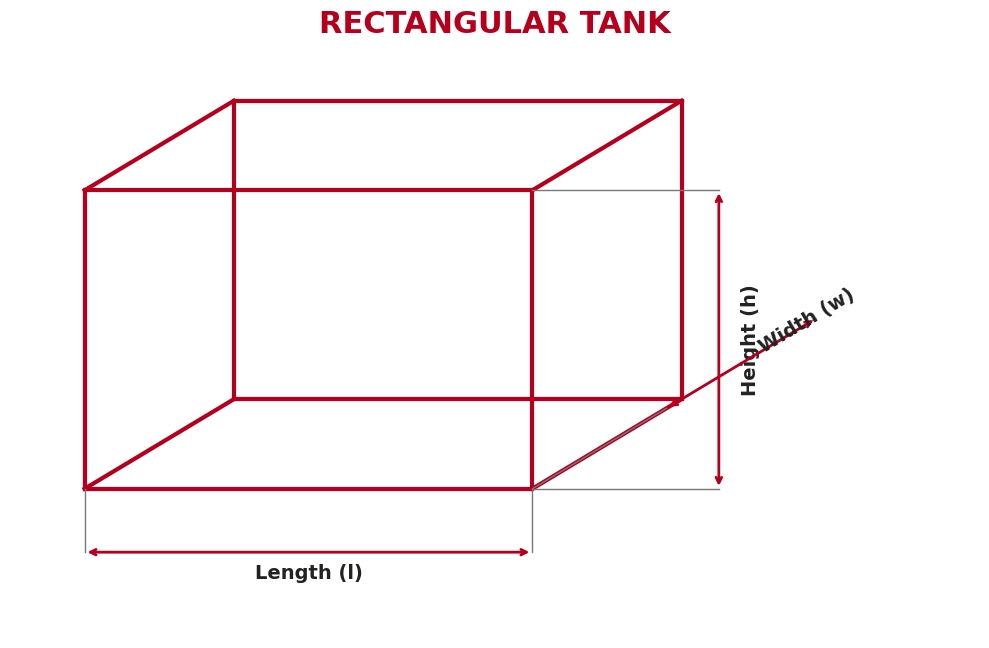
Volume = l × w × h

Formula for Volume of a Rectangular Tank
Volume = Length × Width × Height
V = l × w × h
Where:
l = length of the tank
w = width of the tank
h = height of the tank
Formula in Cubic Units
If measurements are in metres: Volume = cubic metres (m³)
If measurements are in centimetres: Volume = cubic centimetres (cm³)
If measurements are in feet: Volume = cubic feet (ft³)
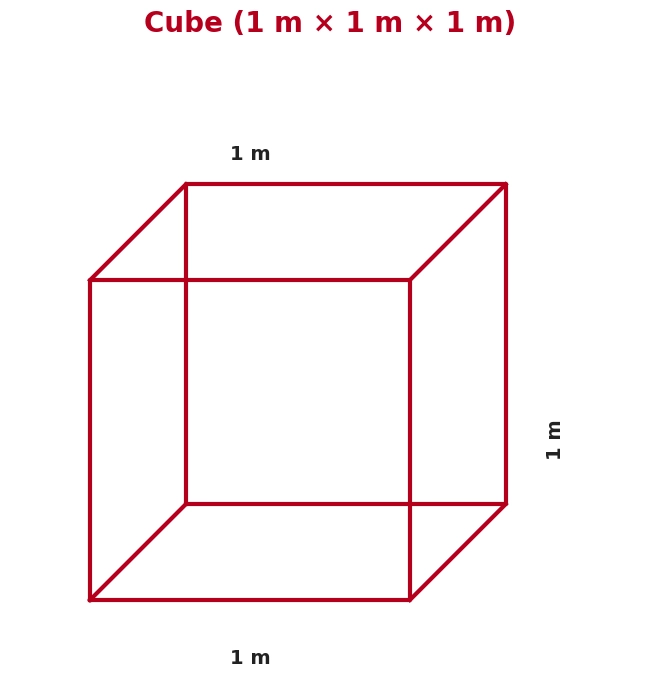
1 m × 1 m × 1 m = 1 m³ (one cubic metre)
Formula in Litres
1 cubic metre (m³) = 1000 litres
1 cubic centimetre (cm³) = 0.001 litres
1000 cm³ = 1 litre
Volume in litres = Volume in m³ × 1000
How to Calculate the Volume of a Rectangular Tank
Step 1: Measure Length
Measure the longest horizontal dimension of the tank.
Use a tape measure from inside the tank for accuracy.
←———————————————→
← Length (l) →
Always measure from INSIDE the tank
(exclude wall thickness for water capacity).
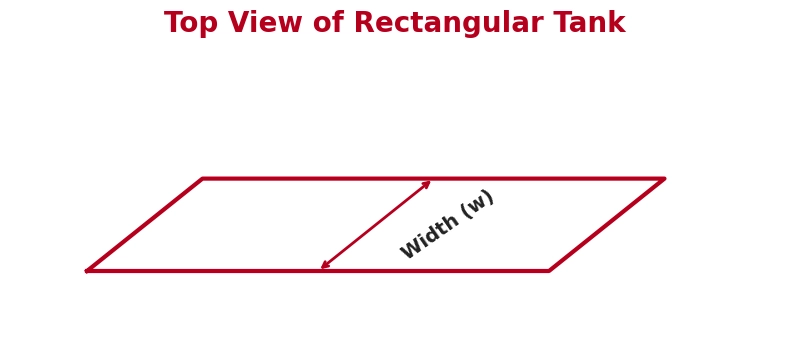
Step 2: Measure Width
Measure the shorter horizontal dimension of the tank.
This is perpendicular to the length.
Step 3: Measure Height
Measure the vertical depth of the tank from bottom to top.
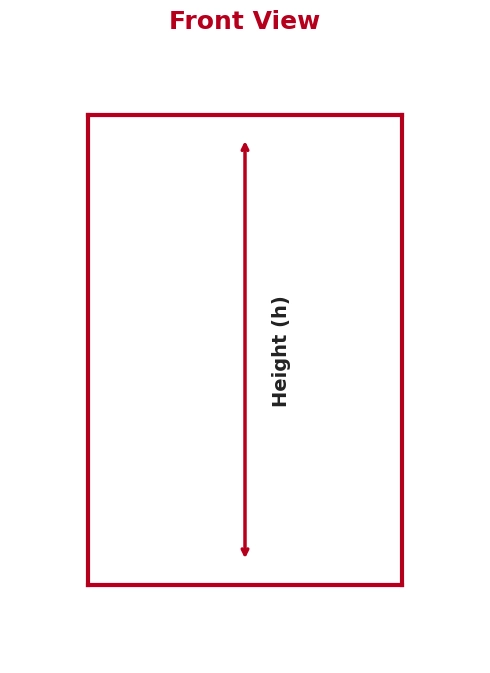
For open tanks, measure the water level
height for ACTUAL volume of water.
Step 4: Apply the Formula
V = l × w × h
Volume of Rectangular Tank Formula Explained
Length × Width × Height
Step 1: l × w = Base Area
This gives you the bottom surface of the tank.
Step 2: Base Area × h = Volume
Stack the base area upward to height h.
Volume fills the entire 3D space.
Understanding Cubic Units
CUBIC UNIT COMPARISON:
1 cm³ = size of a sugar cube (tiny)
1 litre = 1000 cm³ = a water bottle
1 m³ = 1000 litres = a large water tank
How to Convert Cubic Metres to Litres
Cubic Metres to Litres
CONVERSION FORMULA:
Litres = Cubic metres × 1000
Examples:
1 m³ = 1000 L
2 m³ = 2000 L
0.5 m³ = 500 L
3.6 m³ = 3600 L
CONVERSION TABLE:
| Cubic Metres (m³) | Litres (L) |
|---|---|
| 0.5 m³ | 500 L |
| 1.0 m³ | 1,000 L |
| 1.5 m³ | 1,500 L |
| 2.0 m³ | 2,000 L |
| 5.0 m³ | 5,000 L |
| 10.0 m³ | 10,000 L |
Cubic Centimetres to Litres
CONVERSION FORMULA:
Litres = Cubic centimetres ÷ 1000
Examples:
1000 cm³ = 1 litre
5000 cm³ = 5 litres
500 cm³ = 0.5 litres
12000 cm³ = 12 litres
Cubic Feet to Litres
CONVERSION FORMULA:
Litres = Cubic feet × 28.317
Examples:
1 ft³ = 28.317 litres
2 ft³ = 56.634 litres
10 ft³ = 283.17 litres
Solved Examples on Volume of Rectangular Tank
Example 1: Volume in Cubic Metres
Question: A rectangular water tank is 4 m long, 3 m wide, and 2 m high. Find its volume.
Given:
l = 4 m
w = 3 m
h = 2 m
Formula: V = l × w × h
V = 4 × 3 × 2
V = 24 m³
Answer: Volume = 24 m³
Example 2: Water Capacity in Litres
Question: A rectangular tank measures 2.5 m long, 2 m wide, and 1.5 m high. Find its capacity in litres.
Given:
l = 2.5 m
w = 2.0 m
h = 1.5 m
Step 1: Find volume in m³
V = l × w × h
V = 2.5 × 2 × 1.5
V = 7.5 m³
Step 2: Convert to litres
Litres = 7.5 × 1000
Litres = 7500 litres
Answer: Tank capacity = 7500 litres
Example 3: Tank Filled Halfway
Question: A rectangular tank is 5 m long, 4 m wide, and 3 m high. The tank is filled only halfway. Find the volume of water in it.
Given:
l = 5 m, w = 4 m, full h = 3 m
Water fills only half → water height = 3/2 = 1.5 m
V = l × w × water height
V = 5 × 4 × 1.5
V = 30 m³
In litres = 30 × 1000 = 30,000 litres
Answer: Volume of water = 30,000 litres
Example 4: Capacity of an Underground Tank
Question: An underground rectangular water tank is 6 m long, 3 m wide, and 2.5 m deep. Find: a) Volume in cubic metres b) Capacity in litres c) If a family uses 200 litres per day, how many days will the tank last?
Given:
l = 6 m, w = 3 m, h = 2.5 m
a) Volume = l × w × h
= 6 × 3 × 2.5
= 45 m³
b) Capacity in litres:
= 45 × 1000 = 45,000 litres
c) Days the tank lasts:
= 45,000 ÷ 200 = 225 days
Answer:
a) 45 m³
b) 45,000 litres
c) 225 days
Volume of Water in a Rectangular Tank
Completely Filled Tank
Volume of water = l × w × h (full height)
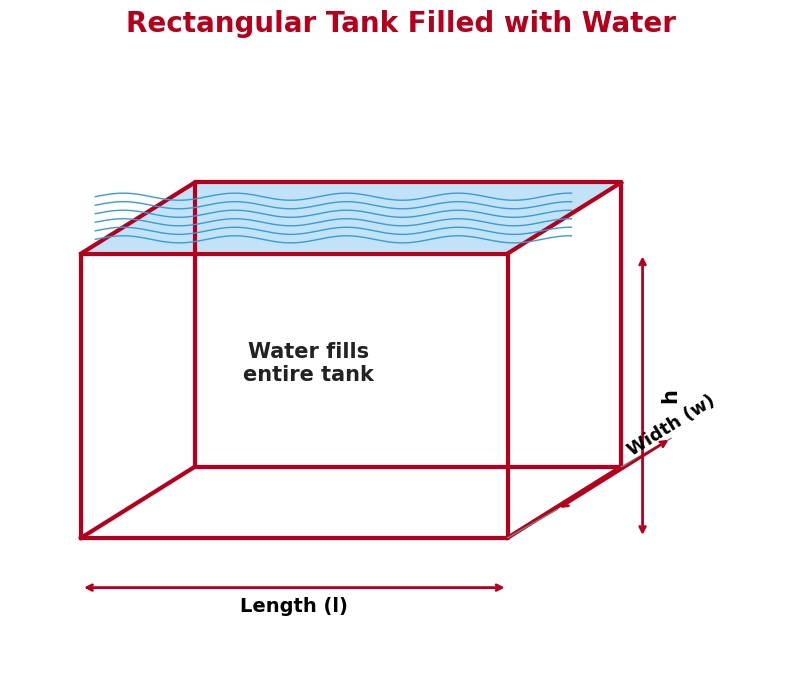
Volume = l × w × h
Partially Filled Tank
When partially filled:
Volume of water = l × w × d
Where d = depth of water (not full height)
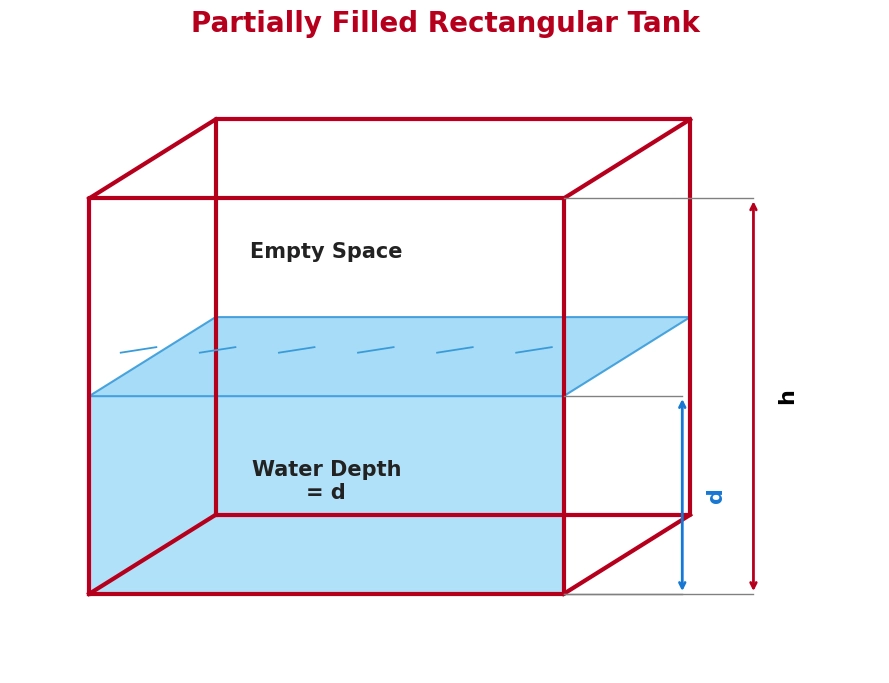
Volume of water = l × w × d
Empty space = l × w × (h − d)
Empty Space Calculation
Empty volume = Total volume − Water volume
= l × w × h − l × w × d
= l × w × (h − d)
Example:
Tank: l = 3m, w = 2m, h = 2m
Water depth: d = 1.5m
Total volume = 3 × 2 × 2 = 12 m³
Water volume = 3 × 2 × 1.5 = 9 m³
Empty space = 12 − 9 = 3 m³ = 3000 litres
Real Life Applications
Household Water Tanks
A typical home rectangular tank: l = 2 m, w = 1.5 m, h = 1.5 m
V = 2 × 1.5 × 1.5 = 4.5 m³ = 4500 litres
Average family uses 500 − 600 litres per day.
This tank lasts about 7 − 9 days.
Swimming Pools
A small rectangular swimming pool: l = 10 m, w = 5 m, h = 1.5 m
V = 10 × 5 × 1.5 = 75 m³ = 75,000 litres
At ₹5 per 1000 litres:
Cost to fill = 75 × 5 = ₹375
Agricultural Water Storage
A farm water storage tank: l = 10 m, w = 8 m, h = 3 m
V = 10 × 8 × 3 = 240 m³ = 240,000 litres
If crops need 5000 litres per day:
Days covered = 240,000 ÷ 5000 = 48 days
Industrial Tanks
Industrial tanks are often much larger: l = 20 m, w = 15 m, h = 5 m
V = 20 × 15 × 5 = 1500 m³ = 1,500,000 litres
Industrial tanks may store fuel, chemicals,
or process water in factories.
Practice Questions on Volume of Rectangular Tank
Q1: A rectangular tank is 3 m long, 2 m wide, and 1 m high. Find its volume.
V = 3 × 2 × 1 = 6 m³
Answer: 6 m³
Q2: Find the capacity in litres of a tank with dimensions 4 m × 2.5 m × 1.5 m.
V = 4 × 2.5 × 1.5 = 15 m³
Litres = 15 × 1000 = 15,000 litres
Answer: 15,000 litres
Q3: A tank holds 1000 litres when full. What is its volume in m³?
1000 litres ÷ 1000 = 1 m³
Answer: 1 m³
Q4: Find the volume in cm³: l = 50cm, w = 40cm, h = 30cm.
V = 50 × 40 × 30 = 60,000 cm³
Answer: 60,000 cm³
Q5: A rectangular tank is half full. Total capacity = 8000 litres. How much water is in it?
Water = 8000 ÷ 2 = 4000 litres
Answer: 4000 litres
Q6: A rectangular water tank is 5 m long, 4 m wide, and 3 m high. Water is filled to 2 m height. Find: a) Volume of water b) Empty volume remaining
a) Volume of water:
V = 5 × 4 × 2 = 40 m³ = 40,000 litres
b) Empty volume:
Total = 5 × 4 × 3 = 60 m³ = 60,000 litres
Empty = 60,000 − 40,000 = 20,000 litres
Answers:
a) 40,000 litres
b) 20,000 litres
Q7: A family needs 400 litres of water per day. They have a rectangular tank measuring 2 m × 2 m × 2.5 m. For how many days will a full tank last?
V = 2 × 2 × 2.5 = 10 m³ = 10,000 litres
Days = 10,000 ÷ 400 = 25 days
Answer: 25 days
Q8: A rectangular tank costs ₹500 per cubic metre to build. The tank is 6 m long, 4 m wide, and 2 m high. Find the construction cost.
V = 6 × 4 × 2 = 48 m³
Cost = 48 × 500 = ₹24,000
Answer: ₹24,000
Q9: Two rectangular tanks are connected. Tank A: 3m × 2m × 2m. Tank B: 4m × 3m × 1.5m. Find total water storage capacity in litres.
Tank A: V = 3 × 2 × 2 = 12 m³
Tank B: V = 4 × 3 × 1.5 = 18 m³
Total = 12 + 18 = 30 m³ = 30,000 litres
Answer: 30,000 litres
Q10: A rectangular tank is 8 m long and 5 m wide. When water fills it to 3/4 of its height, the volume of water is 90 m³. Find the full height of the tank.
Let full height = h
Water height = 3h/4
V of water = l × w × (3h/4)
90 = 8 × 5 × (3h/4)
90 = 40 × (3h/4)
90 = 30h
h = 3 m
Answer: Full height = 3 m
Verify: 8 × 5 × (3×3/4) = 40 × 2.25 = 90
Q11: A rectangular underground tank is 10 m × 8 m × 4 m. It is currently 60% full. A pump empties it at 500 litres per minute. How long will it take to empty the tank completely?
Total volume = 10 × 8 × 4 = 320 m³ = 320,000 litres
Water in tank = 60% of 320,000 = 192,000 litres
Rate = 500 litres per minute
Time = 192,000 ÷ 500 = 384 minutes
= 384 ÷ 60 = 6 hours 24 minutes
Answer: 6 hours and 24 minutes
Q12: Three identical rectangular tanks each have dimensions 4 m × 3 m × 2 m. They supply water to a factory that uses 3000 litres per hour. If all three tanks are full at 6 AM, at what time will they run dry?
Volume of one tank = 4 × 3 × 2 = 24 m³ = 24,000 litres
Total volume = 3 × 24,000 = 72,000 litres
Usage rate = 3000 litres per hour
Time to empty = 72,000 ÷ 3000 = 24 hours
Starting at 6 AM:
6 AM + 24 hours = 6 AM next day
Answer: The tanks run dry at 6 AM the next day
Frequently Asked Questions on Volume of Rectangular Tank
1. What is the formula for the volume of a rectangular tank?
V = lwh
The volume of a rectangular tank is calculated by multiplying its length, width, and height.
2. How do you calculate the volume of a rectangular water tank?
Multiply the length × width × height. Ensure all dimensions are in the same unit before calculating.
3. How do you calculate the capacity of a rectangular tank in litres?
First, find the volume in cubic metres (m³). Then multiply the result by 1,000 to convert it into litres.
4. How many litres does a 1 cubic metre tank hold?
A tank with a volume of 1 cubic metre (1 m³) can hold 1,000 litres of water.
5. What is the difference between volume and capacity?
Volume is the space inside the tank measured in cubic units, while capacity is the amount of liquid the tank can hold, usually measured in litres.
6. What units are used to measure the volume of a rectangular tank?
Volume is measured in cm³, m³, or ft³, while capacity is measured in litres (L) or kilolitres (kL).
7. How do you solve rectangular tank volume word problems?
Identify the length, width, and height, apply the volume formula, calculate the volume, and convert it to litres if required.
Numbers make sense when they're taught right. To see how Orchids The International School turns Maths from intimidating to intuitive, reach out to our admissions team.


Admissions Open for 2026-27
What type of concept pages would you prefer?
CBSE Schools In Popular Cities
- CBSE Schools in Bangalore
- CBSE Schools in Mumbai
- CBSE Schools in Pune
- CBSE Schools in Hyderabad
- CBSE Schools in Chennai
- CBSE Schools in Gurgaon
- CBSE Schools in Kolkata
- CBSE Schools in Indore
- CBSE Schools in Sonipat
- CBSE Schools in Delhi
- CBSE Schools in Rohtak
- CBSE Schools in Bhopal
- CBSE Schools in Aurangabad
- CBSE Schools in Jabalpur
- CBSE Schools in Jaipur
- CBSE Schools in Jodhpur
- CBSE Schools in Nagpur
- CBSE Schools in Ahmednagar
- CBSE School In Tumkur











Orchids The International School is one of India's leading chains of CBSE and ICSE schools, with 110+ schools across the country.