

Summarising for Class 5: Say More in Fewer Words
Have you ever read a long story and then told it to someone in a few sentences? That is called summarising.
Summarising helps you understand the main idea and important details of a passage and write them in your own words.
Table of Contents
- What is Summarising
- Important Points to Remember While Summarising
- How to Summarise (Step-by-Step)
- Dos and Don'ts of Summarising
- Example of Summarising
- Common Mistakes
- Practice Zone
- Frequently Asked Questions about Summarising

What is Summarising?
Summarising is to extract the central idea and important details in a text passage or a visual prompt and rewrite it in your words.
Important Points to Remember While Summarising
Before you begin writing a summary, it is important to understand what to include and what to avoid. These simple pointers will help you write a clear and effective summary.
- Identify the main idea and important details in a passage.
- Transfer key information from a paragraph to a graphic organiser.
- Use short sentences to summarise a paragraph or visualise a prompt.
- Paraphrase important information.
How to Summarise (Step-by-Step)
Step 1: Read Carefully
Read the passage quickly. If it is an image, observe to understand the topic.
Ask yourself: What is the text/mainly about?
Step 2: Find Important Points
Underline or note:
- Main idea
- Key details
- Important characters or events
Step 3: Ask Key Questions
- Who is it about?
- Where did it happen?
- When did it happen?
- What happened?
Step 4: Remove Extra Details
- Ignore examples and repeated information
- Do not include unnecessary descriptions
Step 5: Write the Summary
- Use your own words
- Write in 2–3 short sentences
- Keep it clear and simple
Dos and Don’ts of Summarising
|
Dos |
Don'ts |
|
Ask yourself, “What is the text about?” |
Avoid including your opinions, background knowledge, or personal information. |
|
Ask, “What information do you need to understand the text/visual?” |
Refrain from writing in points. |
|
Remove unnecessary details if it is a fictional story. In non-fiction, remove examples and repetitions. |
Avoid making your summary too short or too long. |
Example of Summarising
Passage:
On the first day of our arrival, my fellow camper named Saeed was arranging his luggage. Scooby popped his head out of my backpack. Saeed let out a scream. Other boys came running to see what had happened. I was immediately taken to the camp instructor. The whole crowd along with our cabin leader, Karl, followed us as we walked to the instructor’s cabin. “You cannot have a kitten in the camp, Rohan,” said Ms. Benekar. She instructed Karl to get rid of Scooby.
Summary:
On the first day of camp, Rohan’s roommate got scared when he saw Scooby, Rohan's kitten. The camp instructor, Ms. Benekar, told Rohan and his cabin leader, Karl, to remove it from the camp.
Common Mistakes
1. Copying from the passage
Wrong: Writing the same sentences
Right: Use your own words
2. Adding personal opinion
Wrong: I think this was wrong
Right: Only include facts
3. Making it too long or too short
Keep it balanced and clear
Practice Zone
A. Observe the poster and answer the question below.
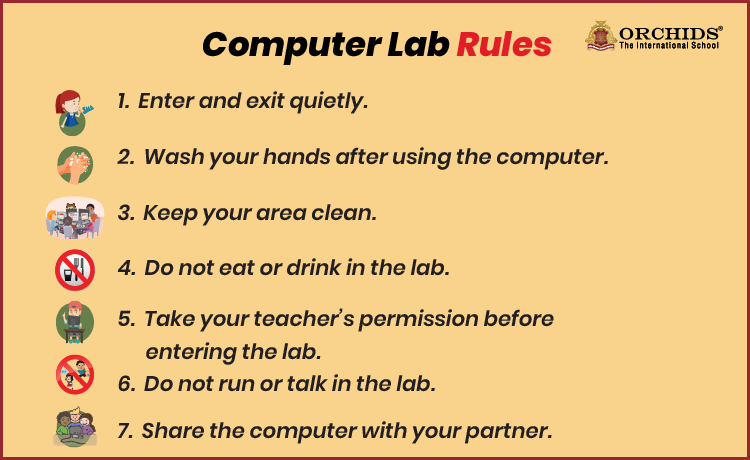
Which of the following is MOST LIKELY the summary of the poster?
- The poster teaches you how to use tablets.
- The poster lays down the rules for students while using a computer lab.
- The poster tells you how to use a computer in the computer lab.
- The poster describes the rules to keep the computer lab neat and clean.
B. Match the nursery rhyme with the correct summary.
|
Nursery Rhyme |
Summary |
|
Rain, rain go away Come again another day. Rain, rain go away Little Johnny wants to play. |
A sheep has wool for its owner, his wife and a boy. |
|
Baa baa black sheep, have you any wool? Yes sir, yes sir, three bags full! One for the master, one for the dame, And one for the little boy who lives down the lane. |
A teapot makes noise when the water has boiled. |
|
I’m a little teapot Short and stout Here is my handle Here is my spout. When I get all steamed up Hear me shout “Tip me over and pour me out!” |
Mary, a small girl, had a white lamb that followed her everywhere. |
|
Mary had a little lamb, It's fleece was white as snow; And everywhere that Mary went The lamb was sure to go. |
The narrator requests the rain to go away because a small child wants to play. |
C. Read the passage and write a summary of the passage.
Do you know that a stamp can be worth more than a crore? If it’s the 1948 Gandhi Service stamp, it might cost you more than a crore. The reason why this stamp is the rarest of rare is that only 100 stamps were printed with ‘Service’ printed on it. Moreover, these stamps were printed specifically for government use. Only eight stamps were released for private collectors, making this stamp one of the costliest stamps. Another ultra-rare stamp is the 1854 Inverted Head Four Annas stamp. This stamp is special for two reasons:
- It was one of the first multi-coloured stamps.
- The head of Queen Victoria was printed upside down. Today, about 28 such stamps exist and have become a part of many private stamp collectors. It will easily fetch eight to nine lakh rupees at an auction.
Now, that's a special stamp, isn't it?
D. Read the Chinese folk tale and answer the following questions.
Long ago, in a town later known as Beijing, lived a boy called Woo Sing, who was as quarrelsome as he could be. His father was worried for him because he thought Woo might be in trouble, so he decided to teach him to be friendly. He bought a large decorated mirror and hung it on the wall. Woo Sing had never seen a mirror before, so when he stood in front of it, he thought it was another boy. When he smiled, the other boy also smiled.
Delighted by the company, Woo talked to the other boy but there was no reply from the mirror. Whatever Woo did, the other boy imitated. Woo thought that the other boy mocked him and was thus enraged; he struck the boy in the mirror, but ended up hurting his own hand!
His father seeing this said, “If you strike someone without any cause, you will hurt yourself the most."
1. Find the most important details.
- Who is the story about? .....................................
- When did the story take place? ............................................
- Where did the story take place? .............................................
- What did the main character do? ........................................
- What happened at the end? ...........................................
2. Write a summary in 25 words.
E. Read the advertisement and summarise it in one to two sentences.

- What is the poster mainly about?
- Which details help you understand the main idea?
Frequently Asked Questions about Summarising
1. What is summarising?
Summarising means writing the main idea and important points of a passage in a shorter form using your own words. It helps you focus on what is most important in the text.
2. How long should a summary be?
A summary should be short and clear. For Class 5, it is usually written in 2–3 sentences, depending on the length of the passage.
3. Can I copy from the passage?
No, you should not copy sentences directly from the passage. Instead, you should understand the content and rewrite it in your own words.
4. Should I include my opinion?
No, a summary should only include facts and important details from the passage. Personal opinions or ideas should not be added.
5. What should I include in a summary?
You should include the main idea, key details, and important events. Avoid extra information, examples, or repeated ideas.
6. Why is summarising important?
Summarising helps you understand what you read, remember important points, and express ideas clearly in a shorter form.
Strong language skills open doors well beyond the classroom, shaping how confidently a child reads, writes and expresses ideas. If you want to know more about how Orchids The International School builds these skills through its English curriculum, get in touch with our admissions team.


Admissions Open for 2026-27
What type of concept pages would you prefer?
CBSE Schools In Popular Cities
- CBSE Schools in Bangalore
- CBSE Schools in Mumbai
- CBSE Schools in Pune
- CBSE Schools in Hyderabad
- CBSE Schools in Chennai
- CBSE Schools in Gurgaon
- CBSE Schools in Kolkata
- CBSE Schools in Indore
- CBSE Schools in Sonipat
- CBSE Schools in Delhi
- CBSE Schools in Rohtak
- CBSE Schools in Bhopal
- CBSE Schools in Aurangabad
- CBSE Schools in Jabalpur
- CBSE Schools in Jaipur
- CBSE Schools in Jodhpur
- CBSE Schools in Nagpur
- CBSE Schools in Ahmednagar
- CBSE School In Tumkur











Orchids The International School is one of India's leading chains of CBSE and ICSE schools, with 130+ schools across the country.