

Jellyfish: Definition, Anatomy, Adaptation, Sting and Lifespan
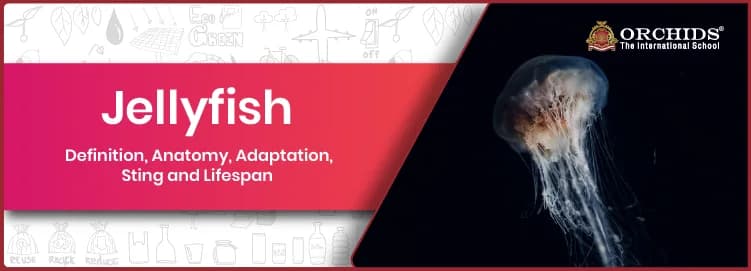
Jellyfish have existed long before dinosaurs, having been on Earth for more than 500 million years. They belong to the class Scyphozoa and the phylum Cnidaria and they inhabit all oceans, from the chilly waters close to the Arctic to the warm tropical seas. However, since jellyfish aren't actually fish at all, the term is a little deceptive. They don’t have bones. Rather, they are bell-shaped, soft, jelly-like beings that simply float wherever the current carries them.
Table of Contents

Anatomy
About 95% of a jellyfish’s body is made of water, which is why it looks clear and almost transparent. The top, umbrella-shaped part of its body gently opens and closes to help it move through the water. Hanging below it are long, thin tentacles with tiny stinging parts. These help the jellyfish catch food and protect itself from danger.
Jellyfish have a very simple body. They have just one opening that they use to eat food and remove waste. They also do not have a brain like people or other animals. Instead, they have a simple system that helps them notice light, movement and changes in the water around them. Some jellyfish can even tell the difference between light and dark, which helps them move through the ocean.
Adaptation
Jellyfish have lived on Earth for millions of years because they can easily adjust to different ocean conditions. Their bodies are mostly made of water, so they do not need much food or energy to stay alive. This helps them survive even in places where food is hard to find. They eat small sea animals, fish eggs, tiny fish and plankton.
One of the most unusual jellyfish is Turritopsis dohrnii, often called the ‘immortal jellyfish’. Once it becomes an adult, it can revert to its young form and begin its life cycle again. This is why many people call it ‘immortal’. Jellyfish can also have babies in more than one way, which helps their numbers grow quickly. Some jellyfish that live deep in the ocean can glow in the dark. This glow helps them catch prey and deter other sea animals.
Sting
A jellyfish sting is one of the most common injuries people can get while swimming in the sea. When its tentacles touch your skin, they release a poisonous substance that can cause pain. Some stings only leave redness, itching, or a burning feeling, while others can cause severe pain and, in rare cases, become life-threatening. The box jellyfish, found in the Indo-Pacific Ocean, has one of the most dangerous stings in the world.
Jellyfish do not sting people on purpose. They use their stings to catch food or protect themselves when they feel threatened. Even a tentacle that has broken off, or one from a dead jellyfish, can still sting if you touch it. If someone is stung, any tentacles should be removed carefully without touching them directly. The area should then be rinsed with seawater. In some cases, vinegar may help, but the right treatment depends on the type of jellyfish that caused the sting.
Lifespan
Most jellyfish do not live for a long time. Some live for only a few hours, while others can survive for several months. How long they live depends on the type of jellyfish and the place where they live. For example, the moon jellyfish usually lives for about 12 to 18 months in the wild.
One jellyfish is very different from the others. Turritopsis dohrnii, often called the ‘immortal jellyfish’, can change back into its young form after becoming an adult. Because it can repeat this process, it may be able to live for a very long time. This unusual ability has made it an important subject for scientists who are trying to understand how living things grow older and how the body can repair itself.
Frequently Asked Questions about Jellyfish
1. Are jellyfish dangerous to humans?
Most jellyfish won't hurt you badly, but a few, like the box jellyfish, can be deadly. It's best to avoid touching any jellyfish, even ones that look dead.
2. Do jellyfish have a brain?
No. Instead of a brain, they have a simple network of nerves that helps them react to what's around them.
3. What do jellyfish eat?
They eat things like plankton, small fish, fish eggs and other tiny sea creatures, using their tentacles to catch their food.
4. Can jellyfish live forever?
Turritopsis dohrnii can turn back into a younger version of itself after becoming an adult, so in theory, it could live indefinitely. But it can still die from disease or being eaten.
5. Why are jellyfish increasing in numbers?
Warmer ocean temperatures, overfishing of the animals that eat jellyfish and ocean acidification are some of the main reasons jellyfish numbers are booming in many areas.
Understanding the world starts with the environment around us. To see how Orchids The International School brings EVS to life, reach out to our admissions team.


Admissions Open for 2026-27
What type of concept pages would you prefer?
CBSE Schools In Popular Cities
- CBSE Schools in Bangalore
- CBSE Schools in Mumbai
- CBSE Schools in Pune
- CBSE Schools in Hyderabad
- CBSE Schools in Chennai
- CBSE Schools in Gurgaon
- CBSE Schools in Kolkata
- CBSE Schools in Indore
- CBSE Schools in Sonipat
- CBSE Schools in Delhi
- CBSE Schools in Rohtak
- CBSE Schools in Bhopal
- CBSE Schools in Aurangabad
- CBSE Schools in Jabalpur
- CBSE Schools in Jaipur
- CBSE Schools in Jodhpur
- CBSE Schools in Nagpur
- CBSE Schools in Ahmednagar
- CBSE School In Tumkur











Orchids The International School is one of India's leading chains of CBSE and ICSE schools, with 130+ schools across the country.