

Geological Time Scale: Definition, Importance, Hierarchy of Time Units, Earth’s Main Eras & Eons and the Current Epoch
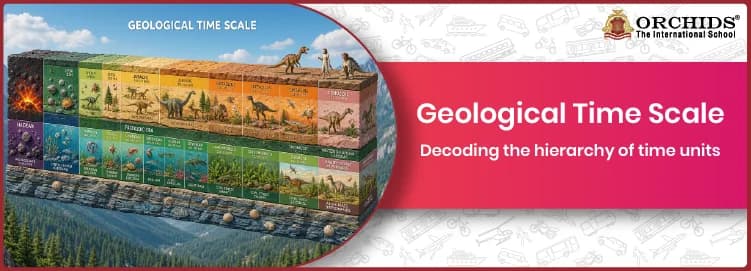
The Geological Time Scale (GTS) is basically a giant calendar that scientists use to map out Earth’s 4.6-billion-year history. It puts rock layers, major events and the story of life on Earth into proper order. Geologists and paleontologists built this system over many decades by studying fossils, examining rock layers and using radiometric dating. Today, it’s overseen and updated by the International Commission on Stratigraphy (ICS), which operates under the International Union of Geological Sciences (IUGS).
Table of Contents
- Importance of the Geological Time Scale
- Hierarchy of Time Units
- Earth’s Main Eons and Eras
- The Current Epoch
- Frequently Asked Questions about Geological Time Scale

Importance of the Geological Time Scale
The GTS isn’t just a chart hanging in a classroom; it's actually one of the most useful tools in Earth science and it matters across several fields.
Palaeontology
It helps scientists figure out exactly where a fossil fits in the bigger picture of how life evolved and roughly when different creatures showed up.
Stratigraphy
It lets geologists match up rock layers found in completely different parts of the world, which helps piece together what ancient environments and events looked like.
Resource Exploration
Things like oil, gas, coal and minerals only form during certain time periods. Knowing the GTS helps companies figure out where to look.
Climate Science
By studying past ice ages, warm spells and mass extinctions, researchers get a better handle on what's happening with climate change today.
Planetary Science
Comparing Earth’s rock record to what we see on other planets gives scientists clues about how planets in general change over time.
Hierarchy of Time Units
The GTS is broken down into different units, going from the biggest chunks of time down to the smallest:
- Eon is the largest unit of all. Earth's story is split into four eons: Hadean, Archean, Proterozoic and Phanerozoic.
- Era comes next and these sit inside eons. For instance, the Phanerozoic Eon is made up of the Paleozoic, Mesozoic and Cenozoic eras.
- Period is a smaller slice within an era; think Jurassic, Cretaceous and Triassic, which all fall inside the Mesozoic Era.
- Epoch breaks periods down even further, like the Pleistocene and Holocene epochs inside the Quaternary Period.
- Age (or Stage) is the smallest official unit on the scale, covering the shortest stretches of time.
Earth’s Main Eons and Eras
Hadean Eon (4.6-4.0 billion years ago)
This was Earth's roughest, earliest stretch. None of the original rocks from this time still exist on the surface. Back then, Earth was basically a molten ball getting hammered by meteorites constantly. Oceans probably started forming toward the end of this eon.
Archean Eon (4.0-2.5 billion years ago)
The first solid crust formed during this time and simple life, bacteria and archaea, showed up. Stromatolites, layered rock structures built by cyanobacteria, are some of the oldest signs of life we have from this period.
Proterozoic Eon (2.5 billion-541 million years ago)
Oxygen started building up in the atmosphere during this eon. More complex cells (eukaryotes) appeared and the first multicellular life forms came along. This period also saw ‘Snowball Earth’ events, where the whole planet froze over.
Phanerozoic Eon (541 million years ago-present)
This is the eon we're living in now and it's known as the age of visible life. It's split into three major eras:
- Paleozoic Era (541-252 Ma): This era saw a huge boom in marine invertebrates, the rise of vertebrates and plants and animals moving onto land for the first time. It ended with the biggest mass extinction Earth has ever seen, the Permian-Triassic event.
- Mesozoic Era (252-66 Ma): Better known as the age of dinosaurs. Reptiles ruled the land, sea and sky, while flowering plants and the first mammals also appeared. This era came to an end with the Cretaceous-Paleogene extinction, most likely triggered by an asteroid impact.
- Cenozoic Era (66 Ma-present): This is the age of mammals. Mammals spread out and adapted to nearly every environment on Earth. Eventually, primates evolved and Homo sapiens showed up near the very end of this era.
The Current Epoch
Right now, we're in the Cenozoic Era, more specifically in the Quaternary Period and within that, we're in the Holocene Epoch, which kicked off around 11,700 years ago once the last ice age ended. The Holocene has had a fairly stable, warm climate, which is part of why human civilisation was able to grow the way it did.
That said, scientists and the ICS have been going back and forth on whether to recognise a new epoch called the Anthropocene officially. The idea behind it is that human activity has changed Earth's geology, atmosphere and biosphere so much that it deserves its own chapter. Things like radioactive traces left over from nuclear testing, plastic showing up in sediment layers and rising CO2 levels in ice cores all point to this shift. But as of 2024, the ICS still hasn’t made it official.
Frequently Asked Questions about Geological Time Scale
1. How is the age of geological periods determined?
Geologists rely on radiometric dating, methods like uranium-lead, potassium-argon and carbon-14 dating, to figure out how old rocks and fossils actually are. By measuring how much a radioactive isotope inside a mineral has decayed, scientists can work out a pretty precise age for when that rock formed.
2. What caused the major mass extinctions in Earth’s history?
A mix of things, really: huge volcanic eruptions, asteroid strikes, sudden climate shifts, changing sea levels and oceans running low on oxygen. The five biggest extinction events are the end-Ordovician, Late Devonian, Permian-Triassic (the worst one by far), Triassic-Jurassic and. Cretaceous-Paleogene.
3. What is the difference between absolute and relative geological time?
Relative time is about order, figuring out whether one rock layer is older or younger than another based on how the layers are stacked. Absolute time goes a step further and pins down an actual number, like ‘this rock is 200 million years old’, using radiometric dating.
Understanding the world starts with the environment around us. To see how Orchids The International School brings EVS to life, reach out to our admissions team.


Admissions Open for 2026-27
What type of concept pages would you prefer?
CBSE Schools In Popular Cities
- CBSE Schools in Bangalore
- CBSE Schools in Mumbai
- CBSE Schools in Pune
- CBSE Schools in Hyderabad
- CBSE Schools in Chennai
- CBSE Schools in Gurgaon
- CBSE Schools in Kolkata
- CBSE Schools in Indore
- CBSE Schools in Sonipat
- CBSE Schools in Delhi
- CBSE Schools in Rohtak
- CBSE Schools in Bhopal
- CBSE Schools in Aurangabad
- CBSE Schools in Jabalpur
- CBSE Schools in Jaipur
- CBSE Schools in Jodhpur
- CBSE Schools in Nagpur
- CBSE Schools in Ahmednagar
- CBSE School In Tumkur











Orchids The International School is one of India's leading chains of CBSE and ICSE schools, with 130+ schools across the country.