

Mount Kanchenjunga: Elevation, Geographical Origin, Biodiversity and Cultural Significance
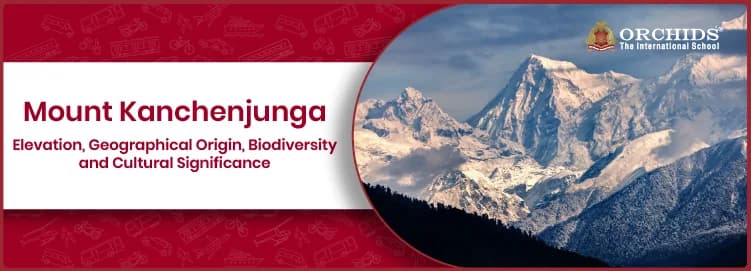
Mount Kanchenjunga also known as Kunchenjunga is the highest peak in India with a height of 28,169 feet. It is also the third highest mountain in the world after Mount Everest in Nepal and K2 in Pakistan. It was formed millions of years ago, after the collision between the Indian and Eurasian tectonic plates. The extreme collision force resulted in buckling and folding of the earth’s crust. The upward thrust resulted in the formation of a mountain range which we know today as Himalayas. Mount Kanchenjunga and its surrounding peaks are part of this Himalayan range that slowly formed over millions of years.
Table of Contents
- Where is Mount Kanchenjunga
- Neighbouring Peaks and Rivers of Mount Kanchenjunga
- Biodiversity of Mount Kanchenjunga
- Cultural Significance of Mount Kanchenjunga
- Frequently Asked Questions about Mount Kanchenjunga

Where is Mount Kanchenjunga
Kanchenjunga is located in the eastern Himalayas between the border of India and Nepal. In India it is situated in the state of Sikkim and Taplejung district in Nepal. This peak is the most biodiverse region in Asia surrounded by beautiful landscapes, glaciers, deep river valleys, dense forests and alpine meadows. It is visible from hill stations of Darjeeling and Gangtok. To the people of Sikkim it is not just a mountain, it is a cultural identity.
Neighbouring Peaks and Rivers of Mount Kanchenjunga
Mount Kanchenjunga is not just a single peak. It is a massif, a cluster of five highest peaks including Kangchenjunga Main (8,586 m), Kangchenjunga West ( 8,505 m), Kangchenjunga central (8,482 m), Kangchenjunga South (8,494 m) and Kangbachen (7,903 m). There are four main glaciers located in this region: Zemu (northeast), Tulang (southeast), Yalung (southwest) and Kanchenjunga (northwest). These four are the source of several important rivers originating from the region.
Zemu Glacier on the northeastern side is one of the largest glaciers in the Himalayas, stretching approximately 26 kilometres in length. It is a primary source of freshwater for the rivers of the region including Teesta river and more. The Teesta river is created by the Zemu and Talung glaciers. This river goes from Sikkim to West Bengal and further in Bangladesh. Yalung glacier in the southwest and Kangchen glacier in the northwest drain to the Arun River and Kosi River. Tamur river flowing through Nepal also originates from glaciers of Kanchenjunga.
Biodiversity of Mount Kanchenjunga
The Kanchenjunga region is one of the most biodiverse areas in the entire Himalayan range, covering glaciers, mountain ranges and ecosystems from subtropical forests to permanent snowfields at the top. The Kanchandzonga national park spans 1,784 square kilometres and is home to a wide variety of animal species. Trees like oak, chestnut, maple, and magnolia, with an understorey of ferns and mosses are found in the region. Some endangered animal species like snow leopard and red pandas are also found in this region. Nearly half of India’s bird diversity, a third of its flowering plants are found in this region. It is also recognised as a UNESCO world heritage site.
Cultural Significance of Mount Kanchenjunga
The inhabitants of Sikkim are called Lepcha people. They believe themselves to be the children of Kanchenjunga and created from the mountain's snow. This mountain holds a great cultural and religious significance for them as they consider it to be a source of all life and the spiritual centre of the universe. Kanchenjunga is also considered sacred in Buddhist culture. They believed that during the huge crisis, the hidden treasures within the mountain would be revealed to protect and sustain humanity.
Frequently Asked Questions about Mount Kanchenjunga
1. Is Kanchenjunga in India or Nepal?
Kanchenjunga is located between the border of India and Nepal.
2. What is the height of Kanchenjunga?
Kanchenjunga is the highest peak in India with a height of 28,169 feet.
3. What is the Pang Lhabsol festival?
Pang Lhabsol is a traditional Sikkimese festival celebrated annually to honour Kanchenjunga as the protective deity of Sikkim.
4. What wildlife is found in the Kanchenjunga region?
The Kanchenjunga conservation area is home to rare species such as snow leopards, red pandas, musk deer and Himalayan black bears.
Understanding the world starts with the environment around us. To see how Orchids The International School brings EVS to life, reach out to our admissions team.


Admissions Open for 2026-27
What type of concept pages would you prefer?
CBSE Schools In Popular Cities
- CBSE Schools in Bangalore
- CBSE Schools in Mumbai
- CBSE Schools in Pune
- CBSE Schools in Hyderabad
- CBSE Schools in Chennai
- CBSE Schools in Gurgaon
- CBSE Schools in Kolkata
- CBSE Schools in Indore
- CBSE Schools in Sonipat
- CBSE Schools in Delhi
- CBSE Schools in Rohtak
- CBSE Schools in Bhopal
- CBSE Schools in Aurangabad
- CBSE Schools in Jabalpur
- CBSE Schools in Jaipur
- CBSE Schools in Jodhpur
- CBSE Schools in Nagpur
- CBSE Schools in Ahmednagar
- CBSE School In Tumkur











Orchids The International School is one of India's leading chains of CBSE and ICSE schools, with 130+ schools across the country.