

Pine Tree: Definition, Unique Features, Ecoregions in India and Benefits
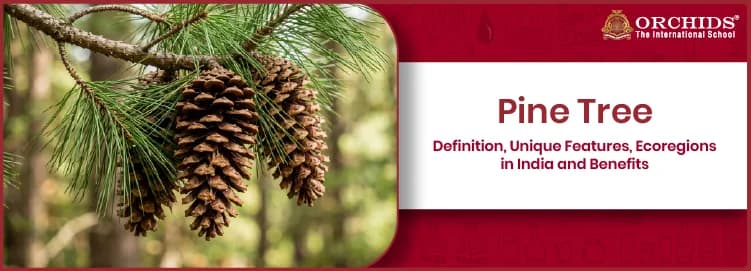
Pine tree is one of the most common coniferous trees found in mountains and forests. These evergreen trees retain their needle-like leaves throughout the year and live longer. Pine tree got its name from the Latin word pinus which means resin or sap. It is named after its strong smelling resin which is a physical characteristic of these trees. Let’s explore some interesting facts about pine trees including their unique characteristics and benefits.
Table of Contents
- What is a Pine Tree
- Unique Features of a Pine Tree
- Where are Pine Trees found in India
- Benefits of Pine Trees
- Frequently Asked Questions about Pine Trees

What is a Pine Tree
A pine tree is an evergreen coniferous tree belonging to the genus Pinus and the family Pinaceae. It has thin pointed leaves that look like needles and produce cones instead of flowers as reproductive parts. Mostly found in cold regions, these trees are tall and strong. Their needles do not freeze easily and help them survive through the harsh conditions.
Unique Features of a Pine Tree
- Leaves: Pine trees have sharp and pointy needle leaves that grow in clusters.
- Woody Cones: Instead of flowers pine trees grow cones that are woody with thick scales.
- Bark: Most of the pine trees have a thick scaly or flaky bark that is brown in colour.
- Conical Shape: Pine trees grow into a conical shape with a single trunk and downward dropping branches that helps it shed snow.
- Reproduction: Pine trees are gymnosperms that reproduce through seeds grown inside their cones. The seeds inside the male and female cones spread with wind and pollinate to regrow new coniferous trees.
- Longevity: The evergreen coniferous trees live for longer periods of time. They are among the species that can exist up to thousand years.
Where are Pine Trees found in India
The Himalayanandsub-Himalayan mountain ranges with higher altitude and cold climate are most suitable for the growth of pine trees. Most of the species of pine trees are found mainly in these regions across different states.
Himachal Pradesh: It is one of the most significant pine-growing states in India. The hills and valleys in Himachal are covered in pine forests. Chir pine is a species of pine tree that commonly grows in the lower and mid-altitude slopes between 1,000 and 2,000 metres.
Uttarakhand: Nainital, Mussoorie, Dehradun and the Garhwal Himalayas are some of the places in Uttarakhand where both Chir Pine and Blue Pine grow.
Jammu & Kashmir: The forests in J&K have a huge number of Himalayan white pine growing in cold and high-altitudes. Pir Panjal range, Banihal and the Himalayan slopes are the parts where these forests are majorly located.
Northeast India: Pine trees, such as the Khasi pine, grow in the subtropical and temperate-to-subalpine zones in Meghalaya. There are coniferous forests located in the higher regions of Arunachal Pradesh and Sikkim as well. Other pine ecoregions include Nagaland and Manipur.
Benefits of Pine Trees
Pine Trees have many ecological benefits in regulating climate and soil health. Most of these trees are evergreen retaining their leaves throughout winters giving oxygen and keeping air clean. Their deep roots retain moisture all through the year and survive the harsh climate while keeping the soil together and preventing soil erosion in hilly areas. A thick acidic mulch produced by needles dropped on the ground prevents the growth of weed and enriches soil. Rich in anti-oxidants and antimicrobial properties, conifer extracts are also used for medicines and pharmaceuticals. The softwood timber from coniferous trees is used in industrial manufacturing for paper, plyboards and other materials.
Frequently Asked Questions about Pine Trees
1. Where do Pine trees grow?
northern-hemisphere in mountains and cold forests such as in the boreal forest of Canada and Siberia.
2. Why are pine trees called evergreen trees?
Pine trees are famously known as the evergreen trees because they retain their green needles throughout the year. These trees shed the older needles gradually over several years.
3. How do pine trees reproduce?
Pine trees reproduce through their cones and not flowers. This is the reason they are called conifers or coniferous trees.
Understanding the world starts with the environment around us. To see how Orchids The International School brings EVS to life, reach out to our admissions team.


Admissions Open for 2026-27
What type of concept pages would you prefer?
CBSE Schools In Popular Cities
- CBSE Schools in Bangalore
- CBSE Schools in Mumbai
- CBSE Schools in Pune
- CBSE Schools in Hyderabad
- CBSE Schools in Chennai
- CBSE Schools in Gurgaon
- CBSE Schools in Kolkata
- CBSE Schools in Indore
- CBSE Schools in Sonipat
- CBSE Schools in Delhi
- CBSE Schools in Rohtak
- CBSE Schools in Bhopal
- CBSE Schools in Aurangabad
- CBSE Schools in Jabalpur
- CBSE Schools in Jaipur
- CBSE Schools in Jodhpur
- CBSE Schools in Nagpur
- CBSE Schools in Ahmednagar
- CBSE School In Tumkur











Orchids The International School is one of India's leading chains of CBSE and ICSE schools, with 130+ schools across the country.