

Tectonic Plates: Definition, Movement, Types of Crust, Major Plates and Boundaries
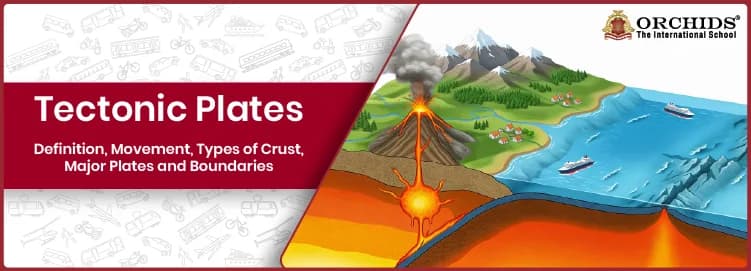
Tectonic plates are huge, oddly shaped pieces of solid rock that make up the Earth's outer shell, known as the lithosphere. This layer includes the crust and the top part of the mantle. According to the theory of plate tectonics, one of the most important ideas in geology, these plates are always moving, just very slowly, across the surface of the planet. The heat coming from deep inside the Earth is what keeps them going. Over millions of years, this slow movement shapes continents, causes earthquakes, triggers volcanic eruptions and builds mountains.
Table of Contents
- Movement of Tectonic Plates
- Types of Crust
- Major Tectonic Plates
- Types of Plate Boundaries
- Frequently Asked Questions about Tectonic Plates

Movement of Tectonic Plates
Tectonic plates move somewhere between 1 and 15 centimetres a year. That's about how fast your fingernails grow. A few things make this movement happen:
- Mantle Convection: The heat from the Earth's core makes the semi-liquid layer below the lithosphere, called the asthenosphere, move in circular patterns. Hot material rises up, spreads out, cools down and sinks back and this drags the plates above it along too.
- Ridge Push: At mid-ocean ridges, new rock forms and pushes the older seafloor away, which helps move oceanic plates.
- Slab Pull: When a heavier oceanic plate sinks below a lighter one, its own weight pulls the rest of the plate down with it. Many scientists think this is actually the strongest force behind plate movement.
All this movement has changed the shape of the Earth quite a lot over time. Around 335 million years ago, there was one giant landmass called Pangaea, which eventually broke apart into the continents we know today. This process hasn't stopped either. The Atlantic Ocean keeps getting wider, while the Pacific Ocean is slowly shrinking.
Types of Crust
Continental Crust
This type of crust is thicker, usually between 30 and 70 km and less dense. It's mostly made of granite-type rocks with a lot of silica and aluminium, sometimes called "sial." Continental crust is also really old, with some parts going back more than 4 billion years. It's what forms the land we live on.
Oceanic Crust
Oceanic crust is thinner, only about 5 to 10 km, but denser. It’s made mostly of basalt rock containing silica and magnesium, known as ‘sima’. Unlike continental crust, oceanic crust is fairly young, usually less than 200 million years old, since it keeps forming at mid-ocean ridges and gets destroyed at subduction zones.
Major Tectonic Plates
The Earth's outer shell is broken up into seven major plates and several smaller ones:
- Pacific Plate: The biggest plate of all, mostly covered by ocean, sitting under most of the Pacific.
- North American Plate: Covers North America and part of the North Atlantic seafloor.
- Eurasian Plate: Stretches across Europe and most of Asia.
- African Plate: Covers the African continent and the ocean floor around it.
- Antarctic Plate: Wraps around Antarctica, making it the southernmost plate.
- Indo-Australian Plate: Includes India, Australia and the oceans around them. Sometimes it’s split into two separate plates, the Indian and the Australian.
- South American Plate: Covers South America and part of the South Atlantic.
There are also several smaller plates worth knowing, like the Arabian, Caribbean, Nazca, Philippine and Juan de Fuca plates.
Types of Plate Boundaries
Convergent Boundaries (Collision Zones)
This happens when two plates move toward each other. There are three ways this can play out: one oceanic plate meeting a continental plate (where subduction happens, forming volcanoes and trenches), two oceanic plates colliding (again with subduction, but forming deep trenches and chains of islands) and two continental plates colliding, which pushes land upward and creates mountain ranges, like how the Himalayas formed when the Indo-Australian and Eurasian plates collided.
Divergent Boundaries (Spreading Zones)
This is when plates move away from each other. As they separate, magma rises up to fill the space and forms a new crust. The Mid-Atlantic Ridge is a good example and so is the East African Rift Valley, which could one day split Africa into two separate pieces of land.
Transform Boundaries (Strike-Slip Faults)
Here, plates slide past one another sideways, without creating or destroying any crust. These boundaries are known for causing strong earthquakes. The San Andreas Fault in California is probably the most well-known example, where the Pacific Plate is slowly sliding northward compared to the North American Plate.
Frequently Asked Questions about Tectonic Plates
1. How many tectonic plates does Earth have?
There are seven major tectonic plates and depending on how you count them, somewhere between eight and twelve smaller ones. If you count every plate and micro-plate, scientists have identified around 57 of them in total.
2. Why does India have frequent earthquakes?
India sits on the Indo-Australian Plate, which is pushing into the Eurasian Plate at roughly 4-5 cm every year. This collision is actually what created the Himalayas and the Tibetan Plateau and it also builds up a lot of stress underground, which is why the Himalayan region and northeastern India see so much earthquake activity.
3. What is subduction?
Subduction happens when a denser plate slides underneath a lighter one at a convergent boundary and sinks into the mantle. As the plate goes down, it starts to melt, which can lead to volcanic activity. This is also how the deepest ocean trenches form, including the Mariana Trench.
4. Can tectonic plate movement be measured?
Yes, it can. Scientists use tools like GPS satellites and a technique called very long baseline interferometry (VLBI) to track plate movement down to the millimetre. These measurements back up what theories and geological evidence have already suggested about how fast plates move.
5. What would happen if tectonic activity stopped?
If plate tectonics somehow stopped, the Earth would lose the main way it recycles carbon, keeps the climate in balance, renews its crust and even supports its magnetic field, since that’s linked to movement in the mantle. Volcanoes would become far less active, mountains would stop forming and over millions of years, erosion would slowly wear down the Earth’s surface.
Understanding the world starts with the environment around us. To see how Orchids The International School brings EVS to life, reach out to our admissions team.


Admissions Open for 2026-27
What type of concept pages would you prefer?
CBSE Schools In Popular Cities
- CBSE Schools in Bangalore
- CBSE Schools in Mumbai
- CBSE Schools in Pune
- CBSE Schools in Hyderabad
- CBSE Schools in Chennai
- CBSE Schools in Gurgaon
- CBSE Schools in Kolkata
- CBSE Schools in Indore
- CBSE Schools in Sonipat
- CBSE Schools in Delhi
- CBSE Schools in Rohtak
- CBSE Schools in Bhopal
- CBSE Schools in Aurangabad
- CBSE Schools in Jabalpur
- CBSE Schools in Jaipur
- CBSE Schools in Jodhpur
- CBSE Schools in Nagpur
- CBSE Schools in Ahmednagar
- CBSE School In Tumkur











Orchids The International School is one of India's leading chains of CBSE and ICSE schools, with 130+ schools across the country.