

Case Study Class 10 Maths Chapter 8 'Introduction to Trigonometry'
The Case Study Questions for Class 10 Maths Chapter 8 "Introduction to Trigonometry" include short, real life problem situations that have clear answers and step by step solutions to help students gain confidence for exams. It covers important topics including understanding the concept of trigonometry and right-angled triangles, defining trigonometric ratios (sine, cosine, tangent, cosecant, secant, cotangent), finding trigonometric ratios for standard angles (0°, 30°, 45°, 60°, 90°), using trigonometric identities (sin²θ + cos²θ = 1, 1 + tan²θ = sec²θ, 1 + cot²θ = csc²θ), solving problems involving complementary angles (sin(90°-θ) = cosθ, tan(90°-θ) = cotθ), calculating heights and distances using trigonometry, applying trigonometry to real-world scenarios like finding building heights, bridge lengths, and ship distances, and understanding the relationship between different trigonometric ratios. These practice questions help the students in better understanding of the concepts, handling trigonometry problems smoothly and to be faster and accurate for their board exams. A free PDF is included for offline timed practice.
Introduction to Case Study Questions on Introduction to Trigonometry
Right-Angled Triangles
Every Introduction to Trigonometry case study is built around a right-angled triangle. The right angle is always 90°. The three sides are the hypotenuse (opposite the right angle, always the longest side), the opposite side (opposite the angle being used), and the adjacent side (next to the angle being used, forming the angle along with the hypotenuse).
Trigonometric Ratios
.webp "trigonometric ratios")
Relationship Between Sides and Angles
The trigonometric ratios depend entirely on which angle you are working with. The same triangle has a different "opposite" and "adjacent" depending on which acute angle is chosen. Always label your triangle with respect to the given angle θ before selecting a ratio.
Standard Angle Values

Case Study 1: Measuring the Height of a Tree
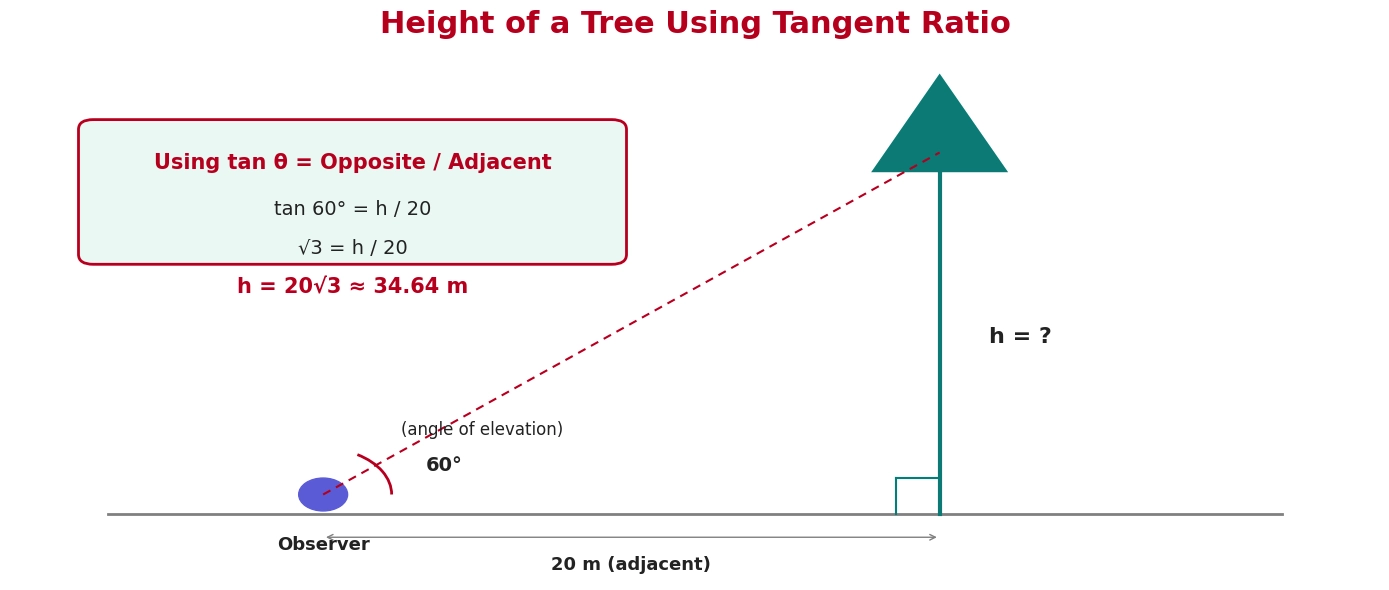
ScenarioRiya is standing 20 metres away from the base of a large tree on level ground. She looks up at the top of the tree and notices the angle of elevation is 60°. She wants to find the height of the tree without climbing it. The ground between her and the tree is perfectly flat.
Questions:
(i) Draw and label the right-angled triangle that represents this situation.
(ii) Which trigonometric ratio connects the height of the tree, the distance from the base, and the angle of elevation?
(iii) Find the height of the tree.
(iv) If Riya moves 10 more metres away from the tree, what is the new angle of elevation? (Use tan values.)
(v) What is the length of the line of sight (hypotenuse) from Riya to the tree top?
Solution:
(i) The right triangle has: the base along the ground = 20 m (adjacent), the vertical tree height = h (opposite), hypotenuse = line of sight from Riya to tree top, and angle θ = 60° at Riya's position. The right angle is at the base of the tree.
(ii) tan θ = opposite/adjacent. Here, tan 60° = h/20. We use tangent because we have the opposite (height) and adjacent (ground distance), with no hypotenuse needed.
(iii) tan 60° = √3. √3 = h/20, h = 20√3 ≈ 20 × 1.732 = 34.64 metres.
(iv) New distance = 20 + 10 = 30 m. Height remains 34.64 m. tan α = 34.64/30 ≈ 1.155 ≈ tan 49.1°. The new angle of elevation is approximately 49°.
(v) Hypotenuse = √(20² + h²) = √(400 + 1200) = √1600 = 40 metres. (Alternatively: cos 60° = 20/H, ½ = 20/H, H = 40 m.)
Know more about related topics:
- Class 10 Maths Chapter 8 Introduction To Trigonometry Worksheets
- Class 10 Maths Mcqs Chapter 8 Introduction To Trigonometry
- Class 10 Maths Notes Chapter 8 Introduction To Trigonometry
- Important Questions Class 10 Maths Introduction To Trigonometry
- Assertion Reason Questions For Class 10 Maths Chapter 8 Introduction To Trigonometry
Case Study 2: Observing a Flagpole
A school has a vertical flagpole of height 15 metres standing on level ground. A student, Aryan, stands at a point on the ground and observes the top of the flagpole at an angle of elevation of 30°. Another student, Priya, stands on the opposite side of the flagpole and observes the top at an angle of elevation of 45°.
Questions:
(i) Find the distance at which Aryan is standing from the base of the flagpole.
(ii) Find the distance at which Priya is standing from the base of the flagpole.
(iii) What is the total distance between Aryan and Priya (they are on opposite sides)?
(iv) Find the length of the line of sight from Aryan to the top of the flagpole.
(v) If Aryan walks towards the flagpole until the angle of elevation becomes 60°, how far does he walk?
Solution:
(i) Aryan: angle = 30°, height = 15 m. tan 30° = 15/d₁, 1/√3 = 15/d₁, d₁ = 15√3 ≈ 25.98 metres.
(ii) Priya: angle = 45°, height = 15 m. tan 45° = 15/d₂, 1 = 15/d₂, d₂ = 15 metres.
(iii) Total distance = d₁ + d₂ = 15√3 + 15 = 15(√3 + 1) ≈ 25.98 + 15 = 40.98 metres.
(iv) From Aryan's triangle: sin 30° = 15/H, ½ = 15/H, H = 30 metres.
(v) New angle = 60°. tan 60° = 15/d₃, √3 = 15/d₃, d₃ = 15/√3 = 5√3 ≈ 8.66 m. Distance walked = d₁ − d₃ = 15√3 − 5√3 = 10√3 ≈ 17.32 metres.
Case Study 3: Designing a Wheelchair Ramp
An architect is designing a wheelchair ramp for a building entrance. The entrance door is 1.5 metres above the ground level. Safety regulations require the ramp to have an angle of inclination of no more than 30° with the ground. The architect wants to find the minimum horizontal length of the ramp and the length of the ramp surface.
Questions:
(i) Draw a right triangle representing the ramp, entrance height, and horizontal ground.
(ii) Which trigonometric ratio relates the height, the angle, and the horizontal distance?
(iii) Find the minimum horizontal length of the ramp.
(iv) Find the length of the ramp surface (hypotenuse).
(v) If the angle is reduced to 20°, what would be the new horizontal length? (Use sin 20° ≈ 0.342, cos 20° ≈ 0.940.)
Solution:
(i) The right triangle has: vertical height = 1.5 m (opposite), horizontal ground length = d (adjacent), ramp surface = slant length (hypotenuse), and the inclination angle θ = 30° at the ground level. Right angle is at the base of the building wall.
(ii) tan θ = opposite/adjacent = height/horizontal length. Here: tan 30° = 1.5/d.
(iii) tan 30° = 1/√3. So 1/√3 = 1.5/d, d = 1.5√3 ≈ 1.5 × 1.732 = 2.598 metres ≈ 2.6 m.
(iv) sin 30° = 1.5/L, ½ = 1.5/L, L = 3 metres. (Alternatively: L = √(d² + h²) = √(6.75 + 2.25) = √9 = 3 m)
(v) sin 20° = 1.5/L₂, L₂ = 1.5/0.342 ≈ 4.39 m (new ramp length). cos 20° = d₂/L₂, d₂ = L₂ × cos 20° ≈ 4.39 × 0.940 ≈ 4.13 metres.
Case Study 4: Construction Site Measurements
A construction worker needs to find the length of a cable to be stretched from the top of a 24-metre-tall building to a point on the ground 10 metres away from the base. An inspector also wants to verify the angle the cable makes with the ground and confirm it matches the design specification of 67°.
Questions:
(i) Identify the three sides of the right triangle formed by the building, the ground, and the cable.
(ii) Find the length of the cable (hypotenuse) using the Pythagorean approach and then verify with trigonometry.
(iii) Find sin θ where θ is the angle the cable makes with the ground.
(iv) Find cos θ and tan θ.
(v) Does the angle approximately match the design specification of 67°? (Given: tan 67° ≈ 2.356.)
Solution:
(i) Building height = 24 m (opposite side), ground distance = 10 m (adjacent side), cable = hypotenuse (unknown).
(ii) Cable = √(24² + 10²) = √(576 + 100) = √676 = 26 metres. Verify: sin θ = 24/26 → θ = sin⁻¹(12/13). cos θ = 10/26. These are consistent with a specific angle.
(iii) sin θ = opposite/hypotenuse = 24/26 = 12/13 ≈ 0.923.
(iv) cos θ = 10/26 = 5/13 ≈ 0.385. tan θ = 24/10 = 12/5 = 2.4.
(v) tan 67° ≈ 2.356, but our tan θ = 2.4. Since 2.4 > 2.356, the actual angle is slightly more than 67° (closer to 67.4°). The cable is approximately consistent with the specification the slight difference is within acceptable construction tolerance.
Important Topics from Introduction to Trigonometry for Case Studies
- Sine Ratio: sin θ = Opposite/Hypotenuse. Used when the scenario gives the hypotenuse (line of sight, cable, ramp surface) and asks for the height or vertical dimension.
- Cosine Ratio: cos θ = Adjacent/Hypotenuse. Used when the scenario gives the hypotenuse and asks for the horizontal distance. Also used when both hypotenuse and adjacent are known and the angle must be found.
- Tangent Ratio: tan θ = Opposite/Adjacent. The most commonly used ratio in Introduction to Trigonometry case studies because most scenarios give the horizontal distance and ask for the height (or vice versa), with no mention of the hypotenuse.
- Trigonometric Ratio Relationships: sin²θ + cos²θ = 1 is the Pythagorean identity. tan θ = sin θ/cos θ. Complementary angle identities: sin(90° − θ) = cos θ and vice versa. These relationships are tested directly in one-mark and two-mark questions within case studies and allow students to find one ratio when another is given.
Download Free PDF - Case Study: Class 10 Chapter 8 - Introduction to Trigonometry
Download PDF - Case Study Class 10 Maths Chapter 8 Introduction to Trigonometry
Frequently Asked Questions on Case Study Class 10 Maths Chapter 8 Introduction to Trigonometry
1. What are trigonometry case study questions?
Trigonometry case study questions are application-based problems that present real life situations and require students to use trigonometric concepts and ratios to find solutions.
2. How do you solve competency-based trigonometry questions?
To solve competency-based questions:
- Read the case carefully.
- Identify the given information.
- Determine the required trigonometric ratio or concept.
- Apply the appropriate formula.
- Calculate the answer step by step.
3. Which trigonometric ratios are most important for case studies?
The most important trigonometric ratios are:
- Sine (sin θ)
- Cosine (cos θ)
- Tangent (tan θ)
Students should also know the reciprocal ratios:
- Cosecant (cosec θ)
- Secant (sec θ)
- Cotangent (cot θ)
4. How is trigonometry used in real life?
Trigonometry is used in:
- Surveying and mapping
- Architecture and construction
- Navigation and aviation
- Engineering and physics
- Measuring heights and distances
- Computer graphics and game design
Numbers make sense when they're taught right. To see how Orchids The International School turns Maths from intimidating to intuitive, reach out to our admissions team.


Admissions Open for 2026-27
What type of concept pages would you prefer?
CBSE Schools In Popular Cities
- CBSE Schools in Bangalore
- CBSE Schools in Mumbai
- CBSE Schools in Pune
- CBSE Schools in Hyderabad
- CBSE Schools in Chennai
- CBSE Schools in Gurgaon
- CBSE Schools in Kolkata
- CBSE Schools in Indore
- CBSE Schools in Sonipat
- CBSE Schools in Delhi
- CBSE Schools in Rohtak
- CBSE Schools in Bhopal
- CBSE Schools in Aurangabad
- CBSE Schools in Jabalpur
- CBSE Schools in Jaipur
- CBSE Schools in Jodhpur
- CBSE Schools in Nagpur
- CBSE Schools in Ahmednagar
- CBSE School In Tumkur











Orchids The International School is one of India's leading chains of CBSE and ICSE schools, with 110+ schools across the country.