

Shapes for Class 2: 2D & 3D Shapes, Lines, Properties & Examples
Shapes for Class 2 introduce children to basic 2D and 3D shapes found in everyday life. Learning about shapes helps students recognise objects around them, understand their properties, and improve observation and spatial thinking skills.
In this article, you'll learn about straight and curved lines, different types of lines, plane (2D) shapes, solid (3D) shapes, their properties, and real-life examples through simple explanations and activities.
Table of Contents
- Lines: Straight and Curved
- Types of Straight Lines
- Plane Shapes (Flat Shapes)
- Solid Shapes (3D Shapes)
- Plane vs Solid Shapes
- Shapes That Roll and Slide
- Frequently Asked Questions of Shapes for Class 2

Lines: Straight and Curved
A line is the most basic thing in all of geometry. Lines come in two main types:
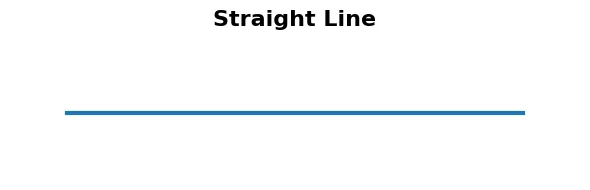
Straight Line
A straight line has no bends or curves. It goes from one point to another in the most direct way possible.
Examples: the edge of a ruler, the edge of a table, the lines on your notebook
Curved Line
A curved line bends and changes direction smoothly. You do not use a ruler to draw a curved line, your hand moves freely.
Examples: a rainbow, a slide at a playground, a river on a map
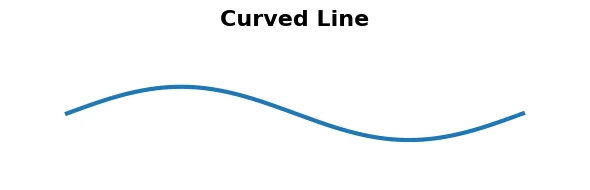
You can draw only one straight line between any two dots. But if you join the same two dots without a ruler, you can draw many different curved lines between them
How to draw a straight line with a ruler: Place your ruler so it touches both dots. Put your pencil on the first dot. Slide the pencil along the ruler until you reach the second dot. Lift the pencil, you have a perfect straight line.
Know more about related topics:
Types of Straight Lines
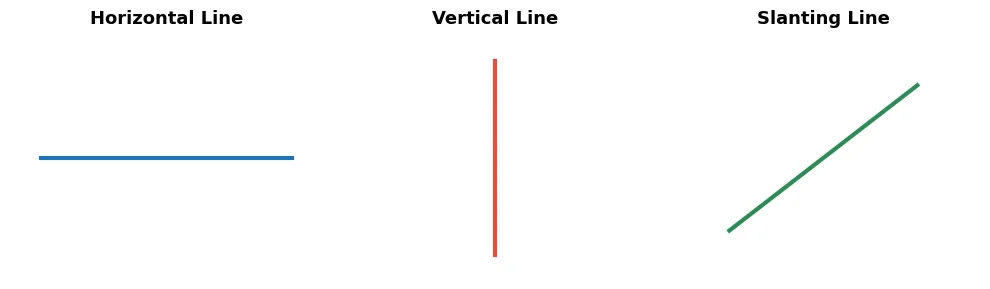
Not all straight lines look the same. Depending on their direction, straight lines are given different names.
-
Horizontal Line
A line that lies flat and goes left to right.
Real-life examples: edges of a table, lines on writing paper, the horizon
-
Vertical Line
A line that stands tall and goes straight up and down.
Real-life examples: door edges, legs of a chair, a flagpole
-
Slanting Line
A line that is neither sleeping nor standing, it leans at an angle.
Real-life examples: a ramp, a slide, a staircase from the side, zigzag designs
Plane Shapes (Flat Shapes)
Plane shapes (also called flat shapes or 2D shapes) are shapes that lie completely on a flat surface. They have length and width, but no height or thickness. You can draw plane shapes on paper.
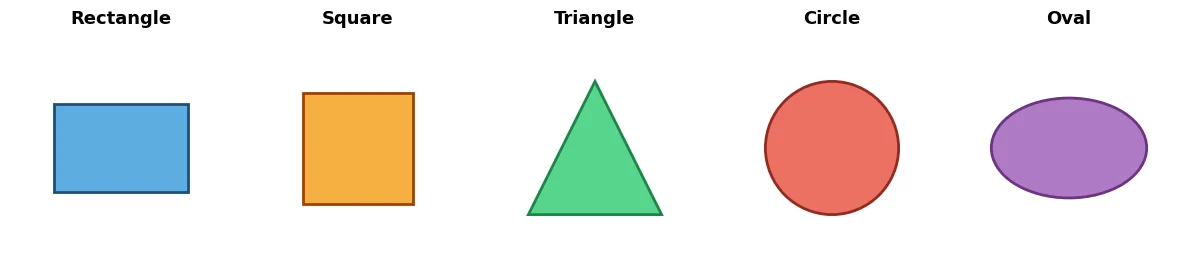
There are five important plane shapes. Let's get to know each one really well:
Rectangle
-
Has 4 sides and 4 corners
-
2 sides are long, 2 sides are short
-
Opposite sides are equal in length
-
Real-life: TV screen, mobile phone screen, sheet of paper, notebook, door, window, brick wall
Square
-
Has 4 sides and 4 corners
-
All 4 sides are equal in length
-
Looks the same on all sides
-
Real-life: Chessboard, bread slice, floor tile, window pane, a square biscuit
Triangle
-
Has 3 sides and 3 corners
-
Sides may or may not be equal
-
Looks like a pointed hat or a slice
-
Real-life: Traffic sign board, chips packet (front), bunting flags, a slice of pizza, a roof top
Circle
-
Has NO sides and NO corners
-
Made of only one curved line
-
Perfectly round from all directions
-
Real-life: Pizza, coin, button, wheel, sun, full moon, a bangle, the face of a clock
Oval
-
Has NO sides and NO corners
-
Like a circle that has been stretched
-
Looks like an egg shape
-
Real-life: Mirror, badminton racket face, an egg, a watermelon cross-section, a welcome mat
Square vs Rectangle: Alike Yet Different
A square is a very special rectangle where someone decided all four sides should be the same length. So every square is a rectangle, but not every rectangle is a square.
Circle vs Oval:
Both circles and ovals have no sides or corners, they are completely curved. But the difference is simple:
A circle is perfectly round. It looks the same from every direction. An oval is like a circle that has been gently stretched, it is longer in one direction than the other.
Solid Shapes (3D Shapes)
Solid shapes (also called 3D shapes or three-dimensional shapes) are shapes that are not flat. They occupy space. You can pick them up, hold them, and turn them around. Unlike plane shapes, solid shapes have length, width, and height.
Parts of a Solid Shape
Let's learn the three important parts that solid shapes have:
Now let's meet the five fundamental solid shapes
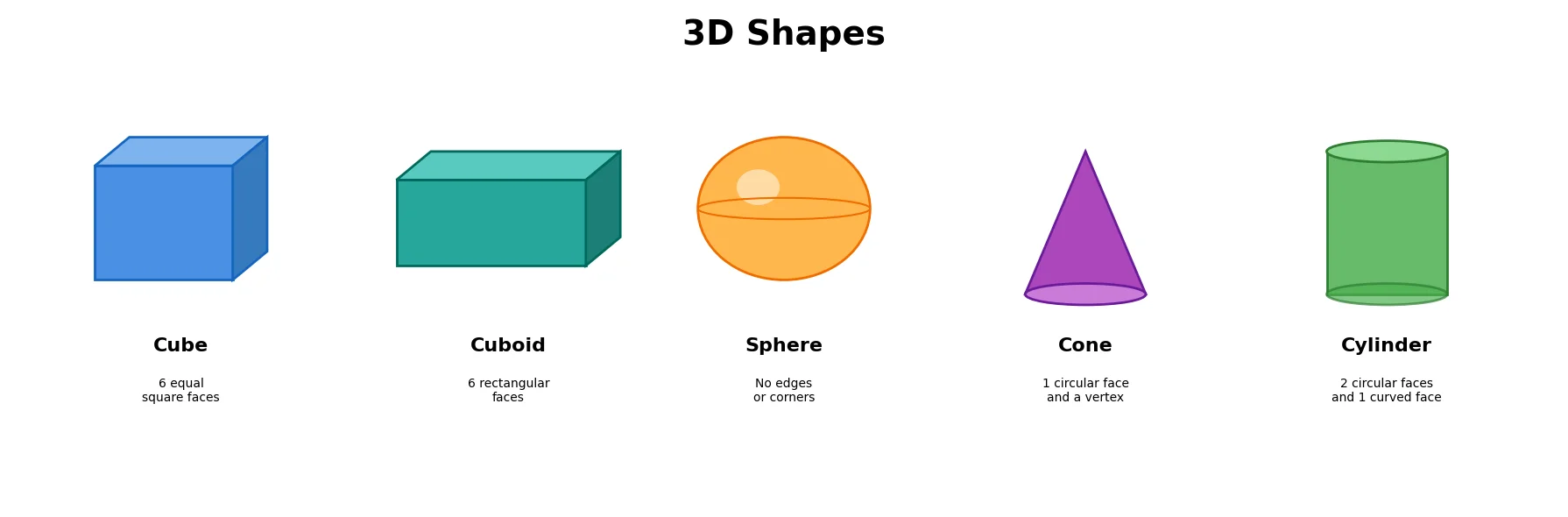
Cube
-
6 faces (all square)
-
12 edges (all equal length)
-
8 corners
-
Real-life: Dice, Rubik's cube, sugar cube, small gift box, some building blocks
Cuboid
-
6 faces (rectangular)
-
12 edges
-
8 corners
-
Opposite edges are equal
-
Real-life: Brick , books, matchbox, pencil box, a tiffin box, fridge, room
Cylinder
-
3 surfaces total
-
2 flat (circular) surfaces
-
1 curved surface
-
2 circular edges, no corners
-
Real-life: Battery, tin can, water bottle, drum, glass, a rolling pin, a candle
Cone
-
2 surfaces total
-
1 flat (circular) surface
-
1 curved surface
-
1 corner, 1 circular edge
-
Real-life: party cap, ice cream cone, funnel, traffic cone, birthday hat
Sphere
-
Only 1 curved surface
-
No edges, no corners
-
Perfectly round from all directions
-
Real-life: Ball, globe, marble, orange, soap bubble, a round ladoo
Plane vs Solid Shapes
Now that we know both types of shapes, let's see the differences between them:
Shapes That Roll and Slide
When you push a solid shape on a flat surface, it can do one of two things: roll or slide. And some shapes can do both.
Rolling:
Rolling is when a shape turns over and over as it moves. This happens with shapes that have a curved surface.
Example: Imagine a ball. You push it and it keeps spinning as it goes. That's rolling.
Sliding:
Sliding is when a shape moves smoothly along a surface without turning over. This happens with shapes that have a flat surface at the bottom.
Example: Push a book and it glides forward without spinning. That's sliding.
Slide Only
-
Cube
-
Cuboid
-
These have ONLY flat surfaces, so they slide but cannot roll.
Roll Only
-
Sphere
-
The sphere has ONLY a curved surface, no flat surface to rest on so it rolls but doesn't slide.
Roll and Slide
-
Cylinder
-
Cone
-
These have BOTH flat and curved surfaces so they can do both.
Frequently Asked Questions of Shapes for Class 2
1. What is the difference between a square and a rectangle?
A square and a rectangle both have 4 sides and 4 corners. The difference is that a square has all 4 sides equal, while a rectangle has only its opposite sides equal.
2. Which shapes roll and which shoes slide?
Shapes with curved surfaces, like circles, spheres, and cylinders, can roll. Shapes with flat surfaces, like squares, rectangles, and cubes, usually slide.
3. What is the face of a solid?
A face is a flat surface on a solid shape. For example, a cube has 6 flat faces, and each face is shaped like a square.
4. How many faces, edges and corners does a cube have?
A cube has 6 faces, 12 edges and 8 corners.
5. How many edges and faces does a sphere have?
A sphere has 0 edges and 0 flat faces. It has one curved surface all around.
Numbers make sense when they're taught right. To see how Orchids The International School turns Maths from intimidating to intuitive, reach out to our admissions team.


Admissions Open for 2026-27
What type of concept pages would you prefer?
CBSE Schools In Popular Cities
- CBSE Schools in Bangalore
- CBSE Schools in Mumbai
- CBSE Schools in Pune
- CBSE Schools in Hyderabad
- CBSE Schools in Chennai
- CBSE Schools in Gurgaon
- CBSE Schools in Kolkata
- CBSE Schools in Indore
- CBSE Schools in Sonipat
- CBSE Schools in Delhi
- CBSE Schools in Rohtak
- CBSE Schools in Bhopal
- CBSE Schools in Aurangabad
- CBSE Schools in Jabalpur
- CBSE Schools in Jaipur
- CBSE Schools in Jodhpur
- CBSE Schools in Nagpur
- CBSE Schools in Ahmednagar
- CBSE School In Tumkur











Orchids The International School is one of India's leading chains of CBSE and ICSE schools, with 130+ schools across the country.