

Class 9 Maths Chapter 2 ‘Introduction to Linear Polynomials’ Notes: Complete Guide for CBSE Board Exams
Class 9 Maths Chapter 2: Introduction to Linear Polynomials clear NCERT-aligned notes build a strong foundation in polynomials. This chapter explains what polynomials are, focuses on linear polynomials, and covers standard forms, coefficients, zeroes, and basic operations. In this guide you'll learn step-by-step methods to identify linear polynomials, write them in standard form, find their zeroes, and solve simple linear equations derived from polynomials all with CBSE-style worked examples and quick tips for exams. Ideal for Class 9 students preparing for board exams and unit tests, these concise notes include revision bullets, common mistakes to avoid, practice problems with solutions, and shortcut strategies to improve accuracy and speed.
Table of Contents
- Basics of Algebraic Expressions
- Differences between a Polynomial and a Non-Polynomial
- Degree of a Polynomial Explained
- Concept of Linear Polynomials in One Variable
- Evaluating a Linear Polynomial
- Identifying Linear Patterns
- Modeling Linear Growth and Decay with Polynomials
- Linear Relationships Between Two Variables
- Graphs of Linear Equations
- Frequently Asked Questions of Chapter 2: Introduction to Linear Polynomials Notes for Class 9

Basics of Algebraic Expressions
Definition:
An algebraic expression is a combination of constants, variables, and arithmetic operations (+, −, ×, ÷, powers).
For example, 2x² + 5xy − 3y² is an algebraic expression in variables x and y.
Key Terms:
-
Terms: A term is each individual part of an expression separated by addition or subtraction. In 2x² + 5xy − 3y², the three terms are 2x², 5xy, and −3y².
-
Coefficients: A coefficient is the number in front of the variable. In 2x², the coefficient is 2. In −3y², the coefficient is −3.
-
Variables: A variable (like x, y, z, t) is a letter that can take different values. In 3z + 7, the variable is z.
-
Constants: A constant is a fixed number. In 3z + 7, the constant is 7.
Know more about related topics:
- Class 9 Maths Mcqs Chapter 2 Introduction To Linear Polynomials
- Class 9 Maths Case Study Chapter 2 Introduction To Linear Polynomials
- Important Questions Class 9 Maths Introduction To Linear Polynomials
- Assertion Reason Questions For Class 9 Maths Chapter 2 Introduction To Linear Polynomials
- Class 9 Maths Chapter 2 Polynomials In One Variable
Differences between a Polynomial and a Non-Polynomial
Not every algebraic expression is a polynomial.
A polynomial in one variable (also called a univariate polynomial) is an algebraic expression involving only one variable, where all powers of that variable are non-negative integers (0, 1, 2, 3, …). There are no variables in denominators and no variables under square roots.
Degree of a Polynomial Explained
Definition:
The degree of a polynomial is the highest power of the variable present in the expression.
For example, in x² + 5x + 3, the highest power is 2, so the degree is 2.
Classification of Polynomails by Degree
Concept of Linear Polynomials in One Variable
A linear polynomial is a polynomial of degree 1.
General Form of a Linear Polynomial:
p(x) = ax + b
where a ≠ 0 (a is any non-zero real number), and b is any real number (the constant term). The variable can be x, y, z, t or any letter.
Examples of Linear Polynomials
Why Must a ≠ 0?
If a were 0, the expression ax + b would reduce to just b a constant with no variable. A constant has degree 0, not degree 1. So the condition a ≠ 0 is what keeps a linear polynomial ‘linear’ (degree 1).
Evaluating a Linear Polynomial
To evaluate a polynomial means to find its value at a specific number.
Step-by-Step Process
-
Write down the polynomial.
-
Replace every occurrence of the variable with the given value.
-
Apply order of operations: multiplication and division before addition and subtraction.
-
Simplify to get a single number.
Example: Evaluate p(x) = 5x - 3
Solution: Find the value of p(x) = 5x − 3 at x = 0, x = −1, and x = 2.
p(0) = 5(0) − 3 = 0 − 3 = −3
p(−1) = 5(−1) − 3 = −5 − 3 = −8
p(2) = 5(2) − 3 = 10 − 3 = 7
When you set a linear polynomial equal to a specific value, you get a linear equation
Example: A bookshop sells notebooks for ₹15 each and adds a ₹30 packaging charge per order. Priya spent ₹165 in total. How many notebooks did she buy?
Solution: Let n = number of notebooks
Total cost = 15n + 30
Equation: 15n + 30 = 165
15n = 165 − 30 = 135
n = 135 ÷ 15 = 9
Priya bought 9 notebooks.
Identifying Linear Patterns
Definition:
A linear pattern is a sequence in which the difference between any two consecutive terms is always the same. This fixed difference is called the common difference. The general (nth) term of a linear pattern is always a linear polynomial in n.
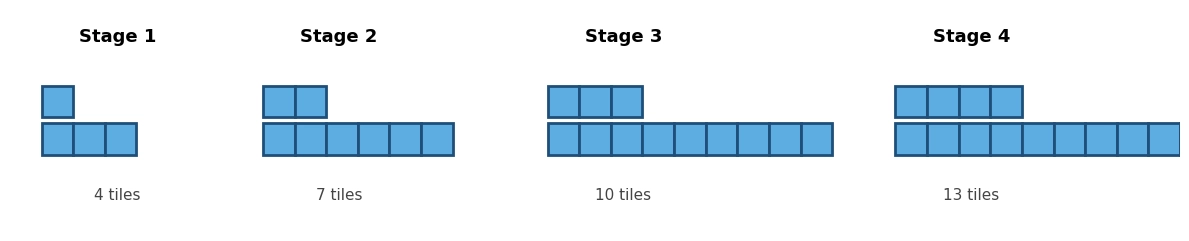
Example: Triangular tiles are arranged in stages.
-
How many tiles at Stage 20?
-
Which stage has 61 tiles?
Solution: Stage 1: 4 tiles Stage 2: 7 tiles Stage 3: 10 tiles Stage 4: 13 tiles
The common difference: 7 − 4 = 3, 10 − 7 = 3, 13 − 10 = 3.
Common difference = 3.
nth term = first term + (n − 1) × common difference = 4 + (n − 1) × 3 = 4 + 3n − 3 = 3n + 1
-
Number of tiles at Stage 20 = 3(20) + 1 = 61 tiles.
-
Which stage has 61 tiles?
3n + 1 = 61 → 3n = 60 → n = 20
Modeling Linear Growth and Decay with Polynomials
Linear Growth
Occurs when a quantity increases by a fixed amount at each step. The common difference is positive. The graph slopes upward.
Example: A water tank starts with 300 litres and water is pumped in at 150 litres per hour. The amount of water W (in litres) after t hours:
W(t) = 300 + 150t
Each hour the water increases by exactly 150 litres: a constant increase. This is linear growth.
Linear Decay
Occurs when a quantity decreases by a fixed amount at each step. The common difference is negative. The graph slopes downward.
Example: A candle is 30 cm tall when lit. It burns at 2 cm per hour. The height h (in cm) after t hours:
h(t) = 30 − 2t
Each hour the height decreases by exactly 2 cm: a constant decrease. This is linear decay.
Linear Relationships Between Two Variables
Linear Equation in Two Variables
ax + by = c
Here, x and y are two different variables, and a, b, c are constants.
Example: A cyclist travels at a constant speed of 15 km/h. The distance d (in km) covered in t hours is:
d = 15t
Here, for every 1 hour increase in t, d increases by exactly 15 km. This is a linear relationship between d and t. If you fix d and solve for t, you get a linear equation.
Graphs of Linear Equations
Every linear polynomial, when graphed, gives a perfectly straight line.
How to Plot the Graph of a Linear Polynomial
-
Choose at least 2 values for x. Using x = 0 and x = 1 is usually the easiest start.
-
Substitute each x value into the polynomial to find y.
-
Write these as ordered pairs (x, y).
-
Plot the points on a coordinate plane.
-
Draw a straight line through all three points. If they don't line up, re-check your calculations.
Example 1: Find 3 coordinate pairs for y = 3x + 1
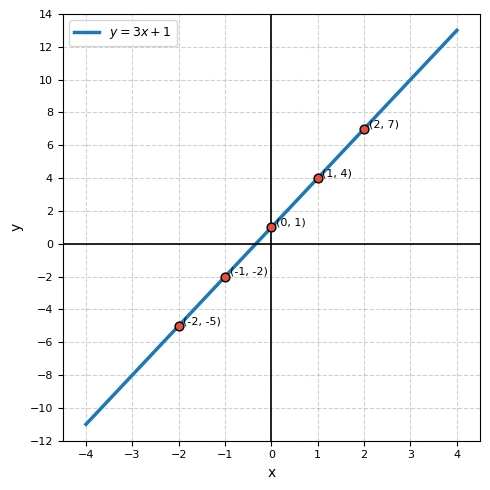
x = 0: y = 3(0) + 1 = 1 → Point: (0, 1)
x = -1: y = 3(-1) + 1 = -2 → Point: (-1, -2)
x = 1: y = 3(1) + 1 = 4 → Point: (1, 4)
The Slope: How Steep Is the Line?
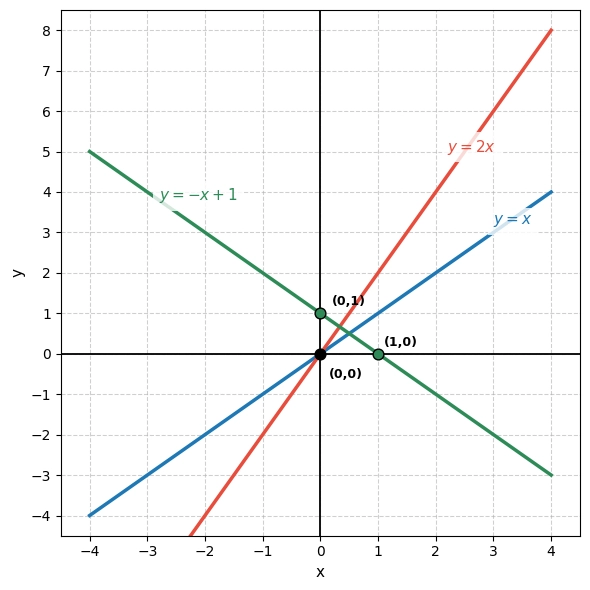
The coefficient a in y = ax + b tells you the slope (steepness) of the line:
-
If a > 0 (positive), the line slopes upward from left to right (linear growth)
-
If a < 0 (negative), the line slopes downward from left to right (linear decay)
-
The larger the value of |a|, the steeper the line
-
The constant b is the y-intercept: the point where the line crosses the y-axis (at x = 0)
Example: Compare y = x, y = 2x and y = −x + 1.
Click below to download your free Class 9 Chapter 2: Introduction to Linear Polynomials PDF Notes perfect for last-minute CBSE board exam revision.
Download PDF - Class 9 Chapter 2: Introduction to Linear Polynomials Notes
Frequently Asked Questions of Chapter 2: Introduction to Linear Polynomials Notes for Class 9
1. What is the difference between a polynomial and an algebraic expression?
A polynomial specifically requires that all powers of the variable are non-negative integers (0, 1, 2, 3, ...). Expressions like 1/x + 3 or √x + 2 are algebraic expressions but NOT polynomials.
2. What is the general term of a linear pattern?
The general (nth) term of a linear pattern is given by: Tₙ = a + (n−1)d, where a is the first term and d is the common difference.
3. Why does the graph of a linear polynomial always form a straight line?
Because the rate of change is constant. This constant rate of change means the points (x, y) are always equally spaced vertically for equal horizontal spacing, which geometrically defines a straight line.
4. Is a constant polynomial like 8 a linear polynomial?
No. A constant polynomial like 8 has degree 0, not degree 1.
5. Is √2x-1 a polynomial?
Yes. √2x-1 is a polynomial. It is a linear polynomial because the highest power of x is 1.
Numbers make sense when they're taught right. To see how Orchids The International School turns Maths from intimidating to intuitive, reach out to our admissions team.


Admissions Open for 2026-27
What type of concept pages would you prefer?
CBSE Schools In Popular Cities
- CBSE Schools in Bangalore
- CBSE Schools in Mumbai
- CBSE Schools in Pune
- CBSE Schools in Hyderabad
- CBSE Schools in Chennai
- CBSE Schools in Gurgaon
- CBSE Schools in Kolkata
- CBSE Schools in Indore
- CBSE Schools in Sonipat
- CBSE Schools in Delhi
- CBSE Schools in Rohtak
- CBSE Schools in Bhopal
- CBSE Schools in Aurangabad
- CBSE Schools in Jabalpur
- CBSE Schools in Jaipur
- CBSE Schools in Jodhpur
- CBSE Schools in Nagpur
- CBSE Schools in Ahmednagar
- CBSE School In Tumkur











Orchids The International School is one of India's leading chains of CBSE and ICSE schools, with 130+ schools across the country.