

Table of 177
The Table of 177 shows the results formed when 177 is multiplied by different whole numbers. This section helps learners understand how the value increases in fixed steps and supports them while working with bigger multiplication tasks. A Table of 177 PDF is also provided so students can review the multiples whenever they want.
Table of 177 Chart
The Table of 177 chart shows the results of multiplying 177 by numbers in sequence. It helps students observe how the value grows with each multiplication and makes revision easier.
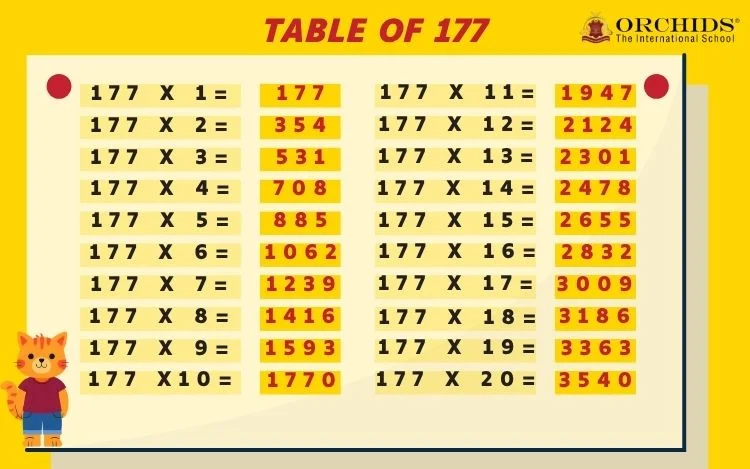

Multiplication Table of 177
The multiplication table of 177 lists all the products created when 177 is multiplied by whole numbers. It helps students notice the gradual increase in values and supports them while working with bigger numerical problems.
| Multiplicand | Operation | Multiplier | Result | |
| 177 | x | 1 | = | 177 |
| 177 | x | 2 | = | 354 |
| 177 | x | 3 | = | 531 |
| 177 | x | 4 | = | 708 |
| 177 | x | 5 | = | 885 |
| 177 | x | 6 | = | 1062 |
| 177 | x | 7 | = | 1239 |
| 177 | x | 8 | = | 1416 |
| 177 | x | 9 | = | 1593 |
| 177 | x | 10 | = | 1770 |
| 177 | x | 11 | = | 1947 |
| 177 | x | 12 | = | 2124 |
| 177 | x | 13 | = | 2301 |
| 177 | x | 14 | = | 2478 |
| 177 | x | 15 | = | 2655 |
| 177 | x | 16 | = | 2832 |
| 177 | x | 17 | = | 3009 |
| 177 | x | 18 | = | 3186 |
| 177 | x | 19 | = | 3363 |
| 177 | x | 20 | = | 3540 |
Download the Table of 177 PDF to see all the multiplication answers in one place and review them whenever needed.
Know more about related topics:
Download PDF - Table of 177
How do you read the multiplication table of 177?
You can read the table of 177 by following the sequence of results in order. Each line shows how multiplying 177 by a new number changes the total, making the pattern easy to understand.
177 times 1 equals 177
177 times 2 equals 354
177 times 3 equals 531
177 times 4 equals 708
177 times 5 equals 885
177 times 6 equals 1062
177 times 7 equals 1239
177 times 8 equals 1416
177 times 9 equals 1593
177 times 10 equals 1770
177 times 11 equals 1947
177 times 12 equals 2124
177 times 13 equals 2301
177 times 14 equals 2478
177 times 15 equals 2655
177 times 16 equals 2832
177 times 17 equals 3009
177 times 18 equals 3186
177 times 19 equals 3363
177 times 20 equals 3540
Table of 177 in Words
The Table of 177 in Words writes every multiplication result as a full sentence. This method helps students clearly track how 177 moves from one multiple to the next and supports smooth learning of the table.
One hundred seventy-seven times one equals one hundred seventy-seven
One hundred seventy-seven times two equals three hundred fifty-four
One hundred seventy-seven times three equals five hundred thirty-one
One hundred seventy-seven times four equals seven hundred eight
One hundred seventy-seven times five equals eight hundred eighty-five
One hundred seventy-seven times six equals one thousand sixty-two
One hundred seventy-seven times seven equals one thousand two hundred thirty-nine
One hundred seventy-seven times eight equals one thousand four hundred sixteen
One hundred seventy-seven times nine equals one thousand five hundred ninety-three
One hundred seventy-seven times ten equals one thousand seven hundred seventy
One hundred seventy-seven times eleven equals one thousand nine hundred forty-seven
One hundred seventy-seven times twelve equals two thousand one hundred twenty-four
One hundred seventy-seven times thirteen equals two thousand three hundred one
One hundred seventy-seven times fourteen equals two thousand four hundred seventy-eight
One hundred seventy-seven times fifteen equals two thousand six hundred fifty-five
One hundred seventy-seven times sixteen equals two thousand eight hundred thirty-two
One hundred seventy-seven times seventeen equals three thousand nine
One hundred seventy-seven times eighteen equals three thousand one hundred eighty-six
One hundred seventy-seven times nineteen equals three thousand three hundred sixty-three
One hundred seventy-seven times twenty equals three thousand five hundred forty
Table of 177 Using Repeated Addition
You can explore the Table of 177 by adding 177 over and over. Begin with 177 once, then add another 177 to extend the sequence, making it easier to track how the multiples rise in a steady pattern.
|
Multiplication |
Repeated Addition |
Result |
|
177 × 1 |
177 |
177 |
|
177 × 2 |
177 + 177 |
354 |
|
177 × 3 |
177 + 177 + 177 |
531 |
|
177 × 4 |
177 + 177 + 177 + 177 |
708 |
|
177 × 5 |
177 + 177 + 177 + 177 + 177 |
885 |
|
177 × 6 |
177 + 177 + 177 + 177 + 177 + 177 |
1062 |
|
177 × 7 |
177 + 177 + 177 + 177 + 177 + 177 + 177 |
1239 |
|
177 × 8 |
177 + 177 + 177 + 177 + 177 + 177 + 177 + 177 |
1416 |
|
177 × 9 |
177 + 177 + 177 + 177 + 177 + 177 + 177 + 177 + 177 |
1593 |
|
177 × 10 |
177 + 177 + 177 + 177 + 177 + 177 + 177 + 177 + 177 + 177 |
1770 |
Solved Examples on the Table of 177
1. A library receives 177 new books every week. How many books in 8 weeks?
Multiply weekly delivery by 8.
177 × 8 = 1416
Answer: 1416 books
2. A factory produces 177 toys daily. How many toys are made in 10 days?
Multiply daily production by 10.
177 × 10 = 1770
Answer: 1770 toys
3. A classroom has 177 students. How many students are there in 7 such classrooms?
Multiply students per classroom by 7.
177 × 7 = 1239
Answer: 1239 students
4. A bakery bakes 177 cakes each day. How many cakes are baked in 15 days?
Multiply daily cakes by 15.
177 × 15 = 2655
Answer: 2655 cakes
5. A warehouse stores 177 boxes in each row. How many boxes are there in 20 rows?
Multiply boxes per row by 20.
177 × 20 = 3540
Answer: 3540 boxes
Learn More Multiplication Tables
Numbers make sense when they're taught right. To see how Orchids The International School turns Maths from intimidating to intuitive, reach out to our admissions team.
Frequently Asked Questions on Table of 177
1. What is the purpose of the table of 177?
It helps learners see all the results of multiplying 177 by natural numbers, making it easier to work with larger numbers.
2. How do I find the multiples of 177?
Start from 177 and keep adding 177 repeatedly: 177, 354, 531… Each step shows the next multiple clearly.
3. How is the table of 177 used in real-life situations?
It can be used to find totals in repeated quantities like daily sales, batches of products, or seats in multiple rows.
4. Does the table of 177 follow a pattern
Yes, each successive number increases by 177. This predictable pattern simplifies calculations of higher multiples.
5. What method helps memorise the table of 177?
Practise in small groups, use repeated addition, and gradually increase the multiplier to memorise all multiples confidently
Related Links


Admissions Open for 2026-27
What type of concept pages would you prefer?
CBSE Schools In Popular Cities
- CBSE Schools in Bangalore
- CBSE Schools in Mumbai
- CBSE Schools in Pune
- CBSE Schools in Hyderabad
- CBSE Schools in Chennai
- CBSE Schools in Gurgaon
- CBSE Schools in Kolkata
- CBSE Schools in Indore
- CBSE Schools in Sonipat
- CBSE Schools in Delhi
- CBSE Schools in Rohtak
- CBSE Schools in Bhopal
- CBSE Schools in Aurangabad
- CBSE Schools in Jabalpur
- CBSE Schools in Jaipur
- CBSE Schools in Jodhpur
- CBSE Schools in Nagpur
- CBSE Schools in Ahmednagar
- CBSE School In Tumkur











Orchids The International School is one of India's leading chains of CBSE and ICSE schools, with 110+ schools across the country.