

Case Study on Chapter 2: ‘Introduction to Linear Polynomials’ for Class 9 Maths
Case Study set for Class 9 Maths Chapter 2: Introduction to Linear Polynomials presents short, focused problem scenarios with clear answers and step‑by‑step solutions to build exam‑ready skills. Covering topics such as identifying polynomials, degree and coefficients, forming linear polynomial expressions from word problems, verifying linearity, solving simple linear equations, and applying algebraic identities, these questions help students strengthen conceptual understanding, practise algebraic manipulation, and improve speed and accuracy for board exams. A free PDF is included for offline timed practice, classroom worksheets, and homework, making this guide ideal for quick revision and targeted skill building before tests.
Know more about related topics:
- Class 9 Maths Mcqs Chapter 2 Introduction To Linear Polynomials
- Class 9 Maths Notes Chapter 2 Introduction To Linear Polynomials
- Important Questions Class 9 Maths Introduction To Linear Polynomials
- Class 9 Maths Case Study Chapter 1 Orienting Yourself The Use Of Coordinates
- Assertion Reason Questions For Class 9 Maths Chapter 2 Introduction To Linear Polynomials
Case Study on Chapter 2: Introduction to Linear Polynomials for Class 9 With Answers
CBSE's case-based questions usually give you a short passage describing a real situation, sometimes with a small figure, followed by 4–5 questions of increasing difficulty, a couple of MCQs to check basic understanding, a short-answer question that needs a calculation, and a longer question that asks you to interpret or justify your answer.
Case Study 1: The School Fete Stall
Aarav and his classmates run a stall at the school's annual fete. They sell handmade greeting cards for ₹15 each and friendship bracelets for ₹8 each. On top of whatever they sell, Aarav adds a flat ₹20 of his own pocket money to the charity box every single day. If ‘p’ cards and ‘q’ bracelets are sold on a given day, the day's total contribution to the charity box can be written as 15p + 8q + 20.
Questions:
(i) Write down the terms of the expression 15p + 8q + 20.
(ii) What are the coefficients of p and q?
(iii) What is the constant term here, and what does it represent in real life?
(iv) If 6 cards and 4 bracelets are sold on a particular day, find the total contribution to the charity box.
OR
Is 15p + 8q + 20 a linear polynomial in two variables? Give a reason for your answer.
Solution:
(i) The terms are 15p, 8q and 20.
(ii) Coefficient of p = 15; coefficient of q = 8.
(iii) The constant term is 20. It represents the flat ₹20 Aarav contributes every day regardless of how many cards or bracelets are sold.
(iv) Substituting p = 6, q = 4: 15(6) + 8(4) + 20 = 90 + 32 + 20 = ₹142.
OR: Yes, every term has degree at most 1 (no variable is raised above the power 1), so 15p + 8q + 20 is a linear polynomial in the two variables p and q.
Case Study 2: Karan's E-Scooter (Linear Decay)
Karan buys a second-hand e-scooter for ₹54,000. Because of regular usage and battery wear, its resale value falls by a constant ₹4,500 every year.
Questions:
(i) Write a linear expression for the resale value V (in ₹) after n years.
(ii) Find the resale value after 3 years.
(iii) Why does this situation represent linear decay rather than linear growth?
(iv) After how many complete years will the resale value first drop below ₹18,000?
OR
Will the graph of V against n rise or fall, and why?
Solution:
(i) V = 54000 − 4500n
(ii) V(3) = 54000 − 4500(3) = 54000 − 13500 = ₹40,500.
(iii) The value decreases by a fixed amount every year, and the coefficient of n is negative (−4500); this is exactly what defines linear decay.
(iv) 54000 − 4500n < 18000 ⇒ 36000 < 4500n ⇒ n > 8. At n = 8 the value is exactly ₹18,000, so it first drops below ₹18,000 after 9 complete years.
OR: 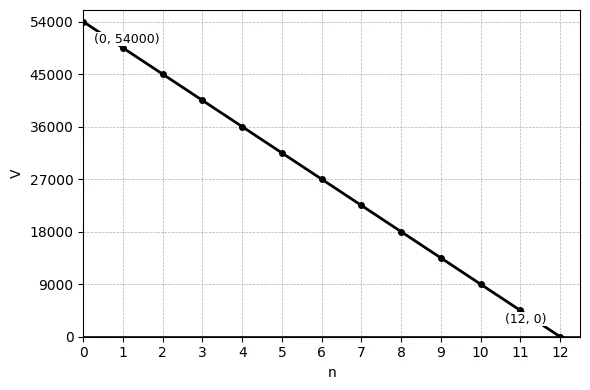
The graph will fall (slope downward from left to right), because the coefficient of n is negative. A negative slope always produces a falling line.
Case Study 3: Reading a Graph of Three Lines
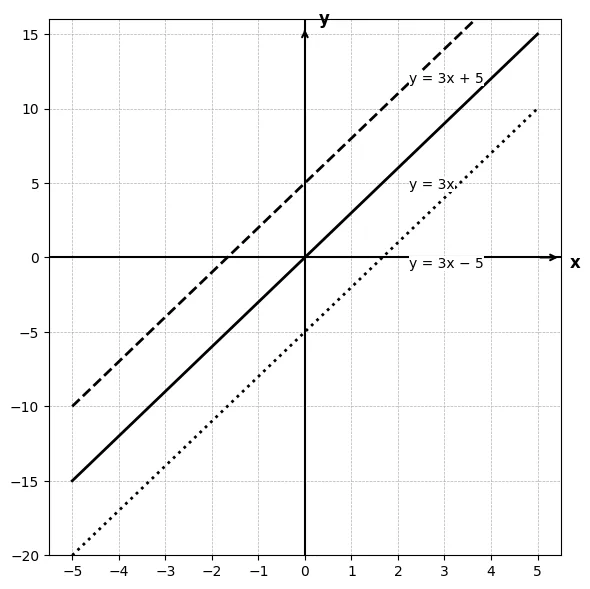
Three linear relationships, y = 3x, y = 3x + 5 and y = 3x − 5, are plotted on the same coordinate grid below.
Questions:
(i) Identify the y-intercept of each of the three lines.
(ii) What do you notice about the slope of all three lines? What does this tell you about how they're positioned relative to one another?
(iii) Which line crosses the y-axis at the highest point, and why?
(iv) If a fourth line, y = −3x + 5, were added to this graph, would it be parallel to the others? Justify.
OR
At what point does the line y = 3x cross the y-axis?
Solution:
(i) Substituting x = 0 in each: y = 3x → 0; y = 3x + 5 → 5; y = 3x − 5 → −5.
The y-intercept of each of the three lines are 0,5 and -5 respectively.
(ii) All three lines have the same slope, a = 3. Equal slopes mean the lines are parallel. They're equally steep, just shifted up or down by different amounts.
(iii) y = 3x + 5 crosses highest, at (0, 5), because it has the largest value of b among the three.
(iv) No. Its slope is −3, which is different in sign from the slope 3 shared by the other three lines. Lines are parallel only when their slopes are exactly equal, same magnitude isn't enough if the sign differs.
OR: y = 3x crosses the y-axis at the origin, (0, 0), since its constant term b is 0.

Download Free PDF - Case Study: Class 9 Chapter 2 - Introduction to Linear Polynomials
Download PDF - Class 9 Chapter 2: Introduction to Linear Polynomials Case Study
Frequently Asked Questions of Chapter 2: Introduction to Linear Polynomials Case Study for Class 9
1. What exactly is a case-based or case-study question in CBSE Class 9 Maths?
A case-based question gives you a short real-life passage and then asks three or four connected sub-questions about it. Instead of testing a formula in isolation, it checks whether you can read a situation, translate it into a linear polynomial or linear relationship, and then use that relationship to answer practical questions.
2. What is the difference between a linear polynomial and a linear equation?
A linear polynomial, like 3x + 5, is just an expression that has no equals sign and no fixed value on its own. A linear equation, like 3x + 5 = 20, takes that expression and sets it equal to something, which then lets you solve for a specific value of x.
3. What is the general form of a linear polynomial?
A linear polynomial in one variable is written as ax + b, where a and b are real numbers and a ≠ 0.
4. How do you tell whether a real-life situation shows linear growth or linear decay?
Write the situation as y = ax + b and look only at the sign of a. If a is positive, the quantity increases by the same fixed amount every step, which is linear growth. If a is negative, it decreases by a fixed amount every step, which is linear decay.
5. What does the constant b represent in y = ax + b?
b is the y-intercept: he value y takes when x is zero.
Numbers make sense when they're taught right. To see how Orchids The International School turns Maths from intimidating to intuitive, reach out to our admissions team.


Admissions Open for 2026-27
What type of concept pages would you prefer?
CBSE Schools In Popular Cities
- CBSE Schools in Bangalore
- CBSE Schools in Mumbai
- CBSE Schools in Pune
- CBSE Schools in Hyderabad
- CBSE Schools in Chennai
- CBSE Schools in Gurgaon
- CBSE Schools in Kolkata
- CBSE Schools in Indore
- CBSE Schools in Sonipat
- CBSE Schools in Delhi
- CBSE Schools in Rohtak
- CBSE Schools in Bhopal
- CBSE Schools in Aurangabad
- CBSE Schools in Jabalpur
- CBSE Schools in Jaipur
- CBSE Schools in Jodhpur
- CBSE Schools in Nagpur
- CBSE Schools in Ahmednagar
- CBSE School In Tumkur











Orchids The International School is one of India's leading chains of CBSE and ICSE schools, with 130+ schools across the country.