

Case Study on Chapter 1 ‘Orienting Yourself - The Use of Coordinates’ for Class 9 Maths
The case study set for Class 9 Maths Chapter 1: Orienting Yourself - Use of Coordinates provides focused short problem scenarios with answers and step‑by‑step solutions to build exam‑ready skills. Covering the Cartesian plane, plotting points, abscissa and ordinate, quadrant sign patterns, and distances between points, these questions help students reinforce core concepts, practise formula application, and improve speed and accuracy for board exams. This guide work through fully solved case studies based directly on the situations and figures used in this chapter. A free PDF is included for offline practice, making it ideal for timed revision, classroom worksheets, and homework.
Case Study on Chapter 1: Orienting Yourself - The Use of Coordinates for Class 9 With Answers
CBSE's case-based questions usually give you a short passage describing a real situation, sometimes with a small figure or a set of coordinates, followed by 4–5 questions of increasing difficulty, a couple of MCQs to check basic understanding, a short-answer question that needs a calculation, and a longer question that asks you to interpret or justify your answer.

Case Study 1: Shalini Maps the New Neighbourhood
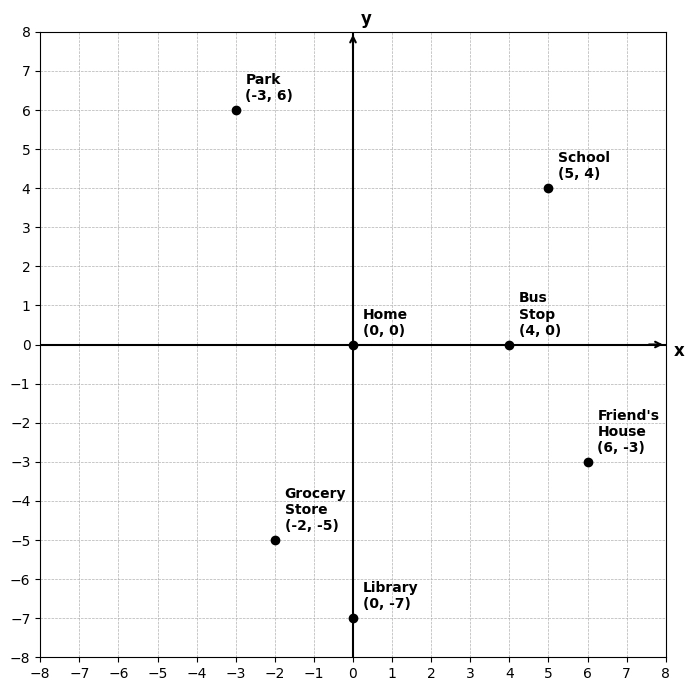
Shalini decides to make a simple map of the neighbourhood for Reiaan, with their home at the origin O(0, 0). On this map, the school is at (5, 4), the park is at (–3, 6), the grocery store is at (–2, –5), Reiaan's new friend's house is at (6, –3), the bus stop on the main east-west road is at (4, 0), and the community library on the main north-south road is at (0, –7).
Questions:
(i) In which quadrant does the park lie?
(a) I (b) II (c) III (d) IV
(ii) The bus stop, at (4, 0), lies on:
(a) the x-axis (b) the y-axis (c) the origin (d) Quadrant I(iii) Reiaan's friend's house is at (6, –3).
Identify its quadrant, and explain in words what the sign of each coordinate tells you about its direction from home.
(iv) A new ice-cream shop is to be placed so that it has the same y-coordinate as the park, but lies in Quadrant I. Suggest one possible pair of coordinates for the shop, and justify your choice.
(v) Shalini says, ‘If I swap the coordinates of the school, (5, 4), to get (4, 5), it would still be the same point.’ Is she correct? Use the chapter's idea about (x, y) and (y, x) to explain your answer.
Solutions:
(i) The park is at (–3, 6): x is negative, y is positive, so it lies in Quadrant II. Correct option: (b).
(ii) The point (4, 0) has a y-coordinate of 0, so it lies on the x-axis. Correct option: (a).
(iii) The friend's house, (6, –3), has x > 0 and y < 0, so it lies in Quadrant IV. The positive x-coordinate means the house is 6 units to the east (right) of home, and the negative y-coordinate means it is 3 units to the south (below) of home.
(iv) The park's y-coordinate is 6. For Quadrant I, we need both coordinates positive, so any point of the form (positive number, 6) works for example, (2, 6). This places the shop in Quadrant I (since 2 > 0 and 6 > 0) while keeping it in line with the park.
(v) Shalini is not correct. As the chapter explains, (x, y) is the same point as (y, x) only when x = y. Here, the school's coordinates are (5, 4), and 5 ≠ 4, so (5, 4) and (4, 5) represent two different locations. Swapping the coordinates would actually move the school to a different spot on the map.
Know more about related topics:
- Class 9 Maths Mcqs Chapter 1 Orienting Yourself The Use Of Coordinates
- Class 9 Maths Notes Chapter 1 Orienting Yourself The Use Of Coordinates
- Class 9 Maths Chapter 3 Coordinate Geometry
- Important Questions Class 9 Maths Orienting Yourself The Use Of Coordinates
- Class 9 Maths Case Study Chapter 2 Introduction To Linear Polynomials
Case Study 2: Triangle ADM and the Distance Formula
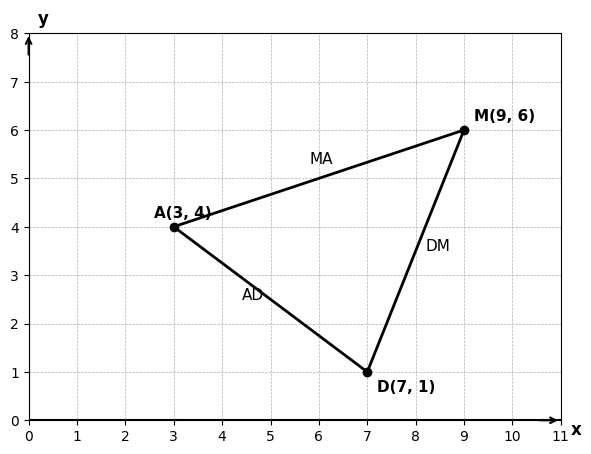
While studying distances, Shalini plots three points on graph paper to form a triangle: A(3, 4), D(7, 1), and M(9, 6). All three points lie in the first quadrant. She wants to find the lengths of all three sides AD, DM, and MA and figure out what kind of triangle ADM is.
Questions:
(i) The horizontal distance covered while moving from A(3, 4) to D(7, 1) is:
(a) 3 units (b) 4 units (c) 5 units (d) 7 units
(ii) Using the distance formula, find the length of AD.
(iii) Find the lengths of DM and MA. (Leave your answers in surd form where needed.)
(iv) Based on the three side lengths, is triangle ADM (a) equilateral, (b) isosceles, or (c) scalene? Give a reason.
(v) A triangle is acute-angled if the square of its longest side is less than the sum of the squares of the other two sides. Use this rule to confirm that triangle ADM is acute-angled.
Solutions
(i) Horizontal distance = difference of x-coordinates = |7 – 3| = 4 units. Correct option: (b).
(ii) Using the distance formula:
AD = √[(7 – 3)² + (1 – 4)²] = √[4² + (–3)²] = √(16 + 9) = √25 = 5 units
(iii) DM = √[(9 – 7)² + (6 – 1)²] = √[2² + 5²] = √(4 + 25) = √29 units (≈ 5.39 units)
MA = √[(9 – 3)² + (6 – 4)²] = √[6² + 2²] = √(36 + 4) = √40 = 2√10 units (≈ 6.32 units)
(iv) All three sides 5, √29, and √40 are of different lengths, so triangle ADM is scalene (option c). None of the sides are equal, and none of the angles need to be equal either.
(v) The longest side is MA = √40, so MA² = 40. The other two sides squared are AD² = 25 and DM² = 29, and their sum is 25 + 29 = 54. Since 40 < 54, the square of the longest side is less than the sum of the squares of the other two. So triangle ADM is acute-angled.
Case Study 3: Designing a Game Screen
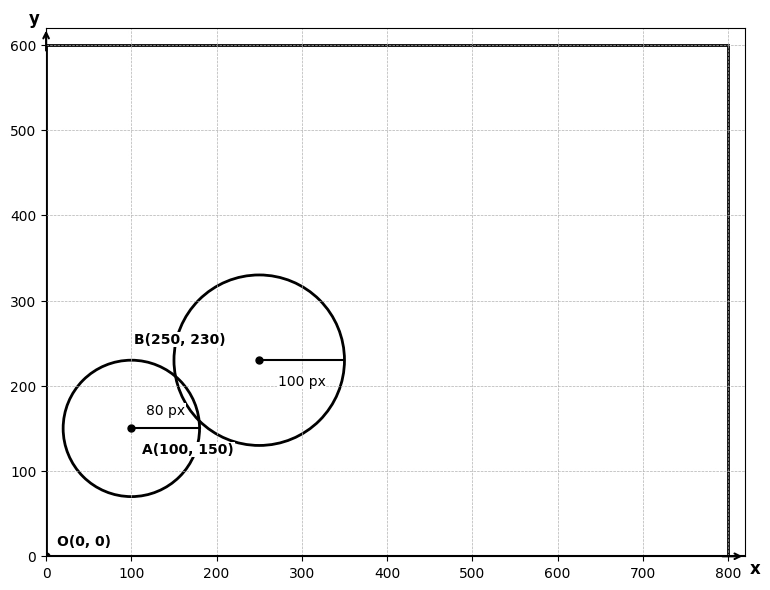
A student is designing a simple mobile game. The screen is a rectangle 800 pixels wide and 600 pixels high, with the origin (0, 0) placed at the bottom-left corner of the screen, a common convention in computer graphics. The game has two circular icons: Icon A, with radius 80 pixels, centred at A(100, 150), and Icon B, with radius 100 pixels, centred at B(250, 230).
Questions:
(i) On this screen, the point (800, 600) represents:
(a) the bottom-left corner (b) the top-left corner (c) the bottom-right corner (d) the top-right corner
(ii) Check whether Icon A lies completely within the screen, by examining its leftmost, rightmost, topmost, and bottommost points.
(iii) Check whether Icon B also lies completely within the screen.
(iv) Find the distance between the centres A and B.
(v) Using your answer to (iv) and the radii of the two icons, determine whether Icon A and Icon B overlap (intersect).
Solutions
(i) Since the origin is at the bottom-left, increasing x moves right and increasing y moves up. The point (800, 600) is therefore at the far right and the top: the top-right corner. Correct option: (d).
(ii) Icon A has centre (100, 150) and radius 80. Its extreme points are:
Left: 100 – 80 = 20 (≥ 0 )
Right: 100 + 80 = 180 (≤ 800 )
Bottom: 150 – 80 = 70 (≥ 0 )
Top: 150 + 80 = 230 (≤ 600 )
All four extreme values stay within the screen's range, so Icon A lies completely inside the screen.
(iii) Icon B has centre (250, 230) and radius 100. Its extreme points are:
Left: 250 – 100 = 150 (≥ 0 )
Right: 250 + 100 = 350 (≤ 800 )
Bottom: 230 – 100 = 130 (≥ 0 )
Top: 230 + 100 = 330 (≤ 600 )
These also stay within range, so Icon B lies completely inside the screen too.
(iv) Using the distance formula:
AB = √[(250 – 100)² + (230 – 150)²] = √[150² + 80²]
= √(22500 + 6400) = √28900 = 170 pixels
(v) The sum of the radii is 80 + 100 = 180, and the difference of the radii is |100 – 80| = 20.
The distance between centres, 170, satisfies 20 < 170 < 180, i.e., the distance is less than the sum of the radii but more than the difference. This means the two icons overlap (intersect at two points) without either one fully containing the other.
Download Free PDF - Case Study: Class 9 Chapter 1 - Orienting Yourself - The Use of Coordinates
Download PDF - Class 9 Chapter 1: ‘Orienting Yourself - The Use of Coordinates’ Case Study
Frequently Asked Questions of Case Study on Chapter 1: Orienting Yourself - The Use of Coordinates for Class 9
1. What is the distance formula?
The distance between two points (x₁, y₁) and (x₂, y₂) is √[(x₂ – x₁)² + (y₂ – y₁)²].
2. Are case study questions important for the Class 9 Maths exam?
Yes. CBSE has been steadily increasing the weight given to competency-based and case-study questions across subjectsand coordinate geometry, being inherently visual and situational, is one of the chapters where these questions appear most naturally.
3. How many marks are case-study questions usually worth?
This can vary by year and by the specific sample paper, but case-based questions are typically grouped together with a passage followed by several sub-questions worth 1–2 marks each, adding up to 4–5 marks per case.
4. What's the easiest way to remember the quadrant rules?
Start at Quadrant I (+, +) and move anticlockwise: Quadrant II is (–, +), Quadrant III is (–, –), and Quadrant IV is (+, –).
Numbers make sense when they're taught right. To see how Orchids The International School turns Maths from intimidating to intuitive, reach out to our admissions team.


Admissions Open for 2026-27
What type of concept pages would you prefer?
CBSE Schools In Popular Cities
- CBSE Schools in Bangalore
- CBSE Schools in Mumbai
- CBSE Schools in Pune
- CBSE Schools in Hyderabad
- CBSE Schools in Chennai
- CBSE Schools in Gurgaon
- CBSE Schools in Kolkata
- CBSE Schools in Indore
- CBSE Schools in Sonipat
- CBSE Schools in Delhi
- CBSE Schools in Rohtak
- CBSE Schools in Bhopal
- CBSE Schools in Aurangabad
- CBSE Schools in Jabalpur
- CBSE Schools in Jaipur
- CBSE Schools in Jodhpur
- CBSE Schools in Nagpur
- CBSE Schools in Ahmednagar
- CBSE School In Tumkur











Orchids The International School is one of India's leading chains of CBSE and ICSE schools, with 130+ schools across the country.