

Important Questions and Answers on Orienting Yourself: The Use of Coordinates Explained for Class 9
Important questions for Class 9 Maths Chapter 1, Orienting Yourself: The Use of Coordinates, are available in this Maths article. These questions are very helpful for understanding the chapter and solving coordinate-based problems with ease. This article helps students revise important concepts such as plotting points, identifying quadrants, reading coordinates, and working with the Cartesian plane. Our subject experts have provided detailed solutions based on the CBSE syllabus and the NCERT textbook. This study material helps students build conceptual clarity, practise important question types, and prepare well for examinations.
Table of Contents
- Key Concepts of Coordinate Geometry for Class 9
- Important Questions of Coordinate Geometry for Class 9: 1 Mark
- Important Questions of Coordinate Geometry for Class 9: 2 Marks
- Important Questions of Coordinate Geometry for Class 9: 3 Marks
- Important Questions of Coordinate Geometry for Class 9: 5 Marks
- Previous Year Questions from CBSE: Coordinate Geometry for Class 9
- Frequently Asked Questions of Orienting Yourself: The Use of Coordinates for Class 9

Key Concepts of Coordinate Geometry for Class 9
- The Cartesian Plane: The Cartesian plane (also called the coordinate plane or XY-plane) is formed by two perpendicular number lines:
-
X-axis: the horizontal number line
-
Y-axis: the vertical number line
-
-
Coordinates of a Point: Every point P on the plane is written as P(x, y) where:
-
x = the abscissa (horizontal distance from the y-axis)
-
y = the ordinate (vertical distance from the x-axis)
-
-
The Four Quadrants: The x-axis and y-axis divide the plane into four regions called quadrants.
-
Points on the Axes
-
A point on the x-axis always has its ordinate (y) = 0. Example: (5, 0), (−3, 0)
-
A point on the y-axis always has its abscissa (x) = 0. Example: (0, 4), (0, −7)
-
Know more about related topics:
Important Questions of Coordinate Geometry for Class 9: 1 Mark
Q1. What are the coordinates of the origin?
Answer: The coordinates of the origin are (0, 0).
Q2. In which quadrant does the point (−3, 5) lie?
Answer: The x-coordinate is negative and the y-coordinate is positive, so the point (−3, 5) lies in Quadrant II.
Q3. What is the abscissa of the point (7, −2)?
Answer: The abscissa (x-coordinate) is 7.
Q4. A point lies on the x-axis at a distance of 6 units to the left of the origin. What are its coordinates?
Answer: The point is (−6, 0).
(On the x-axis, ordinate = 0. Six units to the left means x = −6.)
Q5. In which quadrant does the point (4, −9) lie?
Answer: x is positive and y is negative. ⇒ Quadrant IV.
Important Questions of Coordinate Geometry for Class 9: 2 Marks
Q1. Plot the points A(2, 3) and B(−4, 1) on the Cartesian plane and name the quadrants they lie in.
Answer:
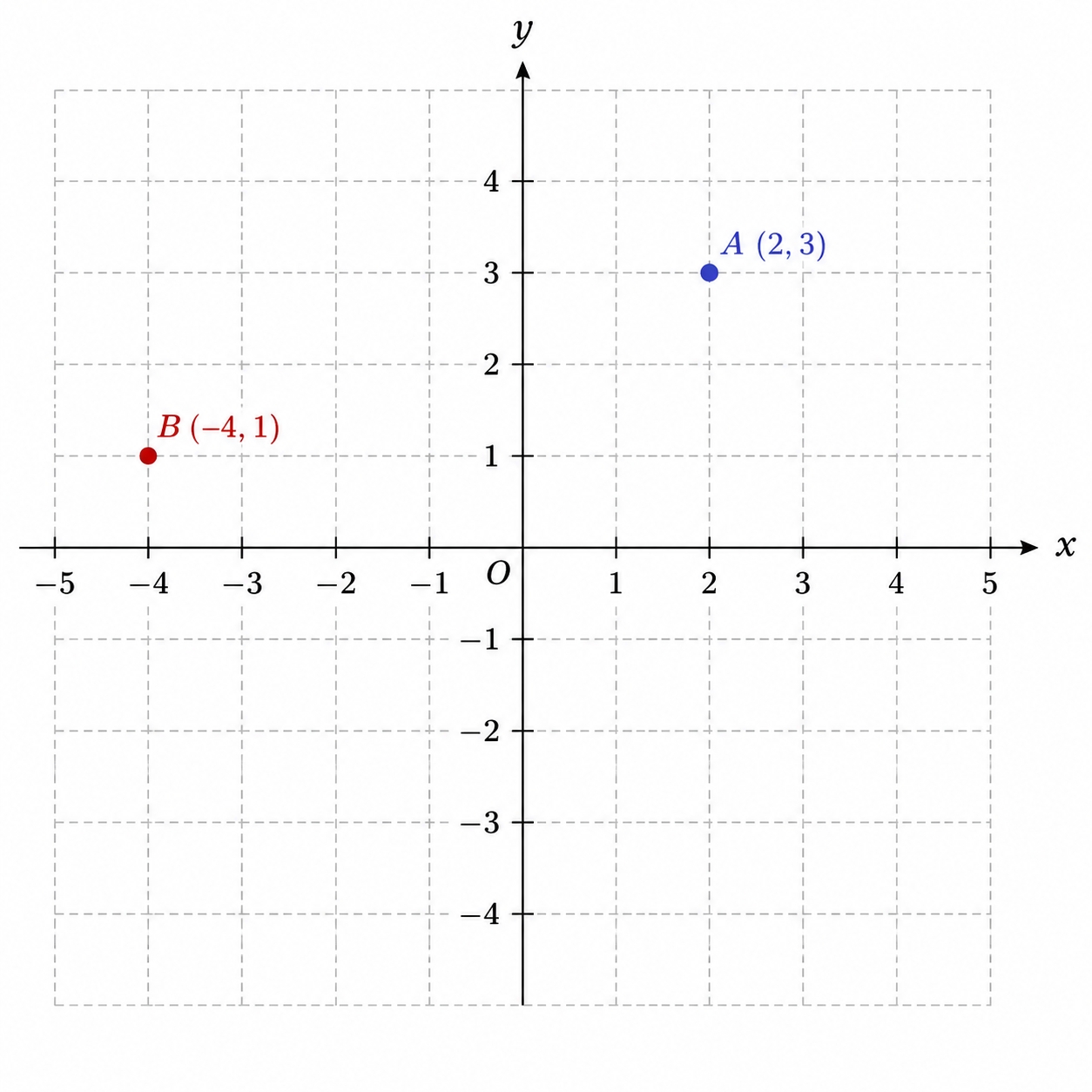
Point A(2, 3): x = 2 (positive), y = 3 (positive) ⇒ Quadrant I
Point B(−4, 1): x = −4 (negative), y = 1 (positive) ⇒ Quadrant II
Q2. From the list below, separate the points that lie on the X-axis and those that lie on the Y-axis: (3, 0), (0, −5), (−2, 0), (0, 7), (4, 0), (0, −1)
Answer: Points on the X-axis (ordinate = 0): (3, 0), (−2, 0), (4, 0)
Points on the Y-axis (abscissa = 0): (0, −5), (0, 7), (0, −1)
Q3. Write the quadrant for each of the following points:
(i) (−1, −7) (ii) (3, −4) (iii) (−5, 2) (iv) (6, 8)
Answer:
(i) (−1, −7): both negative. Therefore, Quadrant III
(ii) (3, −4): x positive, y negative Therefore, Quadrant IV
(iii) (−5, 2): x negative, y positive. Therefore, Quadrant II
(iv) (6, 8): both positive ⇒ Quadrant I
Q4. The abscissa of a point is −3 and its ordinate is 4. Write down the coordinates and state which quadrant it belongs to.
Answer: The coordinates are (−3, 4).
Since x is negative and y is positive, the point lies in Quadrant II
Q5. A point P is 5 units below the X-axis and lies on the Y-axis. What are the coordinates of P?
Answer: Since P lies on the Y-axis, abscissa = 0. ‘5 units below the X-axis’ means ordinate = −5.
Therefore, P = (0, −5).
Important Questions of Coordinate Geometry for Class 9: 3 Marks
1. Plot the following points on a Cartesian plane and join them in order. Name the figure formed: A(1, 3), B(−1, 3), C(−1, −3), D(1, −3)
Answer:
A(1, 3) ⇒ Quadrant I
B(−1, 3) ⇒ Quadrant II
C(−1, −3) ⇒ Quadrant III
D(1, −3) ⇒ Quadrant IV
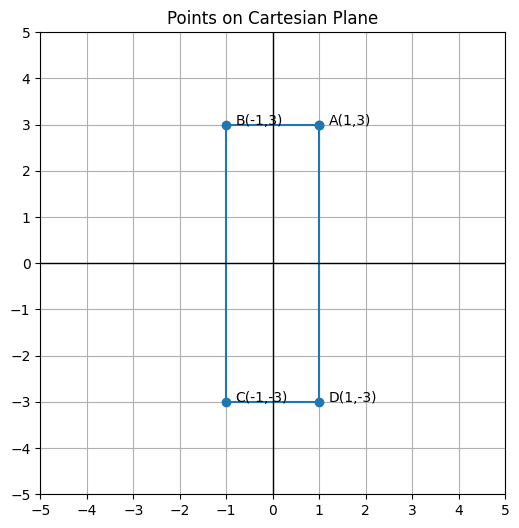
The figure formed by the points is a rectangle.
Q2. From the figure of a Cartesian plane, read the coordinates of the following:
(i) A point in Quadrant II at distance 3 from Y-axis and 4 from X-axis.
(ii) A point on the negative Y-axis at a distance 6 from origin.
(iii) A point in Quadrant IV at equal distances of 2 units from both axes.
Answer:
(i) In Quadrant II, x is negative and y is positive: (−3, 4)
(ii) On negative Y-axis: (0, −6)
(iii) In Quadrant IV, x = positive, y = negative, both equal to 2: (2, −2)
Q3. Plot the following points and find whether they are collinear (lie on a straight line): A(0, 2), B(2, 0), C(−2, 4)
Answer: Plot the three points and then calculate whether the slopes between pairs of points are equal to check if point are collinear.
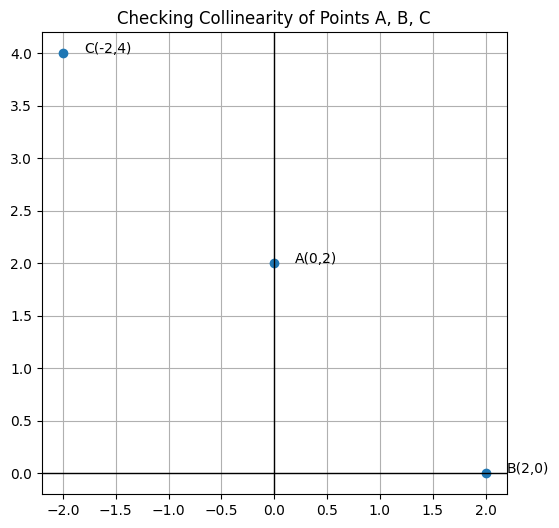
Slope of AB = (0 − 2)/(2 − 0) = −2/2 = −1
Slope of AC = (4 − 2)/(−2 − 0) = 2/(−2) = −1
Since slope of AB = slope of AC = −1. Therefore they lie on the same straight line. Hence, the points are collinear.
Q4. Three vertices of a rectangle are A(−2, 3), B(4, 3), and C(4, −2). Find the fourth vertex D. Also find the area of the rectangle.
Answer: In a rectangle, opposite sides are equal and parallel.
AB is horizontal (both have y = 3)
BC is vertical (both have x = 4)
So DC must be horizontal and AD must be vertical.
The fourth vertex D must have: x = −2 (same as A) and y = −2 (same as C).
Therefore, D = (−2, −2).
Length AB = 4 − (−2) = 6 units
Breadth BC = 3 − (−2) = 5 units
Area = 6 × 5 = 30 sq. units
Q5. Look at the Cartesian plane and answer the following:
The vertices of a triangle are P(1, 3), Q(3, 1), R(−1, 1).
(i) Write the coordinates of each vertex.
(ii) State the quadrant each vertex lies in.
(iii) Find the base and height if QR is the base.
Answer:
(i) P(1, 3), Q(3, 1), R(−1, 1)
(ii) P(1, 3) ⇒ Quadrant I; Q(3, 1) ⇒ Quadrant I; R(−1, 1) ⇒ Quadrant II
(iii) Base QR = distance along the horizontal (y = 1 for both Q and R)
QR = 3 − (−1) = 4 units
Height = vertical distance from P to line QR (which lies at y = 1)
Height = 3 − 1 = 2 units
Area = ½ × 4 × 2 = 4 sq. units
Important Questions of Coordinate Geometry for Class 9: 5 Marks
Q1. Draw a Cartesian plane and plot the following points. Then join them in the given order and identify the shape:
A(−3, 0), B(0, 3), C(3, 0), D(0, −3)
Answer:
A(−3, 0): on the negative X-axis
B(0, 3): on the positive Y-axis
C(3, 0): on the positive X-axis
D(0, −3): on the negative Y-axis
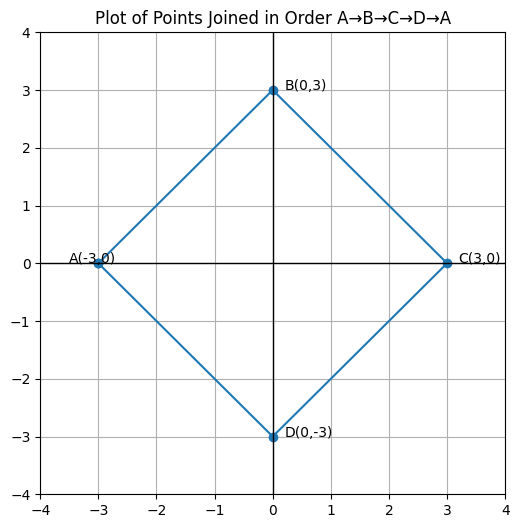
Now find the side lengths:
AB = √[(0−(−3))² + (3−0)²] = √[9 + 9] = √18 = 3√2 units
BC = √[(3−0)² + (0−3)²] = √[9 + 9] = 3√2 units
CD = √[(0−3)² + (−3−0)²] = 3√2 units
DA = √[(−3−0)² + (0−(−3))²] = 3√2 units
All four sides are equal. The diagonals AC and BD are along the axes and are equal (each = 6 units) and thus perpendicular to each other.
The shape formed is a square (all sides equal, diagonals equal and perpendicular bisectors of each other).
Q2. Plot the points P(1, 0), Q(4, 0), R(4, 3), S(1, 3) on a Cartesian plane. Join them in order. Find:
(i) The type of quadrilateral formed.
(ii) The perimeter.
(iii) The area.
(iv) Whether the diagonals bisect each other.
Answer:
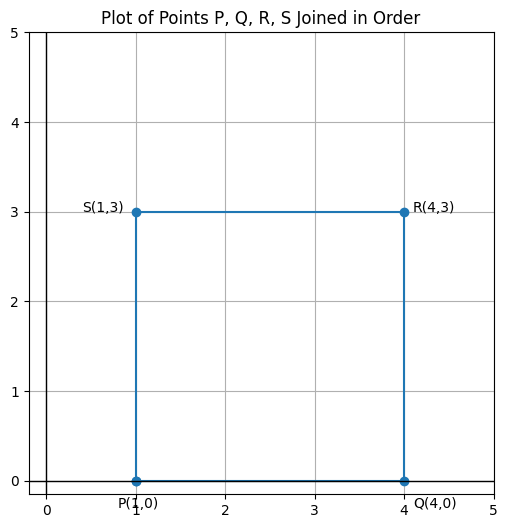
(i) Type of quadrilateral:
PQ is horizontal (y = 0 for both), length = 4 − 1 = 3 units
RS is horizontal (y = 3 for both), length = 4 − 1 = 3 units
PS is vertical (x = 1 for both), length = 3 − 0 = 3 units
QR is vertical (x = 4 for both), length = 3 − 0 = 3 units
All four sides are equal and all angles are 90°⇒ Square
(ii) Perimeter = 4 × 3 = 12 units
(iii) Area = side² = 3² = 9 sq. units
(iv) Midpoint of diagonal PR = [(1+4)/2, (0+3)/2] = (2.5, 1.5)
Midpoint of diagonal QS = [(4+1)/2, (0+3)/2] = (2.5, 1.5)
Both diagonals have the same midpoint ⇒ the diagonals bisect each other.
Q3. The following table gives the ages (in years) and heights (in cm) of five students in Class 9. Plot these as points on a Cartesian plane, with age on the X-axis and height on the Y-axis.
Answer:
Plot the points: (14, 155), (15, 162), (13, 148), (16, 170), (14, 157).
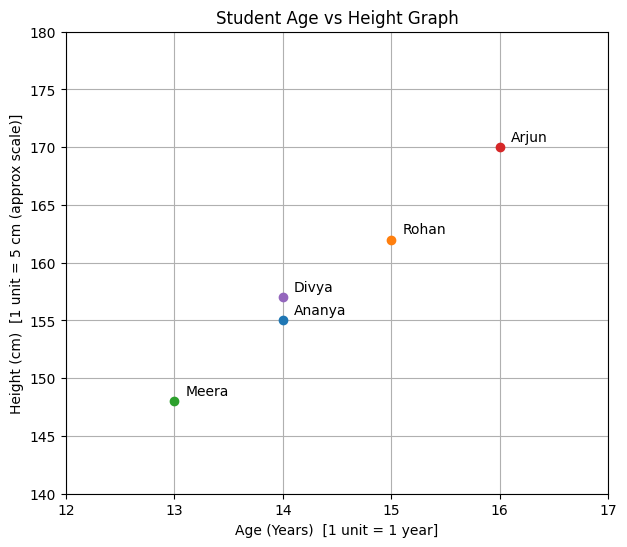
Observation: As age increases, height generally increases. This shows a positive correlation between age and height.
Previous Year Questions from CBSE: Coordinate Geometry for Class 9
These questions have appeared in CBSE Board-related exams and school-level tests over recent years.
Q1. (1 Mark) Write the coordinates of a point which lies on the negative Y-axis at a distance of 7 from the origin.
Answer: (0, −7)
Q2. (1 Mark) In which quadrant does the point (−3, −4) lie?
Answer: Quadrant III
Q3. (2 Marks) Plot the points A(4, 0), B(0, 3), C(−4, 0), D(0, −3) on the Cartesian plane. Name the figure formed by joining them in order.
Answer:
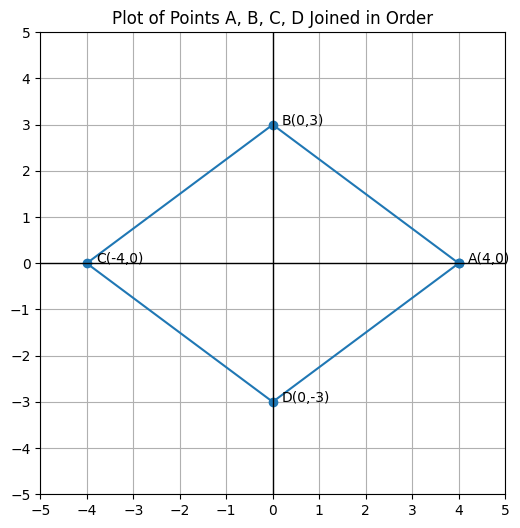
All four points lie on the axes (two on X-axis, two on Y-axis).
Joining A→B→C→D→A forms a rhombus (all sides equal but not a square since the diagonals have different lengths: AC = 8 units, BD = 6 units).
Q4. (2 Marks) If P(2, −3) is plotted on a Cartesian plane, state the distance of P from the X-axis and from the Y-axis.
Answer:
Distance from X-axis = |ordinate| = |−3| = 3 units
Distance from Y-axis = |abscissa| = |2| = 2 units
Q5. (3 Marks) The points A(1, 2), B(4, 2), C(4, 5), D(1, 5) are plotted on a Cartesian plane and joined. What figure is formed? Find its area and perimeter.
Answer:
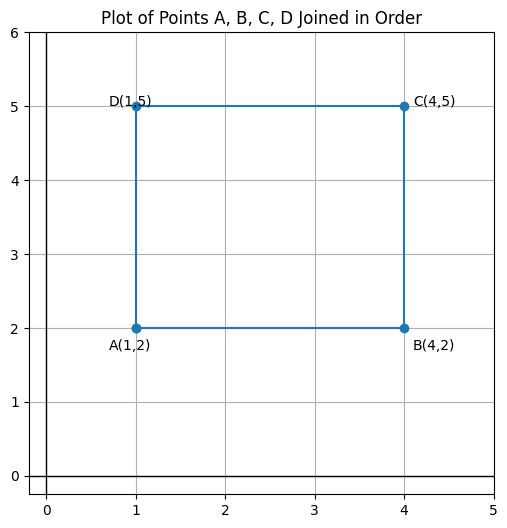
AB: horizontal, y = 2, length = 4 − 1 = 3 units
BC: vertical, x = 4, length = 5 − 2 = 3 units
CD: horizontal, y = 5, length = 3 units
DA: vertical, x = 1, length = 3 units
All sides equal, all angles = 90° ⇒ Square
Perimeter = 4 × 3 = 12 units
Area = 3 × 3 = 9 sq. units
Frequently Asked Questions of Orienting Yourself: The Use of Coordinates for Class 9
1. What are the most important topics in Class 9 Maths Chapter 3 Coordinate Geometry?
The most important topics are the Cartesian plane, X-axis and Y-axis, origin and its coordinates, the four quadrants and their signs, coordinates of a point (abscissa and ordinate), plotting points and forming simple shapes by joining plotted points.
2. How do I remember which quadrant a point belongs to?
Use the word ASTC (All Students Take Calculus: a mnemonic used in trigonometry) adapted for quadrants:
Q1: All positive (+, +)
Q2: x negative, y positive (−, +)
Q3: Both negative (−, −)
Q4: x positive, y negative (+, −)
3. Can a point have negative coordinates and still be on an axis?
Yes.For example, (−5, 0) has a negative x-coordinate but lies on the X-axis (on the negative side). Similarly, (0, −4) lies on the Y-axis (negative side).
4. How do I find the shape formed by joining plotted points?
First, plot all the points carefully. Then look at the side lengths and check whether the sides are equal, parallel, or perpendicular. Use these observations to identify whether the shape. Always check whether the diagonals bisect each other for parallelogram families.
Numbers make sense when they're taught right. To see how Orchids The International School turns Maths from intimidating to intuitive, reach out to our admissions team.


Admissions Open for 2026-27
What type of concept pages would you prefer?
CBSE Schools In Popular Cities
- CBSE Schools in Bangalore
- CBSE Schools in Mumbai
- CBSE Schools in Pune
- CBSE Schools in Hyderabad
- CBSE Schools in Chennai
- CBSE Schools in Gurgaon
- CBSE Schools in Kolkata
- CBSE Schools in Indore
- CBSE Schools in Sonipat
- CBSE Schools in Delhi
- CBSE Schools in Rohtak
- CBSE Schools in Bhopal
- CBSE Schools in Aurangabad
- CBSE Schools in Jabalpur
- CBSE Schools in Jaipur
- CBSE Schools in Jodhpur
- CBSE Schools in Nagpur
- CBSE Schools in Ahmednagar
- CBSE School In Tumkur











Orchids The International School is one of India's leading chains of CBSE and ICSE schools, with 130+ schools across the country.